Texas Tuberose (Manfreda maculosa)
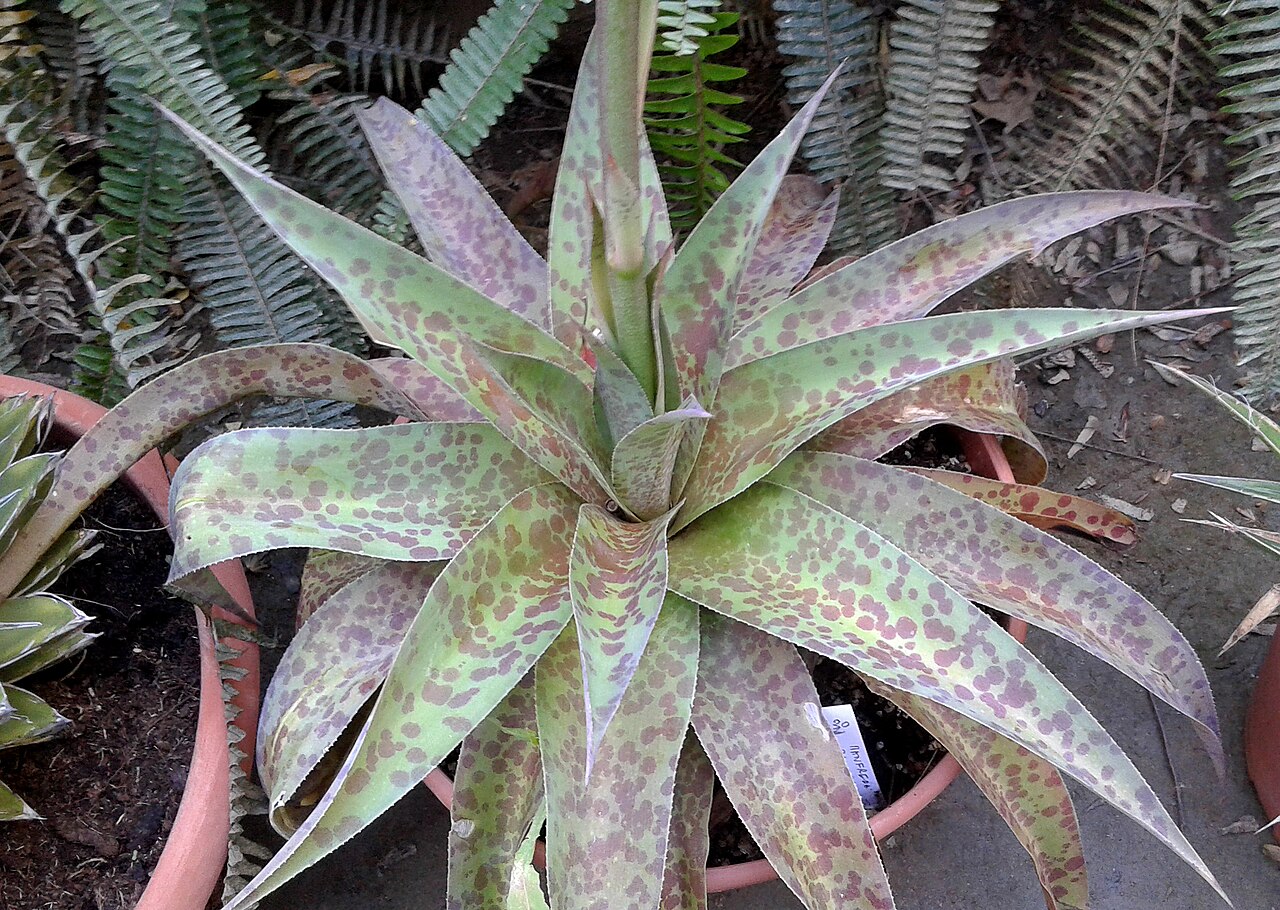
Manfreda maculosa, known as Texas Tuberose, spice lily, or huaco, is a low-growing succulent perennial in the agave family, native to the brushlands of South Texas and adjacent northeastern Mexico. It forms a flat rosette of soft, fleshy, lance-shaped leaves boldly marked with irregular maroon to purple spots and blotches — a pattern distinctive enough that the plant is often grown purely as an ornamental foliage succulent, quite apart from its flowers.
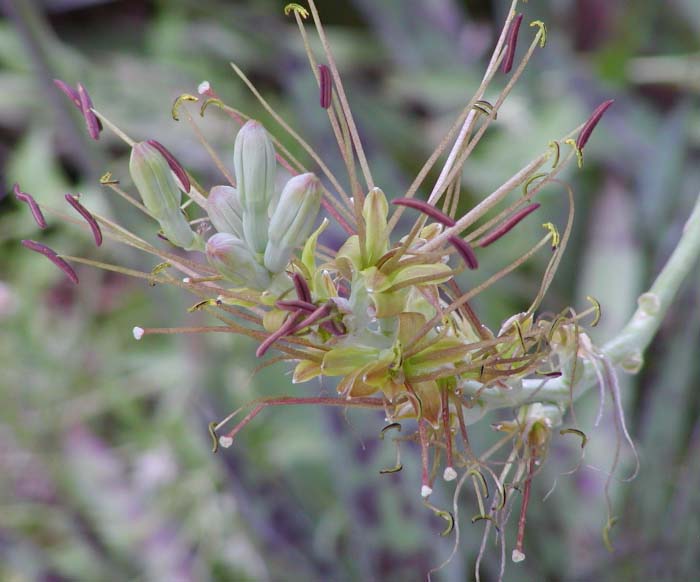
In late spring, Texas Tuberose sends up a tall, slender flower stalk well above the leaves, topped with a loose cluster of small, tubular, greenish to purplish flowers that open at dusk and release a sweet, spicy fragrance through the night — the source of both its “spice lily” common name and its appeal to night-flying moths. Unlike its spiky agave relatives, Manfreda has soft, unarmed leaves, making it a pleasant, low-maintenance addition near walkways and patios.
Texas Tuberose is also the larval host plant for the Manfreda Giant-Skipper, a striking large butterfly whose caterpillars bore into the plant’s fleshy leaves and roots — a reminder that even a modest-looking succulent can anchor a specific and fascinating piece of South Texas ecology.
Identification
Texas Tuberose grows from a thick, fleshy underground rhizome or bulb-like base, producing a flat, spreading rosette of leaves close to the ground, typically 6 to 12 inches across.
Leaves
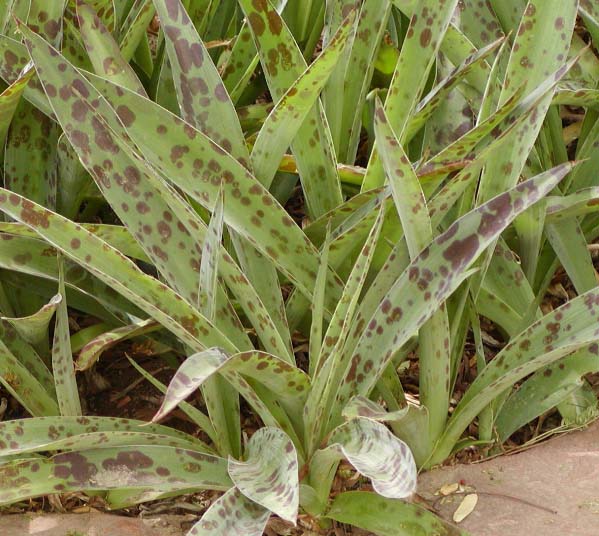
The leaves are soft and fleshy (unlike the rigid, spine-tipped leaves of true agaves), lance-shaped, 6 to 12 inches long, and gray-green to olive in color, boldly patterned with irregular purple-maroon spots and blotches that vary in intensity from plant to plant. Leaf margins are smooth or very finely toothed, without the sharp terminal spine typical of agaves. The spotting is most vivid in full sun and tends to fade somewhat in shadier conditions.
Flowers
In late spring to early summer, a single slender, leafless flower stalk rises 3 to 6 feet above the rosette, bearing a loose, elongated cluster of small, tubular flowers in dusky shades of greenish-yellow to purplish-brown with long, thread-like protruding stamens. The flowers open in the evening and are strongly, sweetly fragrant after dark, attracting night-flying pollinators. Individual flowers are small, but the tall flower spike makes the plant conspicuous even from a distance when in bloom.
Fruit & Seeds
Flowers are followed by a dry, three-chambered capsule that splits open to release flat, black, papery seeds, similar to those of related agaves. The seed capsules are inconspicuous compared to the showy flower spike.
Quick Facts
| Scientific Name | Manfreda maculosa (syn. Agave maculosa) |
| Family | Asparagaceae (Agave subfamily) |
| Plant Type | Evergreen succulent perennial |
| Mature Height | 8–12 in (rosette); 3–6 ft in flower |
| Mature Spread | 6–12 in |
| Growth Rate | Slow |
| Sun Exposure | Full Sun to Part Shade |
| Water Needs | Low once established |
| Soil Type | Rocky, sandy or clay loam; well-drained |
| Soil pH | Neutral to alkaline |
| Bloom Time | Late spring – early summer |
| Flower Color | Greenish-yellow to purplish-brown |
| Fall Color | None; evergreen rosette year-round |
| Fruit | Small dry capsule, not ornamentally significant |
| Deer Resistant | Yes |
| USDA Hardiness Zones | 8–11 |
Native Range
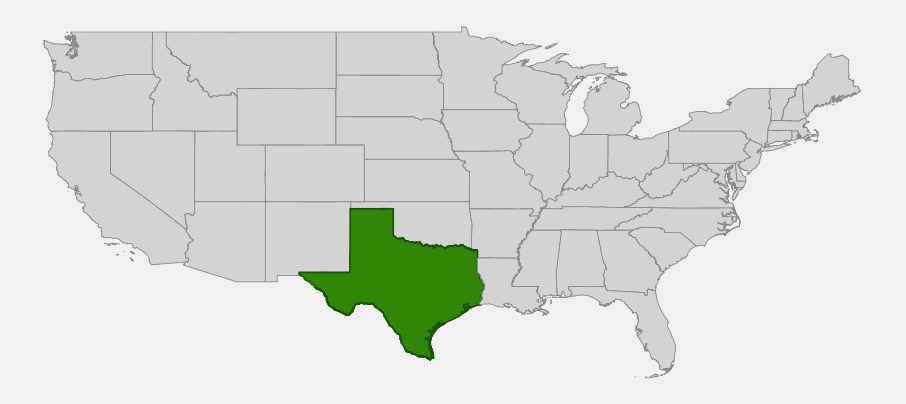
Texas Tuberose is native to South Texas, concentrated in the South Texas Plains (Rio Grande Plains) with its range extending into the southern Edwards Plateau, and continuing south of the border into adjacent northeastern Mexico (Tamaulipas and Nuevo León). It is essentially endemic to this South Texas brushland region within the United States.
Within its native range, Texas Tuberose grows in open areas within shrublands and mesquite brushland (mesquital), typically on rocky, sandy, or clay soils that drain well. It is often found at the edges of brush thickets or in openings where it receives enough light for good flowering, alongside other South Texas Plains natives adapted to the region’s thin, often caliche-influenced soils.
Because of its ornamental spotted foliage, Texas Tuberose is cultivated by succulent enthusiasts and native-plant gardeners well outside South Texas, including in other warm, dry regions of the Southwest. Outside its native South Texas Plains range, it should be treated as an adapted ornamental rather than a local native.
📋 Regional plant lists featuring Texas Tuberose: South and West Texas
Growing & Care Guide
Texas Tuberose is an easy, low-maintenance succulent for South Texas gardens, prized as much for its patterned foliage as for its fragrant night-blooming flower spike.
Light
Full sun brings out the strongest leaf spotting and the best flowering, though the plant tolerates part shade, where the leaf pattern tends to be softer and less vivid. Give it the sunniest spot available for the showiest foliage.
Soil & Water
Like most agave relatives, Texas Tuberose demands sharp drainage; rocky, sandy, or gravelly soil suits it well, and heavy, waterlogged clay should be avoided or amended with coarse grit. It is quite drought tolerant once established and needs only occasional deep watering during extended dry spells — overwatering is a far greater risk than underwatering.
Planting Tips
Plant in spring after the danger of frost has passed, in a site with excellent drainage, ideally slightly elevated or on a slope. Space plants 12 to 18 inches apart to allow the rosettes to spread. Because the leaves are soft rather than spine-tipped, Texas Tuberose is comfortable to plant near paths and seating areas, unlike many of its armed agave relatives.
Pruning & Maintenance
Little maintenance is needed. Remove the flower stalk after bloom and seed set if desired, though it is not required. Trim any damaged or discolored leaves at the base as needed. The plant is not monocarpic (it does not die after flowering, unlike many true agaves), so it will rebloom in future years. It has few pest or disease problems when grown in appropriately well-drained soil.
Landscape Uses
Texas Tuberose fits naturally into dry, sunny South Texas plantings:
- Succulent and xeriscape gardens as a textural, patterned foliage accent
- Rock gardens on well-drained, rocky soil
- Night gardens — the fragrant evening flowers reward planting near patios
- Butterfly gardens as the larval host for the Manfreda Giant-Skipper
- Container plantings for a compact, spineless succulent accent
Wildlife & Ecological Value
Texas Tuberose supports a specific and notable piece of South Texas insect life, in addition to its general pollinator value.
For Pollinators
The evening-opening, sweetly fragrant flowers are adapted for pollination by night-flying moths, particularly hawk moths, which are drawn to the pale color and strong scent after dark. The long, protruding stamens dust visiting moths with pollen as they probe for nectar.
For Butterflies
Texas Tuberose is the larval host plant for the Manfreda Giant-Skipper (Stallingsia maculosus), a large, striking skipper butterfly whose caterpillars bore into the fleshy leaves and roots of Manfreda and related agave-family plants. Gardeners hoping to attract this specialty butterfly should grow Texas Tuberose and tolerate some leaf damage from its larvae.
Ecosystem Role
As a low-growing succulent in the South Texas brushland understory, Texas Tuberose contributes to the structural diversity of the mesquital plant community and provides a specific larval food resource that few other garden plants can replace, making it ecologically valuable well beyond its modest size.
Cultural & Historical Uses
Texas Tuberose is also known by the common name “huaco” in South Texas and Mexico, a name connected to a documented history of use by Indigenous and Mexican folk traditions, where the fleshy leaves and roots of related Manfreda species were used topically in traditional remedies for wounds, bites, and skin ailments. These are historical ethnobotanical practices, not a present-day recommendation, since Manfreda species can cause skin irritation in some people.
The genus name honors Manfredi (Manfred) di Monreale, a mediaeval Sicilian botanical writer, while “maculosa” is Latin for “spotted,” directly referencing the plant’s most recognizable feature. In recent decades, Texas Tuberose has become increasingly popular in the succulent and native-plant nursery trade, valued by collectors specifically for its unusual leaf patterning.
Frequently Asked Questions
Is Texas Tuberose the same as true tuberose?
No. True tuberose (Polianthes tuberosa) is an unrelated ornamental bulb from Mexico grown for cut flowers. Texas Tuberose is a distinct native succulent in the genus Manfreda, related to agaves, and the shared common name reflects a similar sweet evening fragrance rather than a close botanical relationship.
Does Texas Tuberose have sharp, spiny leaves like an agave?
No. Unlike true agaves, Manfreda species have soft, fleshy leaves without the rigid terminal spine and marginal teeth typical of agaves, making Texas Tuberose safe to plant near walkways and seating areas.
Why are the leaves spotted?
The maroon-purple spotting is a natural and highly variable trait of the species, most pronounced in full sun. It is purely a leaf pigmentation pattern and not a sign of disease or stress.
Does Texas Tuberose die after it flowers?
No. Unlike many true agaves, which are monocarpic and die after a single bloom, Texas Tuberose is not monocarpic and will flower again in future years.
What pollinates Texas Tuberose?
Its evening-opening, fragrant flowers are primarily pollinated by night-flying moths, especially hawk moths, drawn to the scent and pale coloring after dark.

Looking for a nursery that carries Texas Tuberose?
Browse our native plant nursery directory: Texas