Shrubby Blue Sage (Salvia ballotiflora)
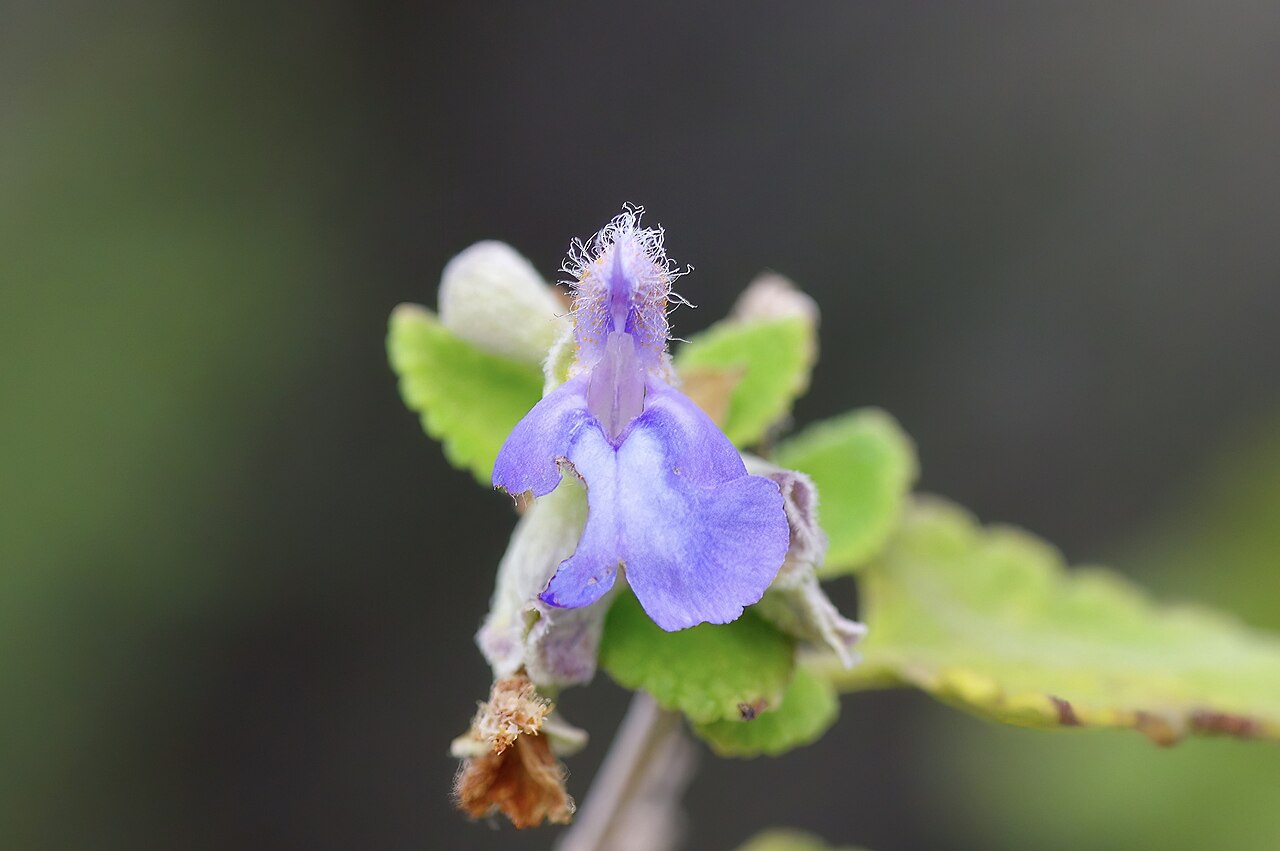
Salvia ballotiflora, known as Shrubby Blue Sage (also called mejorana), is a tough, aromatic native shrub of South and Central Texas and the brushlands of northeastern Mexico. It forms a dense, rounded thicket of wiry, gray-barked stems clothed in small, crinkled, gray-green leaves, and from spring through fall it carries a scattering of small but vividly violet-blue flowers. Crush a leaf and you will catch a sharp, minty-resinous scent typical of the mint family, a trait that also makes the plant unpalatable to deer and livestock.
In the wild, Shrubby Blue Sage is a signature plant of the South Texas Plains and the southern Edwards Plateau, where it grows on shallow, rocky, caliche or limestone soils in chaparral and brush country alongside blackbrush, guajillo, and cenizo. It is extremely drought tolerant and thrives in heat, making it one of the most reliable flowering shrubs for South Texas xeriscaping.
Though individual flowers are small, Shrubby Blue Sage blooms over a long season and is a dependable nectar source for native bees and butterflies in a region where summer heat shuts down many other flowering plants. Its dense, twiggy form also makes it valuable as cover and nesting structure for small birds in brushland habitat.
Identification
Shrubby Blue Sage is a many-branched, rounded shrub typically 2 to 6 feet tall and similarly wide, with a dense, twiggy structure. Stems are square in cross-section, as in all mints, gray-barked and wiry with age.
Stems & Leaves
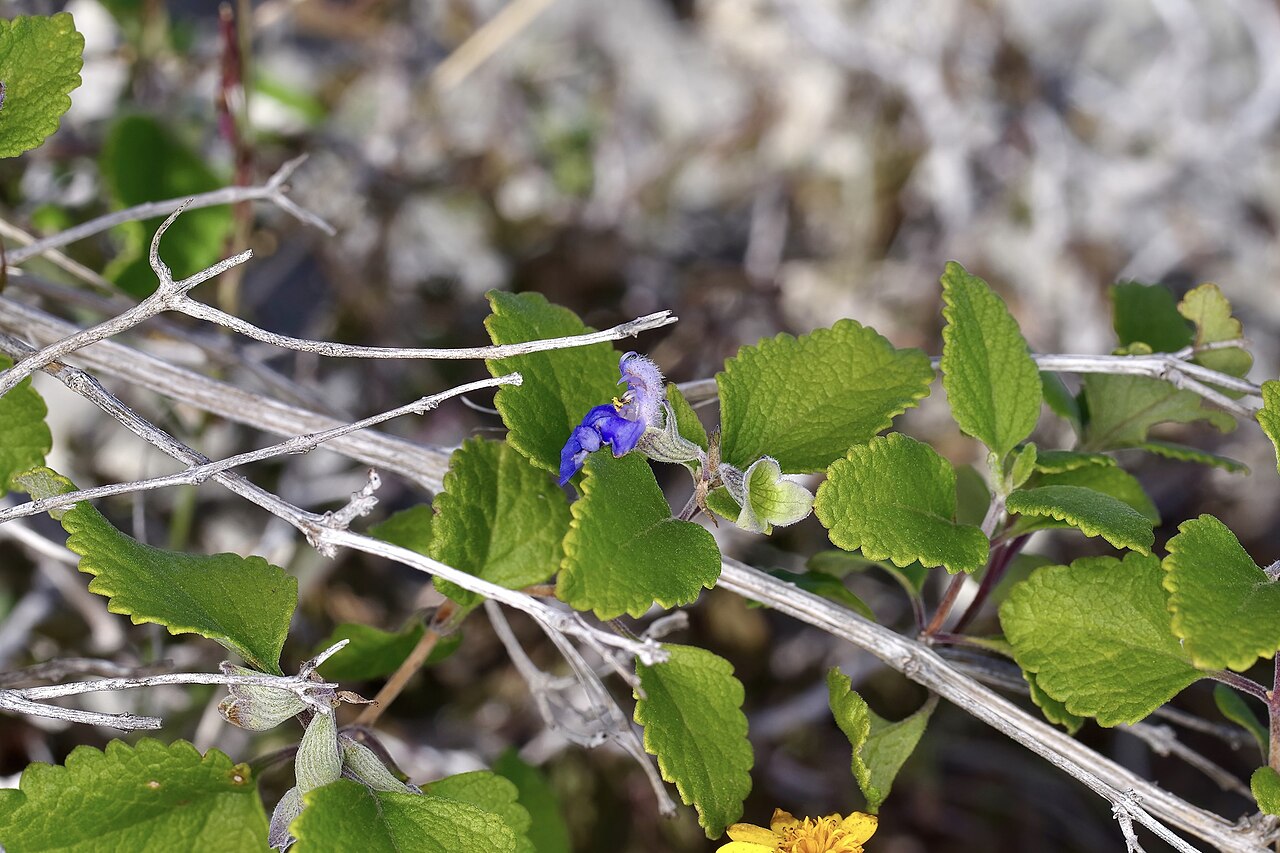
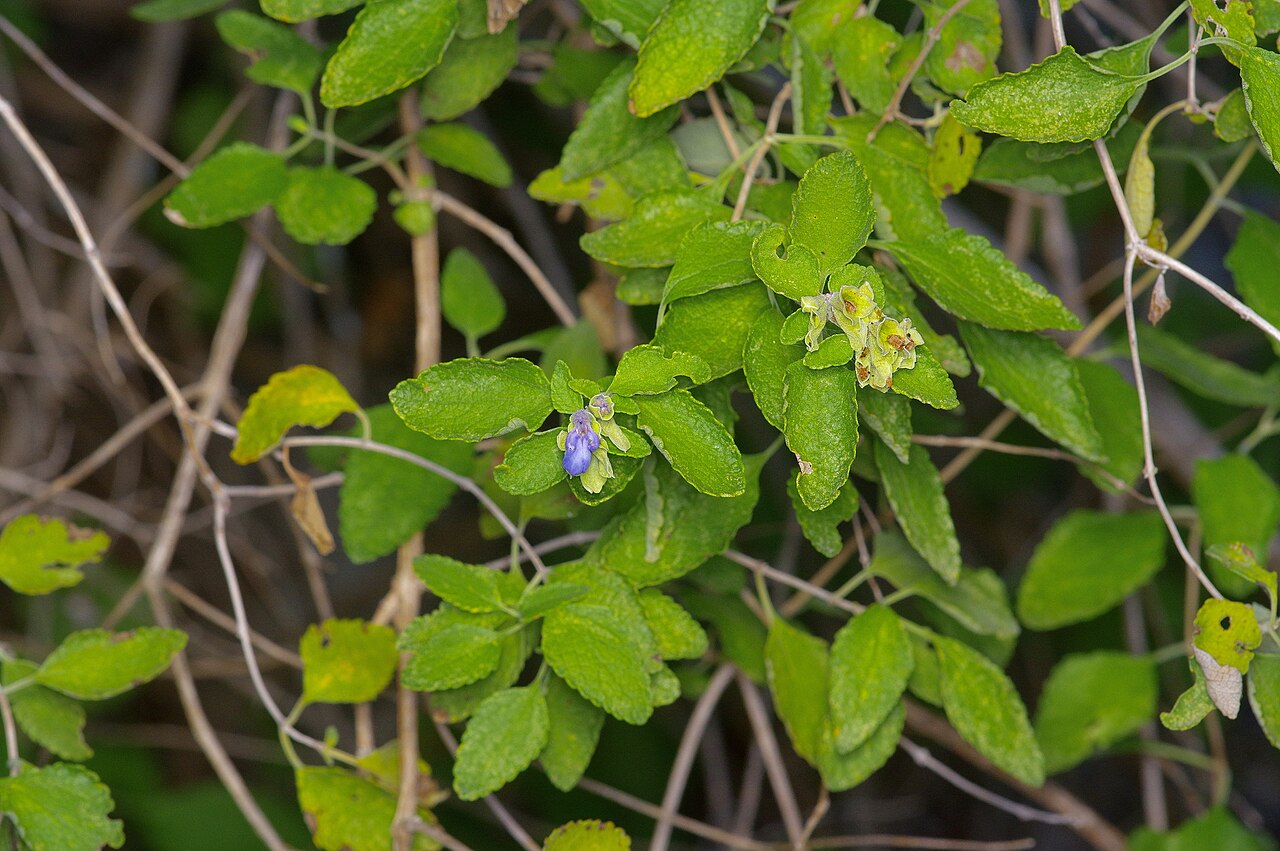
The leaves are small, opposite, oval to ovate, usually under an inch long, with a scalloped or bluntly toothed margin and a noticeably wrinkled, textured surface. Foliage color ranges from gray-green to dull green, often with a slightly felted or hairy texture on young growth. The leaves are strongly aromatic, releasing a sharp, minty-resinous scent when crushed.
Flowers
Flowers are small, about ½ inch long, two-lipped and tubular in the classic sage shape, in shades of violet-blue to lavender-blue, often with a paler or white-tufted throat where fine hairs project from the upper lip. They appear singly or in small clusters along the branch tips, opening over an extended bloom period that can run from spring through fall, with peaks after rain. Despite their small size, the color is vivid enough to stand out against the gray-green foliage.
Fruit & Seeds
As in other salvias, the flower is followed by small dry nutlets held in the persistent calyx. These are not a significant wildlife food source or ornamental feature; the plant’s value lies in its flowers, foliage, and structure.
Quick Facts
| Scientific Name | Salvia ballotiflora |
| Family | Lamiaceae (Mint) |
| Plant Type | Evergreen to semi-evergreen shrub |
| Mature Height | 2–6 ft |
| Mature Spread | 2–6 ft |
| Growth Rate | Slow to moderate |
| Sun Exposure | Full Sun to Part Shade |
| Water Needs | Low once established |
| Soil Type | Shallow, rocky, caliche or limestone; well-drained |
| Soil pH | Neutral to alkaline |
| Bloom Time | Spring – Fall (heaviest after rain) |
| Flower Color | Violet-blue to lavender-blue |
| Fall Color | None notable; evergreen to semi-evergreen |
| Fruit | Small dry nutlets, not ornamentally significant |
| Deer Resistant | Yes (aromatic foliage generally avoided) |
| USDA Hardiness Zones | 8–10 |
Native Range
Shrubby Blue Sage is native to South and South-Central Texas, concentrated in the South Texas Plains (the Rio Grande Plains) and extending onto the southern and western Edwards Plateau. It grows on shallow, rocky, often caliche or limestone soils in chaparral, thorn-scrub, and brush country, typically at low elevations under about 2,000 feet. The species continues south of the border through much of northeastern and central Mexico.
Within its native brushland habitat, Shrubby Blue Sage grows alongside other South Texas thorn-scrub species such as Blackbrush Acacia, Guajillo, Cenizo, and Texas Persimmon, forming part of the dense, drought-adapted brush community typical of the region. It tolerates the caliche-heavy, poorly developed soils common across the South Texas Plains better than many other flowering shrubs.
Shrubby Blue Sage is increasingly planted as an ornamental in Central Texas gardens beyond its native South Texas range, valued for its drought tolerance and long bloom season; gardeners there should recognize it as an adapted regional plant rather than a true local native outside the South Texas Plains and Edwards Plateau.
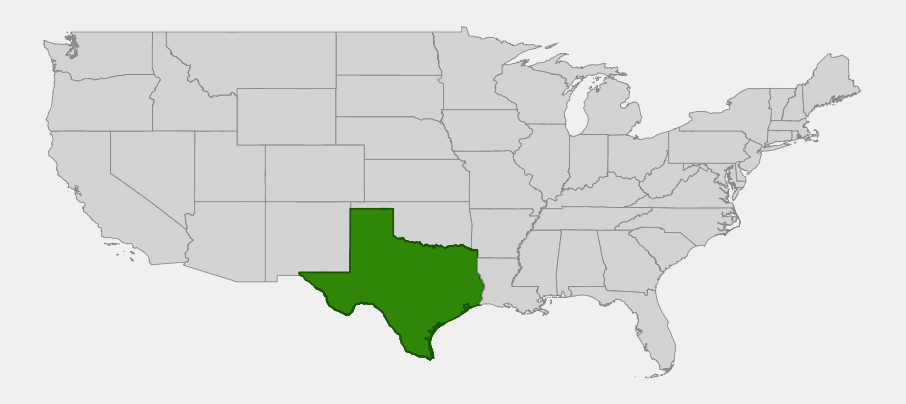
📋 Regional plant lists featuring Shrubby Blue Sage: South and West Texas
Growing & Care Guide
Shrubby Blue Sage is about as low-maintenance as a flowering native shrub gets, built for heat, drought, and poor rocky soils. It rewards gardeners who resist the urge to baby it.
Light
Full sun produces the densest, most compact growth and the heaviest bloom, though the plant tolerates part shade, especially in the hottest parts of its range. In deep shade it becomes leggy and flowers sparsely.
Soil & Water
This shrub is built for shallow, rocky, alkaline soils and performs poorly in rich, consistently moist garden beds. Excellent drainage is essential — heavy clay or poorly drained sites invite root rot. Once established, it needs little to no supplemental water and is one of the more drought-proof flowering shrubs available for South Texas landscapes, flushing with new bloom after rain.
Planting Tips
Plant from containers in spring or fall. Avoid amending the planting hole with rich organic matter, which can hold too much moisture around the roots in heavy soils; native caliche or rocky soil left largely unamended suits this plant best. Space plants 3 to 5 feet apart for a natural thicket or hedge effect.
Pruning & Maintenance
Shrubby Blue Sage tolerates shearing well and can be pruned into a tidy, rounded hedge, though it also looks attractive left in its naturally loose, twiggy form. Prune in late winter to remove dead wood and shape the plant before spring growth begins. It requires no fertilization and has no significant pest or disease problems.
Landscape Uses
Shrubby Blue Sage suits a range of dry, sunny South Texas plantings:
- Xeriscape and rock gardens on shallow, rocky or caliche soils
- Low hedges or screens — tolerates shearing for a formal look
- Pollinator gardens as a long-blooming nectar source through summer heat
- Brush-country restoration plantings alongside other South Texas Plains natives
- Wildlife cover — dense branching shelters small birds
Wildlife & Ecological Value
In the demanding brush country of South Texas, Shrubby Blue Sage offers reliable resources across a long season when many other plants go dormant.
For Pollinators
The small tubular flowers attract native bees, including leafcutter and carpenter bees, as well as butterflies and occasionally hummingbirds. Because the plant blooms intermittently from spring through fall, especially after summer rains, it provides a steadier nectar supply through the hottest months than many showier but shorter-blooming natives.
For Birds
The dense, twiggy branching structure offers good nesting cover and shelter for small brushland birds such as wrens, sparrows, and thrashers, which are common in the South Texas chaparral where this shrub grows.
Ecosystem Role
As a common understory and thicket component of South Texas thorn-scrub, Shrubby Blue Sage helps stabilize shallow, erosion-prone caliche soils and contributes to the dense brush structure that defines this ecoregion, providing both food and physical shelter for the wildlife adapted to it.
Cultural & Historical Uses
Shrubby Blue Sage is known locally by the Spanish name mejorana, and like many aromatic native sages it has a history of informal use in South Texas and northern Mexican folk tradition, where aromatic mint-family plants were commonly brewed as teas. These uses are historical folk practices, not medical recommendations, and the plant is not cultivated or marketed today as an herbal remedy.
Its modern significance is primarily horticultural and ecological. As South Texas gardeners and ranchers have embraced native, low-water landscaping, Shrubby Blue Sage has become a go-to shrub for xeriscape plantings and brush-country restoration, valued for thriving in conditions — thin, rocky, alkaline soil and long dry spells — where few other flowering shrubs persist.
The plant also holds a practical place in South Texas ranching country, where its unpalatable, aromatic foliage makes it one of the native shrubs that persists in heavily grazed pastures, since livestock generally avoid browsing it.
Frequently Asked Questions
Is Shrubby Blue Sage native to all of Texas?
No. It is native to South Texas and the southern Edwards Plateau — the South Texas Plains brush country. It is increasingly planted elsewhere in Central Texas as an adapted ornamental but is not native outside that southern region.
How much water does Shrubby Blue Sage need?
Very little once established. It is highly drought tolerant and actually performs better in lean, rocky soil with infrequent watering than in rich, consistently moist garden beds.
Can Shrubby Blue Sage be pruned into a hedge?
Yes. It tolerates shearing well and is often grown as a low, rounded hedge in South Texas landscapes, though it also looks attractive left unpruned in its natural twiggy form.
Is Shrubby Blue Sage deer resistant?
Generally yes. Like most aromatic mint-family shrubs, its strongly scented foliage is usually avoided by deer and livestock, making it a reliable choice in areas with heavy browsing pressure.
When does Shrubby Blue Sage bloom?
It blooms intermittently from spring through fall rather than in one concentrated flush, with the heaviest flowering typically following summer rains.

Looking for a nursery that carries Shrubby Blue Sage?
Browse our native plant nursery directory: Texas