Thompson’s Yucca (Yucca thompsoniana)
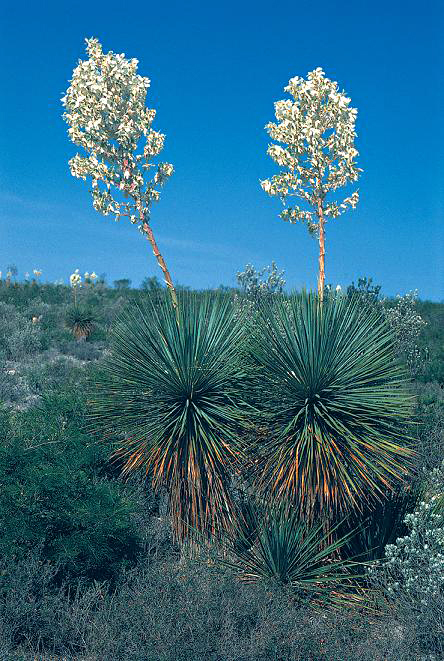
Yucca thompsoniana, commonly called Thompson’s Yucca or beaked yucca, is a striking, slow-growing, tree-form yucca native to the limestone canyons and desert grasslands of the Trans-Pecos region of far west Texas and adjacent northern Mexico. With age it develops a single or branching trunk topped by dense, globe-shaped rosettes of narrow, powder-blue leaves, giving it one of the most sculptural silhouettes of any native Texas plant.
Closely related to, and sometimes confused with, the even more restricted Beaked Yucca (Yucca rostrata) of Brewster County, Thompson’s Yucca has a somewhat wider natural range across the Trans-Pecos and is the plant most often sold in the nursery trade under both names. Its clean, rounded form, cool blue-gray color and tolerance of serious cold make it a favorite accent plant for xeric gardens well beyond its native range.
In the wild, Thompson’s Yucca is a plant of rocky limestone slopes, canyon walls and desert grassland edges in the Chihuahuan Desert, growing alongside lechuguilla, sotol and other Trans-Pecos succulents. In cultivation it is prized as a specimen plant: a single well-grown trunked yucca can anchor an entire xeriscape bed for decades.
Identification
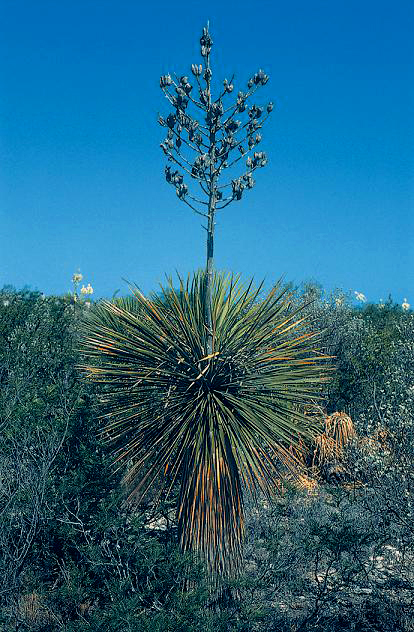
Thompson’s Yucca eventually builds a woody trunk up to about 10 to 12 feet tall, branching as it ages, with each branch tip carrying a dense, nearly spherical rosette of leaves. Young plants flower while still stemless, and continue flowering as the trunk develops — unusual among tree yuccas, most of which must reach a mature trunk before blooming.
Trunk & Stems
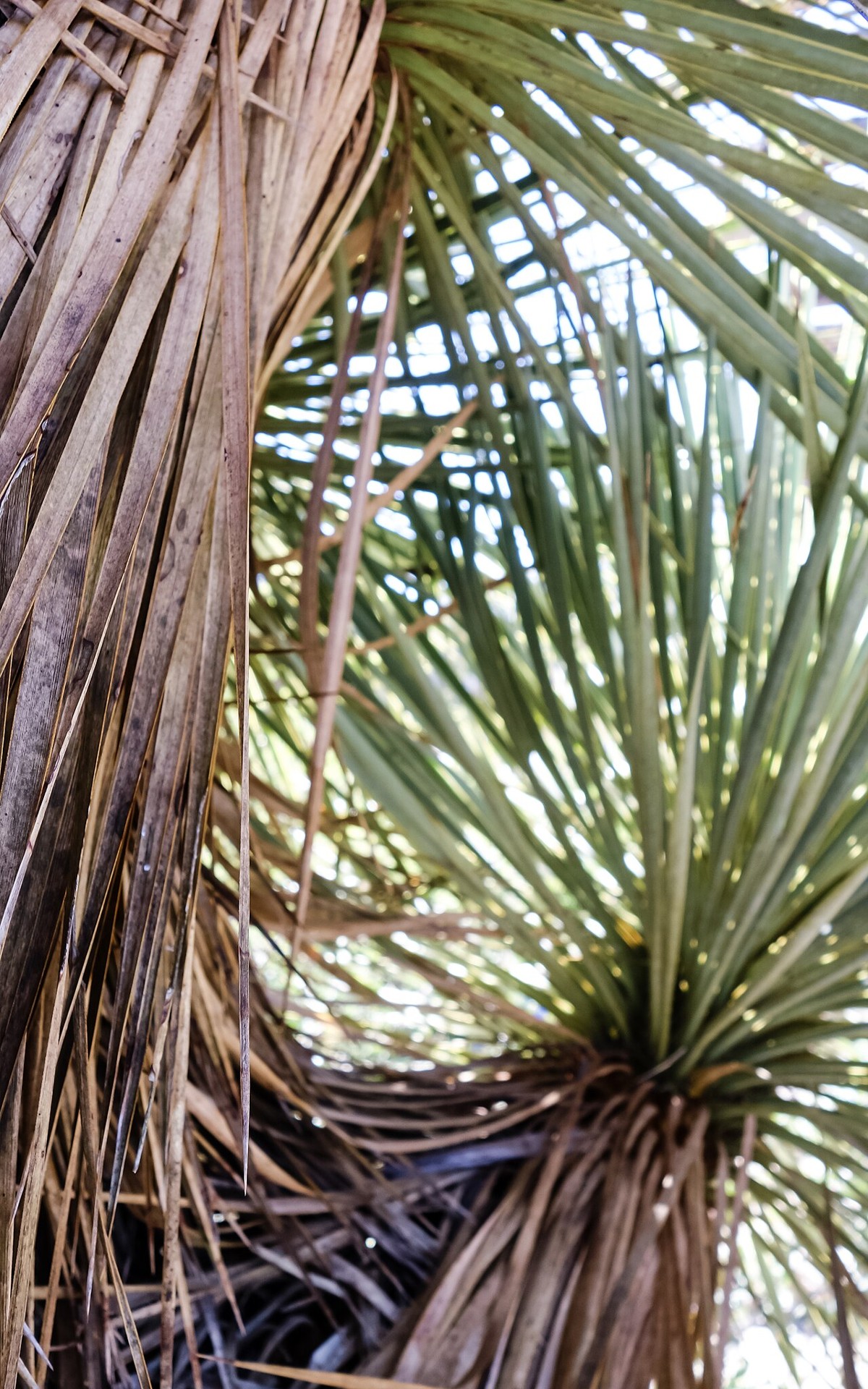
The trunk is slow to form, reaching roughly 3 feet in the first decades of growth before branching begins. Older trunks are often skirted in a thatch of dried, down-curved leaves below the live rosette, though many growers trim this away to reveal the trunk.
Leaves
Leaves are narrow (about ⅜ inch wide), rigid, and finely toothed along the margins, colored a distinctive glaucous (powdery) blue-green to blue-gray. They radiate densely from the rosette, up to about 14 inches long, each tapering to a firm but not especially vicious point.
Flowers
From late March through May, a tall flower panicle up to about 3 feet high rises from the rosette, carrying dozens of pendent, bell-shaped white flowers roughly 1½ inches long, sometimes tinged with purple at the base. The flowers open at night for pollination by yucca moths and stay showy for several weeks.
Fruit & Seeds
Flowers are followed by dry, egg-shaped capsules that darken and dry on the stalk, splitting open to release flat black seeds. Spent capsule clusters can persist into the following season, giving mature plants an architectural, dried-flower look through fall and winter.
Quick Facts
| Scientific Name | Yucca thompsoniana |
| Family | Asparagaceae (Agavoideae) |
| Plant Type | Evergreen, trunk-forming succulent (cacti & succulents) |
| Mature Height | 6–12 ft (trunked, with age) |
| Mature Spread | 3–5 ft rosette, branching with age |
| Growth Rate | Slow |
| Sun Exposure | Full sun |
| Water Needs | Low |
| Soil Type | Rocky, caliche or gravelly; very well-drained |
| Soil pH | Neutral to alkaline |
| Bloom Time | Late March – May |
| Flower Color | White, sometimes purple-tinged at base |
| Fall Color | Evergreen (no change) |
| Fruit | Dry, egg-shaped capsule with black seeds |
| Deer Resistant | Yes |
| USDA Hardiness Zones | 7–10 |
Native Range
Thompson’s Yucca is native to the Trans-Pecos region of far west Texas, centered on Brewster, Pecos, Terrell, Val Verde and Crockett counties, with its range extending south across the Rio Grande into the Mexican states of Chihuahua, Coahuila and Nuevo León. It is a true Chihuahuan Desert endemic, restricted to this limestone-dominated corner of the continent.
Within this range it grows on rocky limestone slopes, canyon rims and desert grassland edges, typically at moderate elevations where winter cold is reliable enough to support its considerable hardiness. It is often found scattered among lechuguilla, sotol, ocotillo and other Chihuahuan Desert succulents rather than in dense stands.
Because wild populations are restricted to a relatively small area of rugged, arid terrain, Thompson’s Yucca is uncommon outside its native Trans-Pecos range except where planted. Gardeners well outside this native range should treat it strictly as an introduced ornamental rather than a locally native plant, even though it performs well horticulturally in much drier and colder climates than its home range might suggest.
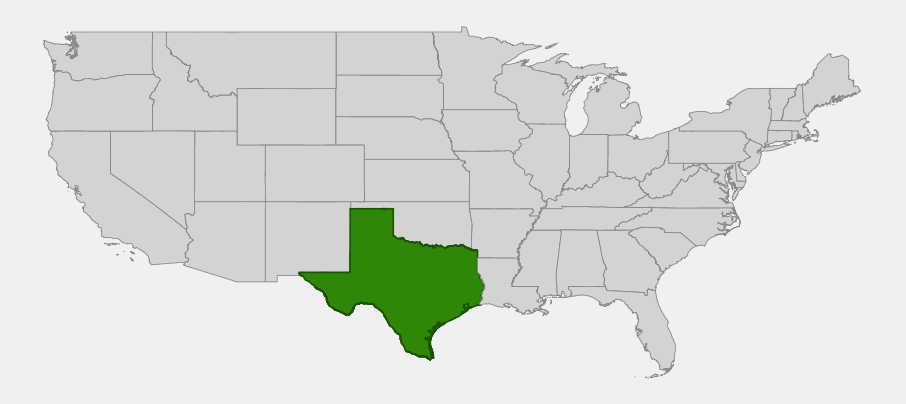
📋 Regional plant lists featuring Thompson’s Yucca: South and West Texas
Growing & Care Guide
Thompson’s Yucca is slow to establish a trunk but otherwise undemanding, and its cold tolerance makes it one of the most widely planted trunk-forming yuccas well outside its native Chihuahuan Desert range.
Light
Give it full sun. Shaded plants etiolate and lose the tight, symmetrical rosette form that makes the species so attractive.
Soil & Water
Sharp drainage is essential — rocky, gravelly or sandy soils suit it best, and raised beds or slopes help in areas with heavier native soil. It is extremely drought-tolerant once established and is far more likely to be lost to soggy winter soil than to lack of water. Water deeply but infrequently during the first year or two to encourage deep rooting.
Planting Tips
Plant in spring after the last hard freeze, from container stock, setting the crown slightly proud of grade. Because it grows slowly, buy the largest specimen your budget allows if you want an early trunk effect. Give it room — mature, branched specimens can spread 4 to 6 feet across.
Pruning & Maintenance
Remove spent flower stalks after seed capsules dry. Some growers trim the dried, down-curved “skirt” of old leaves from the trunk to expose the bark for a cleaner look; others leave it for a more natural, rustic appearance. Either approach is fine horticulturally.
Landscape Uses
- Specimen or focal-point plant in xeriscape and rock gardens
- Architectural accent near entries, patios or dry streambeds
- Mixed Chihuahuan Desert plantings with sotol, agave and ocotillo
- Large container culture where winter protection is needed outside hardy zones
- Low-water, low-maintenance landscaping in hot, sunny sites
Wildlife & Ecological Value
For Pollinators
Like all yuccas, Thompson’s Yucca relies on the obligate yucca moth (Tegeticula spp.) for pollination; the moth deliberately packs pollen onto the stigma while laying eggs in the ovary, and its larvae consume a share of the developing seeds in return.
Birds
Dried flower stalks and branch tips offer elevated perches for desert songbirds and raptors scanning open Chihuahuan Desert terrain, while the dense rosettes give small birds cover from aerial predators.
Mammals
The tough, fibrous leaves are largely avoided by browsing mammals, which is why deer resistance is rated high; javelina and other desert mammals may shelter near the base of mature clumps.
Ecosystem Role
As a long-lived, slow-growing succulent, Thompson’s Yucca contributes structural diversity to sparse Chihuahuan Desert plant communities and helps stabilize rocky slopes where root systems of other species are limited.
Cultural & Historical Uses
Regional common names such as “soyate” and “palmita,” used in Mexico, reflect the long familiarity of people in the Trans-Pecos and northern Mexico with this and related tree yuccas. As with other Chihuahuan Desert yuccas, the fibrous leaves have historically been used by local communities for cordage and weaving, and the saponin-rich roots as a traditional soap substitute — uses that belong to regional history rather than modern practice.
The species commemorates a collector named Thompson and was formally described by botanist William Trelease in 1911, based on material first collected in Chihuahua by the 19th-century plant explorer John Milton Bigelow.
Today the plant’s primary significance is horticultural: it is one of the most widely sold trunk-forming native yuccas in the Southwestern nursery trade, prized for its cold hardiness and sculptural, blue-gray form.
Frequently Asked Questions
Is Thompson’s Yucca the same plant as Beaked Yucca (Yucca rostrata)?
They are closely related and sometimes confused in the nursery trade, but most current taxonomic authorities, including Flora of North America and Plants of the World Online, treat them as distinct species with slightly different native ranges within the Trans-Pecos.
How cold-hardy is Thompson’s Yucca?
Very. It reliably survives winter lows well below 0°F, which is why it is planted far outside its native Chihuahuan Desert range in colder parts of the Southwest.
How long before it forms a visible trunk?
Expect a decade or more. Thompson’s Yucca grows slowly and flowers as a stemless rosette for years before a trunk becomes obvious, then continues branching and gaining height over subsequent decades.
Will it survive in heavy clay soil?
Not reliably without amendment. Like most Chihuahuan Desert succulents, it needs sharp drainage; planting on a mound or slope, or amending heavily with coarse gravel, greatly improves its odds in clay soils.
Is Thompson’s Yucca native outside the Trans-Pecos?
No. Its native range is limited to far west Texas and adjacent northern Mexico; plantings elsewhere in Texas or the Southwest, however common in the nursery trade, are horticultural introductions rather than native plantings.

Looking for a nursery that carries Thompson’s Yucca?
Browse our native plant nursery directory: Texas