
Toothed Clubmoss (Huperzia serrata)
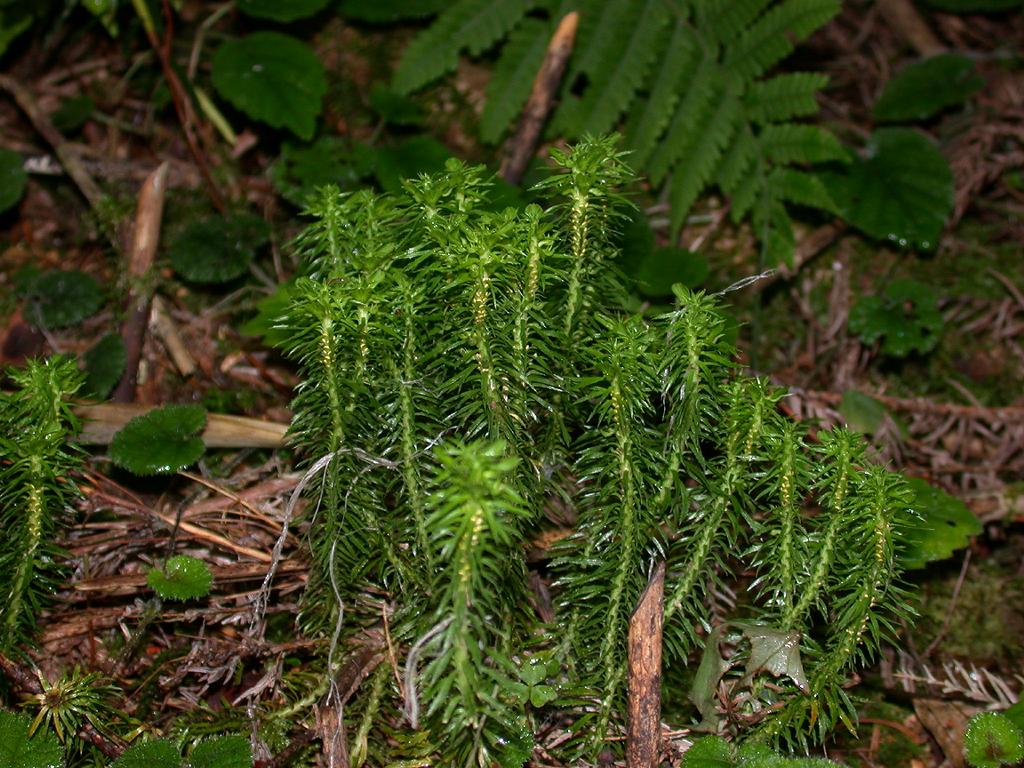
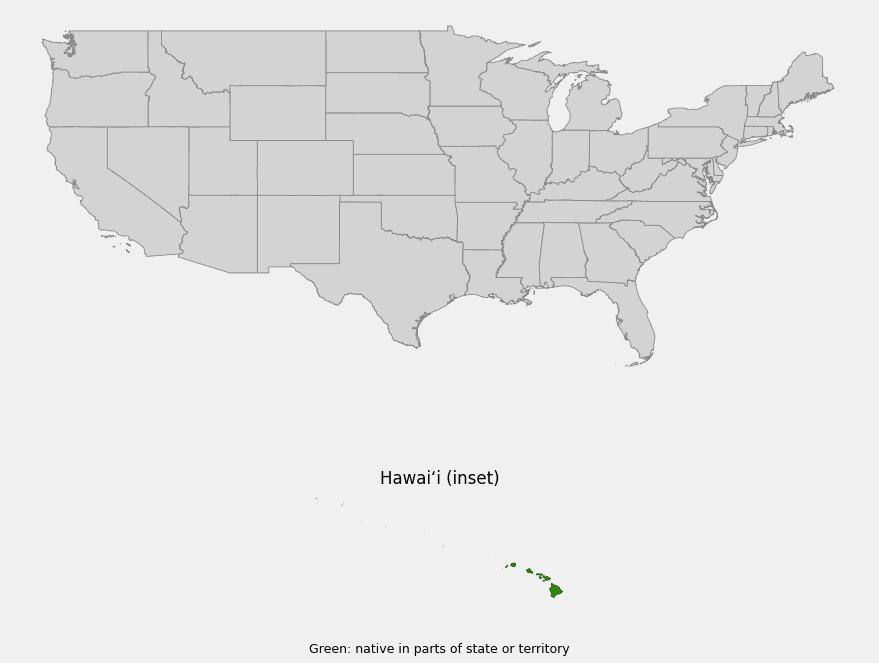
Huperzia serrata, the Toothed Clubmoss or toothed firmoss, is a small evergreen lycophyte: an ancient, spore-bearing plant that looks like a tiny conifer seedling but is related to neither mosses nor ferns. Its upright shoots are clothed in spreading leaves with finely toothed edges, the “serrate” leaves of its name, which set it apart from other firmosses. In the United States, USDA PLANTS lists it as native only in Hawaii, where it grows in mesic to wet forests.
Most people searching for this plant know it by its Chinese name, qian ceng ta, and as the source of huperzine A, a compound sold in dietary supplements for memory. That fame has come at a heavy cost to the plant. It grows very slowly, and wild harvesting for huperzine A has severely depleted populations in China, where it was traditionally collected.
This page is an identification and appreciation guide. Toothed clubmoss is not a garden plant: it is extremely slow and difficult to grow, it is not available from nurseries, and wild plants should never be dug or collected. The page also includes an important safety note about huperzine A and the plant itself, which are toxic in more than tiny doses.
Identification
Firmosses (Huperzia and its relatives) are small, unbranched or forked lycophytes with spore cases in the leaf axils, rather than in cones. Toothed clubmoss is distinguished by its relatively broad, flat, spreading leaves with toothed margins; most other firmosses have narrow, smooth-edged, needle-like leaves. Compare the North American shining clubmoss (H. lucidula), whose glossy leaves are only faintly toothed.
Shoots
The plant forms small tufts of upright or arching shoots, usually 4 to 12 inches tall, that fork a few times near the base (dichotomous branching, typical of lycophytes). There are no creeping stems or runners; each tuft grows from a short base with roots. Epiphytic plants on tree trunks may hang or arch outward.
Leaves
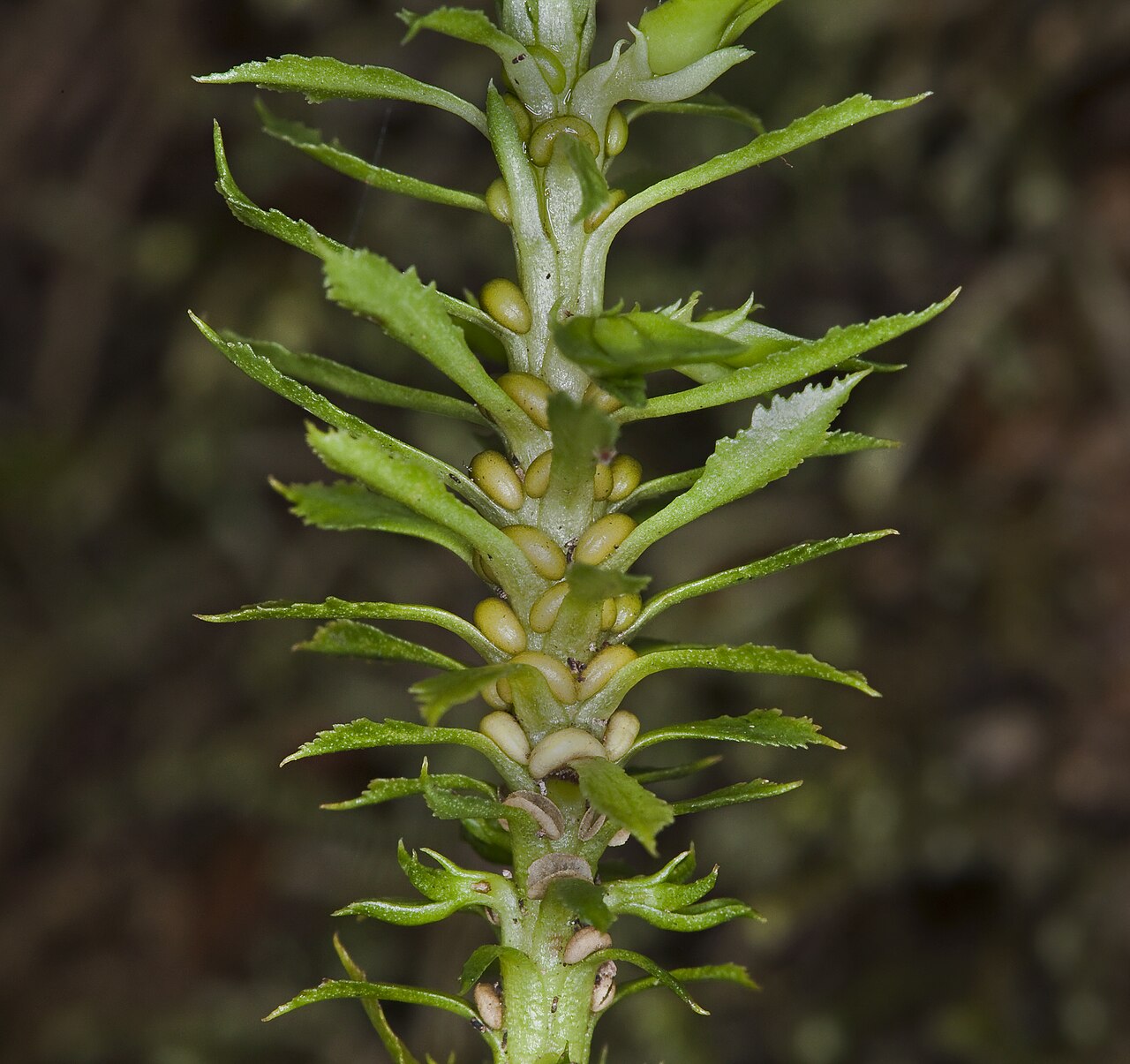
The leaves spiral densely around the stem and spread outward. Each is elliptic to lance-shaped, about ⅜ to 1 inch long and up to about ¼ inch wide, flat, thin, bright to dark green, with a single midvein and irregularly toothed edges, narrowing at the base. Leaves are broadest near the middle, which gives the shoots a soft, bottlebrush look rather than the stiff, needle-like look of most firmosses.
Sporangia
There are no flowers, seeds or cones. Kidney-shaped, yellowish sporangia sit singly at the bases of ordinary leaves along the stem, often in zones that alternate with sterile zones, reflecting yearly growth. They release fine yellow spores. Spores of firmosses germinate underground into tiny, long-lived gametophytes that depend on soil fungi, and a new plant may take many years to appear.
Gemmae
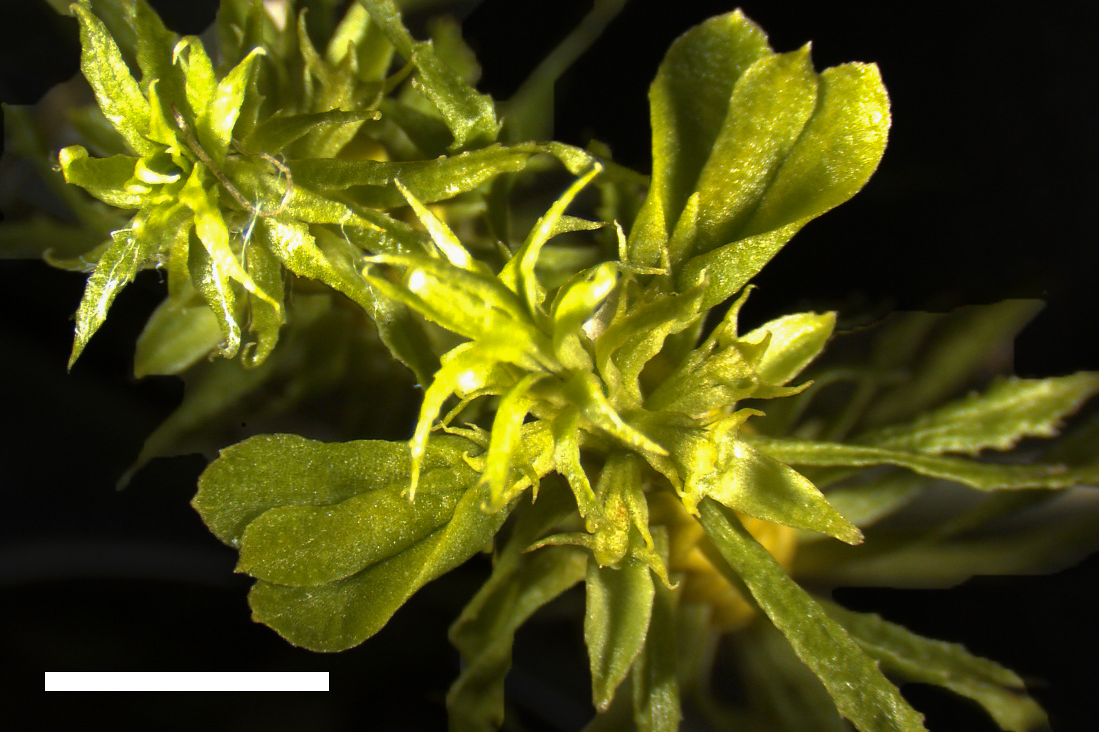
Near the tips of the shoots, toothed clubmoss produces gemmae: small, leafy buds that break off, fall to the ground and grow into new plants. This vegetative reproduction is much faster than reproduction from spores, and it explains why plants often grow in small groups.
Quick Facts
| Scientific Name | Huperzia serrata (Thunb.) Trevis. (syn. Lycopodium serratum) |
| Family | Lycopodiaceae (clubmoss family) |
| Plant Type | Evergreen terrestrial or epiphytic lycophyte (firmoss) |
| Mature Height | 4–12 in |
| Mature Spread | A few inches per tuft |
| Growth Rate | Very slow |
| Sun Exposure | Shade to part shade |
| Water Needs | High; constantly moist air and substrate |
| Soil Type | Moist, humus-rich forest soil, moss mats and bark |
| Soil pH | Acidic (about 4.5–6.0) |
| Bloom Time | None; spore-bearing, sporangia mature mainly in summer |
| Flower Color | None (lycophyte) |
| Fall Color | None; evergreen |
| Fruit | None; kidney-shaped sporangia in leaf axils and leafy gemmae |
| Deer Resistant | Yes; the plant contains toxic alkaloids |
| USDA Hardiness Zones | Hawaiian forest plant (also grows in temperate Asia); not suited to garden cultivation |
Native Range
In the United States, USDA PLANTS lists Huperzia serrata as native only in Hawaii, where it grows in mesic to wet forests, on the ground and as an epiphyte on tree trunks and moss mats. It has been photographed, for example, in wet upland forest along the Pihea Trail on Kauaʻi. Like many small Hawaiian lycophytes, it is easily overlooked among mosses and ferns.
Its main range is in eastern and southern Asia: China, Taiwan, Japan, Korea, the Russian Far East, the Himalaya, India and Southeast Asia, where it grows in moist forests, often on mossy slopes and at forest edges, from low elevations into the mountains. The taxonomy of Asian firmosses is complex, and some botanists split the group into several species; the Hawaiian plants are listed under H. serrata by USDA PLANTS.
Because Hawaiian populations are small and occur in fragile native forest, look but do not touch: trampling, invasive plants, pigs and climate change already pressure the forests where it grows.
📋 Regional plant lists featuring Toothed Clubmoss: Hawaii
Growing & Care Guide
Toothed clubmoss is not a plant for gardens. Firmosses grow extremely slowly, depend on soil fungi in the early stages of their life, and rarely survive transplanting. Plants are not sold by native plant nurseries, and wild plants in Hawaii and elsewhere should never be dug or collected. The notes below explain why, and how to enjoy and protect it instead.
Light
In the wild it grows in shade or filtered light under a forest canopy or among mosses on trunks. Exposure to sun and dry air quickly kills it.
Soil & Water
It needs constantly moist, acidic, humus-rich ground or thick moss, with very high humidity. Its roots are tied to the moist forest floor and to associated fungi. Garden or potting soils do not reproduce these conditions.
Planting Tips
Do not try to plant or transplant it. Dug plants nearly always die within a year or two, and every plant taken from the wild reduces small, slow-growing populations. Researchers have developed tissue-culture methods to propagate Huperzia for huperzine A production, but these are laboratory techniques, not ways to get garden plants.
Pruning & Maintenance
None. In Hawaii, the best care for toothed clubmoss is protecting its habitat: stay on trails, clean boots and gear to avoid spreading weed seeds and pathogens such as the fungi behind Rapid ʻŌhiʻa Death, and support efforts to fence out feral pigs and control invasive plants.
Propagation
In nature it reproduces by gemmae, which drop from shoot tips and root nearby, and by spores, which produce fungus-dependent gametophytes underground over several years. Gemmae can be grown on in specialist settings, but propagation is best left to conservation and research programs.
Landscape Uses
- Nature watching in Hawaii: look for it on mossy trunks and banks along forest trails in wet upland forest
- Botanical education: a living example of the ancient lycophyte lineage
- Medicinal research: the source of huperzine A, which is now produced mainly by extraction and synthesis
- Conservation awareness: an example of how wild harvesting can deplete slow-growing medicinal plants
Wildlife & Ecological Value
Toothed clubmoss is a small, quiet member of the Hawaiian forest understory and epiphyte community. Its value lies in its role in moist forest ecosystems and in its place in a plant lineage more than 400 million years old.
For Pollinators
As a spore-bearing plant, it has no flowers and no value for pollinators.
For Birds
It provides small amounts of cover in moss mats but has no food value for birds.
For Mammals
Its alkaloids make it toxic, and it is not eaten by mammals. Hawaii has few native land mammals.
Ecosystem Role
Together with mosses, liverworts and filmy ferns, it helps form the spongy living layer on trunks and forest floors that stores rainwater and cloud moisture and slowly releases it. Its long-lived underground gametophytes and fungal partners are part of the hidden soil life of Hawaiian wet forests.
Cultural & Historical Uses
Carl Peter Thunberg described the plant from Japan as Lycopodium serratum in 1784, and Vittore Trevisan moved it to Huperzia in the 19th century. The genus honors the German botanist Johann Peter Huperz, who studied fern cultivation. In Chinese traditional medicine the plant, called qian ceng ta (“thousand-layer pagoda”), has long been used for fevers, swelling and other complaints.
In the 1980s, Chinese scientists isolated huperzine A from the plant and found that it inhibits acetylcholinesterase, the enzyme that breaks down the nerve signaling chemical acetylcholine. Huperzine A became the subject of studies for Alzheimer’s disease and other memory disorders and is now sold widely as a dietary supplement. Reviews of the research have found limited and inconsistent evidence of benefit, and it is not an approved drug for Alzheimer’s disease in the United States.
The plant contains only tiny amounts of huperzine A and grows very slowly, so wild harvesting quickly depleted populations in parts of China. Most huperzine A today is extracted under controlled conditions or produced by chemical synthesis, and researchers have studied tissue culture and endophytic fungi as alternative sources. The story of toothed clubmoss is a cautionary tale about demand for natural products.
Frequently Asked Questions
Is toothed clubmoss (Huperzia serrata) poisonous?
Yes. The plant contains huperzine A and other alkaloids that act on the nervous system. Eating the plant or taking too much huperzine A can cause nausea, vomiting, diarrhea, sweating, blurred vision, muscle twitching, slowed heart rate and other serious effects. Never eat the plant or make home preparations from it. Keep supplements away from children and pets, and call Poison Control (1-800-222-1222 in the U.S.) in case of exposure.
Is huperzine A safe to take as a supplement?
Talk to a doctor first. Huperzine A is a potent drug-like compound. It can interact with medications for Alzheimer’s disease, glaucoma, heart conditions, anesthesia and other drugs that affect acetylcholine, and it is not recommended for people with certain heart, lung, digestive or seizure conditions, or during pregnancy. Evidence for its benefits is limited, and supplement quality varies.
Is Huperzia serrata native to the United States?
Yes, in Hawaii, according to USDA PLANTS, where it grows in mesic to wet forests. It does not grow wild on the U.S. mainland, where its relatives include the shining clubmoss.
Can I grow toothed clubmoss?
Not realistically. It grows extremely slowly, depends on soil fungi, and does not survive transplanting. It is not sold by native nurseries, and wild plants should never be collected. Enjoy it in its forest habitat instead.
Is a clubmoss a moss?
No. Clubmosses and firmosses are lycophytes, an ancient group of vascular plants with true roots, stems, leaves and water-conducting tissue. Mosses are non-vascular bryophytes. Lycophytes are more closely related to ferns and seed plants than to mosses.

Looking for a nursery that carries Toothed Clubmoss?
Browse our native plant nursery directory: Hawaii

