
Utah Juniper (Juniperus osteosperma)
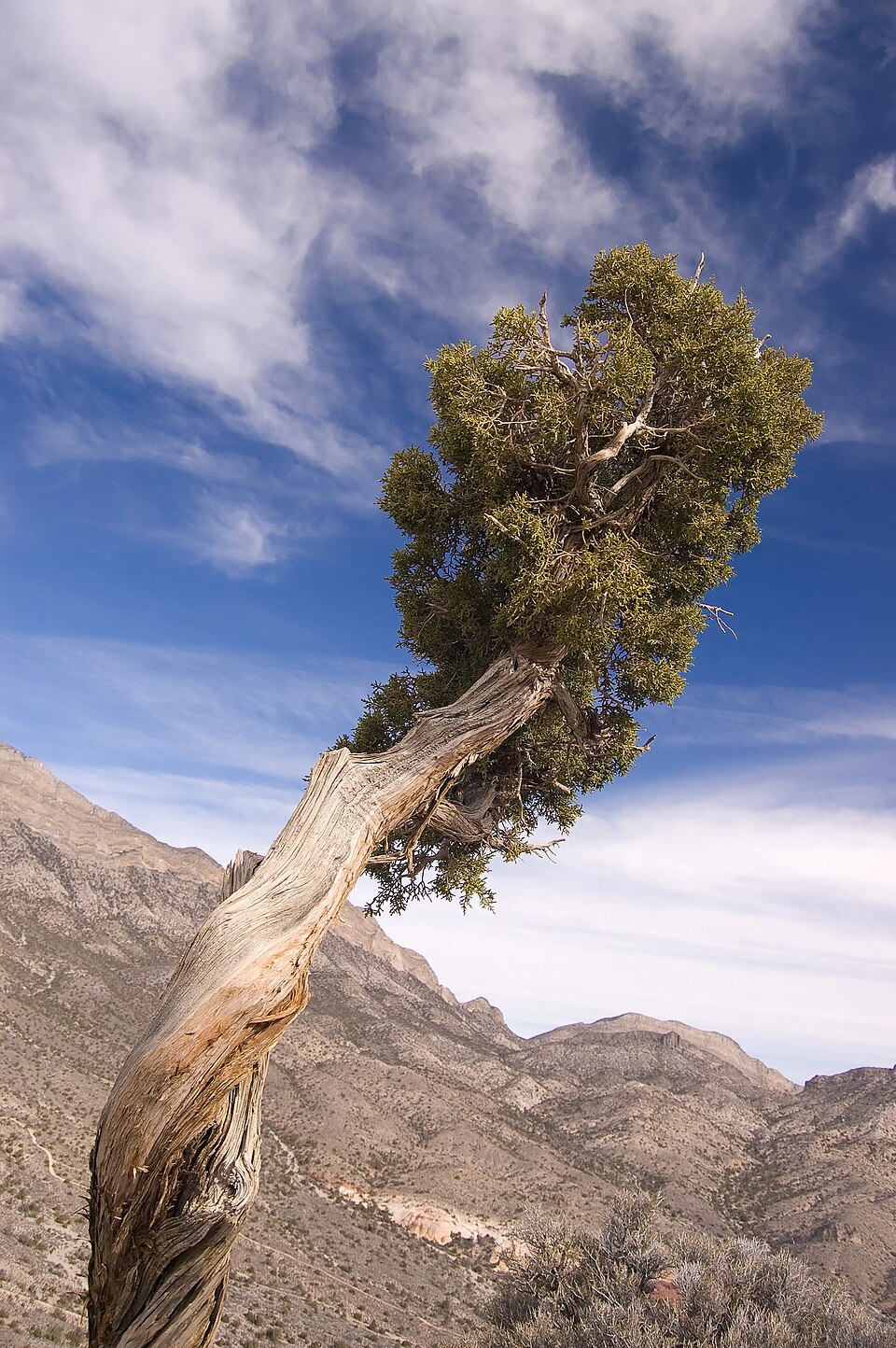
Juniperus osteosperma, commonly known as Utah Juniper, is the quintessential tree of Utah’s High Plateaus and Colorado Plateau — the gnarled, twisted, perpetually green presence that defines millions of acres of pinyon-juniper woodland across the American West. Found from the Great Basin through the Colorado Plateau and into portions of Wyoming, Idaho, Montana, and Arizona, Utah Juniper dominates the woodland zone between approximately 4,500 and 8,000 feet elevation, covering more land area in Utah than any other single tree species. Its slow growth, extraordinary longevity (trees commonly live 500–800 years), and remarkable drought tolerance reflect adaptations refined over thousands of years in some of the most challenging growing conditions in North America.
From a wildlife standpoint, Utah Juniper is among the most productive native trees of the plateau landscape. As noted in the regional plant list, the tree provides both food and cover for a remarkable diversity of birds and mammals. The blue-gray berry-like cones (technically fleshy seed cones) are consumed by dozens of bird species — with the Cedar Waxwing and Townsend’s Solitaire being perhaps the most iconic — and are a critical winter food resource for many species that would otherwise struggle to find nutrition in the winter desert. The dense, aromatic foliage provides year-round thermal cover and nesting habitat, while the distinctive shredding bark (highlighted in the batch data) provides nesting material for a variety of cavity-nesting and cup-nesting birds.
In the landscape, Utah Juniper’s ornamental qualities are underappreciated. The twisted, sculptural trunks develop extraordinary character with age. The reddish-brown shredding bark peels in long strips to reveal smooth, reddish inner layers underneath — a texture and color combination that is architecturally striking. The blue-gray to silvery-green foliage provides year-round color contrast in the landscape. For low-water, low-maintenance landscapes in the Intermountain West, Utah Juniper is a supreme choice — once established, it requires virtually no care and will outlive any structure placed near it.
Identification
Utah Juniper is a small to medium evergreen tree, typically 10 to 30 feet tall with a rounded to irregular crown and one to several twisted trunks. Young trees tend toward a more regular, conical form; mature trees develop the characteristic gnarled, sculptural appearance with twisted trunk(s) and a broadly rounded, often asymmetrical crown. Trees may be multi-stemmed from the base or develop a single dominant trunk over time.
Bark
The bark is one of Utah Juniper’s most distinctive identification characters and one of its most ornamental features. It is thin, grayish-brown to reddish-brown, and shredding — peeling in long, thin, fibrous strips that curl away from the trunk to reveal reddish-orange to cinnamon-brown inner bark beneath. This shredding, “spaghetti-textured” bark is characteristic of junipers and is especially pronounced in Utah Juniper. The strips of shredding bark are actively harvested by birds (particularly wrens, warblers, and sparrows) as nesting material, contributing significantly to the tree’s wildlife value as noted in the batch data.
Foliage
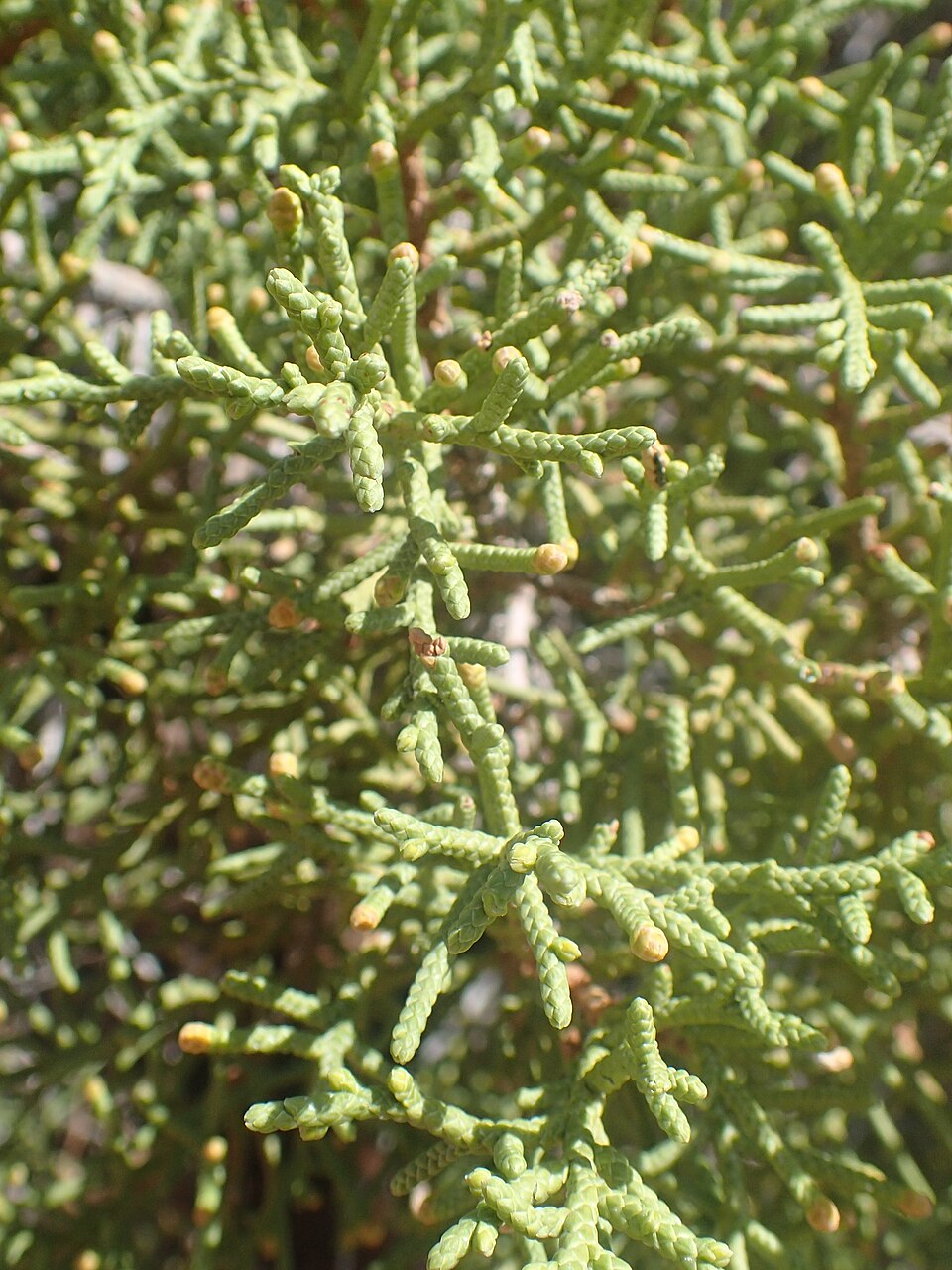
The foliage consists of tiny scale-like leaves, 1–3 mm long, tightly appressed to the branchlets in an overlapping pattern — giving the branchlets a distinctive “braided rope” or “scaly” texture when viewed closely. The color is grayish-green to blue-green, similar to other junipers. A single whitish stomatal stripe on each scale leaf gives the overall foliage a somewhat glaucous (bluish-gray, waxy) appearance, especially on female trees bearing cones. The foliage is aromatic — the characteristic cedar-like scent of juniper is pronounced when branches are crushed.
Cones
Utah Juniper is dioecious, with male and female cones on separate trees. Male cones are tiny (2–3 mm), yellowish, and pollen-bearing, produced in winter and releasing pollen in early spring — a significant late-winter allergen for people sensitive to juniper pollen. Female cones are the berry-like “juniper berries” that characterize the genus — fleshy, rounded, 6–10 mm in diameter, bluish-white to reddish-brown when ripe, produced with 1–2 (occasionally 3) large, bony, wingless seeds. The specific epithet osteosperma means “bone-seeded,” referring to these hard, smooth, large seeds. Cones ripen in September–October and persist on the tree through winter and into the following year, providing extended food resources for birds and mammals.
Quick Facts
| Scientific Name | Juniperus osteosperma |
| Family | Cupressaceae (Cypress) |
| Plant Type | Evergreen Tree |
| Mature Height | 30 ft (typically 10–30 ft) |
| Sun Exposure | Full Sun |
| Water Needs | Extremely Low (Very Drought Tolerant) |
| Cone Ripening | September – October; persisting through winter |
| Foliage Color | Blue-green to grayish-green (evergreen) |
| Bark | Reddish-brown, shredding in long fibrous strips |
| Longevity | 500–800+ years |
| USDA Hardiness Zones | 4–8 |
Native Range
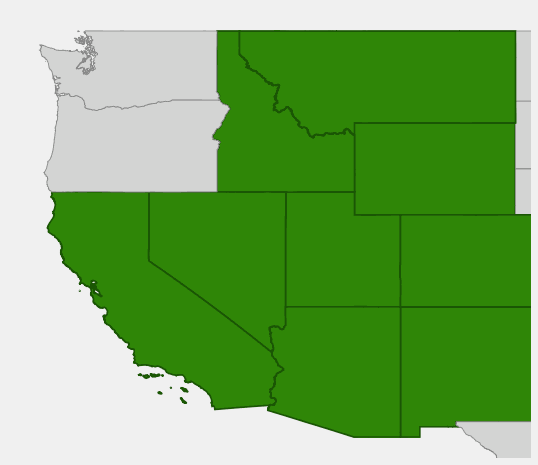
Juniperus osteosperma is one of the most widespread trees of the Interior West, occupying an enormous swath of plateau, basin, and foothill country across Utah, Nevada, Arizona, Colorado, New Mexico, Wyoming, Idaho, Montana, and California. Its core range is the Great Basin and Colorado Plateau, where it co-dominates the “pinyon-juniper woodland” — the most extensive woodland type in the American West, covering approximately 75 million acres. Utah Juniper is the most abundant tree in Utah, covering a larger total area than any other single species in the state.
The species occurs from the hot, dry lower edges of the woodland zone at about 4,000–4,500 feet elevation up to the cooler, moister upper woodland boundary at about 7,500–8,000 feet, where it is replaced by Ponderosa Pine and mixed-conifer forest. Across this elevation range, it grows in a remarkable variety of soils — sandy loams, clay soils, rocky stony soils, volcanic soils, and both calcareous and non-calcareous substrates. It tolerates annual precipitation as low as 8 inches in some areas, making it one of the most drought-tolerant trees in the continental United States. In the driest, lowest-elevation portions of its range, Utah Juniper occurs as widely spaced individual trees; at moister, higher elevations, it forms dense woodland canopies.
Two varieties are sometimes recognized: the nominate J. osteosperma var. osteosperma with rounded to hemispherical seed cones, and J. osteosperma var. saxicola of rocky canyon habitats. Utah Juniper occasionally hybridizes with Rocky Mountain Juniper (J. scopulorum) where their ranges overlap, producing trees with intermediate characteristics. The species is long-lived and slow-growing — growth rings on ancient specimens have confirmed ages of 500–800 years or more for some plateau trees.
📋 Regional plant lists featuring Utah Juniper: Utah
Growing & Care Guide
Utah Juniper is one of the most self-sufficient trees available for Intermountain West landscapes. It thrives with virtually zero maintenance once established, and it will likely outlive your house. The key is getting the establishment right.
Light
Utah Juniper requires full sun. It is intolerant of significant shade and will not thrive in positions that receive less than 6 hours of direct sun. In the wild, it grows in open, exposed positions — plateau tops, south-facing slopes, open valleys — where light is unlimited. In landscape settings, plant it where it will receive all-day sun for best form and cone production.
Soil & Water
This is among the most drought-tolerant trees available for the Intermountain West. Once established (typically requiring 2–3 years of establishment irrigation), Utah Juniper survives entirely on natural precipitation in areas receiving as little as 8–10 inches annually. It grows in sand, gravel, clay, rocky talus, and shallow soil over rock — essentially any well-drained substrate. Poor nutrition is not a problem; this tree evolved in low-nutrient plateau soils and does not need fertilizing. The only non-negotiable requirement is good drainage: Utah Juniper will not tolerate wet feet or prolonged soil saturation.
Planting Tips
Plant in fall or early spring. Use container-grown stock — Utah Juniper does not transplant well from the wild (the root system is extensive and difficult to capture). Water weekly for the first growing season, then every 2 weeks in the second season, then transition to monthly deep watering or natural rainfall. Mulch the root zone with rock or gravel (not organic mulch, which retains too much moisture). Young trees may look sparse for the first few years — patience is required. Once established, the tree is essentially care-free for centuries.
Pruning & Maintenance
Utah Juniper requires no pruning under natural conditions. The gnarled, sculptural form develops naturally over decades and is one of the tree’s greatest ornamental assets — do not attempt to shape it into a formal topiary. Remove dead branches as they appear. The shredding bark naturally peels and does not need removal. The tree is highly resistant to insects and diseases; the strongly aromatic oils in the foliage deter most pest species.
Landscape Uses
- Specimen tree — the sculptural form and shredding bark are unmatched
- Xeriscape anchor — extreme drought tolerance for water-wise landscapes
- Wildlife garden cornerstone — food and cover for dozens of species
- Wind screen or privacy screen — dense evergreen foliage, year-round
- Erosion control on rocky, dry slopes
- Canyon and plateau restoration — the defining woodland tree of the region
- Long-term legacy planting — a tree your grandchildren will still enjoy
Wildlife & Ecological Value
Utah Juniper is a wildlife powerhouse — few trees in the Interior West support more species through more seasons. As highlighted in the regional plant list, it provides both food and cover for an extensive community of birds and mammals.
For Birds
The fleshy seed cones are consumed by an extraordinary number of bird species. Cedar Waxwings are perhaps the most famous juniper consumers — flocks of dozens or hundreds will strip the cones from productive trees in winter. Townsend’s Solitaires actually defend individual juniper trees as exclusive feeding territories throughout winter, relying almost entirely on juniper berries for winter survival. American Robins, Varied Thrushes, Bluebirds (all three Western species), Yellow-rumped Warblers, and numerous other songbirds take juniper berries throughout fall and winter. Dark-eyed Juncos, White-crowned Sparrows, and other ground feeders consume seeds dropped below the tree. The dense evergreen canopy provides nesting habitat for Pinyon Jays, Common Ravens, American Kestrels, Cooper’s Hawks, and many smaller songbirds. The shredding bark is harvested for nesting material by wrens, warblers, and sparrows.
For Mammals
Coyotes, Gray Foxes, and Ringtails consume juniper berries seasonally. Deer mice, Kangaroo Rats, and other desert rodents harvest seeds from the ground. Mule Deer browse the foliage in winter, particularly in deep snow years when other food is scarce. Pronghorn may browse juniper in winter as well. Porcupines occasionally damage Utah Juniper by girdling branches for the inner bark. The dense canopy provides critical thermal cover for many species during winter, when nighttime temperatures can drop dramatically on exposed Utah plateaus.
For Pollinators
Male Utah Juniper trees release enormous quantities of pollen in late winter and early spring (February–March), which constitutes a significant allergen for many people but provides early-season pollen for native bees, flies, and other pollinators emerging in late winter. The fleshy cones also attract fruit flies and other small insects that serve as food for insectivorous birds.
Ecosystem Role
The pinyon-juniper woodland that Utah Juniper co-dominates is one of the most extensive and ecologically important vegetation types in the American West. Utah Juniper functions as a physical habitat creator — its dense canopy modifies the microclimate beneath and around it, creating conditions where more moisture-sensitive plants and shade-adapted organisms can persist. The leaf litter and wood it produces over centuries contributes to soil formation and organic matter accumulation on otherwise thin, rocky soils. As a seed-dispersal partner with birds, it plays a major role in maintaining and expanding woodland across the plateau landscape. When junipers die and fall, the decaying wood provides habitat for invertebrates and cavity-nesting birds — including use of natural cavities by owls, small falcons, and squirrels.
Cultural & Historical Uses
Utah Juniper was central to the lives of the Ancestral Puebloan people and their successors — the Hopi, Southern Paiute, Ute, and Navajo peoples — who inhabited the Colorado Plateau for thousands of years. The tree was used for nearly every conceivable purpose: the aromatic wood and bark were used as building material, fuel, and ceremonial items; the berries were consumed as food and medicine; the shredded bark was used as tinder, basketry material, diaper material, and padding; and the pollen and small branches were used in ceremony and prayer.
Juniper bark, which shreds naturally into long fibrous strips, was the primary tinder and fire-starting material in canyon country before the availability of modern matches. It was also woven and twisted into rope, mats, and the frames of baskets. Among the Diné (Navajo), juniper bark was used to make cradleboard padding for infants — its softness, absorbency, and naturally antimicrobial properties (from the aromatic oils) making it ideal for this purpose. The berry-cones were ground into flour, fermented into a mildly alcoholic beverage, or cooked in stews, providing a calorie source during winter when other foods were scarce.
Medicinally, juniper was one of the most important plants in the Plateau pharmacopoeia. Infusions of leaves and bark were used to treat respiratory infections, arthritis, and skin conditions. The aromatic smoke of burning juniper wood and bark was used for purification, healing ceremonies, and as a fumigant. Utah Juniper was also used in traditional astronomical and calendrical observations — the appearance of specific juniper-associated birds (Townsend’s Solitaire, Pinyon Jay) in juniper woodlands was correlated with seasonal changes and agricultural calendars. Today, the ceremonial use of juniper continues in Navajo, Hopi, and other Plateau cultures, maintaining the deep cultural connection between the people and this enduring tree.
Frequently Asked Questions
How can I tell Utah Juniper from Rocky Mountain Juniper?
Utah Juniper (J. osteosperma) has more rounded, berry-like cones that contain 1–2 large, bony, wingless seeds — the “bone seeds” of its scientific name. Rocky Mountain Juniper (J. scopulorum) has smaller, softer cones with 1–2 smaller, winged seeds. Utah Juniper also tends to occur at lower, drier elevations. Where both species grow together, they can hybridize, producing intermediate individuals that are difficult to identify definitively.
How old can Utah Juniper trees get?
Some Utah Juniper trees on protected plateau sites have been aged at 500–800 years old by ring counts. The largest, oldest trees on canyon rims and protected mesa tops are living relics of the pre-Columbian landscape. Growth is very slow — often only 1/4 to 1/2 inch of trunk diameter per decade — so even a modestly sized tree of 8 inches diameter may be 150–200 years old.
Is Utah Juniper deer resistant?
Mostly yes — the strongly aromatic foliage is unpalatable to deer under normal conditions. However, in severe winter conditions with deep snow cover limiting access to other food, Mule Deer will browse juniper foliage. Young container-grown plants should be protected during their first winter if deer pressure is significant.
Why is my juniper losing foliage on some branches?
Some browning and shedding of interior foliage is normal and seasonal — junipers shed older interior foliage annually, usually in fall. This should not be confused with disease. Widespread browning of branch tips combined with dead branches may indicate Juniper Twig Blight (Phomopsis) or drought stress. Ensure adequate drainage; in severe drought years, even established junipers may show some dieback.
Can I grow Utah Juniper in a container?
Young Utah Junipers can be grown in large containers as bonsai subjects — their slow growth, twisted forms, and dramatic bark texture make them superb bonsai material. For landscape use, however, container culture is only a temporary measure; plant them in the ground where they have room to develop their full size and structure over generations.

Looking for a nursery that carries Utah Juniper?
Browse our native plant nursery directory: Utah