Virginia Creeper (Parthenocissus quinquefolia)
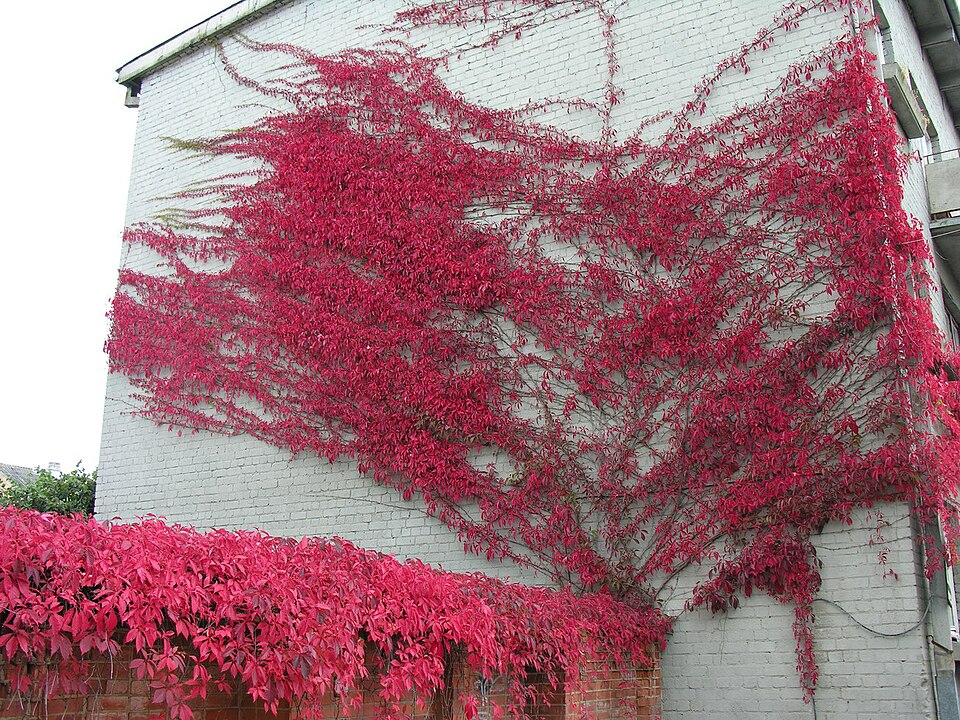
Parthenocissus quinquefolia, commonly known as Virginia Creeper, is one of the most widely distributed and ecologically important native vines in North America. This vigorous, deciduous climbing vine ranges across nearly the entire eastern half of the continent, from the Atlantic Coast west into the Rocky Mountain foothills of Montana and Wyoming, and from southern Canada south to Florida and Mexico. It is perhaps best known for its spectacular autumn display — the palmately compound leaves turn brilliant shades of scarlet, crimson, and deep burgundy in fall, making it one of the most colorful plants in the eastern and central North American landscape.
Virginia Creeper is the kind of plant that native landscape designers call a “workhorse” — tough, adaptable, ecologically valuable, and effective at covering ground, climbing structures, and softening hard edges with lush, attractive foliage. It thrives in a remarkable range of conditions, from deep shade to full sun, from dry rocky slopes to moist bottomlands. It climbs using adhesive discs at the tips of its tendrils, which allow it to grip smooth surfaces like glass and brick without damage — a feature that made it one of the most popular plants for covering building facades in the 19th and early 20th centuries.
Beyond aesthetics, Virginia Creeper provides extraordinary ecological value. Its small dark berries are consumed by over 35 species of birds, including many neotropical migrants that rely on the fruits to fuel their autumn journeys. The dense foliage provides critical nesting and cover habitat, and the inconspicuous flowers supply nectar for native bees and small butterflies. From a conservation standpoint, Virginia Creeper is an important species to include in any native plant restoration project throughout its wide range.
Identification
Virginia Creeper is a woody vine that can climb to 50 feet or more up trees and structures, or spread along the ground as dense groundcover up to 100 feet in extent. It climbs using distinctive adhesive tendrils that terminate in disk-shaped holdfasts that bond to almost any surface. Young stems are reddish; older woody stems become grayish-brown with slightly shaggy bark.
Leaves
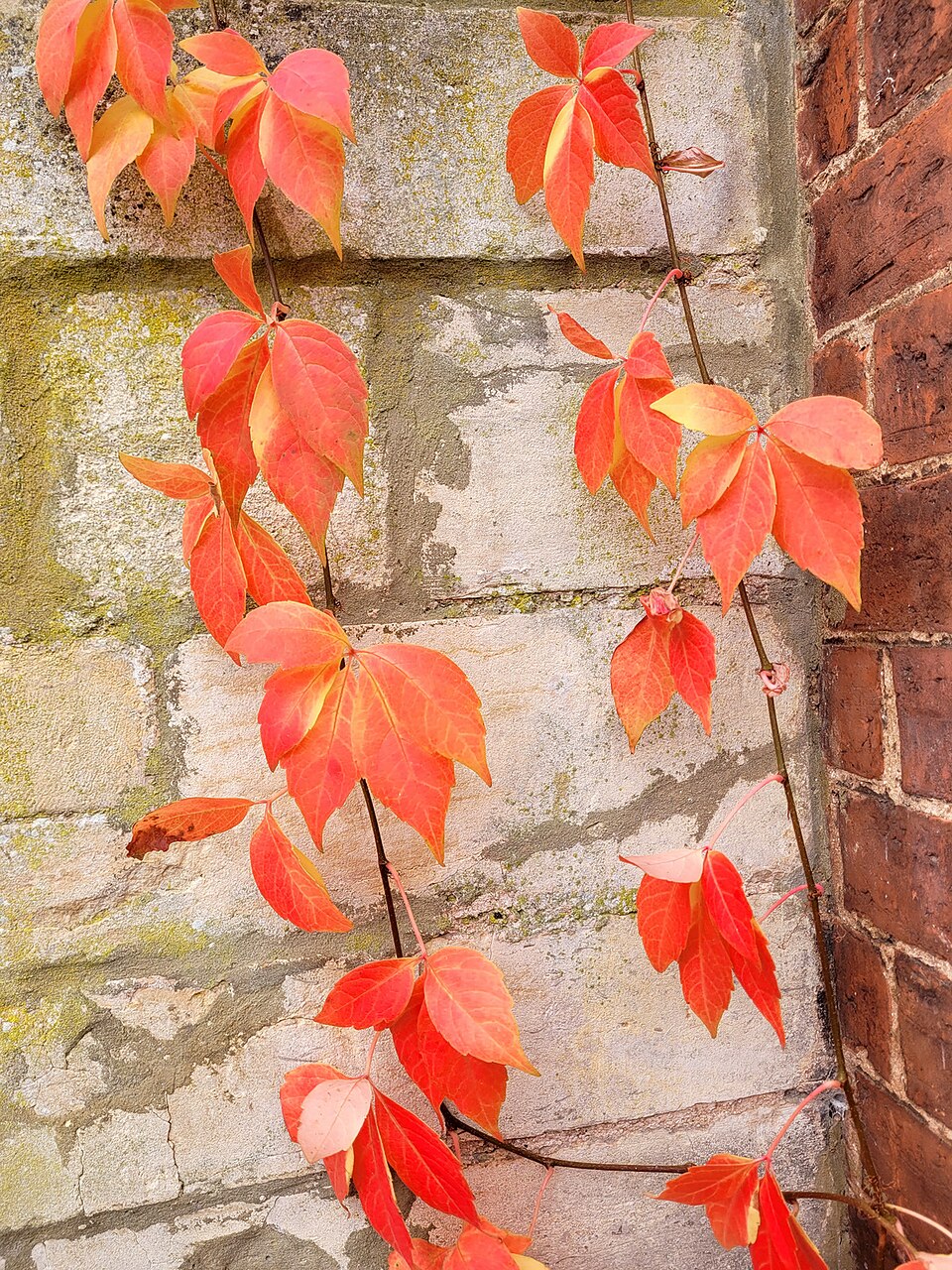
The leaves are the plant’s most distinctive feature and the source of one of its alternate names, “Five-Leaved Ivy.” Each leaf is palmately compound, meaning it consists of 5 (occasionally 3 or 7) leaflets radiating from a central point like fingers on a hand. Individual leaflets are 2 to 6 inches long, oval to elliptic, with coarsely toothed margins and a pointed tip. The upper surface is dark green and slightly glossy; the underside is paler. In autumn, the leaves turn a spectacular scarlet to burgundy, one of the most vivid fall color displays of any woody vine.
Note: Virginia Creeper is frequently confused with Poison Ivy (Toxicodendron radicans), which has 3 leaflets (not 5). The mnemonic “Leaves of three, let it be; leaves of five, let it thrive” is helpful for distinguishing the two. Virginia Creeper is not toxic and does not cause rash, though the berries should not be eaten (they contain oxalic acid and are mildly toxic to humans).
Flowers & Fruit
The flowers are small, inconspicuous, and greenish-white, borne in branched clusters (cymes) in June and July. They are 5-petaled and approximately 1/4 inch across, providing nectar for small native bees, flies, and wasps. The fruit is a small, round berry, approximately 1/4 inch in diameter, that matures from green to dark blue-black in late summer and fall. The berries are borne in loose clusters on distinctive deep red stems (pedicels), creating a striking color contrast. Each berry contains 2 to 3 seeds and a bluish-black skin with waxy bloom. The berries are toxic to humans but eagerly consumed by birds.
Quick Facts
| Scientific Name | Parthenocissus quinquefolia |
| Family | Vitaceae (Grape) |
| Plant Type | Deciduous Native Vine |
| Mature Length | Up to 50 ft as climber; spreads extensively as groundcover |
| Sun Exposure | Part Shade to Full Sun |
| Water Needs | Moderate |
| Bloom Time | June – July |
| Flower Color | Greenish-white (inconspicuous) |
| Fruit | Dark blue-black berries on red stems (fall) |
| Fall Color | Brilliant scarlet to crimson-burgundy |
| USDA Hardiness Zones | 3–10 |
Native Range
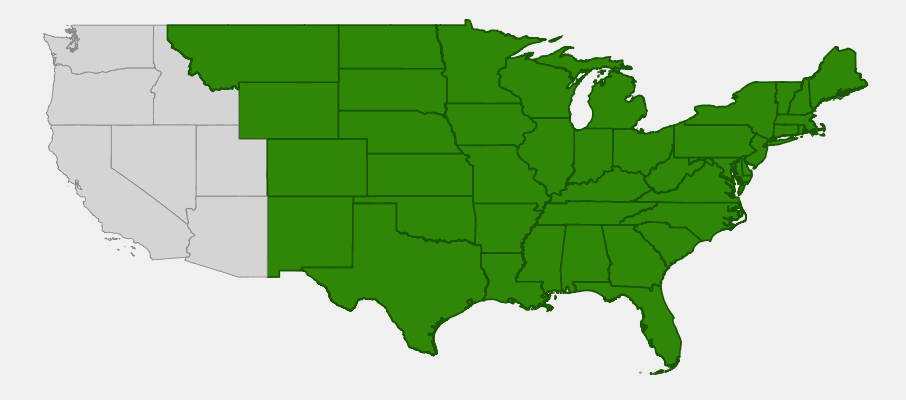
Virginia Creeper is native to a vast area of eastern and central North America, making it one of the most geographically widespread woody vines on the continent. Its range extends from Maine and the Maritime Provinces south to Florida, west across the Great Plains to eastern Colorado, Wyoming, and Montana, and south into Mexico and Central America. In the western part of its range, it is associated with riparian corridors, moist canyon walls, and the eastern slopes of the Rocky Mountains where adequate moisture is available.
In Montana and Wyoming, Virginia Creeper occurs primarily in riparian zones along rivers and streams, on canyon walls, and in moister forest settings in the eastern and central parts of both states. It is found from valley bottoms to moderate mountain elevations, generally below 7,000 feet. Its occurrence in these western states represents the western frontier of the species’ natural range, where it grows in scattered populations along the moist habitats that connect the central Great Plains to the Rocky Mountain foothills.
Across its range, Virginia Creeper is found in a remarkable diversity of habitats: from bottomland forests and swamp margins in the Southeast, to rocky cedar glades in the Ozarks, to dry upland forests in New England, to moist river terraces in the Great Plains. This broad habitat tolerance reflects the species’ exceptional adaptability and explains its wide distribution across 45 US states.
📋 Regional plant lists featuring Virginia Creeper: Montana & Wyoming
Growing & Care Guide
Virginia Creeper is one of the easiest native vines to grow — it is adaptable, vigorous, pest-resistant, and requires minimal care once established. The main challenge is managing its vigor; it is a fast-growing plant that will cover large areas quickly and must be kept in check in smaller landscapes.
Light
Virginia Creeper is exceptionally adaptable to light conditions, growing vigorously in full sun, partial shade, or deep shade. In full sun, it produces the best fall color — the most vivid scarlets and crimsons. In shade, the fall color is less intense (more orange-red) but the plant grows well and covers surfaces effectively. It is one of the best native vines for shaded north-facing walls and deep shade gardens where few other vines thrive.
Soil & Water
Virginia Creeper tolerates an extraordinarily wide range of soil types, from dry, rocky, infertile soils to moist, rich bottomland soils. It grows in sand, clay, loam, and everything in between. While it prefers moderately moist, well-drained conditions, established plants tolerate both periodic drought and temporary flooding. Once established (2 to 3 years), supplemental irrigation is rarely needed in the eastern US; in the drier western part of its range, some irrigation during summer dry periods is beneficial.
Planting Tips
Plant Virginia Creeper in spring or fall. Young plants establish readily from container stock. Provide a structure to climb — trellis, fence, wall, or the trunk of a large tree — if you want it to climb. If used as groundcover on a slope, no structure is needed. Water regularly during the first growing season. The plant grows slowly the first year while establishing its root system, then typically accelerates growth dramatically in years 2 and 3.
Pruning & Maintenance
Virginia Creeper is a vigorous grower and will need regular pruning to keep it within bounds. Prune in late winter or early spring before new growth begins. Cut back any stems growing where you don’t want them — into windows, under roof shingles, or over neighboring plants. The plant can be cut back severely — even to the ground — and will resprout vigorously. For climbing applications, prune side branches that extend too far from the main climbing surface. Note: the adhesive holdfasts can leave marks on some surfaces when stems are removed — consider this before planting against painted wood or other delicate surfaces.
Landscape Uses
- Building coverage — climbs stone, brick, and concrete without damaging masonry
- Fence coverage — quickly covers chain-link, wood, or wire fencing
- Tree climbing — creates dramatic column of fall color on large trees
- Groundcover — spreads to cover large shady areas where other plants struggle
- Slope stabilization — excellent for stabilizing steep, rocky, or disturbed slopes
- Wildlife gardens — outstanding bird and wildlife value
- Shade gardens — one of the best vines for deep shade conditions
Wildlife & Ecological Value
Virginia Creeper is one of the most ecologically valuable native vines in North America, providing food, cover, and habitat structure for a remarkable diversity of wildlife species.
For Birds
The dark berries are consumed by more than 35 species of birds, including American Robins, Northern Mockingbirds, Brown Thrashers, Eastern Bluebirds, Cedar Waxwings, Pileated Woodpeckers, Flickers, and many thrushes, warblers, and vireos. The berries are particularly important during fall migration, when neotropical migrants need high-calorie food to fuel their southward journeys — the high fat content of the berries makes them a critical fuel source. The dense vine growth provides excellent nesting habitat for many bird species including Yellow Warblers, American Robins, and Gray Catbirds.
For Mammals
White-tailed deer browse the foliage, though the vine’s ability to climb above deer browse height mitigates this pressure. Foxes, raccoons, skunks, and opossums consume the berries. The dense vine creates important cover habitat for small mammals including chipmunks, mice, and rabbits. Black bears occasionally consume the berries and foliage in fall.
For Pollinators
The small but abundant flowers attract a variety of native bees, including sweat bees (Halictidae), mining bees (Andrenidae), and small bumblebees. Wasps and flies are also frequent visitors. The flowers provide nectar during the early summer period when many other flowering plants are past peak. Virginia Creeper is a larval host plant for the Virginia Creeper Sphinx Moth (Darapsa myron), a native moth whose caterpillars feed on the foliage.
Ecosystem Role
Virginia Creeper plays important structural roles in many ecosystems. As a climbing vine, it creates vertical habitat complexity — adding a canopy layer where none existed and increasing overall habitat diversity. As a groundcover, it stabilizes erosion-prone slopes and shaded areas where few other plants can establish. The vine’s ability to thrive in disturbed and degraded habitats makes it valuable for ecological restoration, providing rapid habitat recovery on road cuts, logged areas, and abandoned structures.
Cultural & Historical Uses
Virginia Creeper has a rich history of use among Indigenous peoples of eastern and central North America. The Potawatomi boiled the bark to treat jaundice. The Menominee used the bark in a compound medicine to treat lockjaw. Various Algonquian peoples used bark tea for treating venereal diseases and urinary disorders. The Iroquois used a tea made from the plant as a tonic and to treat gonorrhea. The sap was used by some nations as a skin treatment for swelling and inflammation.
The roots and bark contain oxalic acid and a range of bioactive compounds that have been investigated for their potential antimicrobial and anti-inflammatory properties. However, all parts of the plant — particularly the berries — are toxic to humans if consumed in quantity due to oxalic acid content. Skin contact with the plant rarely causes problems for most people, though some individuals may develop mild contact dermatitis.
In 19th and early 20th century American architecture, Virginia Creeper was one of the most fashionable plants for covering the facades of brick and stone buildings, particularly universities, libraries, and estates. The term “Ivy League” is partly derived from the ivy-like appearance of Virginia Creeper (and actual ivy) on the facades of prestigious northeastern universities. Several of these famous “ivy-covered” walls are actually covered with Virginia Creeper rather than true ivy. The vine fell somewhat out of fashion after concerns arose about potential damage to masonry, but restoration landscape designers have revived its use in appropriate applications.
Frequently Asked Questions
Is Virginia Creeper poisonous?
The berries are toxic to humans, containing oxalic acid crystals that can cause throat burning, nausea, and vomiting if consumed. They are not dangerous to birds, which have different digestive chemistry. The foliage and stems rarely cause skin irritation, unlike Poison Ivy, but some sensitive individuals may develop mild dermatitis after contact. Always wash hands after handling the plant.
How do I tell Virginia Creeper from Poison Ivy?
Virginia Creeper has 5 leaflets per leaf; Poison Ivy has 3. The mnemonic “leaves of three, let it be; leaves of five, let it thrive” is reliable. Additionally, Virginia Creeper climbs using adhesive holdfasts (small pads at tendril tips), while Poison Ivy climbs using aerial rootlets along the stem, giving it a distinctive “hairy rope” appearance on tree trunks.
Will Virginia Creeper damage my house?
Virginia Creeper adheres to surfaces using disk-shaped holdfasts, not roots, so it generally does not damage solid masonry, brick, or stone. However, the holdfasts can leave marks when stems are removed, and in rare cases the tendrils can penetrate small cracks in deteriorating mortar. It can also work under siding and trim, damage painted surfaces, and clog gutters. Use it on solid stone or brick walls, not on wood or painted surfaces.
Does Virginia Creeper attract bees?
Yes — the small flowers attract a variety of native bees, wasps, and other pollinators during June and July. It is not as significant a bee plant as major nectar flowers, but contributes meaningfully to the pollinator food web, especially in areas where it covers large expanses.
How fast does Virginia Creeper grow?
After an establishment period of 1 to 2 years, Virginia Creeper can grow 10 to 20 feet per year under favorable conditions. This rapid growth is one of its greatest assets for quick coverage of fences and buildings, but also means it must be pruned regularly to stay within bounds in smaller landscapes.