
Western Bunchberry (Cornus unalaschkensis)
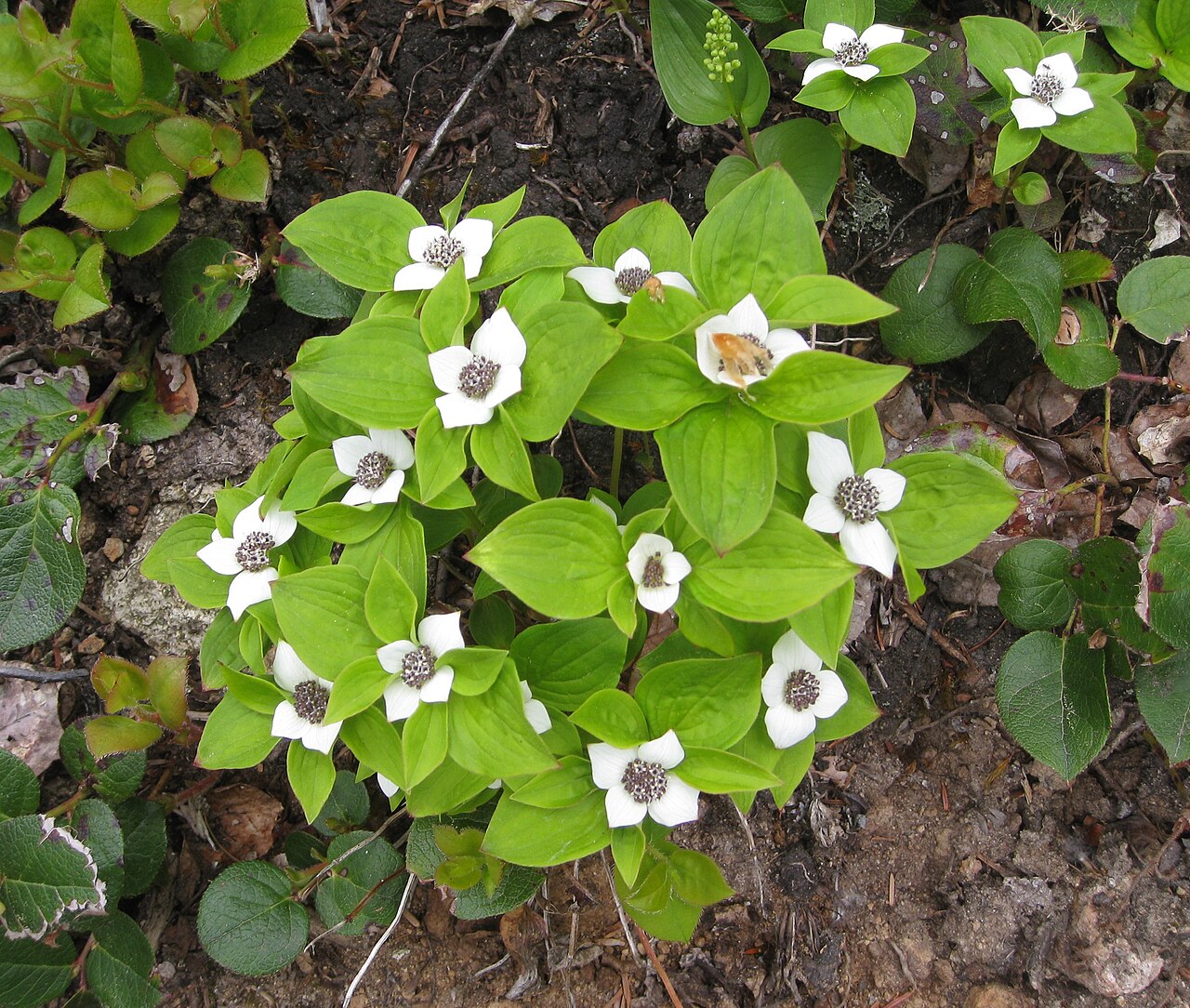
Cornus unalaschkensis, known as Western Bunchberry (USDA: western cordilleran bunchberry), is a low, carpeting dogwood of the moist conifer forests of the Pacific Northwest, from coastal Alaska and British Columbia south to northern California and east to northern Idaho. It belongs to the dogwood family (Cornaceae), the same genus as flowering dogwood. Each stem is only 2 to 8 inches tall, with a whorl of four to six leaves at the top and, in early summer, a single “flower” that is really a cluster of tiny flowers framed by four white bracts. In late summer the clusters turn into bunches of bright red berries.
It is a close relative of the much more widespread Dwarf Dogwood (Cornus canadensis), the bunchberry of boreal forests across Canada and the northern United States, and of Swedish cornel (Cornus suecica), a circumboreal species with dark purple flowers. Western bunchberry is a tetraploid that is widely thought to have arisen from hybridization between those two species, which is why some botanists write it as Cornus × unalaschkensis. Many older books and some current floras include it in C. canadensis, and the two can be hard to tell apart.
In gardens it behaves like eastern bunchberry: a beautiful, slow-spreading groundcover for cool, moist, acidic woodland soil in the Pacific Northwest and similar climates. Its creeping rhizomes form patches on rotting logs, stumps and the forest floor. Buy nursery-propagated plants; wild plants rarely survive being dug.
Identification
Western bunchberry looks like a tiny dogwood tree with no trunk: a short, upright stem, a whorl of veined leaves at the top and a white, four-“petaled” flower head in the center. Many stems grow together in carpets from creeping rhizomes.
Stems & Rhizomes
The plant is a low subshrub with widely spreading, slender rhizomes. The upright stems are 2 to 8 inches (5 to 20 cm) tall, mostly herbaceous, greenish to reddish, with a few small, scale-like leaves or bracts below the main whorl.
Leaves
The true leaves are clustered in a terminal whorl, usually four on nonflowering stems and six on flowering ones. They are elliptic to ovate, 3/4 to 3 inches (2 to 8 cm) long, nearly stalkless, green above and paler and slightly whitish beneath, with the curved, parallel veins typical of dogwoods. If you gently tear a leaf, fine, stretchy threads often hold the two halves together. The leaves may turn reddish or purplish in fall and some persist through winter.
Flowers
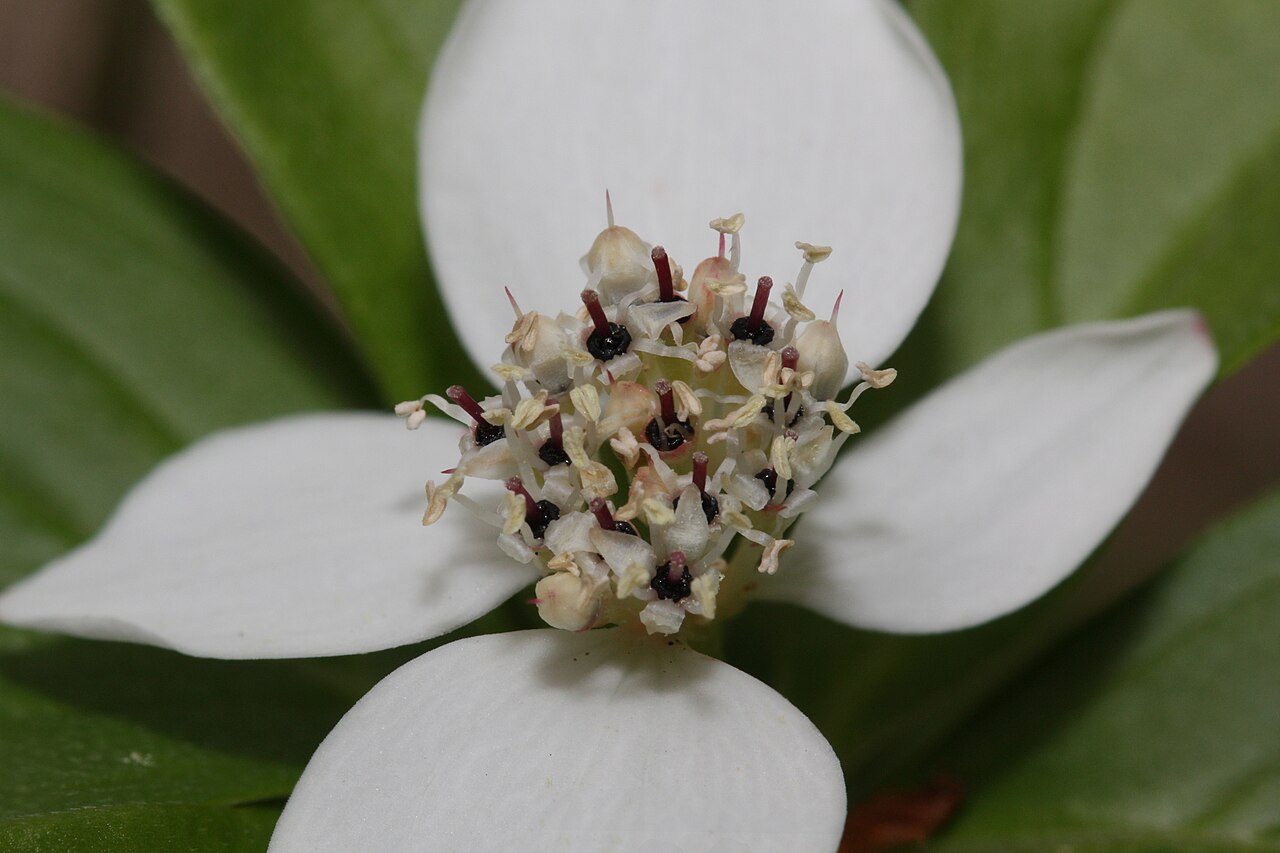
From June to August, a short stalk rises from the center of the whorl and carries a dense head of tiny flowers. Four white, pinkish- or purplish-tinged bracts, each about 1/2 to 3/4 inch (1 to 2 cm) long, surround the head and look like petals. The true flowers are only about 1/16 inch (1 to 1.5 mm) long, greenish-white and often tinged purple. In Swedish cornel the flowers are dark purple; in eastern bunchberry they are usually greenish-white. Western bunchberry is often intermediate.
Fruit
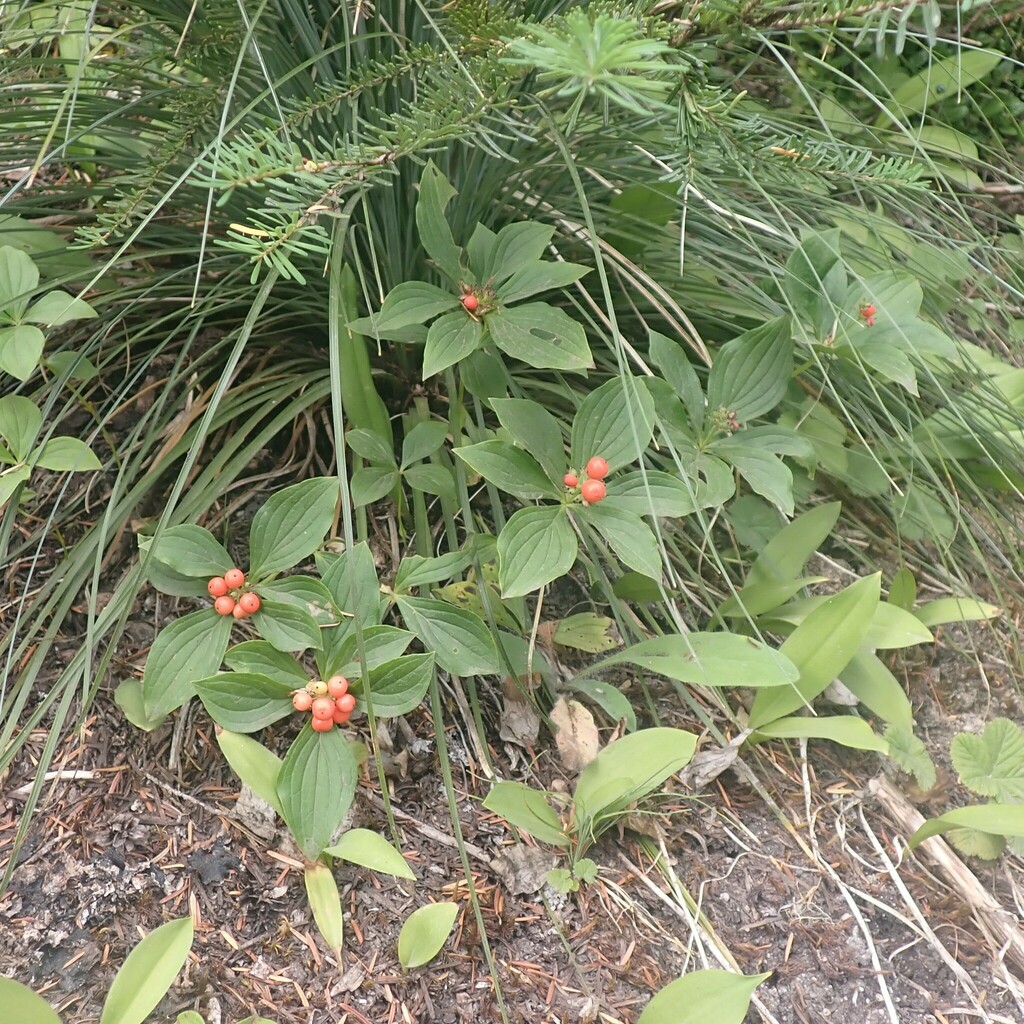
The flowers develop into tight clusters of round, bright coral-red to orange-red drupes about 1/4 inch (6 to 8 mm) long, each with a stone. The berries ripen in late summer and are eaten by birds and mammals.
Look-alikes
Eastern bunchberry (Dwarf Dogwood (Cornus canadensis)) is nearly identical. Where their ranges overlap in Alaska, British Columbia and the northern Rockies, they intergrade, and reliable identification may need careful study of leaf arrangement or chromosomes. In general, western bunchberry is intermediate between its two parents, with flowers that are often tinged purple, while C. canadensis usually has greenish-white flowers. Location helps too: in the coastal forests of Washington, Oregon and northern California, western bunchberry is the expected species. Swedish cornel (C. suecica) of coastal Alaska and British Columbia has stalkless leaves in several pairs up the stem and dark purple flowers. Other low plants with whorled leaves, such as trilliums, have three leaves and three true petals.
Safety & Conservation
The berries are edible but mealy and bland, and they were eaten raw or cooked by some Indigenous peoples of the Northwest. Eating many may upset the stomach, so taste only a few, and be sure of your identification. Western bunchberry is common and not of conservation concern in Washington. Still, wild plants rarely survive transplanting, so buy nursery-propagated plants.
Quick Facts
| Scientific Name | Cornus unalaschkensis |
| Family | Cornaceae (dogwood family) |
| Plant Type | Rhizomatous, deciduous to semi-evergreen subshrub groundcover |
| Mature Height | 2–8 in |
| Mature Spread | 1–3 ft or more, spreading by rhizomes |
| Growth Rate | Slow to moderate |
| Sun Exposure | Part shade to full shade; sun in cool, moist sites |
| Water Needs | Moderate to high; consistently moist soil |
| Soil Type | Humus-rich, acidic forest soil, rotting wood, moss |
| Soil pH | About 4.5–6.0 |
| Bloom Time | June–August |
| Flower Color | White bracts; tiny greenish-white to purplish flowers |
| Fall Color | Red to purplish leaves |
| Fruit | Clusters of bright red drupes in late summer |
| Deer Resistant | No; deer and elk browse it |
| USDA Hardiness Zones | 3–8 |
Native Range
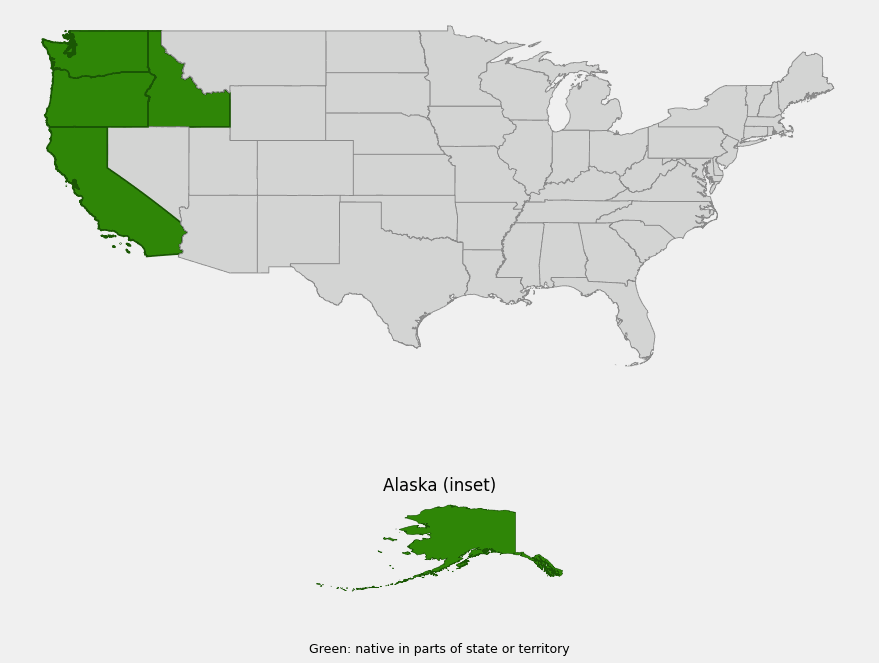
Western bunchberry is a plant of the Pacific Northwest and the northern Rocky Mountains. USDA PLANTS lists it as native in Alaska, California, Idaho, Oregon and Washington, and in Alberta, British Columbia and Yukon in Canada. Its scientific name refers to Unalaska Island in the Aleutians, in Alaska. The Burke Herbarium describes its range as Alaska to northern California, east to western Montana, and notes that it grows on both sides of the Cascade crest in Washington.
In Alaska it grows mainly in the southern coastal regions, from Southeast Alaska to the Aleutians. In Washington and Oregon it is common in the Coast Range, the Olympics and the Cascades, and in California it reaches south through the northern Coast Ranges and Klamath Mountains. In Idaho it grows in the moist forests of the northern part of the state.
It grows in moist coniferous and mixed forests, on rotting logs and stumps, in mossy openings, bog margins and subalpine meadows and heath, from near sea level to the subalpine zone. In the lowlands it is a plant of shady forest floors; higher up it grows in more open, sunny sites.
📋 Regional plant lists featuring Western Bunchberry: Idaho, Eastern Oregon & Eastern Washington · Alaska · Western Oregon & Western Washington · California & Nevada
Growing & Care Guide
Western bunchberry is a lovely but particular groundcover. It does best in cool-summer, humid climates like the Pacific Northwest coast, in acidic, moist, humus-rich soil with shade. Where those conditions exist, it slowly forms carpets with flowers in early summer, red berries in late summer and reddish fall leaves.
Light
Part shade to full shade in most gardens. In cool, coastal or high-elevation gardens with moist soil it can take more sun. Hot afternoon sun scorches the leaves.
Soil & Water
It needs moist, well-drained, acidic soil rich in organic matter. Add rotted wood, leaf mold or conifer needles, and keep the soil evenly moist, especially in summer. It tolerates wet, mossy ground but not standing water or alkaline, compacted soil.
Planting Tips
Plant nursery-grown plugs or divisions in spring or fall about 8 to 12 inches apart, and mulch with conifer needles, shredded bark or rotting wood. It often grows best on old stumps and nurse logs. Combine it with ferns, salal, twinflower and other woodland plants.
Pruning & Maintenance
No pruning is needed. Leave fallen needles and leaves in place as mulch, and avoid cultivating around the shallow rhizomes. Water during dry spells until it is well established.
Propagation
Divide rhizomes in early spring or fall, keeping a good root mass with each piece. Seed needs to be cleaned from the berries and given a warm, then cold, moist period; germination can take more than a year and seedlings grow slowly.
Landscape Uses
- Woodland groundcover: a low, flowering carpet under conifers and in shade gardens
- Stumps and nurse logs: naturalizes on rotting wood like in the wild
- Rock and trough gardens: in cool, shady, moist pockets
- Native plant and wildlife gardens: berries for birds and small mammals
- Forest restoration: understory plantings in moist Pacific Northwest forests
Wildlife & Ecological Value
Western bunchberry is a common part of the forest floor in the Pacific Northwest, and its flowers and fruit support many animals.
For Pollinators
The tiny flowers are visited by beetles, bees and flies. The Burke Herbarium lists beetles as its pollinators. Bunchberries are famous for their explosive flowers: in eastern bunchberry the petals snap open in a fraction of a millisecond, flinging pollen onto visiting insects and into the air, one of the fastest movements known in plants.
For Birds
The red berries are eaten by thrushes, grouse and other forest birds, which disperse the seeds.
For Mammals
Deer and elk browse the leaves, and bears, small mammals and other animals eat the berries.
Ecosystem Role
Its spreading rhizomes help stabilize forest soils and cover rotting logs. As a hybrid-derived species, it is also of interest to botanists studying how new plant species form through hybridization and chromosome doubling.
Cultural & Historical Uses
The species was named by the botanist Carl Friedrich von Ledebour in 1844 from plants collected on Unalaska Island in the Aleutians. For much of the twentieth century it was included in Cornus canadensis or treated as a hybrid swarm. Chromosome and genetic studies found that it is a tetraploid, widely thought to be derived from C. canadensis and C. suecica, and many western floras now recognize it as its own species.
Bunchberries were used by many Indigenous peoples. The berries were eaten fresh or cooked, sometimes mixed with other fruit or with grease, though they were not considered a major food. Some groups also used the plant medicinally. The plants and berries are a familiar sight along Northwest forest trails.
Bunchberry is sometimes called creeping dogwood, dwarf cornel or crackerberry. On this site, the eastern and boreal species has its own page, Dwarf Dogwood (Cornus canadensis). Its larger, tree-sized relatives include Pacific dogwood (Cornus nuttallii), the showy flowering dogwood of western forests.
Frequently Asked Questions
How is western bunchberry different from regular bunchberry?
They are very similar, and some floras treat them as one species. Western bunchberry (Cornus unalaschkensis) often has purple-tinged flowers, intermediate between eastern bunchberry (C. canadensis), with greenish-white flowers, and dark-purple-flowered Swedish cornel. Western bunchberry likely originated as a hybrid of C. canadensis and Swedish cornel.
Is western bunchberry a dogwood?
Yes. It is in the dogwood genus Cornus. Its white bracts and clustered flowers look like a tiny flowering dogwood bloom.
Are bunchberry berries edible?
They are edible but mealy and bland, and were eaten by some Indigenous peoples. Eat only a few, and only if you are sure of the identification.
Can I grow western bunchberry in a hot, dry garden?
It struggles there. It needs cool, moist, acidic, humus-rich soil and shade from hot sun. It grows best in the Pacific Northwest and similar cool, humid climates.
How fast does it spread?
Slowly. Once established in good conditions, its rhizomes form a patch that widens by a few inches a year.

Looking for a nursery that carries Western Bunchberry?
Browse our native plant nursery directory: Alaska · California · Idaho · Oregon · Washington