
Western Lily of the Valley (Maianthemum dilatatum)
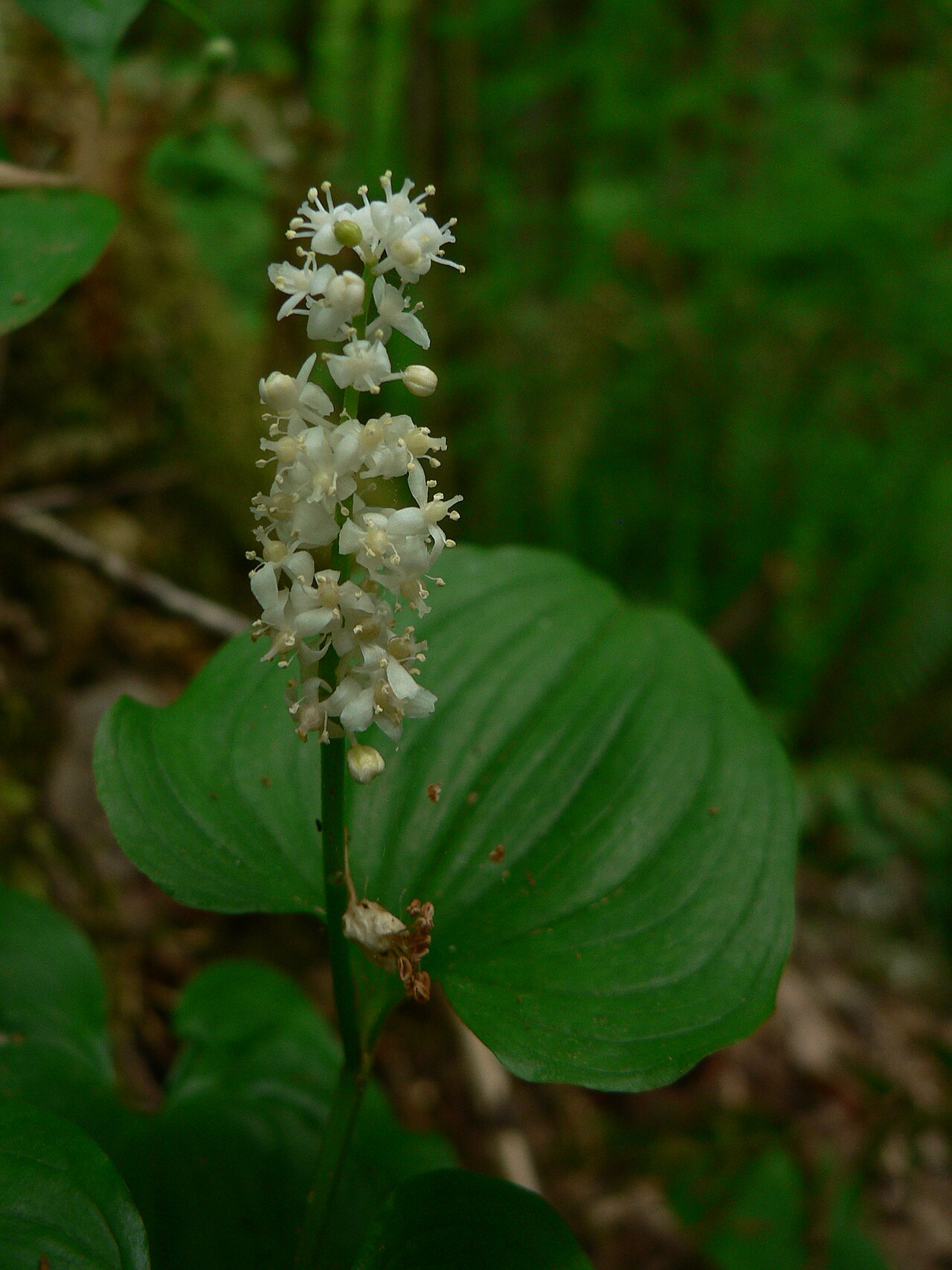
Maianthemum dilatatum, known as Western Lily of the Valley, false lily of the valley (the USDA name), two-leaved Solomon’s seal, snakeberry or deerheart, is a low, spreading woodland perennial of the Pacific Coast. From a network of slender underground rhizomes it raises carpets of glossy, heart-shaped leaves, and in late spring short spikes of tiny, fragrant white flowers rise just above them. The berries that follow are speckled at first and ripen to bright red in late summer.
Despite its common name, it is not a close relative of the European lily of the valley (Convallaria majalis), although both belong to the asparagus family (Asparagaceae) and share the same overall look of broad leaves and small white flowers. Its true relatives are the Canada mayflower (Maianthemum canadense) of eastern North America, the Eurasian May lily (M. bifolium) and the false Solomon’s seals once placed in Smilacina.
Western lily of the valley is one of the signature groundcovers of moist coastal forests from Alaska to northern California. Gardeners in the Pacific Northwest value it as a tough, evergreen-looking groundcover for shade, though it spreads vigorously and needs room. This guide covers identification, native range, care, and its place in the forest ecosystem.
Identification
Western lily of the valley is easy to identify in its range: a low plant with one to three glossy, deeply heart-shaped leaves and, in late spring, a short upright spike of tiny white flowers. It usually grows in dense colonies, with many single-leaved, non-flowering shoots among the flowering stems.
Rhizomes & Stems
The plant spreads by thin, branching rhizomes just below the soil surface, and a single plant can form a colony many feet across. Flowering stems are 4 to 14 inches tall, smooth and unbranched, often slightly zigzag. Non-flowering shoots produce just one leaf on a long stalk.
Leaves
Flowering stems normally carry two leaves, occasionally one or three. They are alternate, long-stalked, and broadly heart-shaped with a deep notch at the base, about 2 to 4 inches long on typical plants and larger in rich, damp soil. They are bright green, glossy, hairless and marked by curved parallel veins, which give them a slightly quilted look. In the Canada mayflower of the East, the leaves are smaller, nearly stalkless, and only shallowly notched.
Flowers
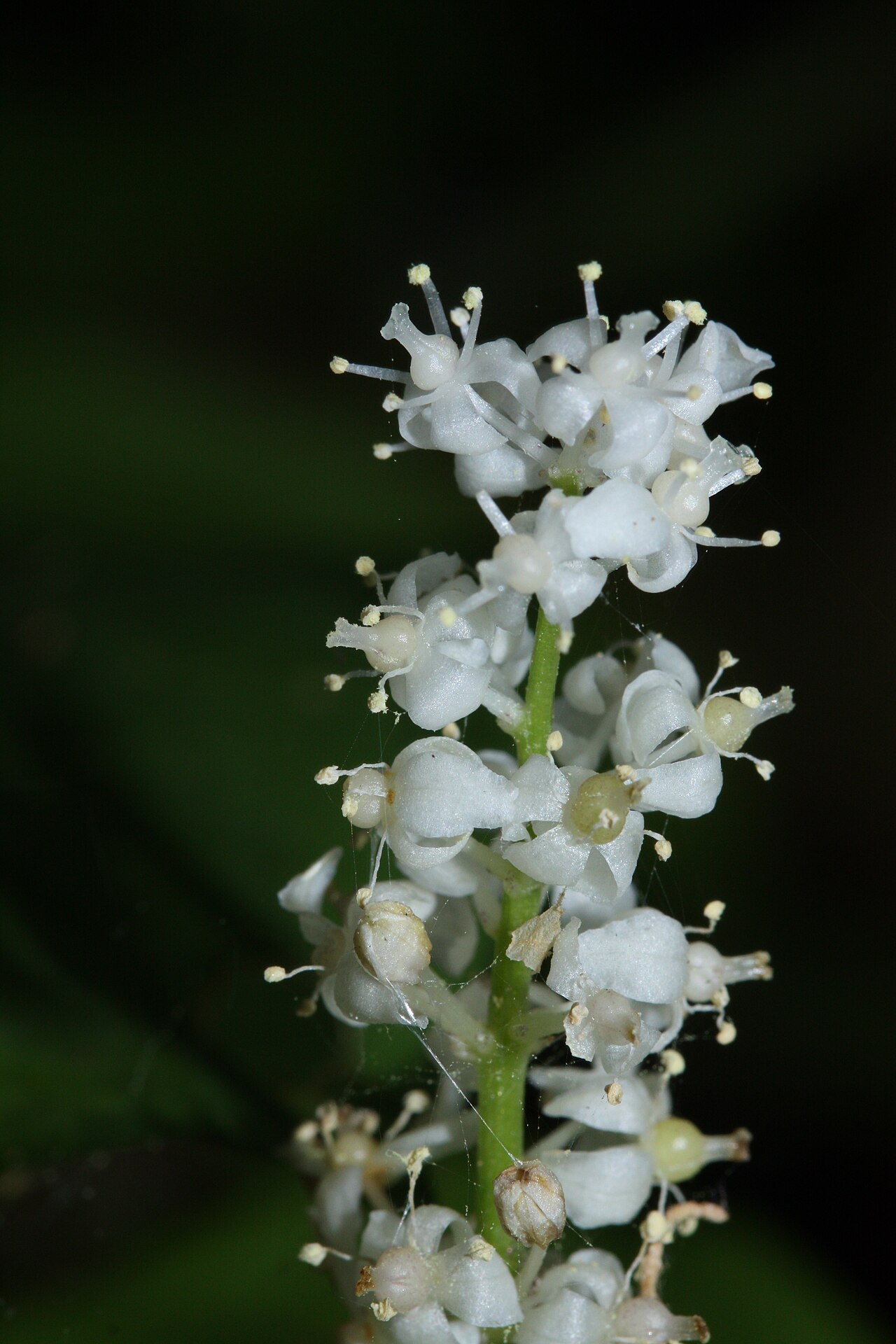
The flowers are borne in a dense raceme 1 to 2 inches long at the top of the stem in May and June (earlier on the coast, later in the mountains and Alaska). Each flower is about ¼ inch across, with four spreading white tepals and four stamens. That arrangement in fours is distinctive: most members of the lily alliance have flower parts in threes or sixes. The flowers have a light, sweet scent.
Fruit & Seeds
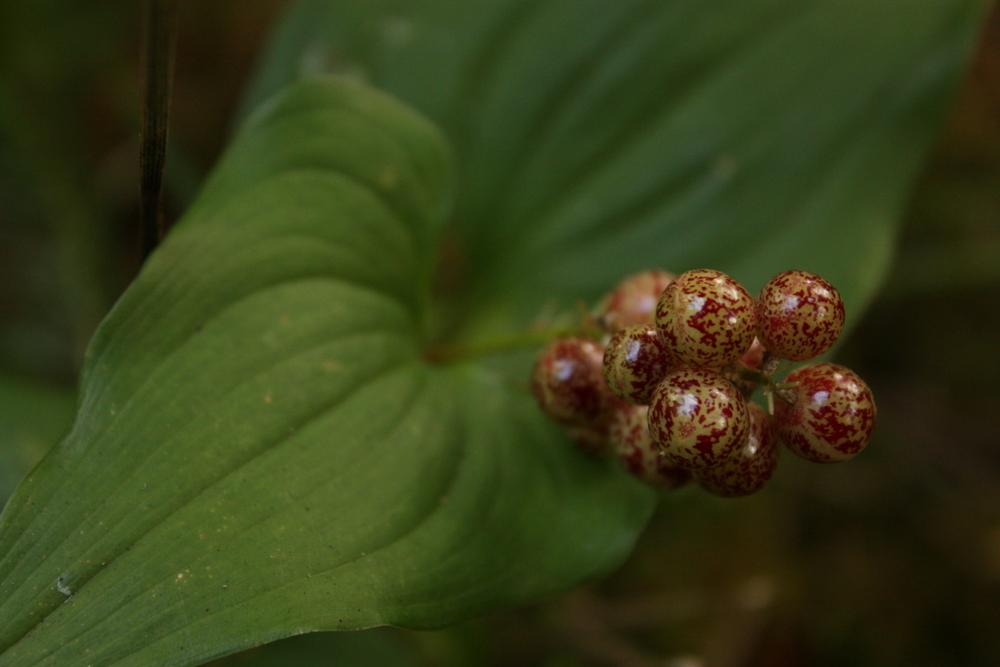
The fruits are round berries about ¼ inch across, carrying one or two seeds each. They are green at first, then speckled or mottled with brown, red and green through midsummer, and finally turn a translucent red by late summer. Their speckled look is the origin of the name snakeberry. The leaves die back in fall, and old fruiting stalks are often still visible in winter.
Quick Facts
| Scientific Name | Maianthemum dilatatum (syn. M. kamtschaticum, Unifolium dilatatum) |
| Family | Asparagaceae (asparagus family) |
| Plant Type | Herbaceous perennial groundcover from rhizomes |
| Mature Height | 4–14 in |
| Mature Spread | Spreads indefinitely by rhizomes, forming colonies |
| Growth Rate | Moderate to fast once established |
| Sun Exposure | Partial to full shade |
| Water Needs | Moderate to high; prefers consistently moist soil |
| Soil Type | Humus-rich loam, forest duff, moist sandy or rocky soils |
| Soil pH | Acidic (about 4.5–6.5) |
| Bloom Time | April–July (mostly May–June) |
| Flower Color | White |
| Fall Color | Leaves yellow and die back in fall |
| Fruit | Speckled berries ripening to red in late summer |
| Deer Resistant | Moderately; occasionally browsed |
| USDA Hardiness Zones | 4–9 |
Native Range
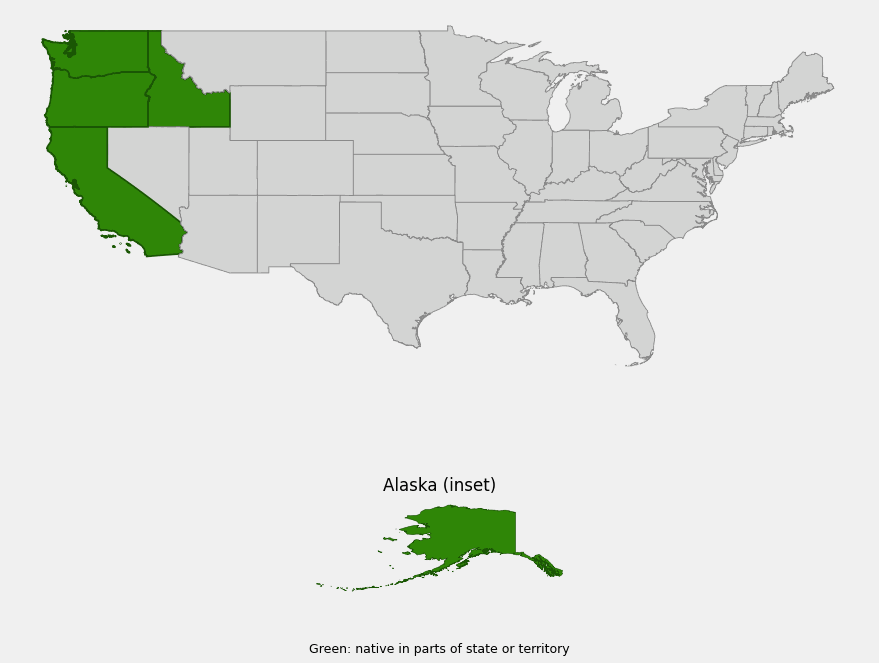
Western lily of the valley grows along the Pacific Rim of North America and Asia. In North America USDA PLANTS records it as native in Alaska, Washington, Oregon, California and Idaho, and in British Columbia. The Lady Bird Johnson Wildflower Center describes its range as northwestern North America from Alaska south to Marin County, California, and east to northern Idaho, as well as northeastern Eurasia. In Asia it grows in Japan, Korea, Sakhalin, the Kuril Islands and the Kamchatka Peninsula.
Its stronghold is the wet coastal forest belt: Sitka spruce, western hemlock and western redcedar forests from southeastern Alaska through British Columbia to the Olympic Peninsula and the Oregon Coast Range. It grows from sea level up into the lower mountains, and in Alaska it reaches the Aleutian Islands and the Kenai Peninsula. In California it is limited to cool, foggy coastal forests in the northwest of the state, south to Marin County.
Inland, it is uncommon east of the Cascade crest, with scattered populations in the moist cedar-hemlock forests of northern Idaho. Throughout its range it favors shady, damp places: stream banks, wet forest floors, seepy slopes, swamp edges and the shaded margins of bogs.
📋 Regional plant lists featuring Western Lily of the Valley: Idaho, Eastern Oregon & Eastern Washington · Alaska
Growing & Care Guide
Western lily of the valley is an excellent native groundcover for moist shade in the Pacific Northwest and coastal northern California. It is easy once established, but the Lady Bird Johnson Wildflower Center warns that it can be aggressive, so plant it where its spreading habit is welcome.
Light
Partial to full shade is ideal. It grows well under conifers and deciduous trees and on north-facing slopes. In cool coastal gardens it tolerates some morning sun, but in hot, sunny spots the leaves scorch and the plant struggles.
Soil & Water
Give it moist, humus-rich, acidic soil, such as forest duff, leaf mold or compost-amended loam. It tolerates seasonally wet ground and does well along streams and in rain gardens in shade. It does not like long summer droughts. In dry inland gardens, water regularly in summer and keep a layer of leaf mulch over the roots.
Planting Tips
Plant divisions or potted plants in fall or early spring, 12 to 18 inches apart. They will fill in within a few seasons. Combine it with ferns, trilliums, vanilla leaf and other woodland natives that can hold their own, rather than delicate small plants it might smother. If you need to limit its spread, use a deep edging or a path as a boundary.
Pruning & Maintenance
Very little maintenance is needed. Leave fallen leaves in place as mulch, which mimics the forest floor. Pull out runners that stray beyond where you want them. The foliage dies back in fall, and new leaves emerge in spring.
Propagation
Division is the easiest method: in early spring or fall, cut sections of rhizome with a few growing points and replant at the same depth. Seed is slow. Clean the pulp from ripe red berries and sow outdoors in fall; germination may take one to two years, and seedlings take several years to flower. Buy nursery-grown plants rather than digging from the wild.
Landscape Uses
- Shade groundcover: dense, glossy carpet under trees and shrubs
- Woodland and native gardens: pairs well with ferns, trilliums and other forest-floor natives
- Stream banks and rain gardens in shade: tolerates moist to seasonally wet soil
- Erosion control on shady slopes: rhizomes knit the soil together
- Wildlife gardens: berries for ground-feeding birds and small mammals
Wildlife & Ecological Value
In coastal forests, western lily of the valley is one of the most common plants of the forest floor, and its flowers and fruits are part of the everyday diet of many small forest creatures.
For Pollinators
The small, fragrant flowers attract small bees, syrphid flies and other flies, and beetles. Their open, shallow shape makes nectar and pollen easy for short-tongued insects to reach, so they are an important early-summer resource in shady forests where flowers can be scarce.
For Birds
Ruffed grouse, sooty grouse, thrushes and other ground-feeding birds eat the berries, which ripen in late summer and early fall when young birds are learning to forage. Birds also disperse the seeds.
For Mammals
Small mammals such as voles, deer mice and chipmunks eat the berries and seeds, and black-tailed deer and elk browse the leaves to some extent. The dense colonies also give cover to small creatures of the forest floor.
Ecosystem Role
The interlacing rhizomes stabilize soil on wet slopes and stream banks, and the dense leaf cover shades the soil and holds moisture. Western lily of the valley readily colonizes nurse logs, root wads and moss mats in old-growth forests, and it persists in second-growth forests, making it one of the most widespread and resilient members of the Pacific Northwest forest-floor community.
Cultural & Historical Uses
The genus name Maianthemum combines the Latin Maius, May, with the Greek anthemon, flower, for the season of bloom, and dilatatum means “widened,” for the broad leaves. The plant was first described from North American material in the nineteenth century as a variety of the Eurasian May lily, and some botanists still treat the Asian and American plants under different names, such as M. kamtschaticum.
Pojar and MacKinnon’s Plants of the Pacific Northwest Coast notes that the berries are edible but were seldom highly regarded by Indigenous peoples of the coast, who gathered them occasionally rather than as a staple. Ethnobotanists have also recorded occasional medicinal uses of the leaves. Because the berries are bland and can be confused with toxic plants, they are best left for wildlife.
For many visitors to the rainforests of the Olympic Peninsula, Vancouver Island and southeast Alaska, the bright green carpets of “deerheart” leaves under towering conifers are one of the defining sights of the forest floor. The National Park Service uses the name “deer heart” for it in some of its materials.
Frequently Asked Questions
Is western lily of the valley the same as lily of the valley?
No. The garden lily of the valley (Convallaria majalis) is a European plant with nodding, bell-shaped flowers and poisonous berries. Western lily of the valley (Maianthemum dilatatum) has tiny, upright, star-shaped flowers in fours and is a separate native species of the Pacific Coast.
Are the berries edible?
Regional guides describe the berries as edible but not very palatable, and they were not a significant food. Since they can be confused with toxic berries, it is safest not to eat them and to leave them for birds and small mammals.
Is western lily of the valley invasive?
It is native, not invasive, in the Pacific Northwest, but it can spread aggressively in moist shade. Give it a defined space or plant it with other vigorous groundcovers. In very dry or sunny gardens it rarely becomes a problem.
How is it different from Canada mayflower?
Canada mayflower (Maianthemum canadense) of eastern and boreal North America is smaller, with leaves that are nearly stalkless and only slightly notched at the base. Western lily of the valley has larger, long-stalked, deeply heart-shaped leaves and grows along the Pacific Coast.
Does it grow well in gardens?
Yes, in moist, shady gardens within or near its native range. It thrives in leaf-rich, acidic soil under trees and is one of the easiest native groundcovers for Pacific Northwest woodland gardens.

Looking for a nursery that carries Western Lily of the Valley?
Browse our native plant nursery directory: Alaska · California · Idaho · Oregon · Washington