
Spotted Coralroot (Corallorhiza maculata)
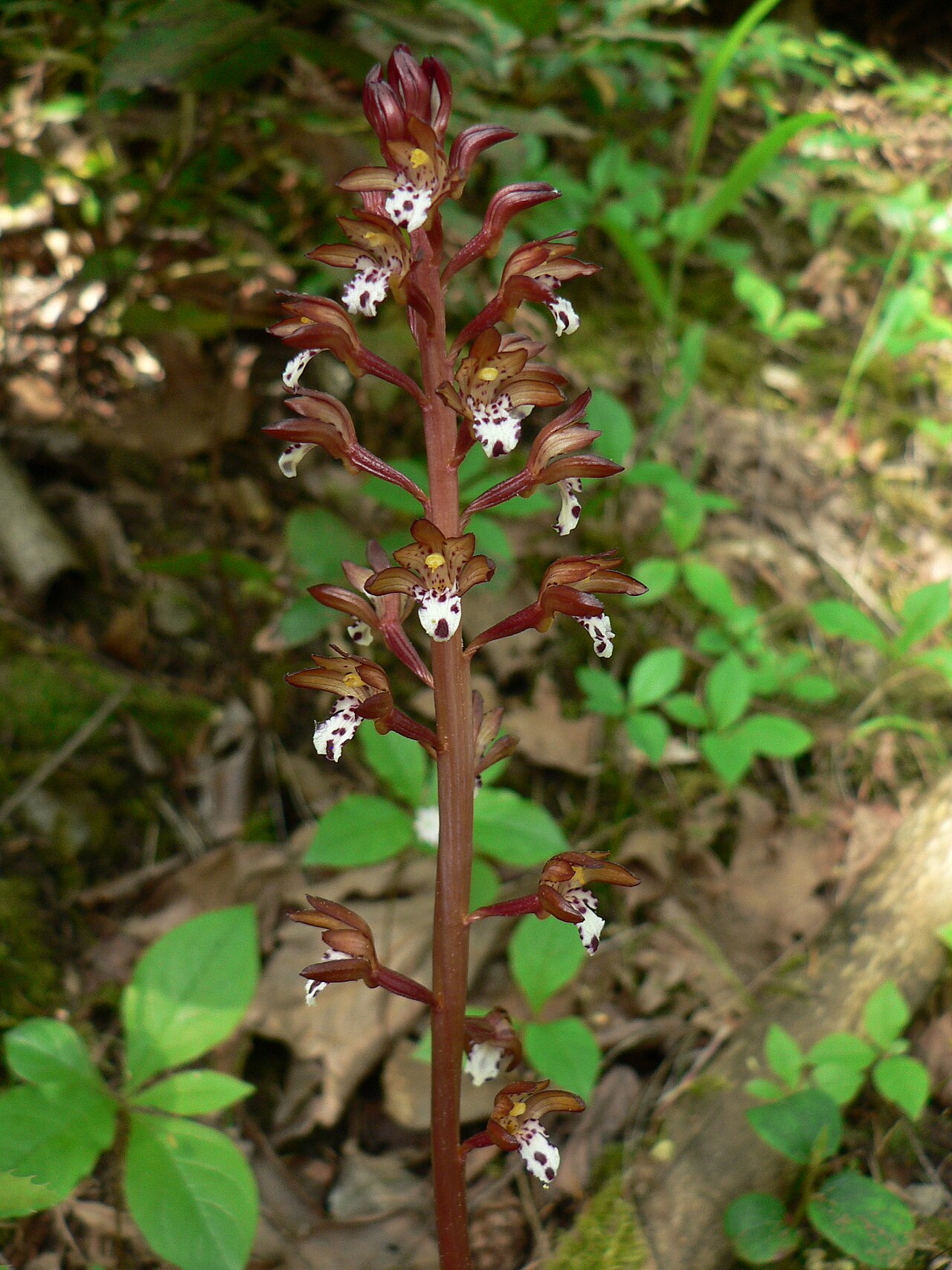
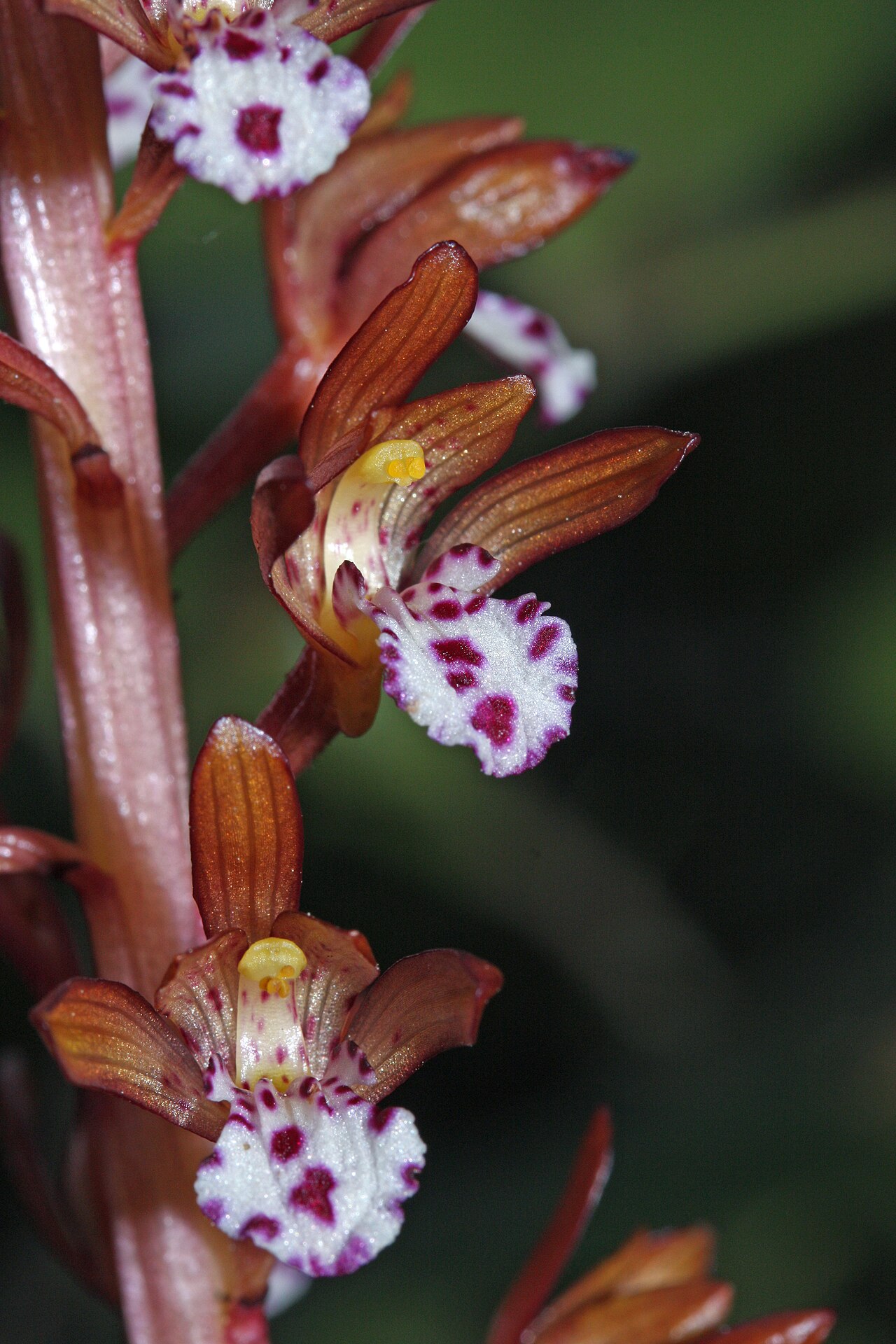
Corallorhiza maculata, known as Spotted Coralroot (USDA PLANTS calls it summer coralroot), is a leafless native orchid of shady forests across much of North America. In late spring and summer a slender stem, usually 8 to 20 inches tall, rises from the leaf litter carrying 10 to 30 or more small orchid flowers. The stem and most of each flower are reddish purple, brown or yellowish, but the lip is white and boldly spotted with crimson, a detail best seen up close. It is the most widespread and common coralroot in North America.
Like most coralroots, spotted coralroot has no green leaves and almost no chlorophyll. It is a mycoheterotroph: it lives on sugars supplied by fungi, mainly species of Russula, that also form mycorrhizae with the roots of nearby trees. Instead of true roots it has a branching underground rhizome that looks like a small piece of coral, which gives the genus its name (Corallorhiza, “coral root”).
Spotted coralroot cannot be grown from nursery stock or transplanted, and it should never be dug up. Without its fungal partners and their host trees, the plant starves. This page is a guide to identifying and appreciating spotted coralroot in the wild and protecting the forests where it grows.
Identification
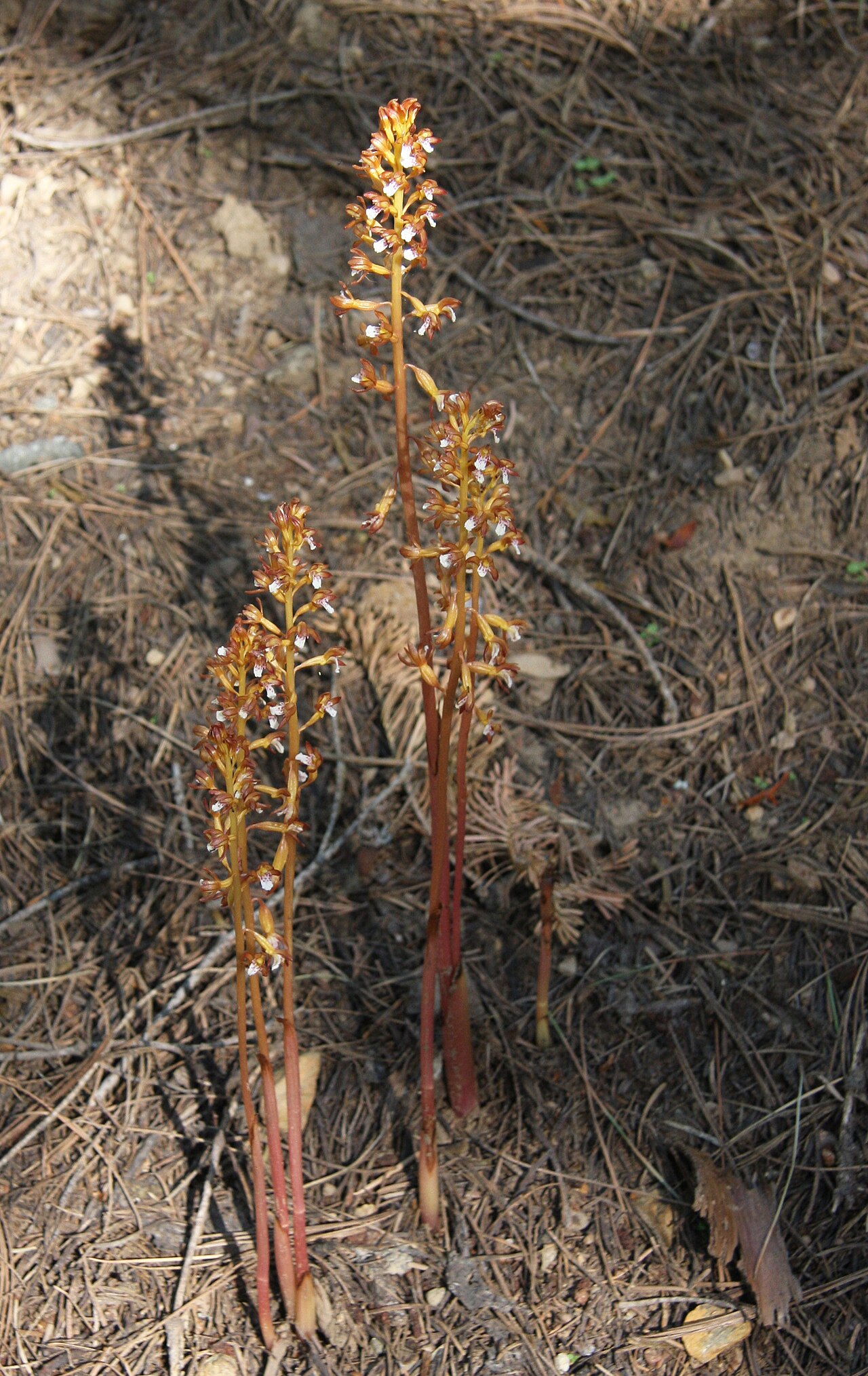
Several coralroots grow in North America, and all are leafless orchids with small flowers on a colored stem. Spotted coralroot is recognized by its summer bloom time, its fairly large number of flowers, and above all its white lip with red to purple spots. Not every plant is spotted, though: unspotted, yellowish plants occur in many populations.
Stems & Rhizome
Above ground the plant is just a flowering stem, 8 to 20 inches tall and occasionally taller, smooth and slightly fleshy. Its color ranges from deep reddish purple to brown, tan or yellow. A few tubular, sheathing scales near the base are all that remain of its leaves. Below ground a branched, coral-like rhizome lies in the humus, closely tied to fungal threads. Several stems often rise from the same rhizome, forming clumps.
Leaves
There are no leaves apart from the sheathing scales on the stem. The plant contains very little chlorophyll, and studies indicate that it gets nearly all of its carbon through its fungal partners rather than through photosynthesis.
Flowers
The flowers are arranged in a loose spike along the upper part of the stem. Each is about half an inch across. The three sepals and two upper petals are narrow, colored like the stem, and form a hood over the column. The lip, which hangs below, is white with two small side lobes and a broad, wavy central lobe, and is usually covered in crimson to purple spots. In unspotted forms the lip is pure white and the plant is yellow. Bloom time runs from about May to August, depending on latitude and elevation.
Fruit & Seeds
Each fertilized flower becomes a drooping, oval capsule about half an inch long. Fruit set is often high, because the flowers can pollinate themselves when insects do not visit. The capsules split to release thousands of dust-like seeds, which can only germinate if they meet a compatible fungus. Dry stalks with empty capsules may remain standing for weeks after flowering.
Similar Species
Early coralroot (C. trifida) is smaller, yellow-green, and blooms in spring with few flowers and an unspotted or faintly spotted lip. Striped coralroot (C. striata) has larger flowers with bold purple stripes rather than spots. Autumn coralroot (C. odontorhiza) blooms in late summer and fall, and its tiny flowers often barely open.
Quick Facts
| Scientific Name | Corallorhiza maculata (Raf.) Raf. |
| Family | Orchidaceae (orchid family) |
| Plant Type | Mycoheterotrophic terrestrial orchid; perennial from a coral-like rhizome |
| Mature Height | 8–20 in (occasionally to about 30 in) |
| Mature Spread | Single stems or small clumps a few inches across |
| Growth Rate | Stems emerge and flower within a few weeks |
| Sun Exposure | Shade to partial shade of forest; not cultivated |
| Water Needs | Not applicable (wild plant); grows in moist to fairly dry forest soils |
| Soil Type | Humus-rich forest soils and deep litter |
| Soil pH | Acidic to near-neutral |
| Bloom Time | May–August |
| Flower Color | Reddish purple, brown or yellow, with a white lip spotted crimson |
| Fall Color | None; stems wither after fruiting |
| Fruit | Drooping oval capsule with dust-like seeds |
| Deer Resistant | Occasionally browsed; not a garden plant |
| USDA Hardiness Zones | Not cultivated; wild populations in roughly zones 2–8 |
Native Range
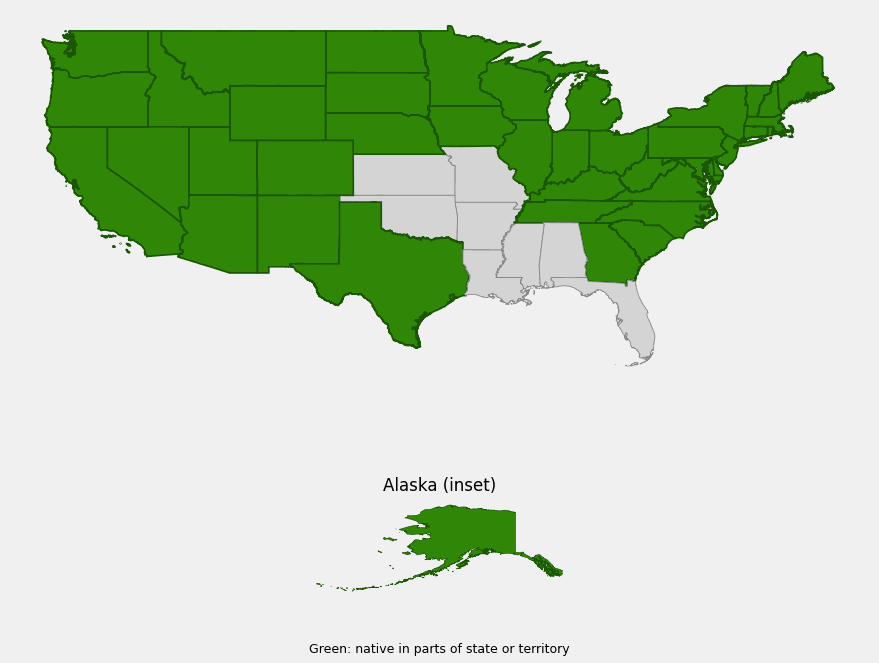
Spotted coralroot has a broad range across temperate and northern North America. USDA PLANTS records it as native in 41 states, including Alaska, and in Canada from British Columbia and Alberta east to Newfoundland and Labrador, as well as Saint Pierre and Miquelon. In the West it grows from Alaska south through the Cascades, Sierra Nevada and Rocky Mountains to Arizona, New Mexico and the mountains of west Texas, and it continues south into the mountains of Mexico.
In the East it is most common in the northern forests of New England, New York, the Great Lakes states and southern Canada, and extends south along the Appalachians to North Carolina, South Carolina, Tennessee and Georgia. It is absent from most of the Southeast Coastal Plain and the lower Mississippi Valley, and in the central Plains it reaches only forested areas such as the Black Hills and northern Nebraska.
Within this range it is a forest plant, found in dry to moist conifer, mixed and hardwood forests, especially where there is a deep layer of needles or leaves. In the West it is often common under pines, firs and Douglas-fir. Its abundance varies from year to year, and in good years a single forest may hold hundreds of stems.
📋 Regional plant lists featuring Spotted Coralroot: New York, Pennsylvania & Northern New Jersey · Idaho, Eastern Oregon & Eastern Washington · Ohio & Indiana · Montana & Wyoming · Michigan, Wisconsin & Eastern Minnesota · Kentucky & Tennessee · Nebraska, Kansas & Eastern Colorado · Utah & Western Colorado · Connecticut, Massachusetts & Rhode Island · New Hampshire, Maine & Vermont · Maryland, Virginia & West Virginia · Delaware, Southern New Jersey & Long Island · Arizona & New Mexico · Illinois, Iowa & Missouri · Alabama, Georgia & Mississippi · Alaska
Growing & Care Guide
Spotted coralroot cannot be grown in gardens. No nursery can propagate it, and transplanted plants die because they are cut off from the fungi that feed them. Wild orchids are also protected by law in some states. The sections below cover how to find and enjoy spotted coralroot in the wild and how to protect its forest habitat.
Light
Look for spotted coralroot in shady to partly shaded forest. It does not need sunlight to grow, but it depends on healthy trees, so it is found under a forest canopy rather than in open clearings. The flowers are small, so get down low and use a hand lens or close-focus lens to see the spotted lips.
Soil & Water
It grows in humus-rich soil with a layer of needles or leaves, in both dry and moist forests. Stems often appear after a wet spring and may be scarce in drought years. Avoid trampling or compacting the forest floor where it grows, and leave the litter layer in place.
Planting Tips
Do not try to plant, transplant or sow spotted coralroot. If it grows on your land, protect the trees around it, since its fungal partners depend on them. Plan trails, firewood cutting and construction to avoid known colonies.
Pruning & Maintenance
No pruning or maintenance is needed. Leave stems standing so their capsules can ripen and release seed. Do not pick the flowering stems: each one is the plant’s whole seed crop for the year.
Propagation
Spotted coralroot reproduces by dust-like seed and by slow branching of its rhizome. Its seeds require a specific fungus to germinate, and there is no practical way to raise it. The best way to help it is to keep mature forests and their soils intact.
Landscape Uses
- Wildflower walks: a frequent summer find in western conifer forests and northern woods
- Macro photography: the spotted lips are a striking close-up subject
- Orchid study: one of the easiest native orchids to see in the wild
- Forest ecology education: a clear example of a plant that feeds through mycorrhizal fungi
- Citizen science: records help track its status where it is rare, such as at the southern edge of its eastern range
Wildlife & Ecological Value
Spotted coralroot is a small part of the forest community, but it is a visible link in the underground network that connects trees and fungi.
For Pollinators
The flowers produce little or no nectar. Small bees and flies visit them, but many flowers pollinate themselves, so the plant does not depend heavily on insects. This helps explain why it sets seed reliably even in deep shade where pollinators are few.
For Birds
Spotted coralroot has no direct food value for birds. The forests where it grows support many birds, including warblers, thrushes, nuthatches and grouse.
For Mammals
Deer and small mammals may occasionally nibble the stems. More importantly, the Russula fungi it depends on produce mushrooms that are eaten by squirrels, deer and other forest mammals.
Ecosystem Role
Spotted coralroot takes sugars from Russula fungi, which receive them from the trees they partner with. Research on coralroots has shown that each species and even each regional population tends to use a narrow set of fungal partners. Healthy coralroot colonies are therefore a sign of a mature forest with intact soil and diverse mycorrhizal fungi.
Cultural & Historical Uses
Constantine Rafinesque described spotted coralroot in the early 1800s, and its current name, Corallorhiza maculata, dates from his work in 1817. The species name maculata means “spotted”. Botanists recognize several varieties, including var. maculata and var. occidentalis, which differ in flower shape and bloom time, and recent genetic studies suggest the species is more complex than once thought.
Some Native American peoples of the West used coralroots in traditional medicine, and coralroot rhizomes appear in older herbal literature. These uses are historical. Harvesting wild orchids is harmful and, in some states, illegal.
For many hikers, spotted coralroot is their first wild orchid, and it is common enough in western forests that it is often seen on popular trails. In parts of the East where it is uncommon, it is a prized find for wildflower enthusiasts. Photographs and location records are the best way to share it.
Frequently Asked Questions
Is spotted coralroot really an orchid?
Yes. It is a member of the orchid family, with typical orchid flowers that have a distinct lip and a central column. It simply lacks green leaves because it gets its food from fungi instead of sunlight.
Can I grow spotted coralroot in my garden?
No. It cannot be grown from nursery stock or transplanted, and it should never be dug up. It depends completely on specific soil fungi and the trees they are connected to. Enjoy it in the wild and protect the forest where it grows.
Why is it called coralroot?
Instead of normal roots, it has a branching underground rhizome that looks like a piece of coral. The genus name Corallorhiza means “coral root”.
Are all spotted coralroots spotted?
No. Some plants have pure white lips without spots, and these usually have yellow stems and flowers. They grow in many populations alongside spotted plants.
When does spotted coralroot bloom?
Mostly from May to August. It blooms earliest at low elevations and in the southern part of its range, and latest in the high mountains and the far north. In much of the East it flowers in early to midsummer.

Looking for a nursery that carries Spotted Coralroot?
Browse our native plant nursery directory: Alaska & Arizona · California · Colorado, Connecticut, Delaware & Georgia · Idaho, Illinois, Indiana & Iowa · Kentucky, Maine, Maryland, Massachusetts, Michigan, Minnesota & Montana · Nebraska, Nevada, New Hampshire, New Jersey, New Mexico, New York, North Carolina, North Dakota & Ohio · Oregon · Pennsylvania, Rhode Island, South Carolina, South Dakota, Tennessee, Texas, Utah, Vermont & Virginia · Washington · West Virginia, Wisconsin & Wyoming