
Wild Plantain (Heliconia bihai)
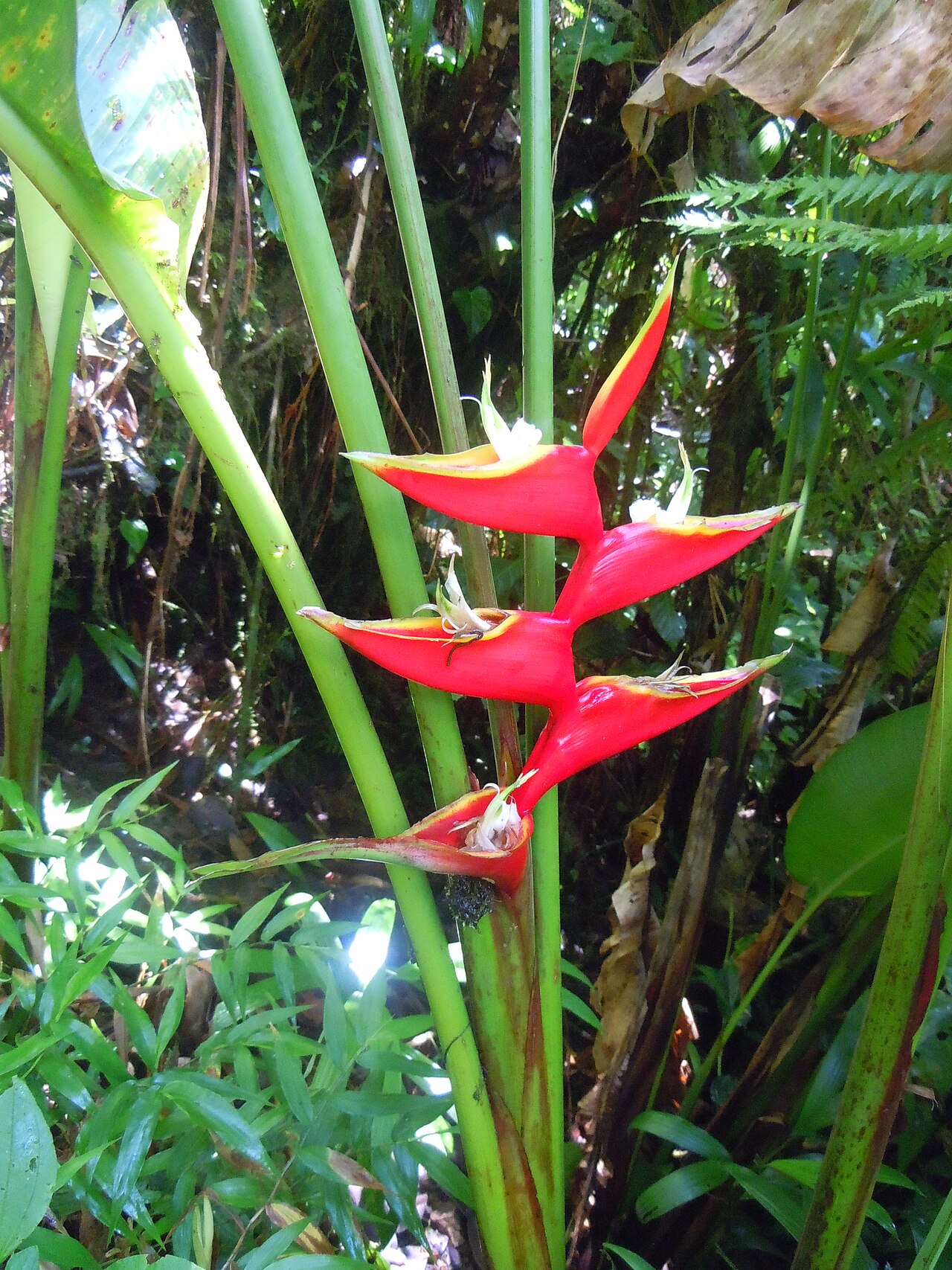
Heliconia bihai, the Wild Plantain, is a giant, banana-like herb with one of the most striking flower spikes in the tropics. USDA PLANTS calls it macawflower, and it is also known as red palulu and lobster claw. In Trinidad and the French Antilles it is the balisier, and across Spanish-speaking Latin America it is widely called bijao. It is native to Puerto Rico, the Lesser Antilles, Hispaniola and northern South America.
The plant grows in spreading clumps of tall, paddle-shaped leaves on long stalks, much like a small banana plant, which is where “wild plantain” comes from. The show is the inflorescence: an upright zigzag of stiff, boat-shaped bracts, usually red with yellow and green edges and keels. The real flowers are small and greenish, tucked inside the bracts, and they are built for hummingbirds.
This guide covers how to identify wild plantain and tell it from its close relative, the Caribbean heliconia, where it grows in Puerto Rico and the wider Caribbean, how to grow it in a frost-free garden, why hummingbirds love it, and its role as a political symbol in the Caribbean.
Identification
Heliconias are easy to recognize as a group: banana-like leaves, and flowers hidden inside bright, stiff bracts. Telling Heliconia bihai from other species takes a look at the bracts, the spike and the overall size of the plant.
Growth Form
A large evergreen herb that grows from creeping underground rhizomes and forms dense clumps. What looks like a stem is a pseudostem of tightly rolled leaf sheaths, as in a banana. Plants commonly reach 6 to 15 feet (2 to 4.5 m), and vigorous clumps in rich, wet soil can grow taller.
Leaves
The leaves are huge and paddle-shaped, roughly 3 to 4 feet (90 to 120 cm) long and 8 to 12 inches (20 to 30 cm) wide, on long stalks, arranged in two ranks like a fan. As in bananas, wind often tears the blades along the side veins into strips.
Inflorescence
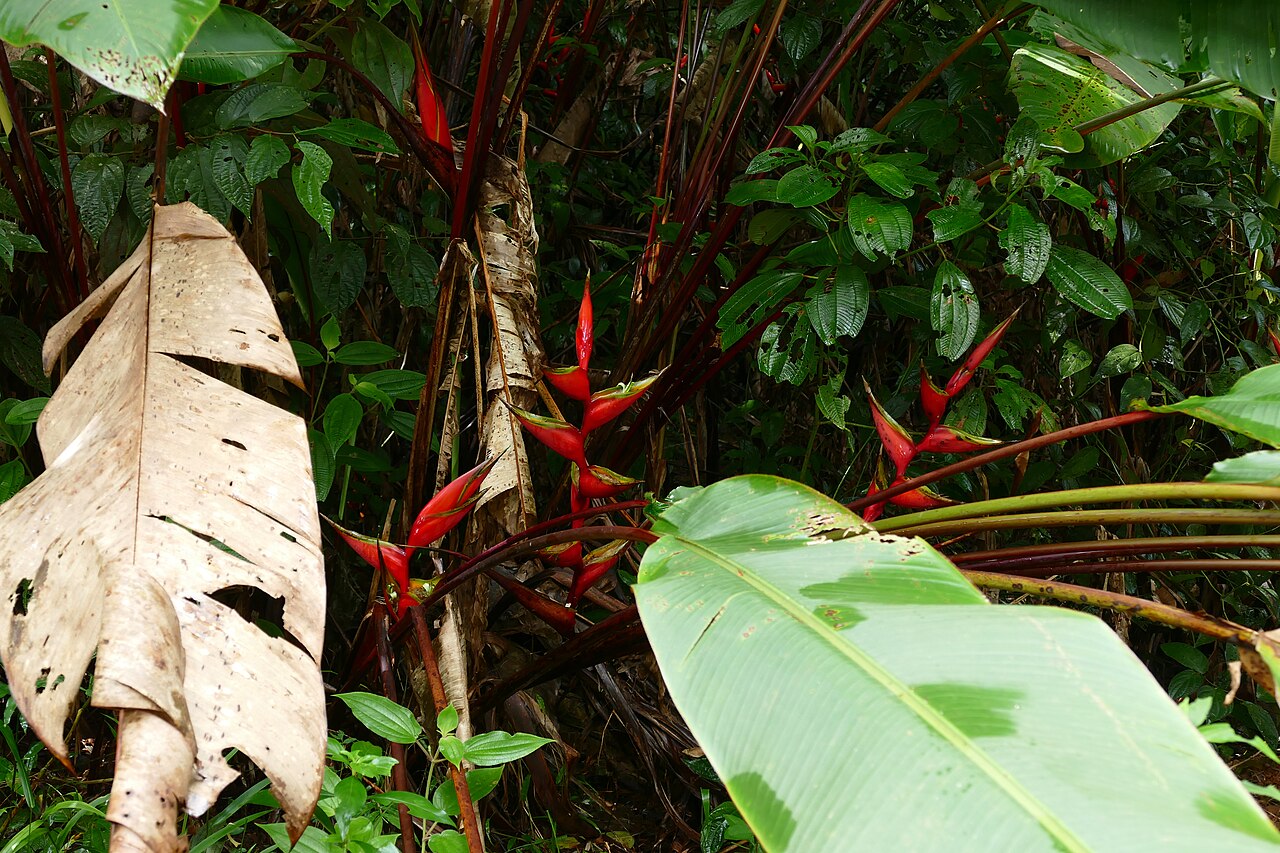
The flower spike is upright, not hanging, on a stalk about 6 to 20 inches (15 to 50 cm) long. It carries a zigzag series of stiff, boat-shaped bracts that are broad at the base and taper to a long point, all pointing up and outward. They are usually red with green or yellowish edges and keels, sometimes almost entirely red or yellowish. The bracts hold water and nectar-rich flowers and stay colorful for weeks.
Flowers and Fruit
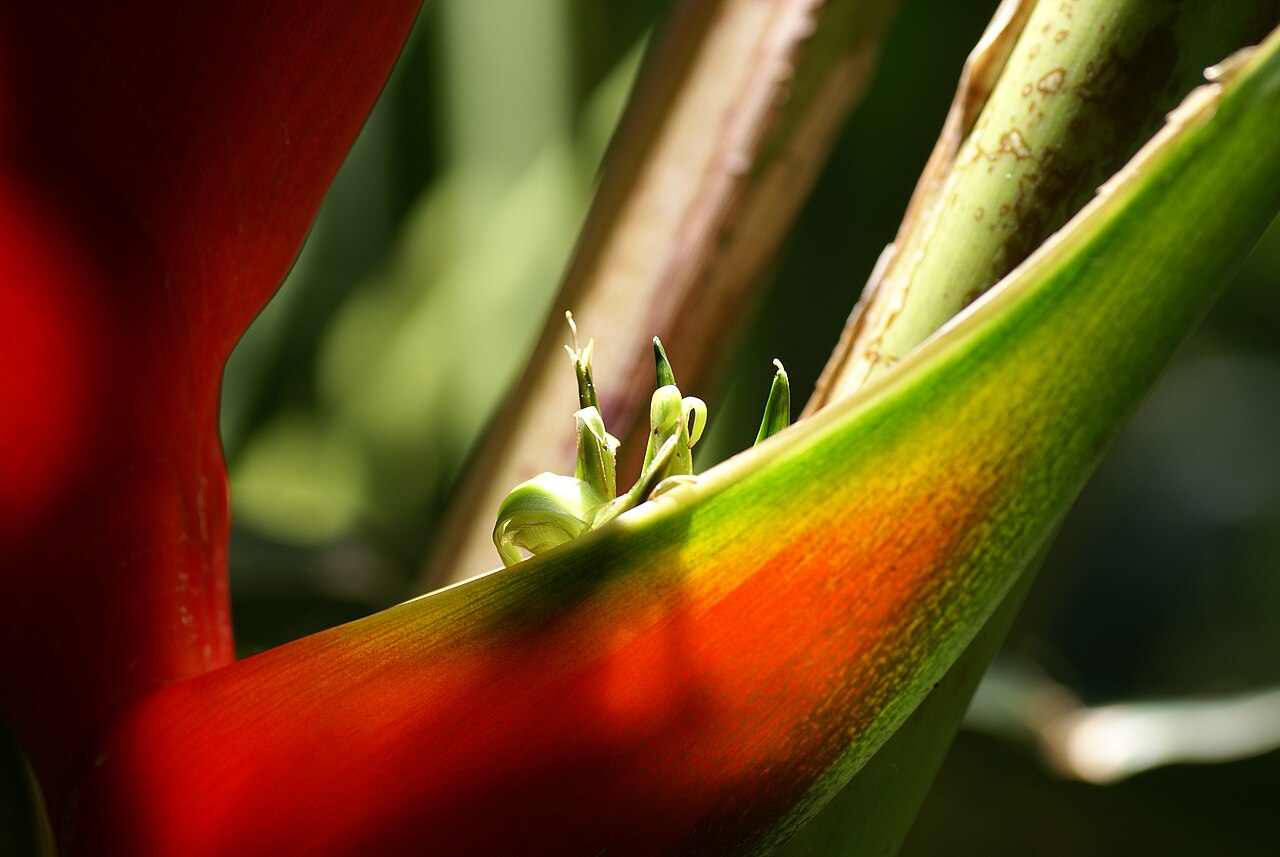
Inside each bract a series of small, curved, tubular flowers about 1½ to 2½ inches (4 to 6 cm) long open one or two at a time. They are greenish to whitish. The fruit is an oblong drupe about ⅝ inch (1.5 cm) long that turns blue when ripe and holds up to three hard seeds.
Quick Facts
| Scientific Name | Heliconia bihai (L.) L. (syn. Heliconia humilis, Bihai bihai, Musa bihai); USDA common name: macawflower |
| Family | Heliconiaceae (heliconia family) |
| Plant Type | Large evergreen clumping herb |
| Mature Height | 6–15 ft |
| Mature Spread | Clumps 4–10 ft wide, spreading by rhizomes |
| Growth Rate | Fast |
| Sun Exposure | Full sun to partial shade |
| Water Needs | High; keep consistently moist |
| Soil Type | Rich, moist, well-drained organic soil |
| Soil pH | Slightly acidic to neutral |
| Bloom Time | Mostly in the warm, wet months; sporadic year-round |
| Flower Color | Red bracts edged yellow-green; greenish flowers |
| Fall Color | None; evergreen |
| Fruit | Oblong drupe about ⅝ in long, blue when ripe |
| Deer Resistant | Not applicable in Puerto Rico |
| USDA Hardiness Zones | 10–12; top killed by frost |
Native Range
USDA PLANTS lists Heliconia bihai as native to Puerto Rico. The Smithsonian flora of the West Indies records it as native in Puerto Rico, Hispaniola (including Haiti and Gonâve) and through the Lesser Antilles, on Antigua, Dominica, Martinique, Montserrat, Saba, St. Eustatius, St. Kitts, St. Lucia and St. Vincent, and in northern South America. Other sources add Jamaica, Trinidad, Venezuela, Colombia and the Guianas. USDA also lists it in Hawaii, but there it is an introduced ornamental, not a native plant.
Wild plantain is a plant of moist and wet tropical forest. It grows in light gaps, along streams and ravines, at forest edges and in clearings and roadsides where enough light reaches the ground. In Puerto Rico, most records come from the wet forests of the Luquillo Mountains around El Yunque, with scattered records elsewhere in the moist uplands of the interior.
It is not listed under the U.S. Endangered Species Act. Because heliconias are so widely planted, some heliconias seen along Puerto Rican roads are garden escapes or cultivated hybrids rather than wild H. bihai. If you want the native species, buy from a nursery that sells it under its scientific name and can tell you its origin.
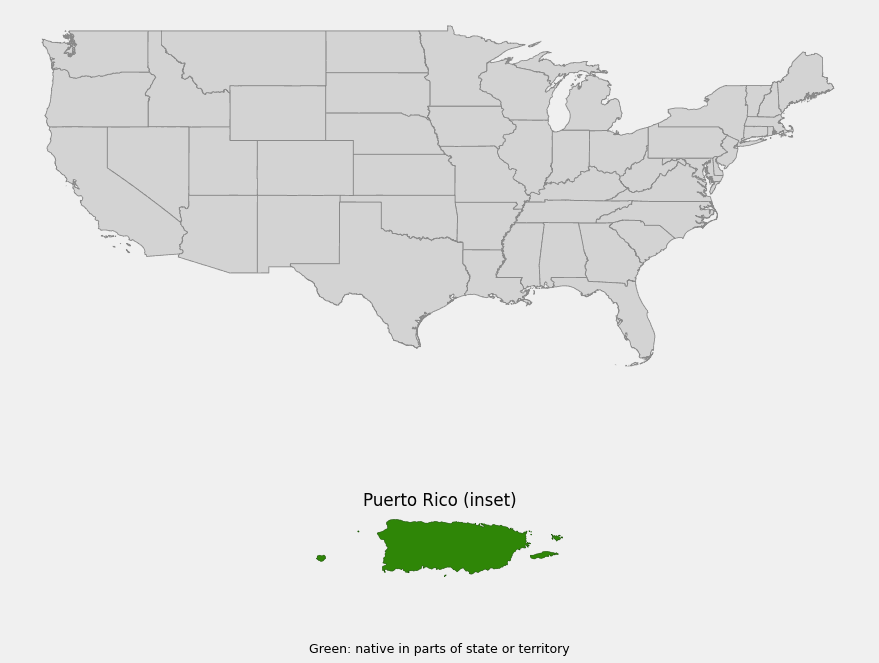
📋 Regional plant lists featuring Wild Plantain: Puerto Rico
Growing & Care Guide
Wild plantain is easy to grow where it is warm and wet, and it fills space fast. Give it rich soil, steady water and room to spread, and it will produce flower spikes for most of the year. In Puerto Rico it does best in the wetter north and the uplands; on the dry south coast it needs regular irrigation. On the mainland it can grow outdoors only in frost-free areas, essentially South Florida, where frost cuts it to the ground. Elsewhere it is a large container plant for a heated greenhouse or conservatory.
Light
Plant in full sun to partial shade. Plants in full sun flower most heavily, as long as they never dry out. In deeper shade they stay green and leafy but bloom less, and the leaves grow larger and softer.
Soil & Water
Use rich, moist, well-drained soil with plenty of organic matter, slightly acidic to neutral. Water generously; heliconias wilt quickly in drought. A thick mulch of leaves or compost helps hold moisture and feeds the shallow rhizomes. Avoid standing water around the rhizomes, which can rot.
Planting Tips
Plant rhizome divisions or potted plants just below the soil surface, in a spot sheltered from strong wind, which shreds the leaves. Allow at least 4 to 6 feet between clumps, and keep it away from narrow beds and paths, because the rhizomes spread steadily. It looks best as a backdrop along a stream, a shaded wall or a woodland edge.
Pruning & Maintenance
Each shoot flowers once. After the bracts fade, cut that shoot down to the ground to make room for new ones. Remove brown and badly torn leaves. Feed regularly through the warm season with a balanced fertilizer or compost; heliconias are heavy feeders. Divide crowded clumps every few years.
Propagation
Divide the rhizomes: cut a section with one or two healthy shoots, trim the leaves back to reduce water loss, and replant at the same depth. Plants can also be raised from seed, but germination is slow and irregular, often taking months, so division is the usual method.
Landscape Uses
- Hummingbird gardens: the tubular flowers are designed for hummingbird bills
- Tropical borders: bold, banana-like foliage and long-lasting color
- Stream banks and rain gardens: thrives in moist soil and humid air
- Cut flowers: the stiff bracts last a long time in arrangements
- Wet-forest restoration edges: a native gap and edge plant for moist Puerto Rican forest
Wildlife & Ecological Value
Heliconias are one of the classic examples of plants and hummingbirds evolving together, and Heliconia bihai is the species in which that relationship has been studied most closely in the Caribbean.
For Pollinators
The curved, tubular flowers hide their nectar at the base of the tube, where only long-billed birds can reach it. On the Lesser Antillean islands of Dominica and St. Lucia, research has shown that H. bihai flowers closely match the long, curved bill of the purple-throated carib, a hummingbird found in the Lesser Antilles. In Puerto Rico, the island’s native hummingbirds visit heliconia flowers for nectar.
For Birds
The ripe blue fruits are eaten by birds, which disperse the seeds. The dense, leafy clumps provide shelter and nesting cover for small birds in forest edges and gardens.
For Mammals
Bats are Puerto Rico’s only native land mammals. In the American tropics, some bats roost under large heliconia leaves, but in Puerto Rico wild plantain is mainly a bird and insect plant.
Ecosystem Role
The upturned bracts hold rainwater, creating small pools that support aquatic insect larvae and other tiny organisms, and that birds and insects drink from. As a fast-growing gap plant, wild plantain helps cover open ground after a tree fall or landslide in wet forest.
Cultural & Historical Uses
The genus name refers to Mount Helicon in Greece, home of the Muses in Greek mythology. It is a botanical pun: heliconias are close relatives of the bananas, genus Musa. Linnaeus first placed this plant in the banana genus as Musa bihai before moving it to Heliconia.
The balisier is a political emblem in the Caribbean. It is the symbol of the People’s National Movement, one of the two main political parties of Trinidad and Tobago, and of the Martinique Progressive Party in Martinique.
Across tropical America, the large leaves of bijao are used to wrap tamales and other foods for cooking, as banana leaves are. The upright, long-lasting bracts also make heliconias favorites of the cut-flower trade, and many named selections and hybrids of H. bihai are sold under names like “Lobster Claw.”
Frequently Asked Questions
How is wild plantain different from the Caribbean heliconia?
Both are large, native Caribbean heliconias with upright bracts. Caribbean Heliconia (Heliconia caribaea) usually has broader, waxier bracts that are solid red or solid yellow. Heliconia bihai bracts are usually narrower and longer-pointed, and red edged with yellow and green. The two hybridize, and many garden plants are hybrids.
Is it native to Hawaii?
No. It is widely planted in Hawaii and listed there by USDA as introduced. Its native range is Puerto Rico, the rest of the Caribbean and northern South America.
Can I grow it outside the tropics?
Only in frost-free areas, essentially South Florida. Frost kills the leaves and shoots, although established rhizomes may resprout after a light freeze. Elsewhere, grow it in a large container in a heated greenhouse.
Why are my plant’s leaves torn?
Torn leaves are normal for heliconias, as in bananas. Wind splits the large blades along the side veins. It does not harm the plant, but planting in a sheltered spot keeps the foliage neater.
How long do the flower spikes last?
A single spike stays colorful for several weeks, because the stiff bracts last long after the individual flowers have finished. The bracts can also be cut for arrangements.

Looking for a nursery that carries Wild Plantain?
Our nursery directory does not yet include Puerto Rico. Browse the native plant nursery directory by state: Alabama–Arkansas · California · Colorado–Hawaii · Idaho–Kansas · Kentucky–Montana · Nebraska–Oklahoma · Oregon · Pennsylvania–Virginia · Washington · West Virginia–Wyoming