Woodland Spiderlily (Hymenocallis occidentalis)
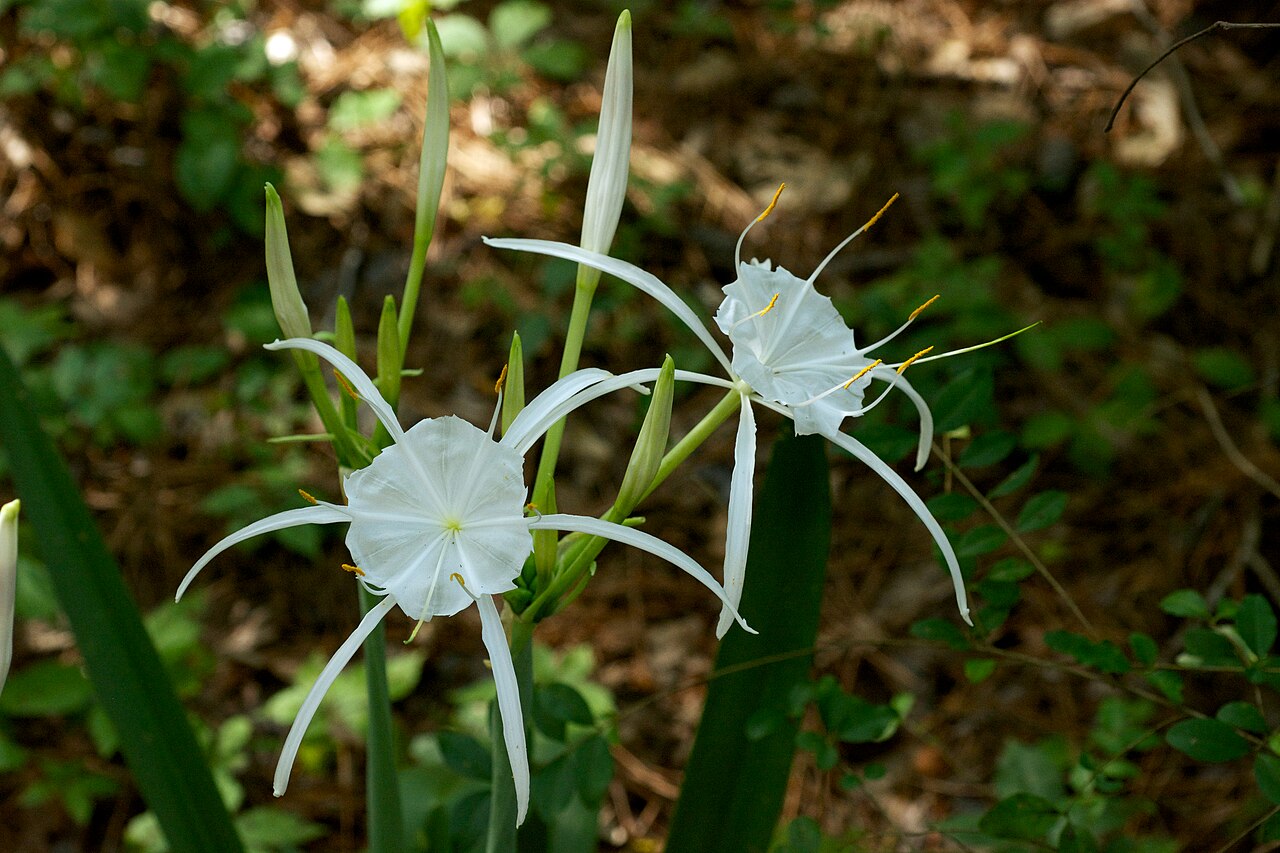
Woodland spiderlily makes a surprisingly delicate display for a native bulb. A white central cup is surrounded by long, narrow flower segments that reach outward like the spokes of a fine wheel. The flowers stand on a leafless stalk above, or sometimes after, a clump of strap-shaped foliage. Their intricate appearance can suggest an exotic greenhouse plant, but Hymenocallis occidentalis is native to parts of the central and southeastern United States.
This page treats the species as a whole, including the two varieties recognized by Kew: var. occidentalis and var. eulae. The latter is associated with Oklahoma and Texas, while the typical variety occurs farther east. Photographs below include both an Arkansas plant and explicitly labeled Texas var. eulae. The varieties should not be confused with unrelated plants also sold as “spider lily,” a common name applied to several very different bulbs.
For the Arkansas–Louisiana–eastern Oklahoma–eastern Texas regional list, the attraction is a native bulb with fragrant summer flowers and a distinct seasonal rhythm. It is best approached as a plant for a moist, suitable woodland or garden setting, not as an interchangeable substitute for every wetland lily. Source nursery-propagated bulbs with a known identity and regional origin, and make space for the foliage as well as the brief but memorable flower display.
Identification
Bulb, Stalk & Habit
The perennial organ is a bulb below ground. Leaves arise in a basal clump, while a separate, leafless flowering stalk carries the flowers. There is no woody trunk and no need to describe bark. A mature clump can enlarge by producing offsets, but an individual flowering stem is seasonal. Keep a label near dormant bulbs so that they are not mistaken for an empty patch and sliced during later planting or weeding.
Leaves
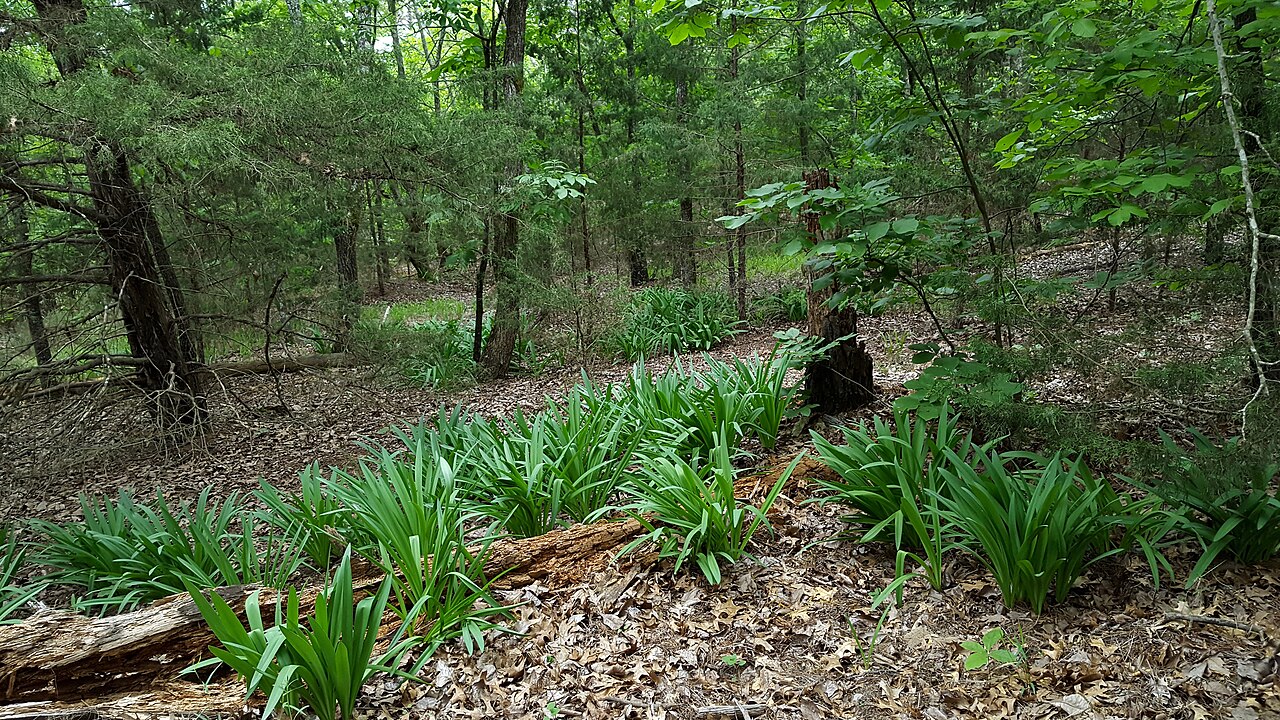
The leaves are long, strap-like to somewhat broader above the middle, with smooth margins and a green to bluish-green appearance. Their timing relative to flowering can vary. Some plants lose much of their foliage around the flowering period; that does not necessarily mean the bulb has died. Do not use a leaf-only photograph to decide between all Hymenocallis species. Flower structure, locality and the overall seasonal pattern provide additional evidence.
Flowers
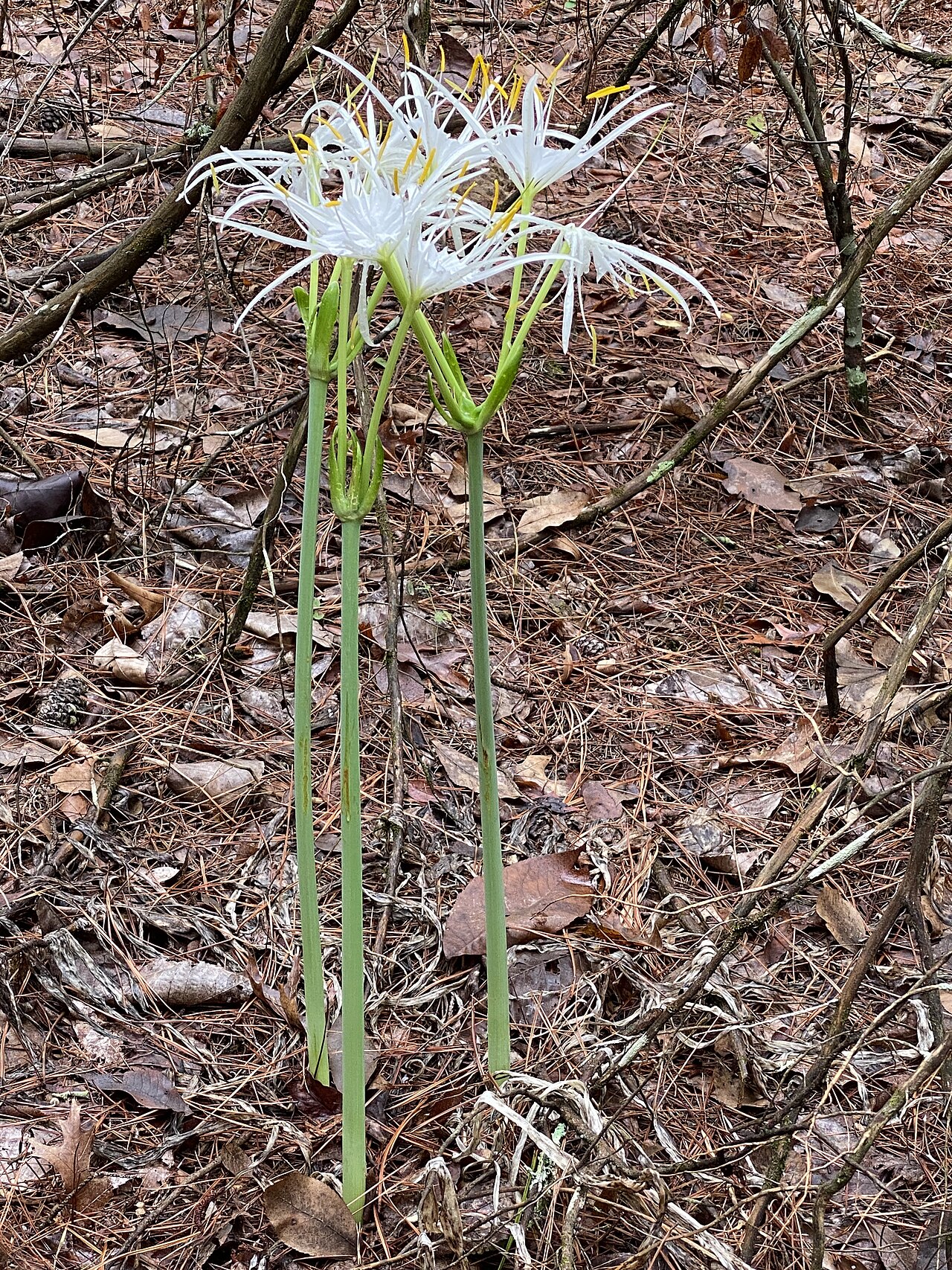
Several flowers are carried together at the top of a stalk, opening in succession rather than all lasting for weeks. Each flower has six narrow, spreading white segments and a conspicuous central cup formed by tissue associated with the stamens. The cup is not a second set of ordinary petals. Individual flowers are short-lived, but successive openings extend the display. Fragrance and the clean white form are most easily appreciated when the plant is placed close enough to observe without trampling the surrounding foliage.
Fruit & Seeds
After pollination, the flower may develop a green, leathery capsule with a small number of fleshy seeds. These are not the dry, dustlike seeds of many meadow wildflowers. Do not automatically store them in a hot, dry shed until the next spring. For propagation, seek instructions specifically for this bulb and use fresh seed with careful moisture management. Bulb offsets are often a more straightforward way to increase a settled garden clump.
Similar Names & Plants
The term spider lily can refer to Hymenocallis, Lycoris and other bulbs with different origins and care requirements. In addition, Hymenocallis caroliniana has a complicated history of misapplication; a seller using that name should clarify exactly which plant is being offered. This page is anchored to H. occidentalis, not to an unspecified white-flowered lily. Other native Hymenocallis species can occur in nearby wetland landscapes, so location alone does not finish an identification.
Quick Facts
| Scientific Name | Hymenocallis occidentalis; varieties occidentalis and eulae |
| Family | Amaryllidaceae (amaryllis family) |
| Plant Type | Bulbous herbaceous perennial |
| Mature Height | Generally about 1–2½ ft in flower |
| Mature Spread | A basal clump that enlarges gradually through bulb offsets |
| Growth Rate | Slow to moderate clump increase |
| Sun Exposure | Part sun or dappled light; full sun only with adequate moisture |
| Water Needs | Mesic to moist soil; avoid severe drying during growth |
| Soil Type | Moist, organic-rich, aerated garden or woodland soil |
| Soil pH | Acidic to neutral |
| Bloom Time | Summer to late summer; varies with variety and locality |
| Flower Color | White, often greenish near the center |
| Fall Color | Not a fall-color plant; foliage dies back seasonally |
| Fruit | Green capsules with fleshy seeds |
| Deer Resistant | Not guaranteed; protect new plants where browsing is heavy |
| USDA Hardiness Zones | About 5–8 in horticultural guidance; provenance and drainage matter |
Native Range
Kew recognizes Hymenocallis occidentalis as native to the central and southeastern United States, from the southern Midwest into the Gulf and Atlantic-side southern states. The map combines the range of its accepted varieties. This is important in the regional list: a Texas plant identified as var. eulae is not evidence that every eastern population belongs to that variety. Regional origin should remain on nursery and garden records whenever it is known.
The typical variety is associated with woodland and related moist habitats farther east, while var. eulae contributes the Oklahoma–Texas portion of the species range. Habitats and moisture regimes are not identical across this span. Florida’s botanical treatment emphasizes that H. occidentalis can occur in upland hardwood forest, unlike several more consistently aquatic-looking relatives. “Spiderlily” should therefore not be translated automatically into permanent submersion in a pond.
State-level distribution also includes historical context. NC State notes the typical variety as historical or extirpated in North Carolina, so that state’s inclusion in the broader range is not a claim of a currently secure wild population. Before a conservation planting, consult current local records and the relevant natural-heritage program. Garden cultivation outside a historical locality should be described as cultivation, not as proof of native occurrence.
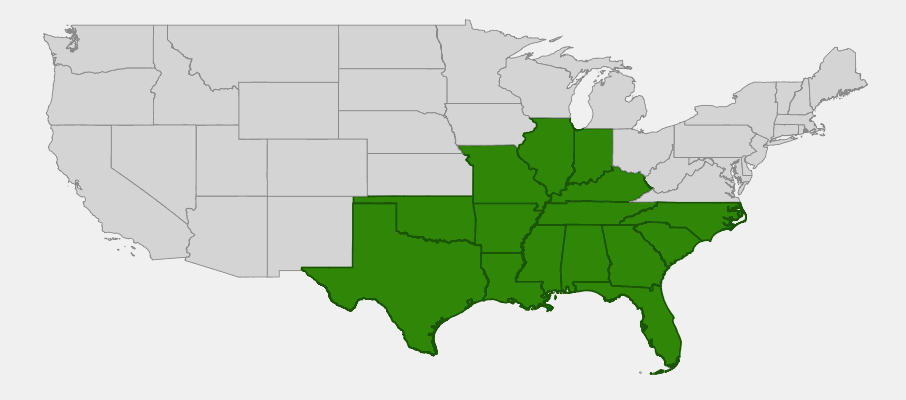
📋 Regional plant list: Arkansas, Louisiana, Eastern Oklahoma and Eastern Texas
Growing & Care Guide
Light
Dappled light or part sun is a practical starting point. Full sun can work where the soil remains adequately moist, but a hot, exposed bed that dries rapidly is a different environment from a bright floodplain opening. Look at the summer canopy, not only winter light. A woodland-edge position can make the flowers visible while moderating afternoon heat, provided surrounding roots do not remove all the soil moisture.
Soil & Water
Aim for moisture without suffocating the bulb. Work with the soil’s existing drainage rather than digging a small, rich hole that becomes a water-filled sump in compacted clay. Keep plants from drying severely while growing, and monitor the root zone during prolonged heat. At the same time, do not assume that continuous standing water is required. Moisture recommendations for other spiderlilies may not apply to this woodland species or to every provenance.
Planting Tips
Buy correctly labeled, nursery-propagated bulbs or container-grown plants. Follow the grower’s depth guidance for the material supplied; do not infer planting depth solely from the height of a flower stalk. For a container plant, preserve the established depth and root system as much as possible. Mark the location, water to settle the soil, and allow time for establishment. A recently moved bulb may need a season to settle rather than flowering immediately on demand.
Pruning & Seasonal Care
Leave green foliage to support the bulb’s growth. Remove it only after it has naturally yellowed and withered, unless damaged tissue needs attention. A bare-looking patch around flowering or later dormancy is not an invitation to dig the bulb up. Keep the label visible and use compatible nearby plants to provide seasonal interest without smothering the emerging leaves. Remove spent flower stalks if seed is not wanted, or retain a few to observe fruit development.
Propagation
Established clumps can produce bulb offsets that may be separated carefully when the plant’s seasonal condition and local climate permit. Avoid breaking up a weak, newly planted clump merely to increase numbers quickly. Seed requires a different approach from dry-stored annual flower seed; keep fresh seed suitably moist and follow species-specific nursery instructions. In either case, record the variety and source. Raising a known local line is more useful for a native garden than mixing bulbs of uncertain identity.
Troubleshooting
A missing flower can reflect recent transplanting, insufficient reserves, deep shade or unsuitable moisture, not necessarily a lack of fertilizer. Check the growing conditions before adding nutrients. Persistent decay in a bulb suggests a drainage or health problem requiring attention, while ordinary seasonal leaf loss can be normal. If the plant differs markedly from these photographs, revisit its label; several unrelated bulbs are marketed under the same common name.
Garden Placement
Place the clump where you can see the fine white flowers without stepping into the bed. Leave an identifiable planting pocket so maintenance tools do not cut dormant bulbs. Because the flower display is seasonal, plan surrounding structure with compatible plants rather than expecting spiderlily foliage to fill a border all year. Avoid mixing it so tightly with vigorous rhizomatous neighbors that future division becomes a destructive tangle.
Landscape Uses
- Feature in a moist woodland-edge bed where flowers can be observed at close range.
- Use a small labeled clump beside a garden path, with enough setback to protect leaves from foot traffic.
- Combine with restrained, site-matched ferns or moist-site forbs for a layered native planting.
- Consider a rain-garden margin only after checking drainage and matching the bulb’s provenance, not the permanently submerged center.
Wildlife & Ecological Value
For Pollinators
The fragrant flowers can attract pollinators, including moths and other visitors described in horticultural accounts. Their white form is especially conspicuous against a shaded background. Observe what uses the flowers locally, and avoid applying insecticides during the display. A brief flowering period contributes to habitat best when other native plants provide resources before and afterward.
For Birds
This is not a shrub with a dependable crop of bird berries, and it should not be selected primarily for that purpose. Its contribution is as part of a diverse herbaceous layer. A surrounding garden with trees, shrubs, grasses and other flowering plants provides more complete habitat than a single ornamental bulb repeated in isolation.
For Mammals
Do not treat bulbs as food for people or pets. Common-name confusion is particularly risky with ornamental bulbs, and no edible use is recommended here. Browsing resistance is not assured in every garden. If damage occurs during establishment, use an appropriate physical barrier and confirm the animal responsible before deciding the plant has failed.
Ecosystem Role
A native bulb adds a seasonal growth pattern different from that of evergreen foliage or summer-long meadow stems. Protecting the soil around a settled clump allows that cycle to continue. In natural habitats, retaining the forest setting and hydrology matters more than removing plants to grow them elsewhere. Source propagated material and leave wild colonies intact.
Cultural & Historical Uses
Hymenocallis occidentalis has been described under several names, and the common name spider lily adds another layer of ambiguity. Kew accepts the species and its two varieties; the older name Pancratium occidentale is a nomenclatural synonym. Keeping a scientific name, variety when known, and source location with a bulb helps prevent a beautiful plant from becoming an unidentified item in a garden collection.
The white central cup illustrates why a close botanical look can be rewarding. The thin tissue joining the staminal structures gives the flower a shape unlike a simple six-petaled lily. Its dramatic appearance does not make it nonnative: visual exoticness is not a geographic category. The Arkansas and Texas photographs on this page show how striking a regionally native bulb can be.
Modern native gardening offers an opportunity to appreciate the plant without collecting wild bulbs. Propagated material supports cultivation while leaving established populations and their habitats undisturbed. No medicinal use is recommended here. The practical legacy worth building is an accurately labeled, sustainably sourced planting that can be maintained and, when appropriate, divided for future gardens.
Frequently Asked Questions
Is this the red spider lily commonly seen in gardens?
No. Red spider lilies generally refer to Lycoris species. This page covers the native white-flowered Hymenocallis occidentalis.
Does it need to stand in water?
No universal rule of that kind is appropriate. H. occidentalis includes woodland plants and needs a suitable moist site, not an automatic prescription for permanent pond submersion.
Why have the leaves disappeared?
Foliage can die back seasonally, sometimes around the flowering period. Keep the planting marked and check the bulb’s normal cycle and site conditions before assuming it has died.
Are the Texas photographs the same species?
Yes, they are labeled Hymenocallis occidentalis var. eulae, one of the two varieties accepted by Kew within this species. The captions preserve that distinction.
How can I avoid buying the wrong spider lily?
Ask for the complete scientific name and propagation source, and compare it with a reliable botanical treatment. A common name or a generic white-flower photograph is not enough.
Sources & Further Reading
- Kew Plants of the World Online — Hymenocallis occidentalis and accepted varieties
- NC State Extension Plant Toolbox — woodland spiderlily
- University of Tennessee Smart Yards — spider lily
- Florida Department of Agriculture — native spiderlilies, Botany Circular 39
- USDA PLANTS — northern spiderlily HYOC2
Find Native Plants
Ask growers about nursery propagation and regional provenance. Browse our Arkansas native plant nurseries, Louisiana native plant nurseries, Oklahoma native plant nurseries, Texas native plant nurseries directory for suppliers.