Woodvamp (Decumaria barbara)
Decumaria barbara — commonly called Woodvamp, and just as often Climbing Hydrangea — is a native woody vine of the southeastern United States, and the only member of its small genus found in North America. It belongs to the Hydrangeaceae (hydrangea family), where it’s sometimes reclassified by botanists as Hydrangea barbara, though Decumaria barbara remains the name most gardeners and nurseries use. Unlike its showier Asian cousin, the true climbing hydrangea (Hydrangea anomala subsp. petiolaris), Woodvamp is a genuine Southern native, quietly at home in bottomland forests from Virginia’s coastal plain to the swamps of the Gulf Coast.
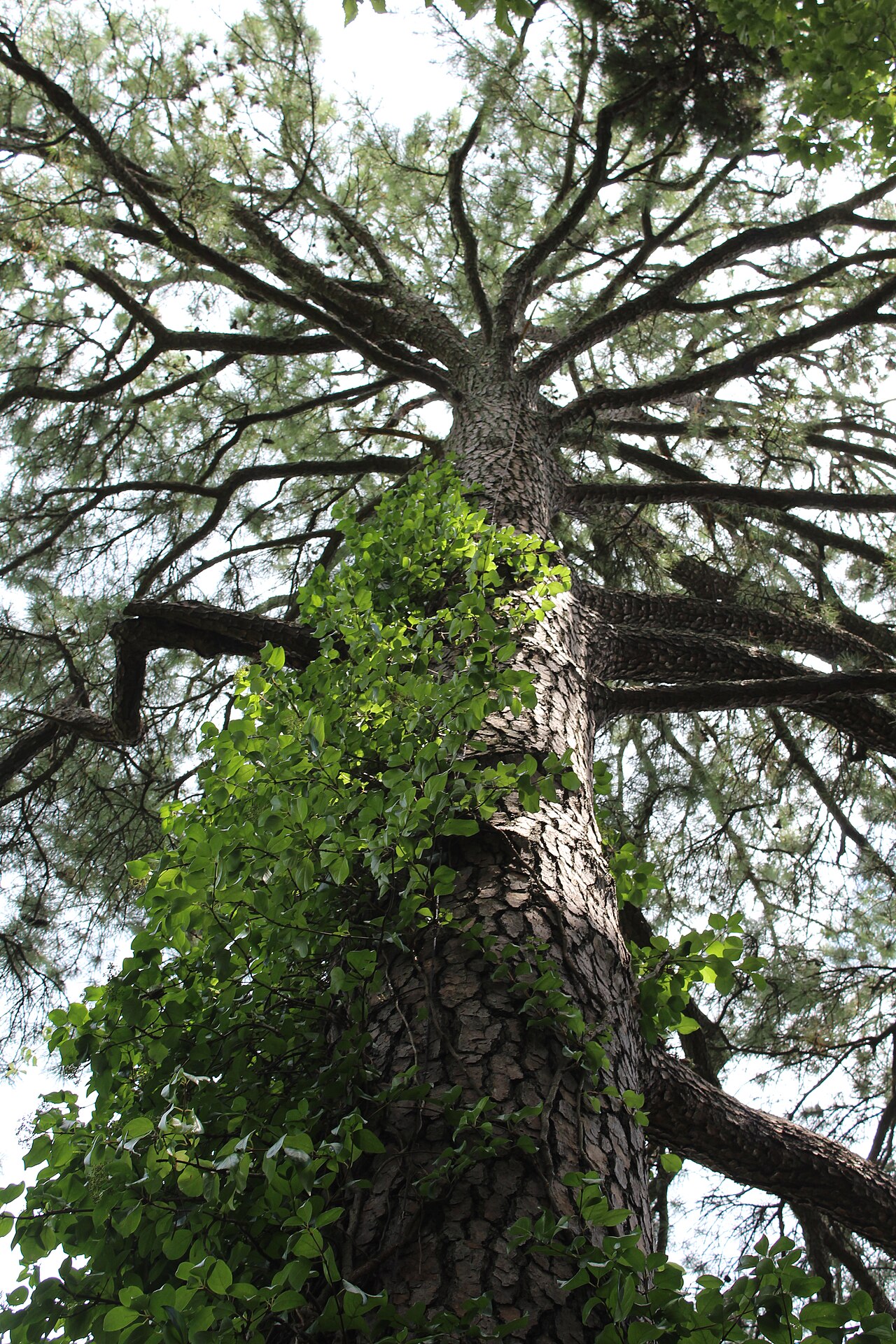
Woodvamp climbs by clinging aerial rootlets that grip bark, brick, and stone the way poison ivy and climbing hydrangea do, hauling itself 20 to 40 feet or more up a mature tree without any twining or tendrils. Its glossy, opposite leaves are deciduous in the colder parts of its range but can remain semi-evergreen in the Deep South. In early summer, mature vines that have reached the sunlit canopy produce rounded clusters of small, fragrant white flowers — a reminder, along with the family name, of its kinship with garden hydrangeas.
In the garden, Woodvamp is an easy, low-maintenance vine for a shaded wall, arbor, or old tree where a tougher, non-invasive alternative to English ivy or Japanese honeysuckle is wanted. It is slow to establish and may not flower for several years while it is still a low, leafy groundcover, but once it finds a vertical support and climbs into better light, it rewards patience with fragrant June blooms and reliably handsome foliage.
Identification
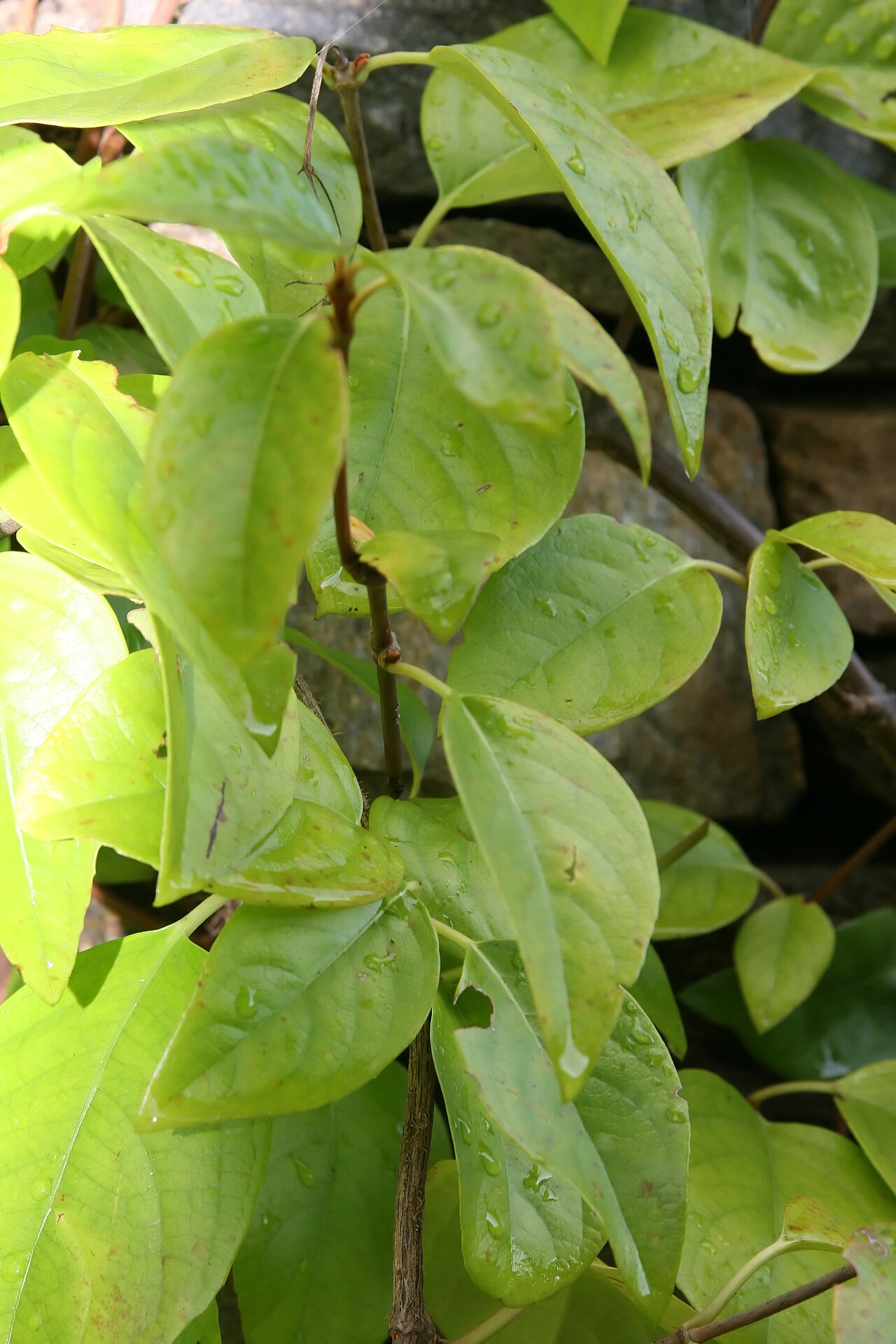
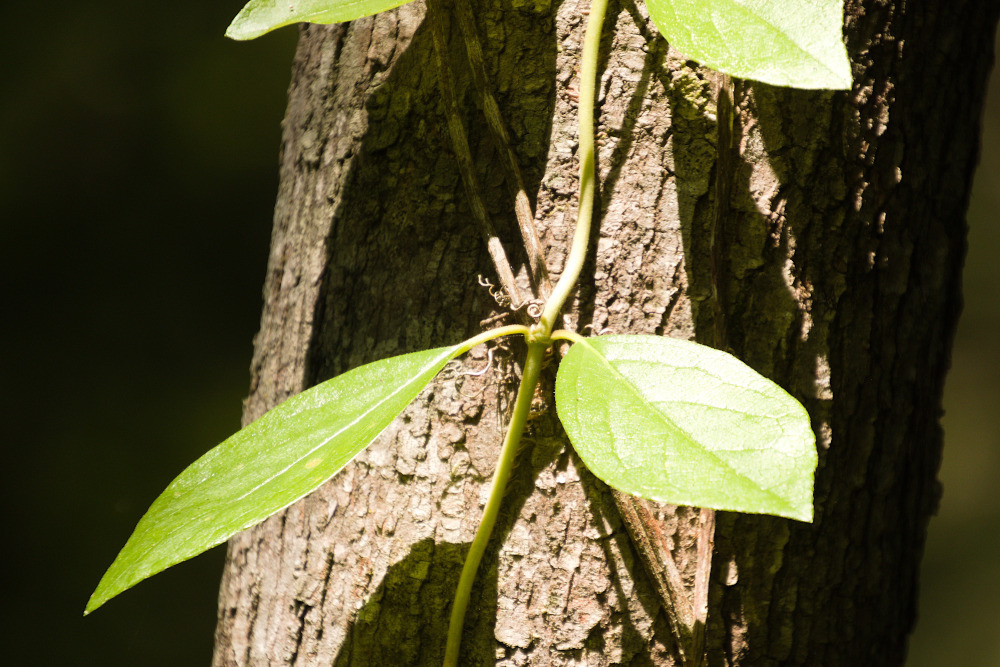
Woodvamp is unmistakable once you know to look for the pattern of smooth, paired leaves pressed flat against a trunk or wall, each node anchored by a short brush of reddish-brown rootlets.
Bark & Stems
Young stems are slender, reddish-brown, and smooth, developing the woody, ropelike character of a mature liana with age. The defining feature is the dense cluster of short, stiff aerial roots produced along the stem wherever it touches a surface — these act like Velcro, letting the vine scale bark, masonry, or wood without twining around its support. Older stems thicken into flattened, cable-like trunks that can reach 2 inches or more in diameter at the base, often half-buried in the bark of the host tree after decades of growth.
Leaves
Leaves are simple, opposite, and oval to elliptic, 2 to 5 inches long, with a glossy, dark green upper surface and smooth or very faintly toothed margins. New growth often has a reddish cast. The foliage is deciduous through most of the range but may hang on through mild winters in the Deep South and Gulf Coast. Non-flowering, juvenile vines creeping along the ground or low on a trunk often have smaller, more closely spaced leaves than the flowering growth high in the canopy.
Flowers & Fruit
Only vines that have climbed into good light produce flowers — plants still creeping along the forest floor rarely bloom. In May and June, flowering stems bear rounded, dome-shaped clusters (corymbs) of small, fragrant, pure white flowers, each with four or five narrow petals and a prominent ring of stamens, giving the cluster a slightly fuzzy appearance similar to a small hydrangea head. The fruit is a tiny, ribbed, urn-shaped capsule that splits open to release numerous minute seeds in late summer and fall.
Quick Facts
| Scientific Name | Decumaria barbara (syn. Hydrangea barbara) |
| Family | Hydrangeaceae (Hydrangea) |
| Plant Type | Deciduous to semi-evergreen woody vine |
| Mature Height | 20–40 ft as a climber (trails low until it finds support) |
| Mature Spread | 6–10 ft along the ground before climbing |
| Growth Rate | Slow to establish, moderate once climbing |
| Sun Exposure | Part Shade to Full Shade (tolerates more sun with consistent moisture) |
| Water Needs | Moderate to High |
| Soil Type | Moist, humus-rich; tolerates occasional flooding |
| Soil pH | 5.0–6.5 (acidic to slightly acidic) |
| Bloom Time | May – June |
| Flower Color | White |
| Fall Color | Yellowish, often minimal |
| Fruit | Small ribbed capsules, not ornamental |
| Deer Resistant | Yes, generally |
| USDA Hardiness Zones | 6–9 |
Native Range
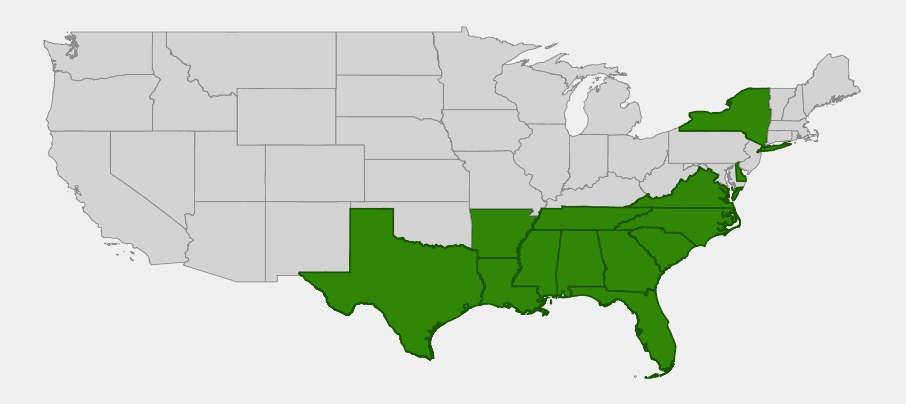
Woodvamp is native to the coastal plain and lower Piedmont of the southeastern United States, ranging from southeastern Virginia south through the Carolinas, Georgia, and peninsular Florida, west along the Gulf Coast through Alabama, Mississippi, Louisiana, and into eastern Texas and Arkansas, with Tennessee near its inland limit. A notable disjunct native population also occurs far to the north on Long Island, New York, a relic occurrence tied to the mild, moist microclimates near the coast.
Throughout this range, Woodvamp is a plant of wet bottomland hardwood forests, swamp margins, river floodplains, and shaded ravines, nearly always growing where soils stay consistently moist. It is a common associate of Bald Cypress, Water Tupelo, Sweetgum, and River Birch in the Southeast’s floodplain forests, climbing whichever large tree happens to be nearby rather than favoring one particular host species.
Because it needs the humid, shaded, wet-footed conditions of bottomland forest, Woodvamp rarely strays far from its native floodplain habitat even where it is widely planted as an ornamental. Gardeners well outside this range — in the upper Midwest or the arid West, for instance — can grow it in cultivation with enough supplemental moisture, but it is not naturalizing or spreading as a weed there; it simply isn’t native to those regions.
📋 Regional plant lists featuring Woodvamp: Maryland, Virginia & West Virginia · North Carolina & South Carolina · Georgia, Alabama & Mississippi · Arkansas, Louisiana, Eastern Oklahoma & Eastern Texas · Kentucky & Tennessee · Delaware, Southern New Jersey & Long Island, New York
Growing & Care Guide
Woodvamp asks very little once it is settled into a shaded, moist site — its main challenge is patience, since it can sulk at ground level for a few seasons before it finds something to climb.
Light
Part shade to full shade suits Woodvamp best, mimicking its native bottomland forest understory. It tolerates more sun if soil moisture stays consistently high, but foliage can scorch in hot, dry, full-sun sites. A north- or east-facing wall, or the dappled shade beneath high tree canopy, is ideal.
Soil & Water
Give it rich, consistently moist, slightly acidic soil. In the wild it grows where soils are seasonally flooded, so it tolerates wet feet far better than drought — established vines can handle brief dry spells, but prolonged drought stunts growth and delays flowering. Mulching heavily helps retain the moisture this vine prefers.
Planting Tips
Plant near a sturdy support — a mature tree trunk, brick wall, or wooden fence — since Woodvamp climbs by clinging rootlets rather than twining, and needs a rough surface to grip. Set out container-grown plants in fall or spring, water deeply and often the first year, and expect slow top growth at first while the root system establishes. Avoid planting against wood siding or anything you don’t want gripped by aerial roots long-term.
Pruning & Maintenance
Prune after flowering to control size or remove wayward stems; Woodvamp tolerates hard pruning and resprouts readily. Non-climbing groundcover growth can simply be trimmed back if it spreads further than wanted. The vine is largely free of serious pests and diseases in cultivation.
Landscape Uses
Woodvamp fills a useful niche for shaded vertical surfaces:
- Shaded arbors and pergolas where a fragrant, non-invasive native vine is wanted
- Old tree trunks in woodland gardens, climbing without harming healthy bark
- Brick or stone walls on the shaded side of a building
- Rain gardens and streambank plantings where soils stay consistently moist
- Native alternative to English ivy for shaded groundcover and wall cover
- Woodland and bog garden plantings alongside other wetland natives
Wildlife & Ecological Value
Woodvamp is a quiet but steady contributor to the wet forests it inhabits, offering nectar, shelter, and structural habitat across the growing season.
For Pollinators
The fragrant white summer flowers attract native bees and other pollinating insects at a time when canopy-level bloom is otherwise scarce in bottomland forest. Because only vines that have reached good light actually flower, the nectar resource is concentrated high in the canopy where it is especially valuable to climbing and flying pollinators.
For Birds
The dense tangle of leaves and stems where Woodvamp mats against a trunk provides cover and nesting structure for small songbirds, and the insects drawn to its flowers and foliage are in turn food for insectivorous birds working the forest edge and understory.
Ecosystem Role
As a non-aggressive native liana, Woodvamp adds structural complexity to bottomland forests without smothering or girdling its host trees the way some introduced vines do. Its tolerance of seasonal flooding makes it a stable, long-lived component of floodplain plant communities, and its low, spreading juvenile growth helps hold moist soil in place on shaded streambanks and swamp margins.
Cultural & Historical Uses
Woodvamp has long been noted by Southern botanists and herbalists for its distinctive habit, though it never achieved the commercial prominence of showier native plants. Early American botanical writers, including those cataloging the flora of the southeastern coastal plain in the 1800s, documented it among the region’s characteristic bottomland vines, often alongside notes on its hydrangea-like flower clusters.
The common name “woodvamp” is an old colloquial term from the rural South, reflecting the vine’s habit of climbing and clinging to trees in wooded swamps — a “vamp” in the sense of something that creeps or clings. “Cowitch vine,” an older regional name occasionally recorded in historical plant catalogs, is more often applied to other climbing irritant plants and should not be confused with any skin-irritating properties in Woodvamp itself, which has no documented toxicity to people or animals.
In more recent decades, Woodvamp has moved from an overlooked woodland native into a minor but valued nursery item, promoted by native-plant growers as a well-behaved, fragrant alternative to aggressive non-native vines for shaded gardens throughout the Southeast.
Frequently Asked Questions
Is Woodvamp the same as climbing hydrangea?
It’s often sold under that name, but true climbing hydrangea (Hydrangea anomala subsp. petiolaris) is a separate species from East Asia. Woodvamp (Decumaria barbara) is the native North American counterpart in the same family, with a similar clinging habit and white flower clusters.
Why hasn’t my Woodvamp bloomed yet?
Young vines typically creep along the ground or low on a trunk for several years before they bloom. Flowering only happens on growth that has climbed high enough to reach good light, so a vine still spreading at ground level simply isn’t mature enough yet — give it a sturdy support to climb and be patient.
Will Woodvamp damage the tree it climbs?
No. Unlike some invasive vines, Woodvamp does not girdle, strangle, or parasitize its host tree. Its aerial roots cling to the bark surface for support only, without penetrating living tissue, so it coexists with mature trees for decades without harming them.
Can Woodvamp tolerate dry soil?
Not well. It’s native to consistently moist bottomland forest and swamp margins, and prolonged drought will stunt its growth and reduce flowering. If your site dries out in summer, plan on supplemental watering or choose a different native vine better suited to dry soil.
Is Woodvamp invasive outside its native range?
No. Where it’s planted as an ornamental outside the Southeast, it stays where it’s put rather than escaping into the wild, since it depends on the warm, consistently wet conditions of its native bottomland habitat to spread and reproduce.

Looking for a nursery that carries Woodvamp?
Browse our native plant nursery directory: Alabama & Arkansas · Georgia, Florida & Delaware · Louisiana & Mississippi · Tennessee, Texas, Virginia & South Carolina · North Carolina & New York