Carolina Larkspur (Delphinium carolinianum)
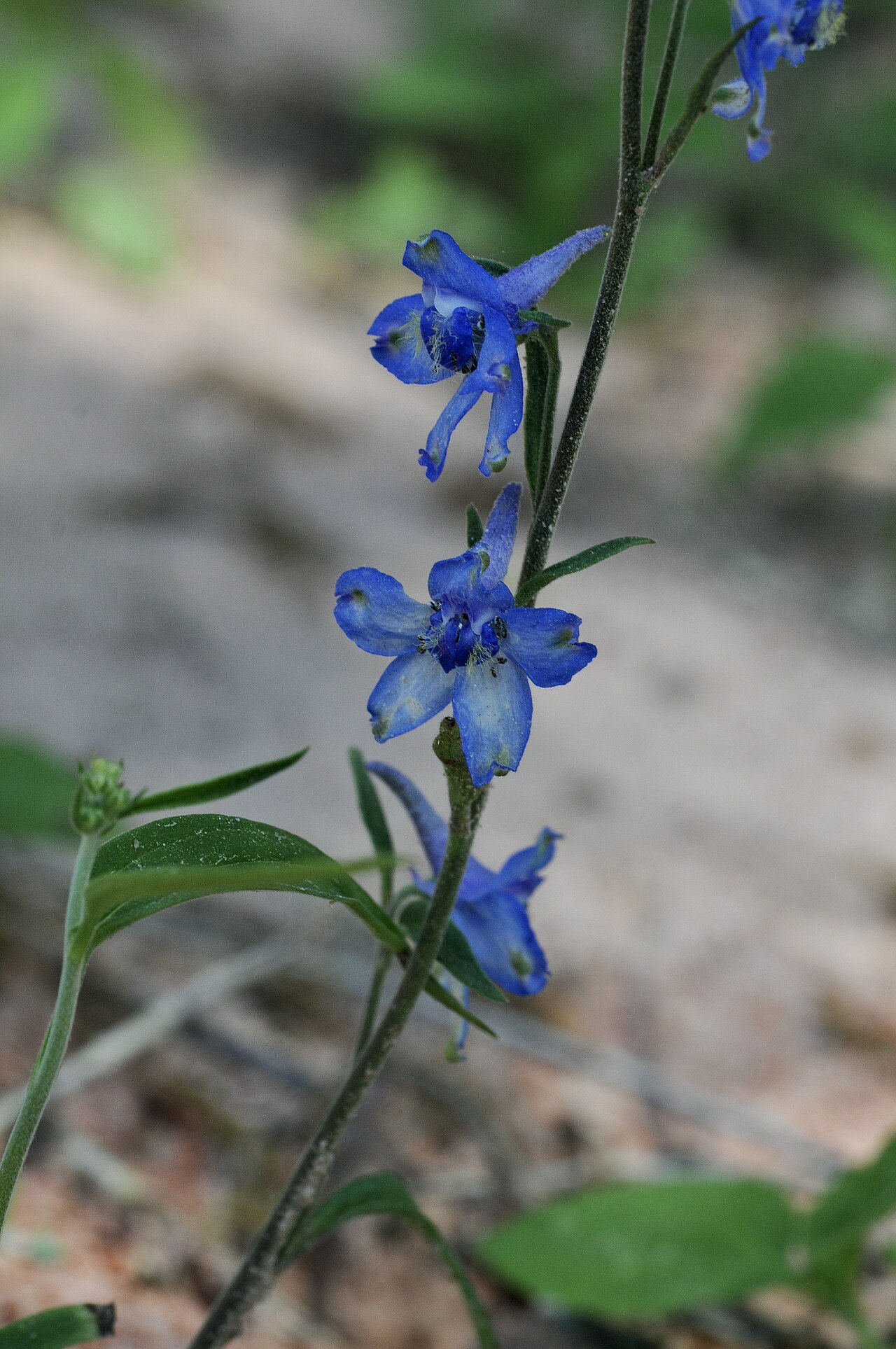
Delphinium carolinianum, known as Carolina Larkspur (and, in its piney-woods form, Pineywoods Larkspur), is a native perennial wildflower of the central and southern United States. It belongs to the buttercup family (Ranunculaceae) and produces loose, airy spikes of spurred flowers in shades of blue, violet, or occasionally white, rising on slender, often sparsely leaved stems from open woodlands, prairies, glades, and dry rocky slopes.
Every part of this plant is toxic. Like all larkspurs, Carolina Larkspur contains diterpenoid alkaloids concentrated in its young foliage and seeds that are poisonous to people and especially dangerous to livestock — cattle losses from larkspur poisoning are a well-documented hazard on western and central rangeland. Keep this plant away from grazing animals and out of reach of curious pets and children, and never confuse its attractive flowers with anything edible.
Despite the need for caution, Carolina Larkspur is a worthwhile addition to a native wildflower meadow or dry prairie garden, where its early-to-midsummer blue spikes stand out against grasses and provide an important nectar source for long-tongued bees and hummingbirds. It thrives in exactly the kind of lean, well-drained, sun-baked sites where many showier garden perennials struggle.
Identification
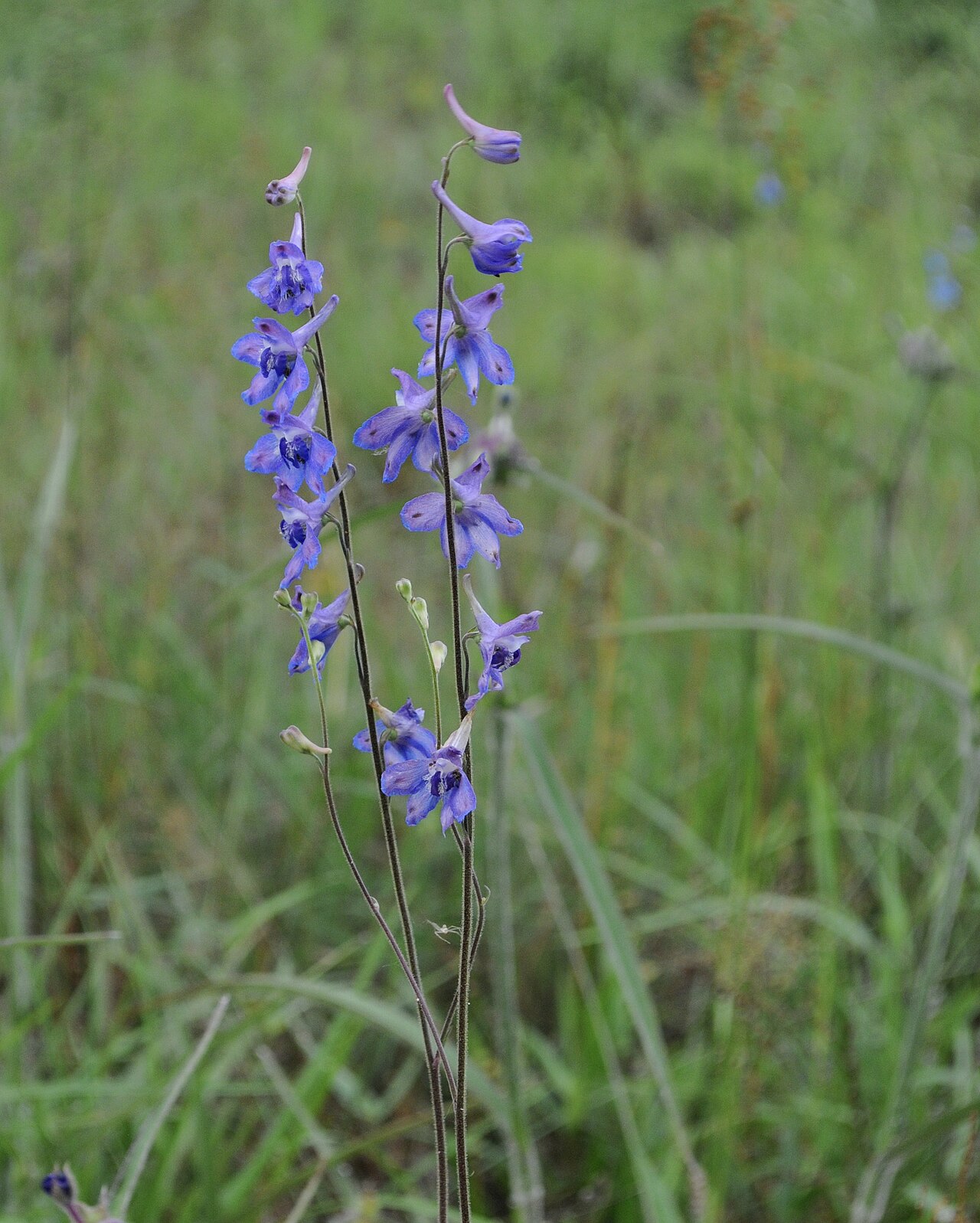
Carolina Larkspur is best recognized by its loose, open flower spike and the backward-pointing nectar spur on each bloom, a hallmark of the genus Delphinium.
Stems & Leaves
Plants grow 1 to 3 feet tall on slender, often minimally branched stems that can be smooth or finely hairy depending on the variety. Basal leaves are deeply palmately divided into narrow lobes and tend to wither by flowering time, leaving the flowering stem looking sparse and almost leafless — a trait that led one observer to note the plant is “definitely needing to be grown with other things,” since there’s little foliage to hide bare stems once it blooms.
Flowers
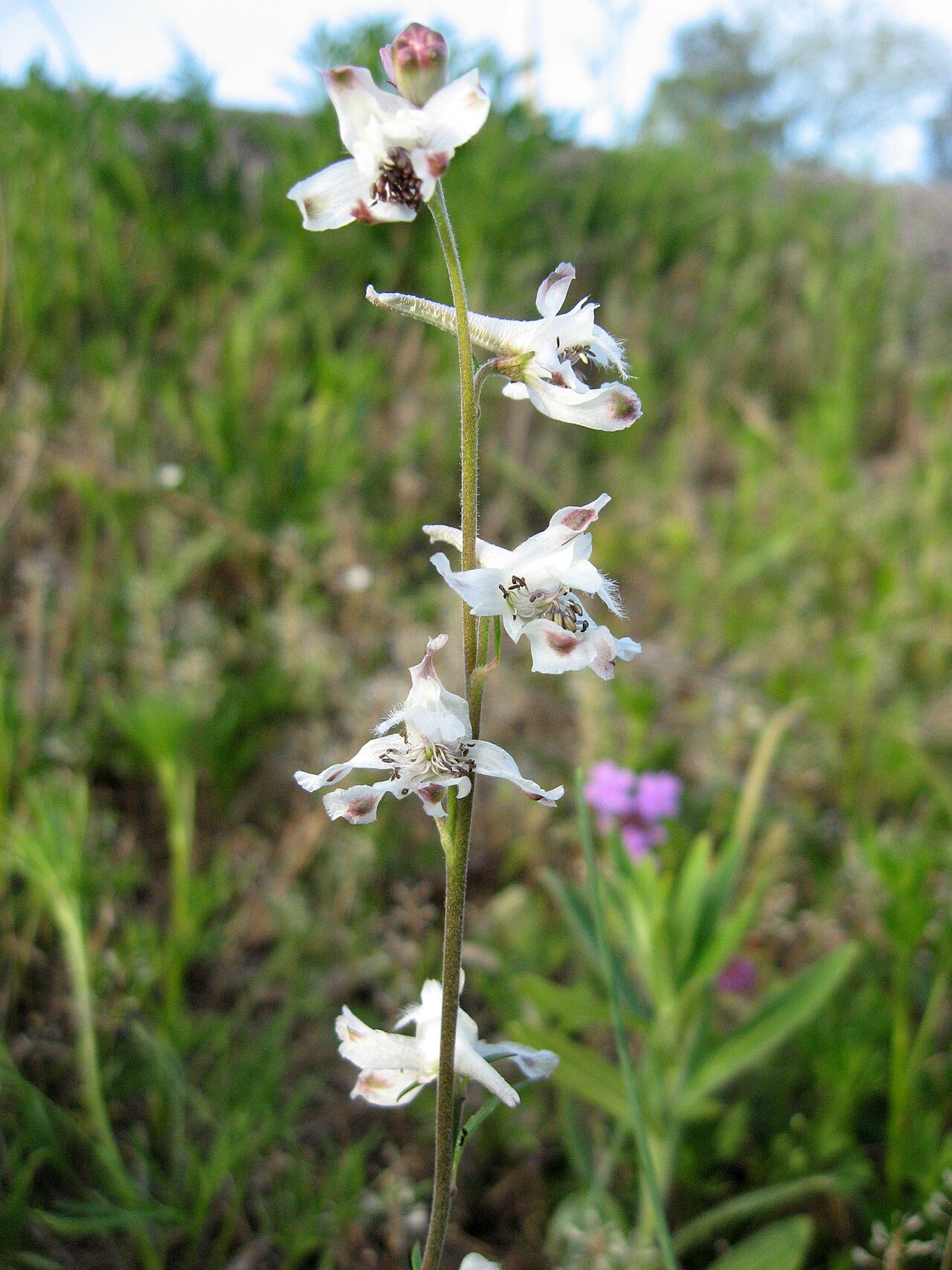
Flowers are arranged in a loose, elongated raceme, each bloom roughly ¾ to 1¼ inches long including its distinctive nectar spur, which projects backward from the five petal-like sepals. Flower color is quite variable across the species’ range and subspecies — most commonly a true blue to violet-blue, but populations on calcium-rich cedar glades in Tennessee, Kentucky, and Alabama (sometimes distinguished as the calciphilum form) often bloom white to pale cream with maroon-tinged petals. Bloom time runs from April through June depending on latitude and elevation, with Gulf Coast plains populations flowering earliest.
Fruit & Seeds
After flowering, each bloom develops into a cluster of narrow, upright seed pods (follicles) that split open at maturity to release numerous small seeds. Seeds, like the rest of the plant, contain toxic alkaloids and should never be collected for anything other than propagation, handled with care, and kept away from children and pets.
Quick Facts
| Scientific Name | Delphinium carolinianum |
| Family | Ranunculaceae (Buttercup) |
| Plant Type | Herbaceous perennial wildflower |
| Mature Height | 1–3 ft |
| Mature Spread | 8–14 in |
| Growth Rate | Moderate; dies back to roots each year |
| Sun Exposure | Full Sun to Part Shade |
| Water Needs | Low to Moderate |
| Soil Type | Lean, well-drained; sandy, rocky, or calcareous |
| Soil pH | 6.0–8.0 (neutral to alkaline) |
| Bloom Time | April – June |
| Flower Color | Blue to violet-blue, occasionally white with maroon tinges |
| Fall Color | None; plant goes dormant in summer |
| Fruit | Narrow upright seed pods (follicles) |
| Deer Resistant | Yes — toxic alkaloids deter browsing |
| USDA Hardiness Zones | 6–9 |
⚠ Toxicity warning: All larkspurs, including Carolina Larkspur, contain toxic diterpenoid alkaloids throughout the plant, most concentrated in young leaves and seeds. These compounds are a leading cause of fatal cattle poisoning on rangeland in the western and central United States, and the plant is also dangerous to horses, sheep, pets, and people if ingested. Never plant it where livestock graze, and keep children and pets from handling or eating any part of the plant.
Native Range
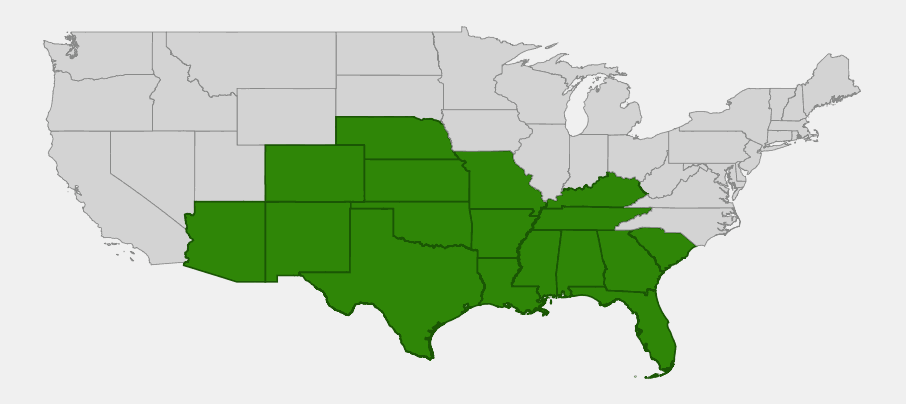
Carolina Larkspur has one of the broadest native ranges of any Delphinium in North America, stretching from the desert grasslands of Arizona and New Mexico east across Colorado, Kansas, and Nebraska, south through Oklahoma and Texas, and on through the mid-South and Gulf states — Arkansas, Louisiana, Missouri, Mississippi, Alabama, Georgia, and the Florida panhandle — with an eastern lobe reaching into Kentucky, Tennessee and South Carolina. It is not native to Utah.
Habitat varies considerably across this range. On the southern Great Plains, it grows in open prairie, dry grassland, and sandy or rocky scrubland, often flowering in the bare, early-season period before grasses green up. In the piney woods of east Texas and Louisiana, it favors open, fire-maintained longleaf and loblolly pine savannas with sandy, acidic soil. Farther east, in Tennessee, Kentucky, and Alabama, distinctive populations occupy limestone cedar glades — thin-soiled, sun-baked openings over exposed bedrock — where the species often blooms white rather than blue.
Across its entire range, Carolina Larkspur needs open, sunny conditions and sharp drainage; it does not persist in dense shade, heavy clay, or wet soils. Fire-maintained and periodically disturbed open habitats — prairies, glades, and pine savannas — are where it is most reliably found.
📋 Regional plant lists featuring Carolina Larkspur: Georgia, Alabama & Mississippi · Arkansas, Louisiana, Eastern Oklahoma & Eastern Texas · North Carolina & South Carolina · Kentucky & Tennessee · Nebraska, Kansas & Eastern Colorado · Arizona & New Mexico · Illinois, Iowa & Missouri
Growing & Care Guide
Carolina Larkspur rewards a lean hand — it wants the dry, sunny, unfussy conditions of open prairie and glade, not the rich, well-watered beds that suit most garden perennials.
Light
Full sun produces the strongest flowering and sturdiest stems, matching its native open prairie and savanna habitat. It tolerates light part shade, especially in the hottest parts of its range, but blooms less heavily and may flop without adequate sun.
Soil & Water
Sharp drainage is essential — this is a plant of sandy, rocky, or thin, calcareous soils, and it will rot in heavy clay or soil that stays wet. Water modestly during active spring growth, then let the plant dry out as it goes summer-dormant after seed set; established plants are quite drought-tolerant once their root system is in place.
Planting Tips
Set out plants in fall so roots establish over the cool season ahead of spring bloom. Because the foliage withers by flowering time, interplant with low grasses or other wildflowers that will carry the display once the larkspur’s basal leaves fade — a mixed prairie or glade planting suits it far better than a solo spot in a border. Site it away from any area accessible to livestock or grazing animals, and away from play areas for children and pets, given its toxicity.
Pruning & Maintenance
Deadhead spent flower spikes if you want to prevent self-seeding, wearing gloves since the plant is toxic to handle in quantity. Otherwise, little maintenance is needed — let the plant go dormant naturally after seed set and leave it undisturbed through summer and winter.
Landscape Uses
Carolina Larkspur earns its place in sunny, well-drained native plantings:
- Dry prairie and meadow restorations alongside native grasses
- Rock gardens and glade plantings on thin, sharply drained soil
- Pollinator gardens for early-season bees and hummingbirds
- Xeric native beds where drought tolerance is a priority
- Cedar glade and limestone barren restoration in the mid-South
Wildlife & Ecological Value
Carolina Larkspur supports pollinators that are adapted to its deep, spurred flowers, while its toxicity keeps browsing animals at bay.
For Pollinators
The nectar spur is sized for long-tongued bees, including bumblebees and some solitary bees, which are the plant’s primary pollinators. Hummingbirds migrating through the central and southern states also visit the blue-flowered forms, drawn to the tubular shape and nectar reward.
For Mammals
Because the plant is toxic, mammalian herbivores — including deer and livestock — generally avoid it, which is precisely why it persists on heavily grazed rangeland even as more palatable plants disappear. This same toxicity is a serious hazard to cattle that do consume it in quantity, particularly on spring range when larkspur is one of the few green plants available.
Ecosystem Role
As an early-blooming component of prairie, savanna, and glade plant communities, Carolina Larkspur provides a nectar source before many summer wildflowers have started blooming. Its presence is often an indicator of relatively undisturbed, fire-maintained open habitat, since it does not persist well under heavy grazing pressure from animals or encroaching woody growth.
Cultural & Historical Uses
Carolina Larkspur and its larkspur relatives have a long documented history as a rangeland hazard rather than a resource. Early twentieth-century agricultural bulletins — including U.S. Department of Agriculture publications on “larkspur poisoning of livestock” — studied larkspur species extensively because of the serious economic losses they caused to cattle herds across the western and central plains, and ranchers historically learned to recognize and avoid turning cattle onto larkspur-heavy range in early spring.
Some Indigenous peoples historically used extracts of toxic Delphinium species cautiously and in limited external applications, reflecting traditional knowledge of the plant’s potent alkaloid content; none of these historical uses translate into a safe home remedy, and the plant should not be used medicinally today.
In the garden and nursery trade, Carolina Larkspur has more recently been recognized by native-plant enthusiasts for its ornamental value in prairie and glade restorations, valued for its early bloom and drought tolerance rather than for any practical or culinary use.
Frequently Asked Questions
Is Carolina Larkspur safe to plant if I have pets or livestock?
No — every part of the plant is toxic, and it is a well-documented cause of poisoning in cattle and other grazing animals. Only plant it in areas completely inaccessible to livestock, grazing animals, and pets that might chew on foliage.
Why does my larkspur have no leaves when it blooms?
This is normal. Carolina Larkspur’s basal leaves typically wither before or during flowering, leaving a nearly bare flowering stem. Plant it among grasses or other wildflowers that will fill in visually around the bloom time.
Is this the same plant as Prairie Larkspur?
No. Prairie Larkspur (Delphinium virescens) is a closely related but botanically distinct species with its own native range centered on the central and northern Great Plains. Carolina Larkspur (Delphinium carolinianum) has a different, more southern and eastern distribution and is treated as a separate accepted species.
Why do some Carolina Larkspur flowers look white instead of blue?
Flower color varies across the species’ range. Populations growing on limestone cedar glades in Tennessee, Kentucky, and Alabama typically bloom white to pale cream with maroon-tinged petals, while plains and pine-woods populations further west and south are usually blue to violet-blue.
How drought-tolerant is Carolina Larkspur?
Very, once established. It is native to lean, sharply drained prairie, glade, and savanna soils that dry out completely in summer, and it naturally goes dormant after setting seed rather than needing supplemental water through the hot months.

Looking for a nursery that carries Carolina Larkspur?
Browse our native plant nursery directory: Alabama, Arkansas & Arizona · Colorado, Florida & Georgia · Kentucky, Louisiana, Mississippi & Missouri · Kansas · Nebraska, New Mexico & Oklahoma · South Carolina, Tennessee & Texas