
Osakazuki Japanese Maple (Acer palmatum ‘Osakazuki’)
Last updated: November 3, 2026
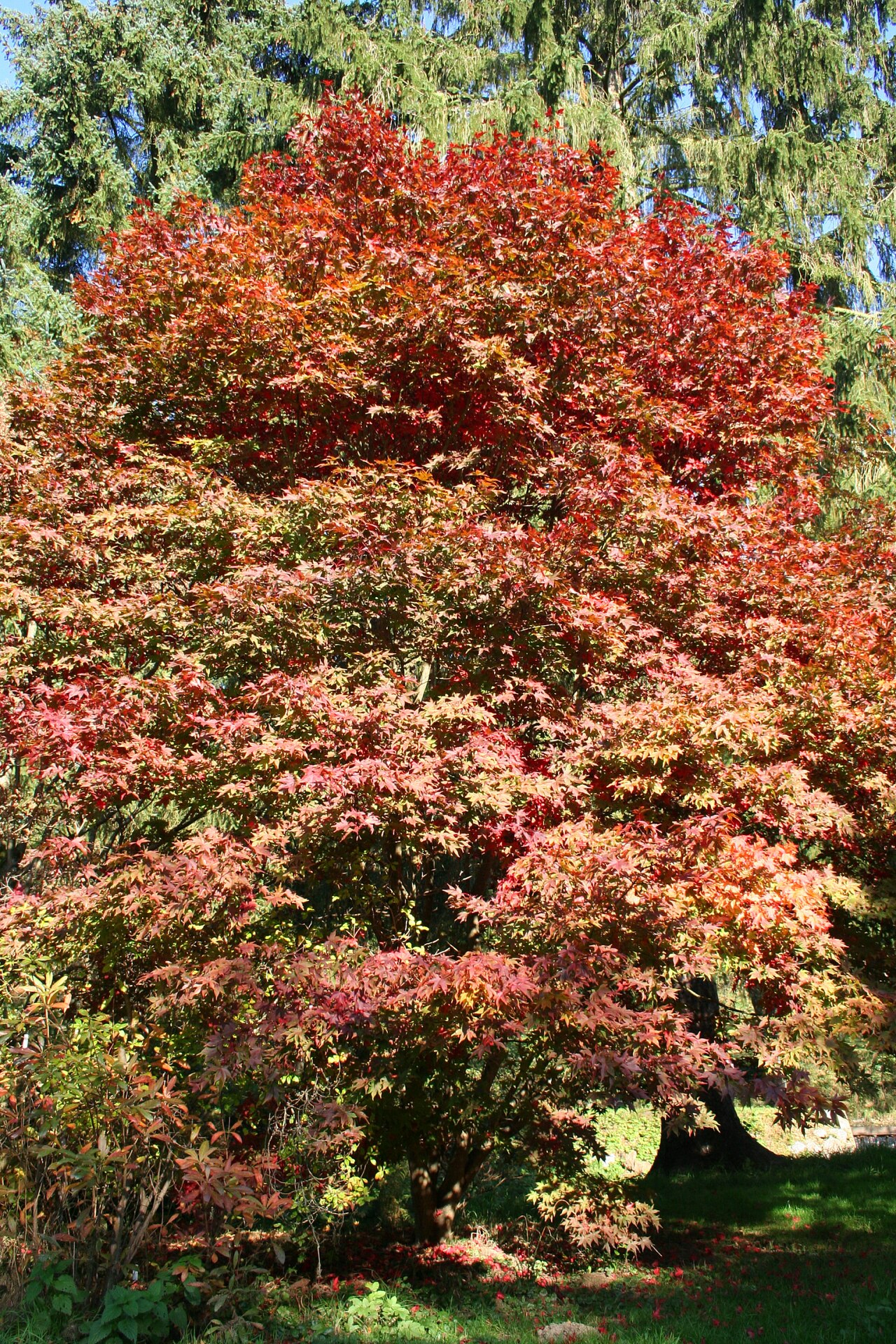
Acer palmatum ‘Osakazuki’ is a mid-sized, upright Japanese maple cultivar grown almost entirely for one trait: it is widely considered to have the most reliable, most brilliant scarlet-red fall color of any Japanese maple selection. The cultivar’s name is said to reference a large Japanese sake cup (an “osakazuki”), a nod to the broad, slightly cupped leaves, though sources differ on the exact origin story. It is one of the oldest named Japanese maple cultivars still widely grown, having been selected and propagated in Japan long before Japanese maples became a major Western nursery crop.
Gardeners plant ‘Osakazuki’ for a single, dependable payoff: a two- to three-week window in mid-to-late fall when the whole canopy turns a saturated, almost glowing red-orange, a color that holds up even in gardens where other red-leafed maple cultivars fade to brown. For the rest of the growing season it is an attractive but unremarkable medium green tree, which makes it a good choice for a garden that wants drama concentrated at one season rather than spread across three.
Japanese maple (Acer palmatum) is not native to North America; it is native to Japan, Korea and eastern China, and was introduced to Western gardens in the 19th century. It is not listed as a federal noxious weed, but in parts of the eastern United States, especially the Mid-Atlantic, seedlings can escape cultivation and establish in forest understories. ‘Osakazuki’ sets a moderate amount of seed, so gardeners near natural woodland edges should watch for and remove volunteer seedlings rather than let them spread into wild areas.
Identification
Bark & Stems
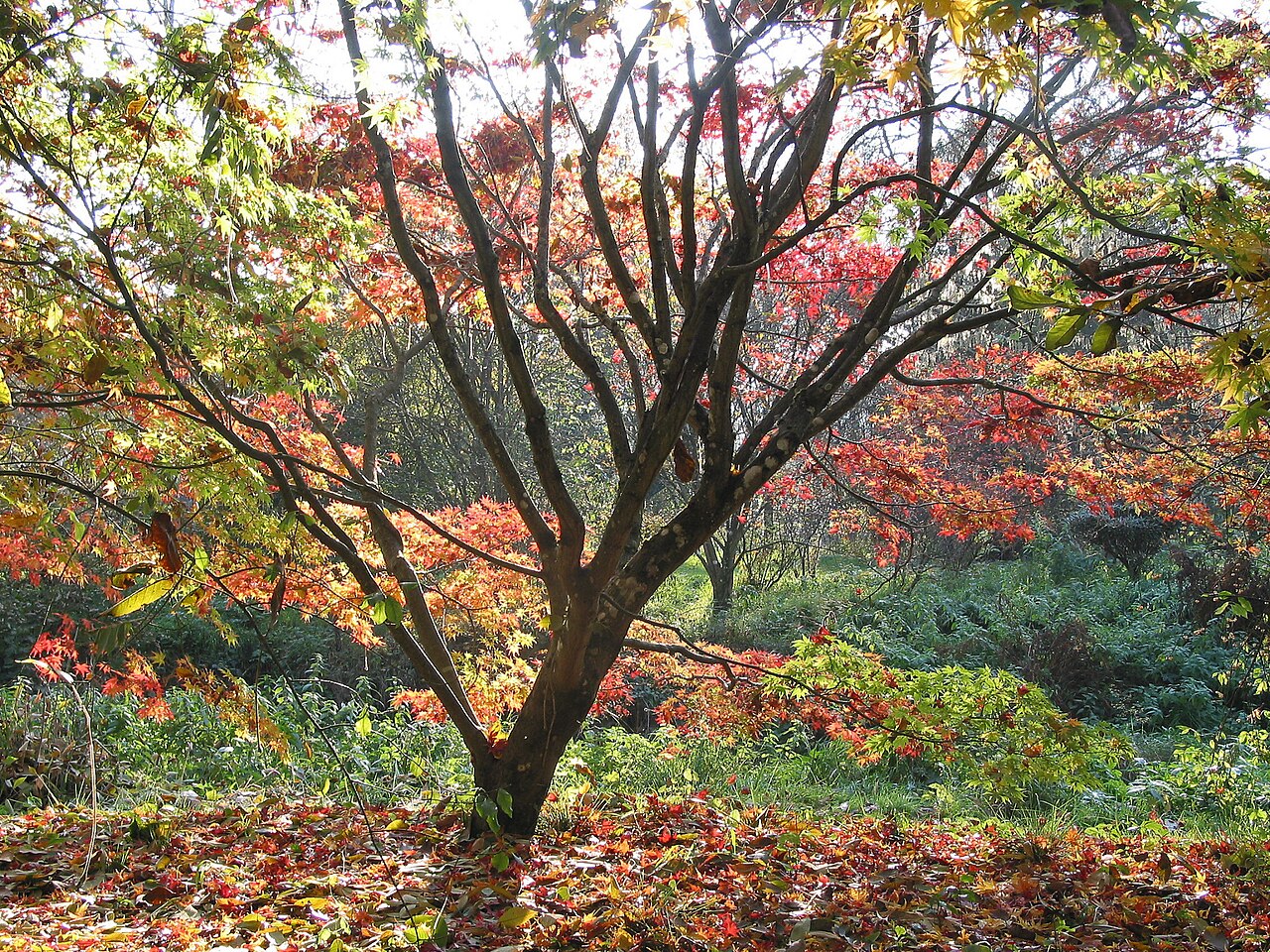
Young stems are smooth and olive-green to reddish-brown, maturing to a smooth gray-brown bark with shallow furrows on older trunks. The habit is upright and rounded to vase-shaped, more tree-like than many dissected or weeping Japanese maple cultivars.
Leaves
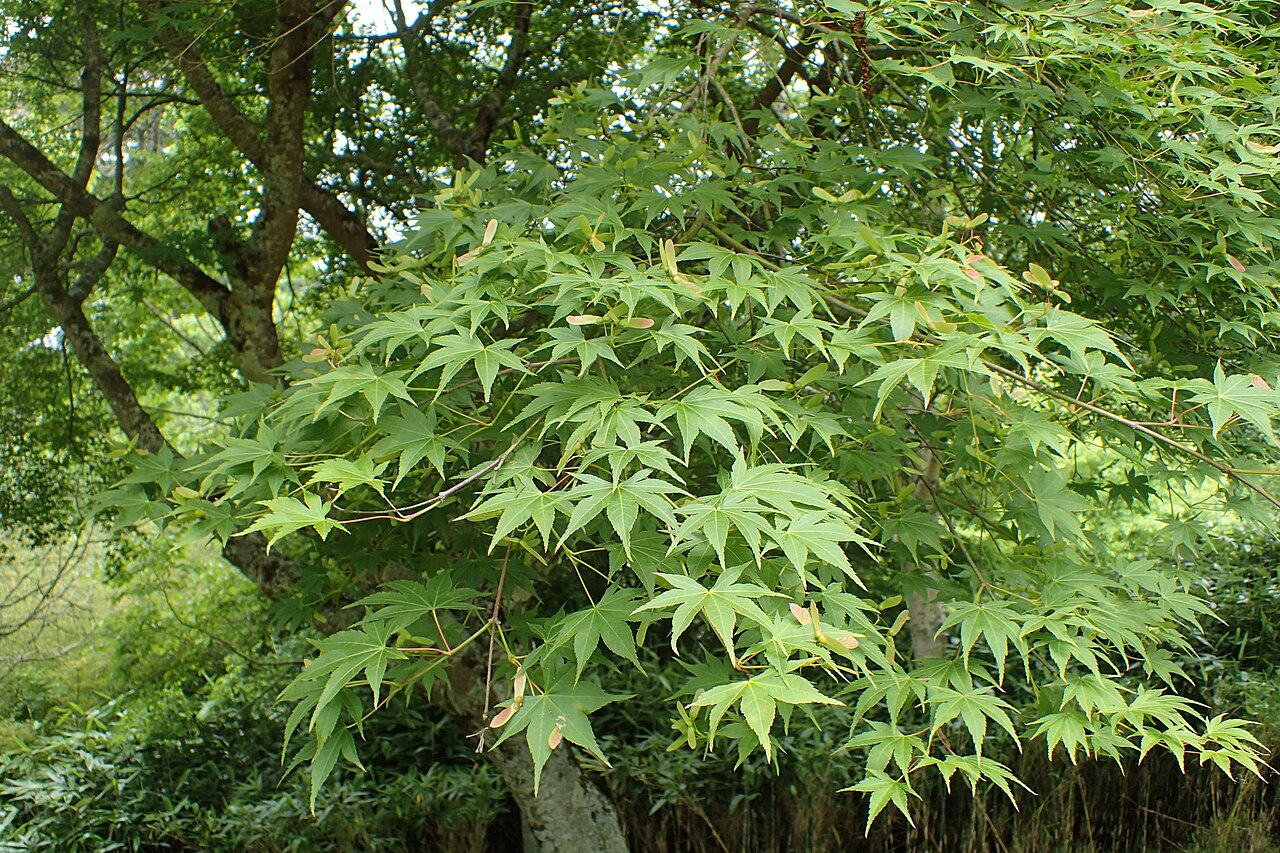
Leaves are palmate with usually seven lobes (occasionally five), 2 to 4 inches across, each lobe doubly serrated along the margin. They emerge medium green in spring, stay green through summer, then shift through yellow and orange before settling into a deep, saturated scarlet-red in fall — the feature that defines the cultivar. Compared with purple-leafed cultivars such as ‘Bloodgood‘, ‘Osakazuki’ is easy to identify by its plain green summer color combined with an exceptionally vivid fall change.
Flowers
Small, inconspicuous reddish-purple flowers appear in spring in drooping clusters as the leaves unfold. They are easy to overlook and are not grown for ornamental flower value.
Fruit & Seeds
Like all Japanese maples, ‘Osakazuki’ produces paired winged seeds (samaras) that develop through summer, often with a light reddish tinge, and mature and disperse by fall.
Quick Facts
| Scientific Name | Acer palmatum ‘Osakazuki’ |
| Cultivar | Osakazuki |
| Family | Sapindaceae (Maple) |
| Plant Type | Deciduous upright tree |
| Native to North America | No — introduced from Japan, Korea and eastern China |
| Mature Height | 15–25 ft (sources vary; often listed 15–20 ft) |
| Mature Spread | 15–20 ft |
| Growth Rate | Moderate |
| Sun Exposure | Full sun to part shade (afternoon shade in hot-summer climates) |
| Water Needs | Moderate; consistent moisture, well-drained soil |
| Soil Type | Rich, well-drained loam; tolerates a range of soils |
| Soil pH | Slightly acidic (5.5–6.5) preferred; tolerates near-neutral |
| Bloom Time | Spring (inconspicuous) |
| Leaf / Fall Color | Green in summer; brilliant scarlet-red in fall |
| Fruit | Small winged samaras, not ornamentally significant |
| Deer Resistant | Moderately (occasional browsing reported) |
| USDA Hardiness Zones | 5–8 |
| Invasive Status | Not federally listed; seedlings can escape in parts of the eastern US |
Origin & Where It Grows
The species Acer palmatum is native to the mountains and woodlands of Japan, Korea and eastern China, where it grows as a small understory tree. ‘Osakazuki’ is a Japanese cultivar of considerable age; it was already an established, named selection in Japanese horticulture before serious Western cataloguing of Japanese maple cultivars began in the late 19th and early 20th centuries, which makes an exact origin date hard to pin down.
In the United States, ‘Osakazuki’ performs best across USDA zones 5 through 8, growing well in the Pacific Northwest, the mid-Atlantic, the upper South and much of the Midwest, wherever it can get consistent moisture and some relief from the most intense afternoon sun in hot climates. Its fall color is generally most intense where nights turn cool while days stay mild, a pattern common across its hardiness range in early-to-mid fall.
Growing & Care Guide
Light
‘Osakazuki’ colors best with at least a half day of sun; morning sun with afternoon shade is ideal in zones 7 and 8, where strong afternoon sun can scorch leaf margins. In the cooler parts of its range it tolerates more sun and still develops strong fall color.
Soil & Water
Give it rich, well-drained soil with consistent moisture. It does not tolerate waterlogged roots or extended drought well, especially while young. A layer of mulch over the root zone helps keep soil temperature and moisture even, which in turn supports more even fall coloring.
Planting Tips
Plant in spring or fall, siting the tree where afternoon shade is available in hotter climates and where it is sheltered from strong, drying winds that can scorch leaf edges. Avoid low spots where cold air and moisture pool.
Pruning & Maintenance
Prune in late fall through winter while the tree is dormant, removing crossing or crowded branches to maintain the open, layered structure that shows off the canopy. Avoid heavy summer pruning, which can stress the tree and reduce fall color intensity.
Propagation
‘Osakazuki’ comes true only from grafting or cuttings taken from a known ‘Osakazuki’ parent; seedlings grown from its samaras will not reliably reproduce the parent’s exceptional fall color, since seedling Japanese maples are genetically variable.
Landscape Uses
- Specimen tree for fall-color display, especially sited where low autumn sun can backlight the canopy
- Shade tree for a small to mid-sized garden
- Companion planting near evergreens, where its scarlet fall color contrasts with dark green needles
- Courtyard or entry tree where seasonal change is a design feature
Wildlife & Ecological Value
Japanese maple offers limited wildlife value compared with native trees: its flowers are mostly self- or wind-pollinated and draw few specialist pollinators, and its foliage supports far fewer native insect species than native maples such as red maple or sugar maple, since most North American moth and butterfly caterpillars have not co-evolved with it. Small seed-eating birds occasionally take the samaras, and the dense canopy provides some perching and nesting cover, but gardeners who want a maple that actively supports local food webs should look to a native species instead.
Native Alternatives
If you want a similar look with a plant native to North America, consider these:
- Vine maple (Acer circinatum) — a native Pacific Northwest understory tree with palmate leaves and good fall color, often used the way Japanese maple is used in gardens.
- Red maple (Acer rubrum) — a widespread native shade tree with brilliant red fall color and much greater wildlife and pollinator value than Japanese maple.
- Rocky Mountain maple (Acer glabrum) — a small native maple with lobed leaves and attractive form for western gardens.
- Fringetree (Chionanthus virginicus) — a small native flowering tree that offers a different but comparably ornamental accent, with fragrant spring flowers and strong wildlife value.
History & Uses
‘Osakazuki’ is among the oldest recognized Japanese maple cultivars still in commerce, selected in Japan for its outstanding fall color long before the modern Western Japanese-maple nursery trade developed. Japanese maples as a group have been cultivated and selected in Japan for centuries, with named cultivars recorded as early as the 1700s, and ‘Osakazuki’ fits within that long tradition of selecting trees for a single standout ornamental trait.
In Western gardens, ‘Osakazuki’ has remained popular since its introduction because it is a relatively easy, adaptable tree compared with more finicky dissected or variegated cultivars, while still delivering one of the most photographed fall displays among all Japanese maples. It is commonly recommended by extension services and arboretums specifically as a reliable fall-color selection for gardeners who have struggled with less consistent cultivars.
Frequently Asked Questions
Is Osakazuki Japanese maple native to the United States?
No. Japanese maple (Acer palmatum) is native to Japan, Korea and eastern China, not North America. ‘Osakazuki’ is an introduced ornamental cultivar; plant it away from natural woodland edges and remove any volunteer seedlings in regions, such as parts of the Mid-Atlantic, where Japanese maple is known to escape cultivation.
Why is Osakazuki grown instead of other Japanese maple cultivars?
It is grown primarily for its exceptionally reliable, vivid scarlet fall color, which many gardeners and nursery professionals consider among the best of any Japanese maple cultivar. Its summer appearance is plain green, so it is chosen specifically for the fall display.
How big does Osakazuki Japanese maple get?
Sources vary, but most list a mature height around 15 to 20 feet with a similar spread, making it a mid-sized tree suitable for small to average residential lots, larger than many dwarf or dissected cultivars.
Does Osakazuki need full sun for good fall color?
It colors best with at least several hours of direct sun. In hot-summer climates, morning sun with afternoon shade usually gives the best balance of strong color without leaf scorch; in cooler regions it tolerates more sun.
Can I grow Osakazuki from the seeds it drops?
You can germinate the seeds, but the resulting seedlings will not reliably have ‘Osakazuki’s fall color, since Japanese maple seedlings vary genetically. True ‘Osakazuki’ trees are propagated by grafting onto seedling rootstock.

