Sand Sage (Artemisin filifolia)
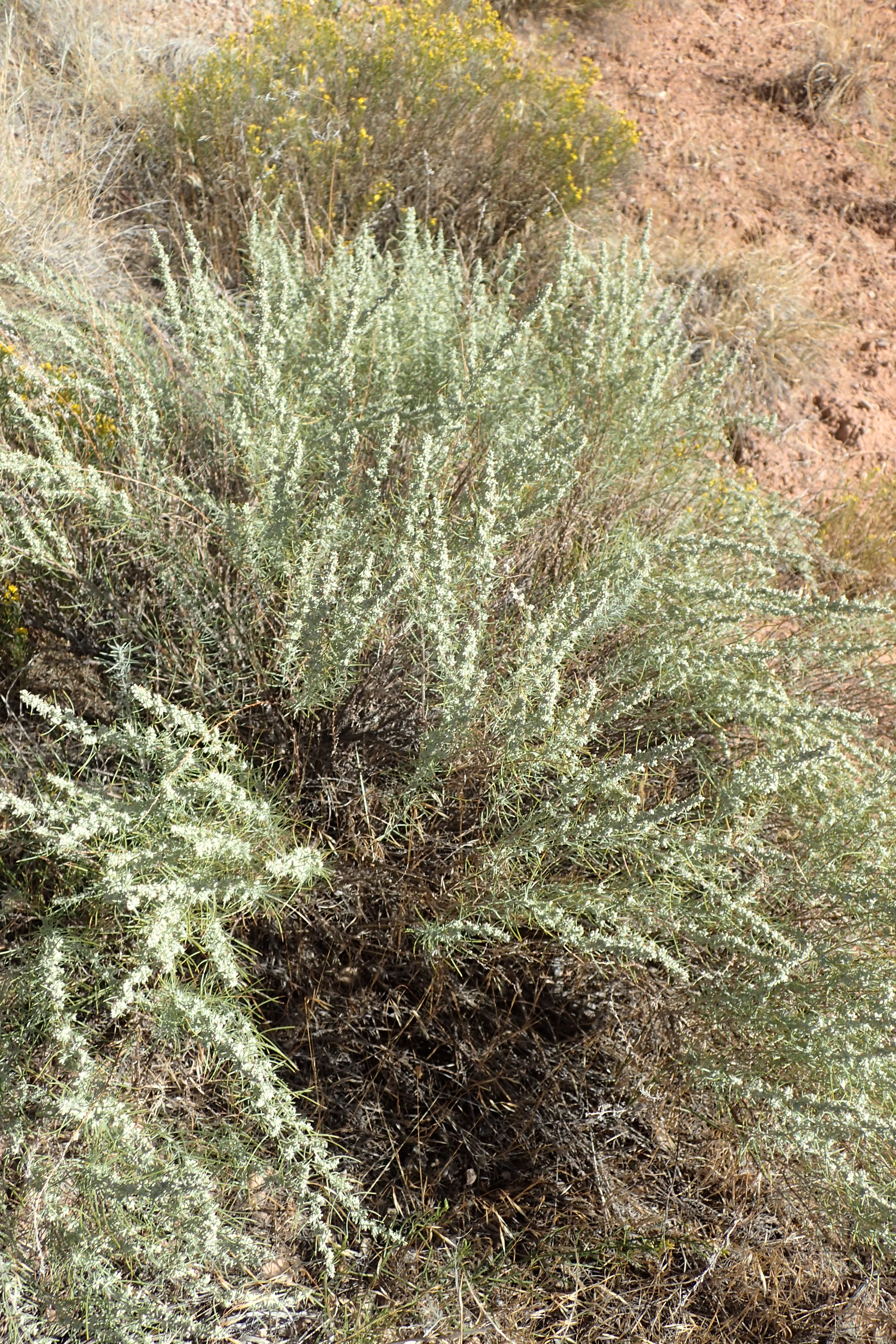
Artemisia filifolia, known as Sand Sage, Threadleaf Sage, or Sand Sagebrush, is one of the most distinctive and ecologically important native sages of the American Southwest and southern Great Plains. Unlike the familiar Big Sagebrush with its broad, wedge-shaped leaves, Sand Sage bears leaves so narrow and thread-like (filiform) that the plant looks almost like a fine-textured ornamental grass seen from a distance — an effect that gives it a uniquely airy, feathery appearance. Close up, the silvery-green, hair-thin leaves catch light beautifully, shimmer in the breeze, and release a pleasant, aromatic sage fragrance when disturbed.
Sand Sage is adapted to one of the most specialized habitats in North America: deep, loose, sandy soils of dunes, sandy plains, and sandy river terraces in the semi-arid Southwest and southern Plains. It is a dominant species of the sand sage–bluestem grasslands — a distinctive plant community that covers enormous areas of sandy soils in Colorado, Kansas, Nebraska, Oklahoma, and Texas — and also occurs in sandy desert situations in New Mexico, Utah, and Arizona. In this habitat type, Sand Sage forms extensive, nearly pure stands that provide crucial cover and food resources for dozens of wildlife species, including some of the most characteristic birds of the southern Plains.
For native plant gardeners, Sand Sage offers an unusual combination: the ornamental feathery texture and aromatic character of a sage, extreme drought tolerance and adaptability to sandy soils, and significant wildlife value. It is an underutilized plant in sustainable landscaping that deserves wider recognition as a beautiful, low-maintenance, ecologically valuable native for dry sandy gardens throughout its natural range.
Identification
Sand Sage is a rounded, multi-stemmed shrub typically 2 to 5 feet tall and similarly wide, with a graceful, arching habit. The thread-like leaves are the most distinctive identification feature: no other common sage shares this leaf form. Plants can be identified at a considerable distance by their distinctive filmy, grayish-green texture.
Stems & Habit
The stems are slender, flexible, and covered with fine silvery hairs when young, becoming grayish-brown and more woody at the base with age. The branching is numerous and somewhat pendulous, giving older plants an attractively arching form. Unlike some artemisias, Sand Sage rarely forms a solid woody framework — most stems are semi-woody to herbaceous, giving the plant a lighter, more graceful character. In severe drought, the plant may partially defoliate, but the root system survives and the plant refoliates quickly after rain.
Leaves
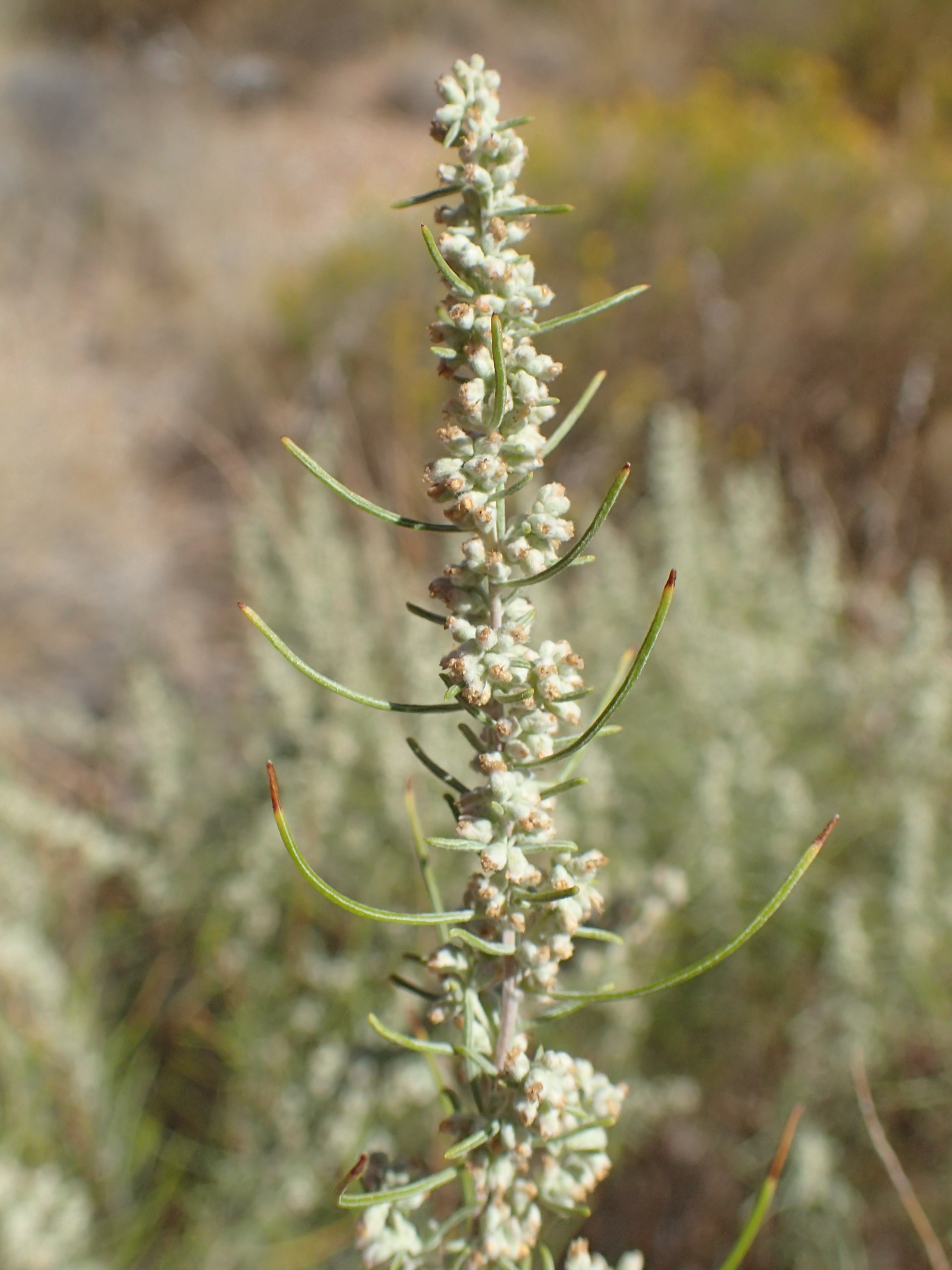
The leaves are the signature feature. They are linear-filiform (thread-like), just 1–3 inches long and barely 1 mm wide, grayish-green to silvery-green, and covered with fine hairs. The leaves are often clustered in fascicles (bundles) along the stems, creating a feathery, almost rush-like appearance. Some leaves are entire (unbranched); others are divided near the base into 3 thread-like lobes. When crushed, all leaf surfaces release a strong, pleasant sage fragrance from volatile oils — somewhat lighter than Big Sagebrush but equally distinctive.
Flowers & Fruit
Sand Sage blooms in late summer and early fall — typically August through October — producing narrow, leafy flower spikes along the upper portions of the current year’s growth. The individual flower heads are tiny — less than 3 mm wide — yellowish, and wind-pollinated. The seeds are tiny but nutritionally rich, and are an important food source for prairie songbirds through winter. The seed-bearing stems add subtle winter interest and should be left standing until early spring.
Quick Facts
| Scientific Name | Artemisia filifolia |
| Family | Asteraceae (Daisy/Composite) |
| Plant Type | Semi-evergreen Shrub |
| Mature Height | 4 ft |
| Sun Exposure | Full Sun |
| Water Needs | Low (Drought Tolerant) |
| Bloom Time | August – October |
| Flower Color | Yellow (inconspicuous) |
| USDA Hardiness Zones | 4–8 |
Native Range
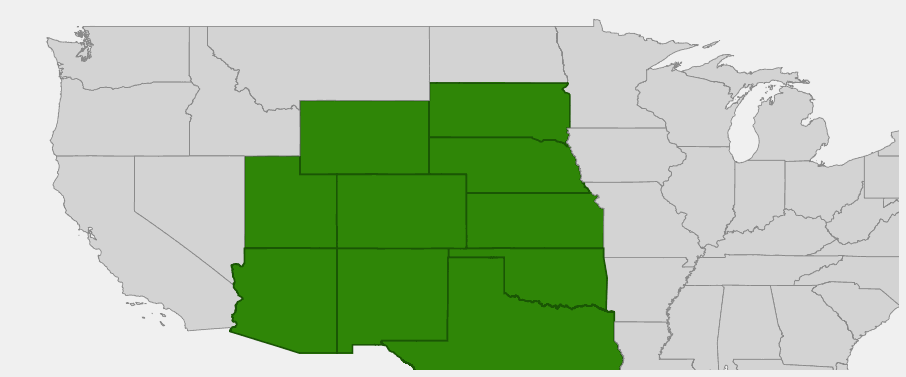
Sand Sage is native to the sandy soils of the semi-arid interior of the United States, ranging from the southern Great Plains westward through the Colorado Plateau and into the desert Southwest. It occurs in Colorado, Kansas, Nebraska, New Mexico, Oklahoma, Texas, Wyoming, South Dakota, Utah, and Arizona. In the southern Plains region — particularly in Colorado, Kansas, Oklahoma, and Texas — Sand Sage is a dominant species of the “sand sage prairie” community, a distinctive grassland type that develops on deep, loose sandy soils deposited by wind or ancient rivers.
In Utah, Sand Sage occurs in the eastern and southeastern parts of the state on sandy flats and dune areas of the Colorado Plateau — in San Juan County, Grand County, and surrounding areas where sandy desert conditions prevail. It is typically found at elevations from 4,500 to 6,000 feet in Utah, growing with other sands-adapted plants including Indian Ricegrass, Galleta Grass, and Fourwing Saltbush. The plant’s specific adaptation to deep sandy soils means it is absent from the rocky or clay-dominated terrain that makes up much of Utah’s landscape.
The distribution of Sand Sage closely tracks the distribution of eolian (wind-deposited) sandy soils across the interior West — it is essentially a map of where the wind has deposited sand over geological time. Along the Arkansas and Canadian river drainages in the southern Plains, enormous Sand Sage communities developed on the sandy terraces and dune fields created by these river systems. These communities have been significantly reduced by agricultural conversion, but large tracts remain on National Grasslands and private ranchlands in Colorado, Kansas, and Oklahoma.
📋 Regional plant lists featuring Sand Sage: Utah
Growing & Care Guide
Sand Sage is highly specialized — it demands sandy, well-drained soil above all else, but in that specific niche it is an exceptionally tough, beautiful, and valuable native shrub. If you have the sandy soil conditions it requires, Sand Sage will reward you with years of ornamental interest and wildlife value.
Light
Full sun is essential. Sand Sage grows on open, exposed sandy flats and dune slopes where it receives unobstructed sunlight all day. In shade or even partial shade, it becomes leggy, loses its characteristic compact form, and is more susceptible to disease. Plant in the most sun-exposed, open location available.
Soil & Water
Sandy, well-drained to excessively drained soil is the absolute requirement. This is not a plant for clay soils under any circumstances — it will fail quickly in poorly draining conditions. Sandy loam, coarse sand, or gravelly soil with very fast drainage is ideal. In appropriate sandy conditions, Sand Sage is extremely drought-tolerant and requires virtually no supplemental irrigation once established. During the first season, water deeply every 2–3 weeks to establish the root system, then largely leave it alone.
Planting Tips
Plant in spring or fall in container-grown form. Handle the root system gently during transplanting — Sand Sage develops a deep taproot that is important for drought survival. Mulch with coarse sand rather than organic material. Do not fertilize. Space plants 4–5 feet apart for a naturalistic planting.
Pruning & Maintenance
Minimal pruning is needed. In early spring, cut back any winter-killed branch tips and trim to maintain a compact, rounded form. Leave the seed-bearing stems standing through winter to provide food for birds — clean up in early spring. Sand Sage is naturally long-lived in appropriate conditions with minimal care.
Landscape Uses
- Sandy soil xeriscape — one of the best shrubs for dry sandy conditions
- Sand dune stabilization — natural sand binder with deep root system
- Prairie and grassland restoration — key species in sand sage prairie communities
- Texture contrast — unique fine-textured foliage contrasts with broader-leaved plants
- Wildlife habitat planting — essential Lesser Prairie-Chicken and songbird cover plant
- Low-maintenance dry slope planting — once established, completely self-sufficient
Wildlife & Ecological Value
Sand Sage is a cornerstone species in sand sage prairie ecosystems, providing critical food, cover, and nesting habitat for a distinctive assemblage of wildlife adapted to sandy semi-arid environments.
For Birds
Sand Sage is perhaps most famous as essential cover and nesting habitat for the Lesser Prairie-Chicken (Tympanuchus pallidicinctus), a threatened grouse species that depends on sand sage prairie communities across the southern Great Plains. Lark Buntings, Cassin’s Sparrows, Scaled Quail, and Loggerhead Shrikes are characteristic breeding birds of sand sage communities. The seeds provide winter food for numerous sparrow species — Vesper Sparrow, Lark Sparrow, and Grasshopper Sparrow are common consumers.
For Mammals
Pronghorn Antelope graze on Sand Sage throughout its range — it is one of the more important forage plants for pronghorn on the southern Plains. Mule Deer browse it in arid portions of its range. Black-tailed Jackrabbits use the dense stands as daytime cover and consume the foliage. Kangaroo Rats are common inhabitants of sand sage habitat, caching seeds for winter food.
For Pollinators
While wind-pollinated and not a major nectar resource, the pollen of Sand Sage does serve specialist bee species that collect Artemisia pollen in late summer. Several native bee species time their late-season brood-provisioning to coincide with the flowering of artemisias including Sand Sage. The flowers also attract beneficial insects including parasitoid wasps that contribute to pest-control ecosystem services.
Ecosystem Role
Sand Sage is an essential sand-binding plant — its deep taproot and extensive lateral root system stabilize loose dune sands that would otherwise move freely in the wind. Loss of Sand Sage from sandy areas through drought, overgrazing, or disturbance can trigger reactivation of sand dunes. The plant’s aromatic oils also appear to play a role in regulating soil microbial communities, and its decaying leaf litter contributes to the thin organic layer that develops on sandy prairie soils over time.
Cultural & Historical Uses
Indigenous peoples of the southern Great Plains and Southwest used Sand Sage and related artemisias for a range of medicinal and ceremonial purposes. The plant was used as a smudging herb — burning bundles of dried Sand Sage to purify spaces and objects in ceremonial contexts. The aromatic smoke was believed to carry prayers and to drive away negative energies, a use consistent with pan-cultural use of artemisia smoke in ceremony across the Americas and Eurasia.
Medicinally, Sand Sage was used to treat respiratory ailments — the fragrant steam from boiling the plant was inhaled to relieve congestion and colds. A poultice of crushed leaves was applied to sores and skin irritations. The plant was used as a natural insect repellent, with bundles placed in bedding and clothing to deter lice and other insects. Spanish settlers and Anglo ranchers also used it for similar purposes, particularly as a campfire fuel that produced pleasant-smelling smoke while repelling insects.
In the ranching culture of the southern Plains, sand sage country was known primarily as winter range — the sandy soils were difficult to farm and the vegetation too sparse for intensive livestock production. Today, these same areas are recognized as having extraordinary conservation value — they harbor rare and declining species including the Lesser Prairie-Chicken, Swift Fox, and various endemic invertebrates. Sand Sage’s role as an ecosystem engineer — literally holding the sand in place — makes it indispensable to the long-term ecological health of these landscapes, and it is increasingly planted in conservation seedings on disturbed sandy soils throughout its range.
Frequently Asked Questions
Is Sand Sage different from Big Sagebrush?
Yes — they are different species within the same genus. Big Sagebrush (Artemisia tridentata) has broader, three-lobed, gray-green leaves and grows much larger (3–8 ft). Sand Sage (Artemisia filifolia) has thread-fine, filiform leaves and typically stays 2–5 feet. Sand Sage is specifically adapted to deep sandy soils; Big Sagebrush grows on a wider range of soils. Both are aromatic, drought-tolerant, and ecologically important natives of western North America.
Will Sand Sage grow in clay soil?
No — Sand Sage is specifically adapted to sandy, fast-draining soils and will not thrive in clay. It is one of the most soil-specific native plants available. For clay soils, consider Fringed Sage (Artemisia frigida) or Big Sagebrush (Artemisia tridentata), which are more soil-adaptable.
How tall does Sand Sage get?
In favorable sandy conditions, Sand Sage typically reaches 3–5 feet tall and equally wide. In very dry, exposed conditions it may stay smaller. In the landscape, most specimens fall in the 3–4 foot range in appropriate sandy conditions without supplemental irrigation.
Is Sand Sage good for birds?
Extremely so, particularly on the southern Great Plains where it is essential cover for the threatened Lesser Prairie-Chicken. For backyard gardens in its range, Sand Sage provides cover and nesting habitat for ground-nesting sparrows and quail, and its seeds feed numerous seed-eating songbirds in fall and winter.
When should I plant Sand Sage?
Plant in spring (after last frost) or fall (at least 6 weeks before first frost). Spring planting in the Southwest allows the plant to establish during the warm season before facing its first winter. Fall planting works well in mild-winter areas. Avoid summer planting in hot, arid climates where establishment stress would be too great.

Looking for a nursery that carries Sand Sage?
Browse our native plant nursery directory: Utah