
Common Silverweed (Argentina anserina)
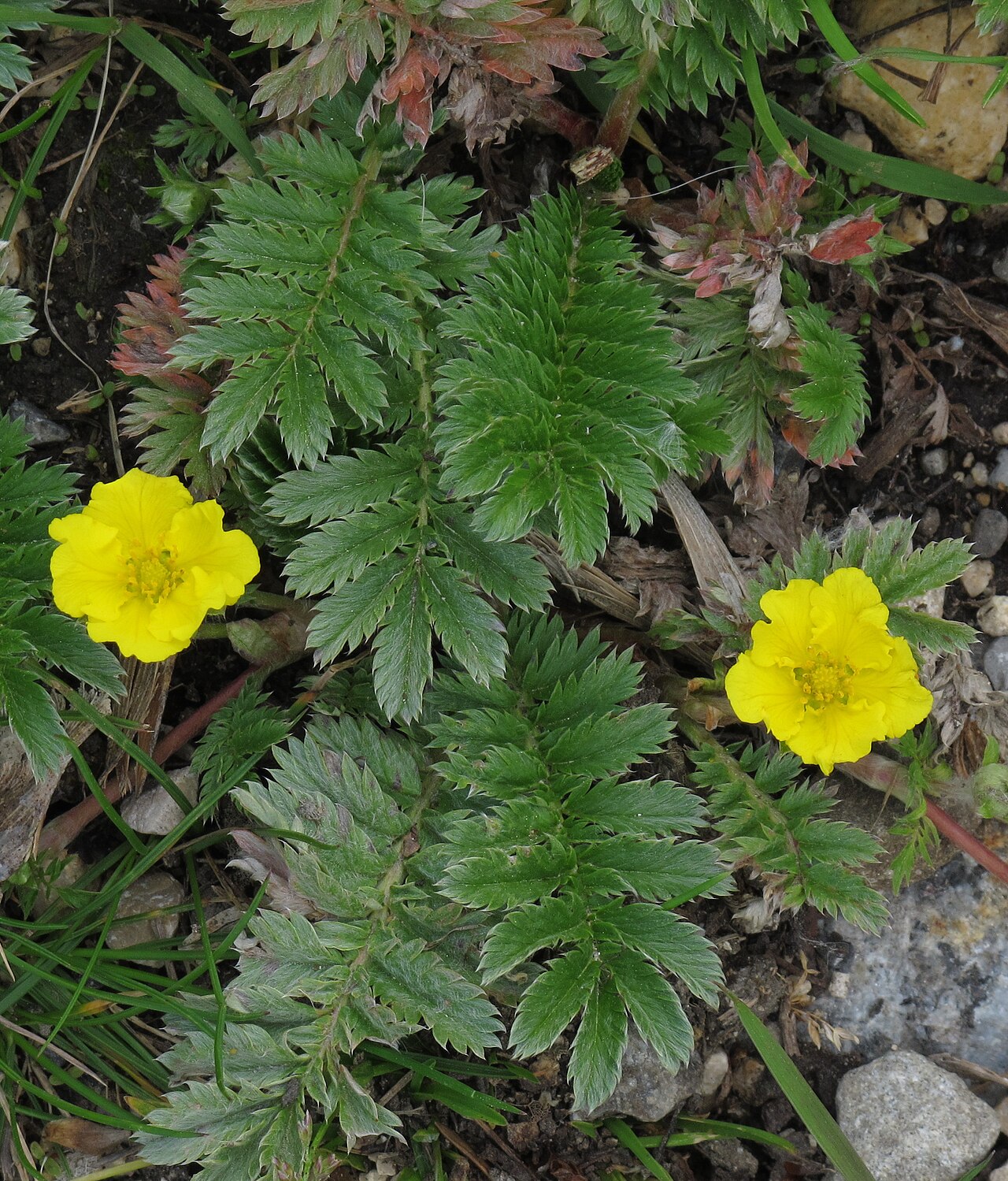
Common silverweed (Argentina anserina), long known as Potentilla anserina, is a low perennial with yellow flowers, finely divided leaves, and a spreading network of runners. The pale, silky appearance of the foliage gives the plant its common name. In the right setting it makes a lively ground layer, but its ability to spread means that it needs thoughtful placement rather than an automatic place in every border.
For New England gardeners, there is an important native-range distinction: Go Botany treats it as native in Maine, New Hampshire, and Vermont, but introduced in Massachusetts. It does not document it as native in Connecticut or Rhode Island. Broader global databases differ, so this guide follows the regional flora for that part of the map. Do not promote it as a universally native New England plant.
Its usual setting is open, moist ground, including shores and wet meadows. Established plants can tolerate some dryness, but a dry-only label does not describe the species well. Choose a sunny, adequately moist location with room for runners, and confirm local status and provenance before planting near natural habitat. The regional table has been clarified to show both moisture needs and the New England nativity caveat.
Identification
Divided Leaves
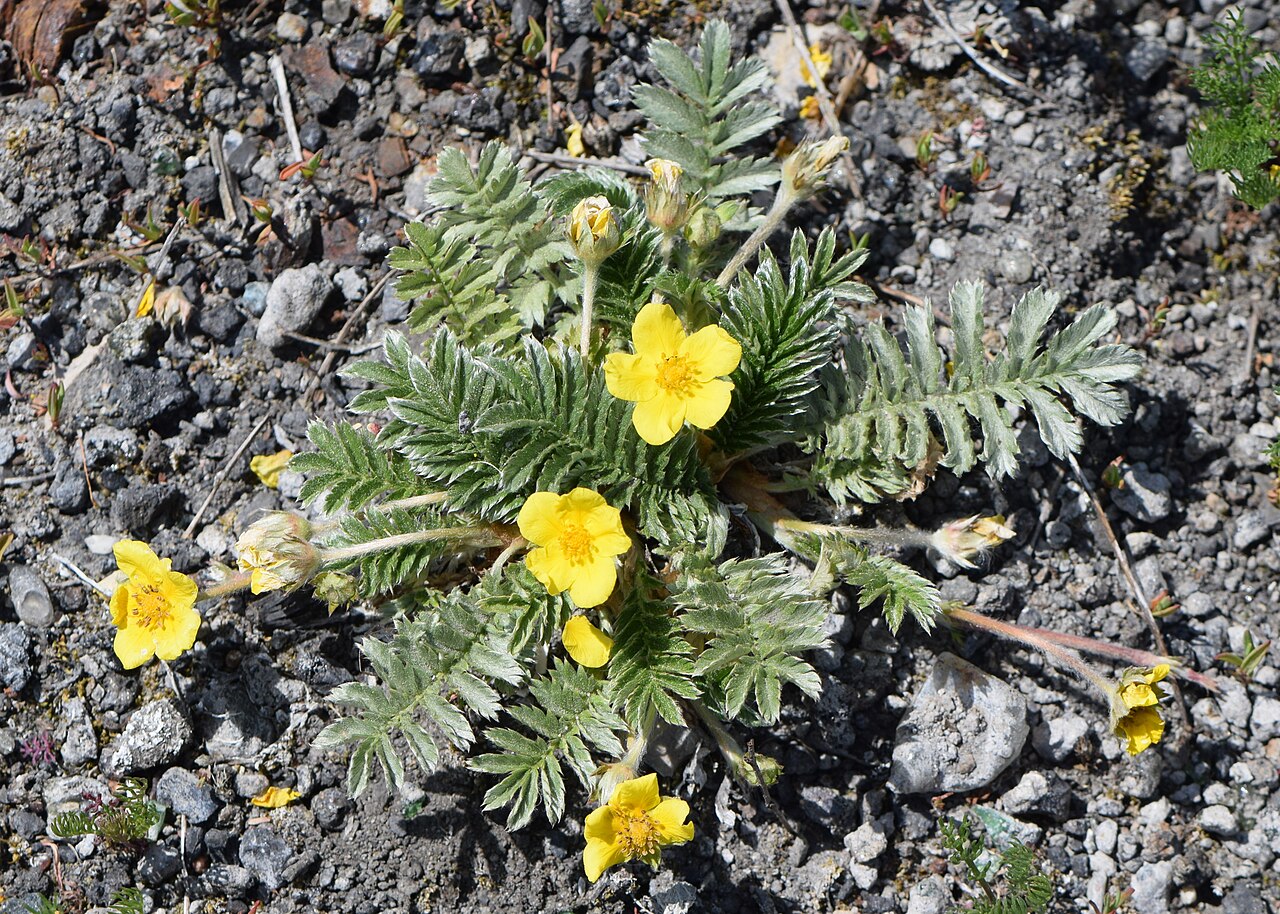
The leaves are pinnately divided: a series of toothed leaflets sits along a central axis, with a terminal leaflet at the end. Smaller segments can occur between larger ones. This feather-like arrangement is different from the simple leaf of a violet or the three main leaflets of a strawberry. The underside is notably silky and pale, creating a silver effect when leaves move or turn. Examine a complete leaf rather than identifying the plant from color alone.
Runners & Low Habit
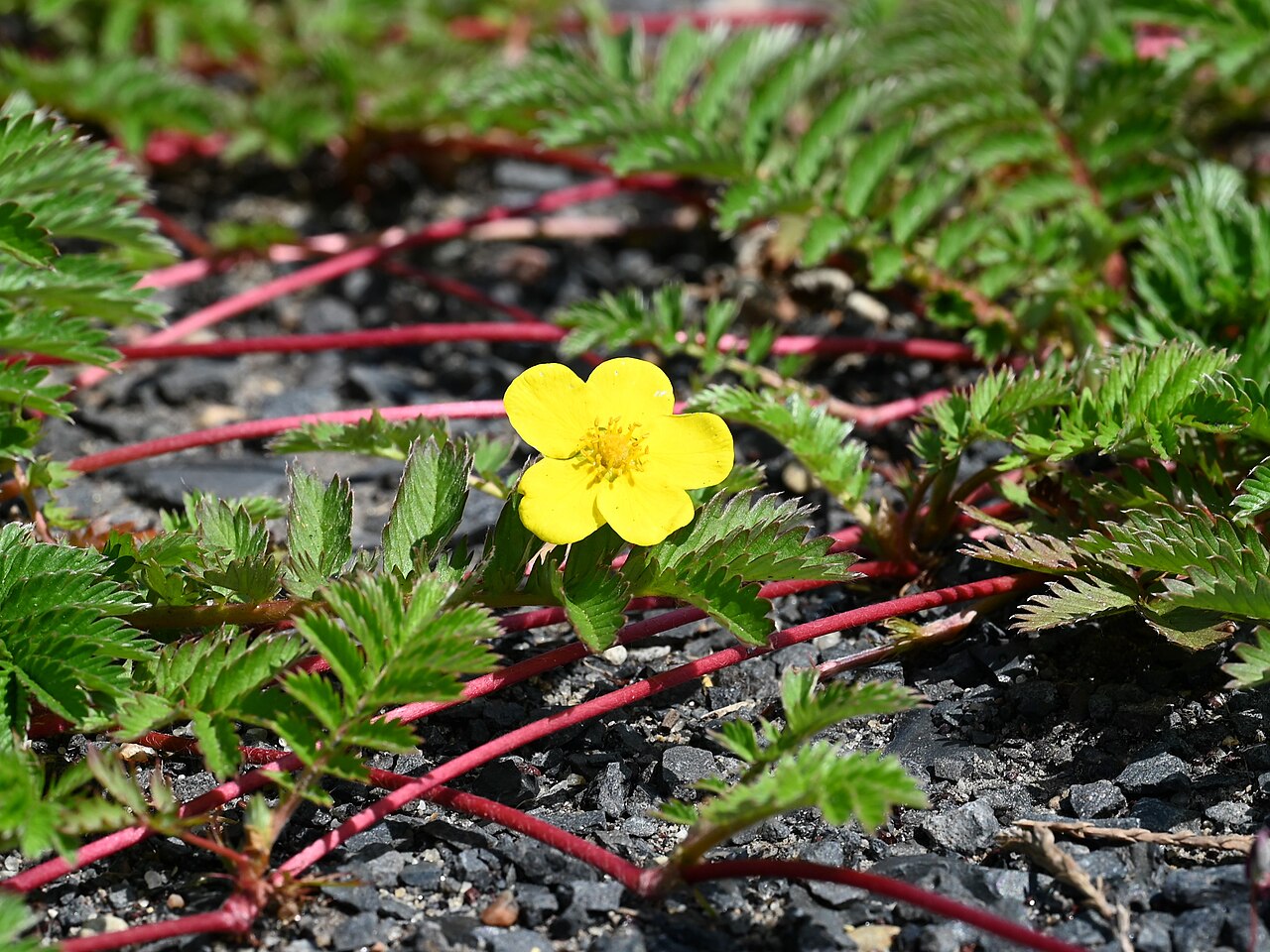
Long, slender runners creep along the ground and can root at nodes to form new plants. The visible patch can therefore be much broader than any one crown. There is no woody bark or shrub framework. Trace a runner gently with your eyes instead of pulling it out; the rooting nodes help explain both its usefulness as cover and its potential to wander into adjacent garden spaces.
Yellow Flowers
Flowers are carried singly on stalks and have five bright yellow petals. Their open shape contrasts with the divided foliage beneath them. Bloom timing varies with climate, often extending through part of the summer. Several unrelated plants have small yellow flowers, so combine the flower with the feather-like leaves, silvery underside, and runner habit before assigning an identification.
Fruit
The fruit is a cluster of small dry achenes rather than a fleshy strawberry. Despite some similarities in creeping growth to strawberries, silverweed does not produce a red berry. Seed and vegetative growth can both contribute to a patch. Where spread is unwanted, removing only faded flowers will not stop runners from rooting into neighboring soil.
Related Silverweeds
Other silverweeds, including coastal taxa formerly included in broad Potentilla anserina treatments, require a regional key. A plant from a salt marsh or Pacific coast should not automatically be assigned to the same narrow species merely because it has silver leaves. The photographs here are identified common silverweed from Europe, within its broad Northern Hemisphere native range; they are not presented as evidence of local North American provenance.
Quick Facts
| Scientific Name | Argentina anserina (L.) Rydb.; synonym Potentilla anserina L. |
| Family | Rosaceae |
| Plant Type | Low, stoloniferous herbaceous perennial |
| Mature Height | Typically about 6–12 inches in garden descriptions |
| Mature Spread | Often 1–3 feet initially; runners can extend the patch farther |
| Growth Rate | Spreading by rooting runners in suitable conditions |
| Sun Exposure | Full sun; light shade tolerated, not deep shade |
| Water Needs | Moist to average soil; established plants can tolerate some drying |
| Soil Type | Adaptable open-site soil, including moist meadow and shore substrates |
| Soil pH | Adaptable; assess the actual site rather than applying a narrow target |
| Bloom Time | Summer, with timing varying by region |
| Flower Color | Yellow |
| Fall Color | Not selected for a predictable fall display |
| Fruit | Small dry achenes, not a berry |
| Deer Resistant | No firm resistance rating adopted |
| USDA Hardiness Zones | 4–7 in Missouri Botanical Garden horticultural guidance |
Native Range
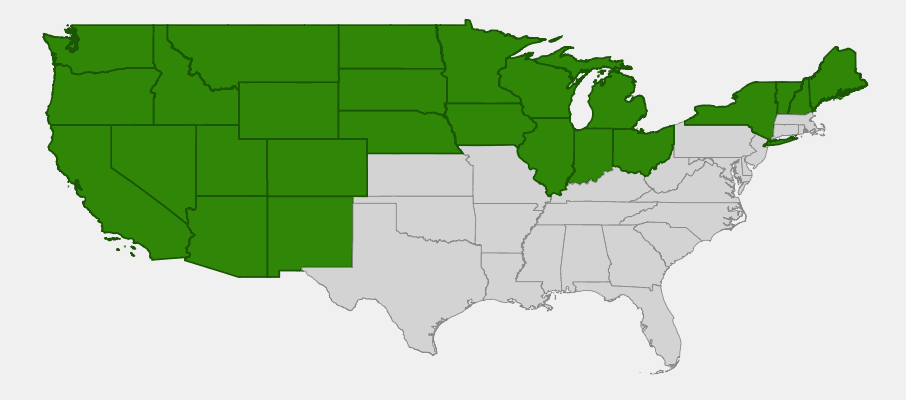
Kew recognizes Argentina anserina as an accepted species native across much of the temperate Northern Hemisphere and into northern Mexico. Its North American range includes Alaska, broad Canadian areas, and many western and northern U.S. states. Potentilla anserina is a synonym, not a second species to plant alongside it merely because a supplier uses the older genus.
At the New England scale, the regional account is more restrictive than Kew’s broad distribution. Go Botany identifies native populations in Maine, New Hampshire, and Vermont and introduced occurrence in Massachusetts; Connecticut and Rhode Island are not included in its documented regional distribution. This map therefore removes those three southern New England states from Kew’s broad native list and explains that choice rather than silently treating all records as equivalent.
The map should be read as a source-based overview, not as proof of nativity at every shore, meadow, or roadside within a shaded state. Historic planting, disturbance, and changing taxonomic concepts can complicate local records. For restoration or planting next to natural wetlands, consult a regional botanist or conservation source and obtain material of appropriate origin. An ornamental garden label alone is not enough to establish local native status.
📋 Regional plant list: New England
Growing & Care Guide
Check Local Status First
Before choosing silverweed for a native planting, verify that it belongs in your region under the current local treatment. This is especially important in southern New England, where a broad continental map can be misleading. Keep nursery provenance information with the garden record. If the objective is strict local restoration rather than ornament, do not substitute a plant of unknown origin simply because the scientific name appears on a general native list.
Use Open Light
Full sun is the standard garden position, with light shade tolerated. Deep woodland shade is a poor match for a plant associated with open shores and meadows. Consider the mature canopy of neighboring plants as well as current conditions. A low silverweed patch can be shaded out when a dense tall perennial grows over it, even if the bed begins the season in full sun.
Match Moisture & Drainage
Moist, reasonably drained soil is a useful starting point. The species occurs in wet-ground settings, and established plants can also endure some drying, but those facts do not justify a dry-only recommendation. Observe both the spring and summer water pattern. Avoid assuming that permanent deep water or a parched gravel bed is suitable merely because the species tolerates a wide range of conditions somewhere in its continental range.
Plant With Room for Runners
Set propagated plants at their original soil depth and water them in. Leave room for the runners to move across the surface, but define the boundary of the planting from the beginning. A path or maintained edge can make monitoring easier. Do not place a vigorous spreading plant immediately against a small, slow-growing specimen that cannot compete for space.
Control Spread Early
Inspect the edge of the colony during active growth. Runners that have just reached an unwanted area are easier to redirect or remove than a large rooted patch. Keep viable fragments out of adjacent natural areas and dispose of unwanted material responsibly. Native status within a region does not mean that a plant will behave politely in every garden design; its spreading habit must still fit the intended use.
Water New Plants Carefully
A nursery root ball can dry before the surrounding soil does, especially in sun and wind. Check it directly during establishment and water gently when needed. Once the plant is rooted into the site, adjust watering to actual conditions rather than following a fixed daily schedule. Drought tolerance in an established patch should not be used as a reason to neglect newly transplanted material.
Feeding & Soil Care
Heavy feeding is rarely a sensible first step for a plant that already spreads readily. Evaluate moisture, light, and root health before adding nutrients. A soil test can guide corrections where a real deficiency or pH problem is suspected. Avoid fertilizer runoff into nearby water, particularly in a shore or rain-garden planting. Keep the soil stable and do not repeatedly cultivate through the runners.
Propagation & Seasonal Maintenance
Rooted runner sections provide an obvious vegetative propagation route for established garden material; retain healthy roots and keep divisions moist during transplanting. Seed can also contribute to reproduction. Use responsibly propagated stock rather than removing wild shore vegetation. Cut back only what is necessary for the design, and monitor new growth the following season so the colony remains within its intended boundaries.
Climate & Performance
Missouri Botanical Garden notes that performance is generally better in cool northern summers and can decline in hotter, humid regions. A hardiness-zone number describes winter temperature, not every aspect of summer suitability. If a planting repeatedly struggles despite adequate moisture, consider heat exposure and regional adaptation rather than attempting to solve the problem with more fertilizer.
Landscape Uses
- A monitored low groundcover in locally appropriate open, moist garden areas.
- A sunny native meadow edge where its runner habit is compatible with neighbors.
- A close-view foliage planting highlighting silvery divided leaves and yellow flowers.
- A botanical teaching garden with clear labels distinguishing common silverweed from related coastal taxa.
Wildlife & Ecological Value
Flowers & Habitat Context
The open yellow flowers add seasonal floral structure to a moist-ground planting. The most useful approach is to grow the species within a diverse assemblage of locally appropriate plants rather than attributing an unsupported list of specialist animals to it. Observe actual visitors and combine it with species that provide other flowering times and physical structures.
Ground Cover
A spreading patch occupies the soil surface and can complement low grasses or sedges where growth rates are compatible. It is not a universal erosion-control solution, and it should not be introduced into a sensitive natural area without local guidance. The distinction between a manageable garden colony and an ecological introduction is important, especially where the species is not regionally native.
Responsible Sourcing
Select nursery-grown material and retain the identity and origin records. Avoid collecting plants from wild shores, where roots and runners may be part of a fragile plant community. When silverweed is introduced rather than native in your locality, choose a locally native alternative for habitat restoration instead of assuming that a continental native designation settles the question.
Cultural & Historical Uses
Common silverweed has been widely recorded under Potentilla anserina, and many horticultural sources still use that name. Kew and the USDA profile used here place it in Argentina. The change does not make the older name a different garden plant, but it is useful to search both combinations when reviewing older sources.
The plant’s broad Northern Hemisphere range explains why European photographs can correctly illustrate its morphology. Those images do not establish the origin of a nursery clone or the nativity of a particular North American population. Botanical identity, geographic provenance, and local native status are related questions, but they are not interchangeable.
Historical accounts of silverweed food use often involve particular peoples, places, or related taxa. This guide does not merge those accounts into a general edible-root recommendation. The practical focus is accurate identification, appropriate regional use, and management of a spreading perennial in a suitable moist, open setting.
Frequently Asked Questions
Is Potentilla anserina the same plant?
Yes, it is the older scientific combination for Argentina anserina used here. Search both names when checking older horticultural references.
Is it native throughout New England?
No. Go Botany treats it as native in Maine, New Hampshire, and Vermont, introduced in Massachusetts, and does not document Connecticut or Rhode Island as regional native occurrences.
Why was the dry-soil table code changed?
The plant commonly occupies moist open ground. Established drought tolerance does not make dry soil its only or best general description; the table now reflects moist-to-average conditions.
Does it produce strawberries?
No. It spreads by runners but produces dry achenes rather than fleshy red fruit.
Will it stay in a small clump?
Not necessarily. Runners can root beyond the original plant. Use it where that behavior is acceptable and monitor the edge of the patch.
Can I use any coastal silverweed photo or plant?
No. Related coastal taxa require separate identification. Do not assume every silvery, yellow-flowered shore plant belongs to Argentina anserina in the same taxonomic sense.
Sources & Further Reading
- Go Botany: Argentina anserina, regional nativity
- Kew Plants of the World Online: Argentina anserina
- Missouri Botanical Garden: Potentilla anserina
- USDA PLANTS: Argentina anserina
Find Native Plants
Ask growers about nursery propagation and regional provenance. Browse our Maine native plant nurseries, New Hampshire native plant nurseries, Vermont native plant nurseries, Connecticut native plant nurseries directory for suppliers.