
Thinleaf Alder (Alnus incana subsp. tenuifolia)
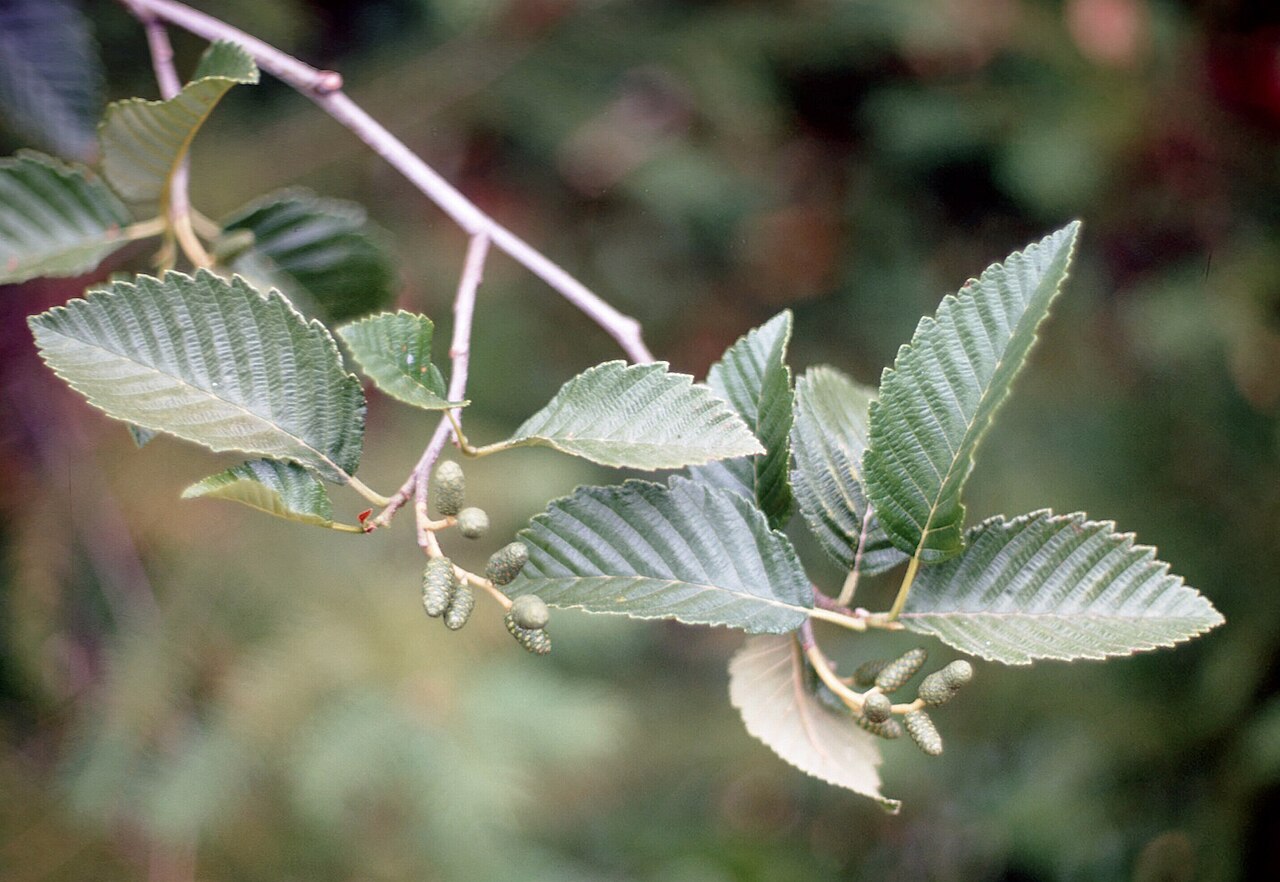
Thinleaf alder belongs to the cool, moist side of the western landscape. Along a mountain stream its many stems, toothed leaves and small woody fruit clusters create a dense green layer between water and upland vegetation. In a garden, the same plant can be useful on an appropriately wet site, but it is not a sensible choice for a dry gravel bed simply because it is native to Utah.
This page treats the western thinleaf alder as Alnus incana subsp. tenuifolia, also widely known as Alnus tenuifolia. The broader species Alnus incana includes other geographic forms, including eastern speckled alder and a Eurasian subspecies. Those broader records and photographs should not all be applied to the western plant.
The regional table once misspelled the genus as “Ainus.” Its common name, western location and Utah botanical references establish the intended thinleaf alder. The corrected entry now points to this subspecies-level guide rather than to an eastern alder with a similar name.
Identification
Leaves and their margins
The alternate leaves are simple rather than compound, with conspicuous teeth around the edge and prominent lateral veins. They are relatively thin and can have a slightly lobed outline. Compare both surfaces and several leaves, because a single damaged leaf may obscure the shape. Leaves are shed for winter; the plant should not be selected as an evergreen screen.
Twigs and buds
Slender twigs carry noticeable lenticels, and the buds sit on short stalks. These features are useful when leaves are absent. A photograph that includes a bud, a short section of twig and the attachment point can be more informative than a distant winter tree image. Bark on younger stems is relatively smooth and thin.
Catkins and cone-like fruits
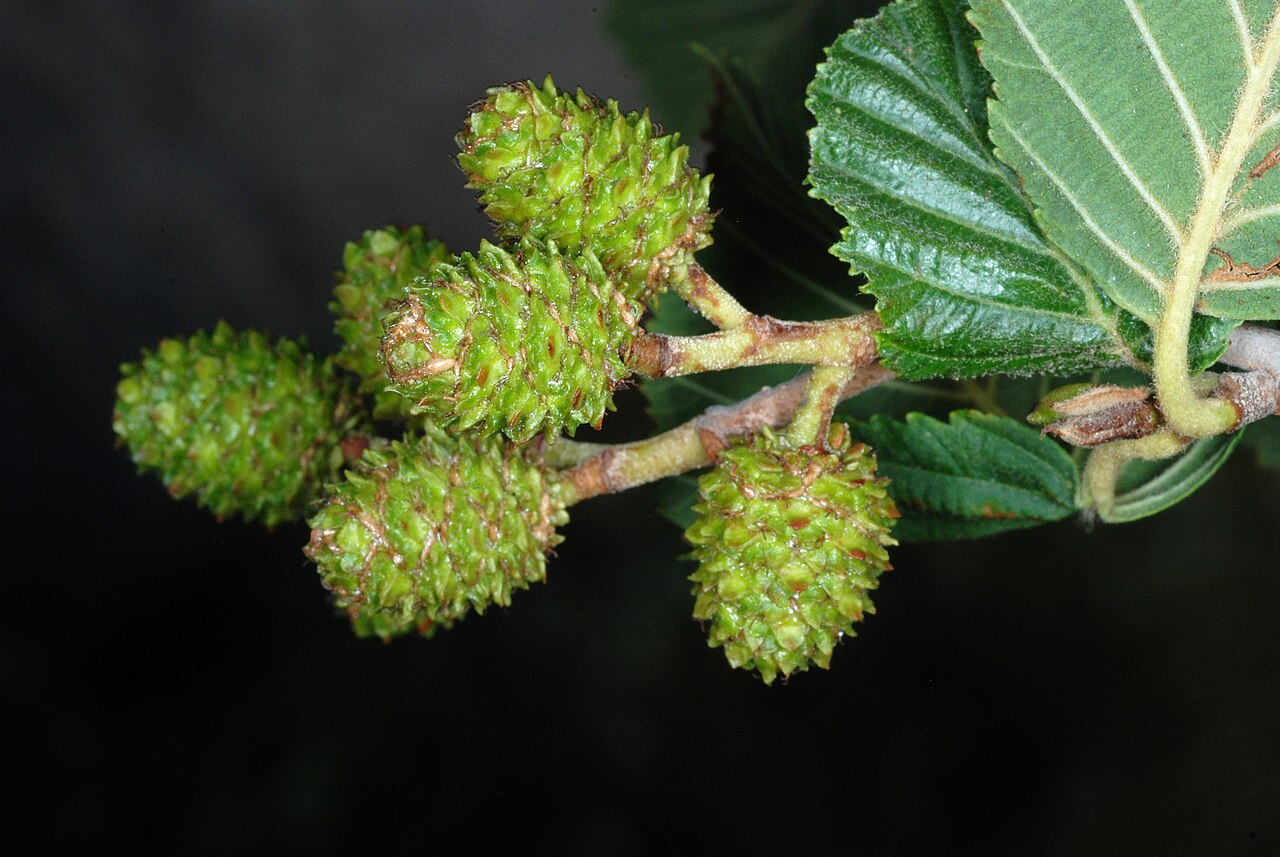
Male flowers occur in hanging catkins, while the female structures develop into small woody strobili containing nutlets. Gardeners commonly call these cones, but alder is a flowering tree, not a conifer. Old fruit clusters can remain after seed dispersal, so spring branches may show persistent older structures as well as new reproductive growth.
Whole-plant shape
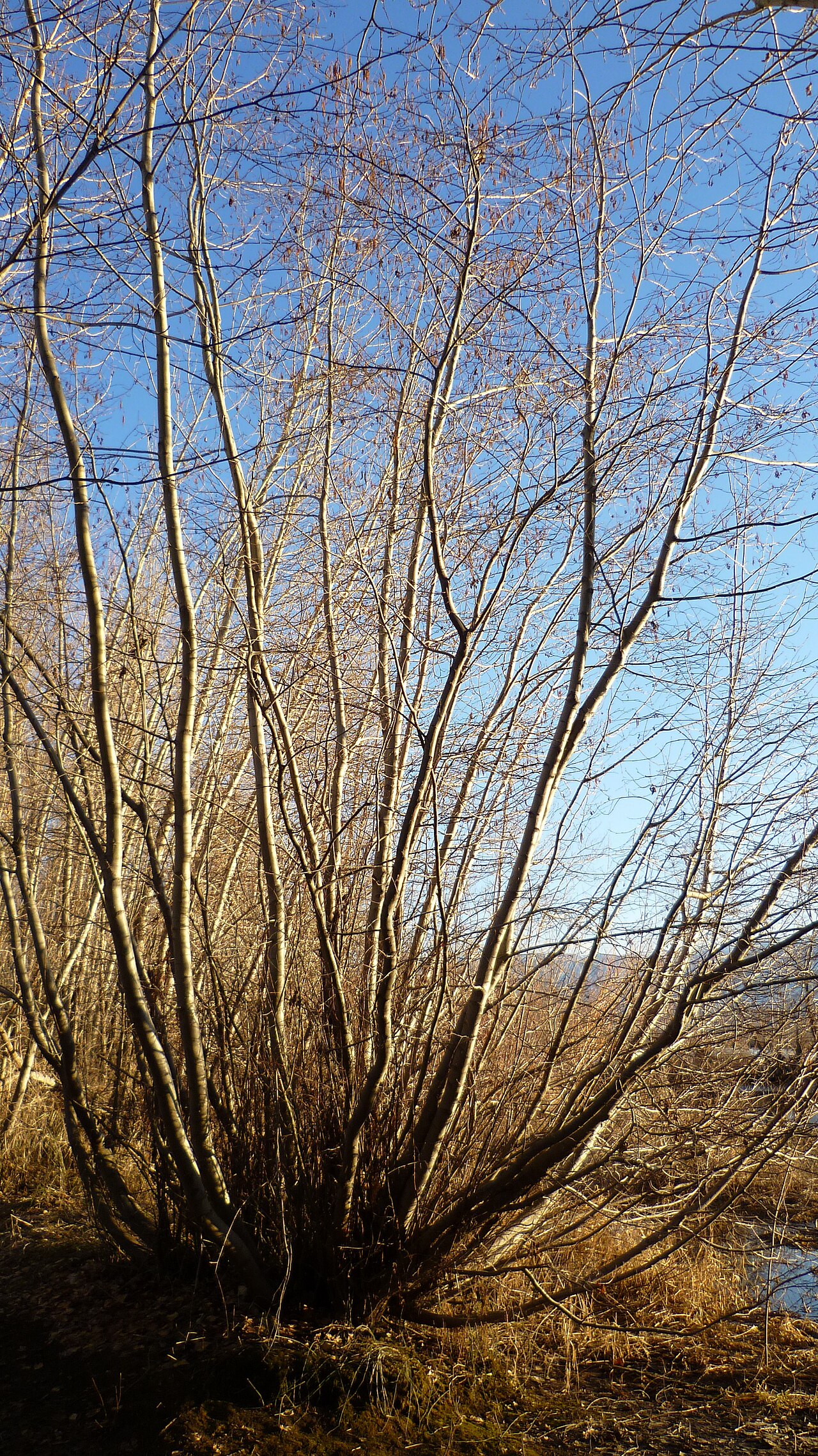
Thinleaf alder often has several stems rather than one tall, dominant trunk. Its form can be shrubby or tree-like depending on age and setting. Allow for that breadth when positioning a nursery plant. Repeatedly cutting a naturally multi-stemmed plant into an unsuitable narrow space can create a maintenance problem that better initial placement would avoid.
Distinguishing the western taxon
The name Alnus incana by itself is not precise enough to establish western provenance. Thinleaf alder is the subspecies tenuifolia in the treatment used here; eastern speckled alder is a different subspecies. Photographs of European gray alder are not substitutes for images of this western plant. Ask a nursery for the full name and source rather than relying on “alder” on a label.
Quick Facts
| Scientific Name | Alnus incana subsp. tenuifolia (syn. Alnus tenuifolia) |
| Family | Betulaceae |
| Plant Type | Deciduous multi-stemmed shrub or small tree |
| Mature Height | Often 10–30 feet; the regional table uses about 30 feet |
| Mature Spread | A broad, often multi-stemmed crown; allow room for local growth form |
| Growth Rate | Moderate; can form thickets on suitable moist sites |
| Sun Exposure | Sun to partial shade; young plants tolerate more shade |
| Water Needs | Moist, cool root zone preferred; not a dry-desert landscape tree |
| Soil Type | Moist streamside and alluvial soils; tolerates poor drainage |
| Soil pH | Can tolerate alkaline soils; site moisture remains important |
| Bloom Time | Spring catkins, before or around leaf emergence |
| Flower Color | Hanging male catkins; small female flower clusters |
| Fall Color | Usually modest foliage color; persistent fruit adds winter texture |
| Fruit | Small nutlets in persistent woody, cone-like strobili |
| Deer Resistant | Wildlife may browse it; young plants may need protection |
| USDA Hardiness Zones | 1–7 as listed by Utah State University |
Native Range
The native range runs from Alaska and western Canada south through the western United States to New Mexico. Both Utah and Colorado are included. Alaska is shown in a labeled inset on the map so that the northern part of the range is not lost when the contiguous states are displayed.
Thinleaf alder follows suitable moist habitat within this large geographic area. A colored state does not imply that the tree grows naturally on every dry hillside or throughout every desert valley. Stream flow, groundwater, soil and local climate help determine where a population can persist.
For a streamside restoration, use the local subspecies and appropriate provenance, and consider the hydrology before planting. A home garden has the same basic constraint: a cool, moist rooting environment is much more relevant than the fact that the plant occurs somewhere in the state. Do not transfer the entire worldwide range of Alnus incana onto this western subspecies map.
Native Range at a Glance
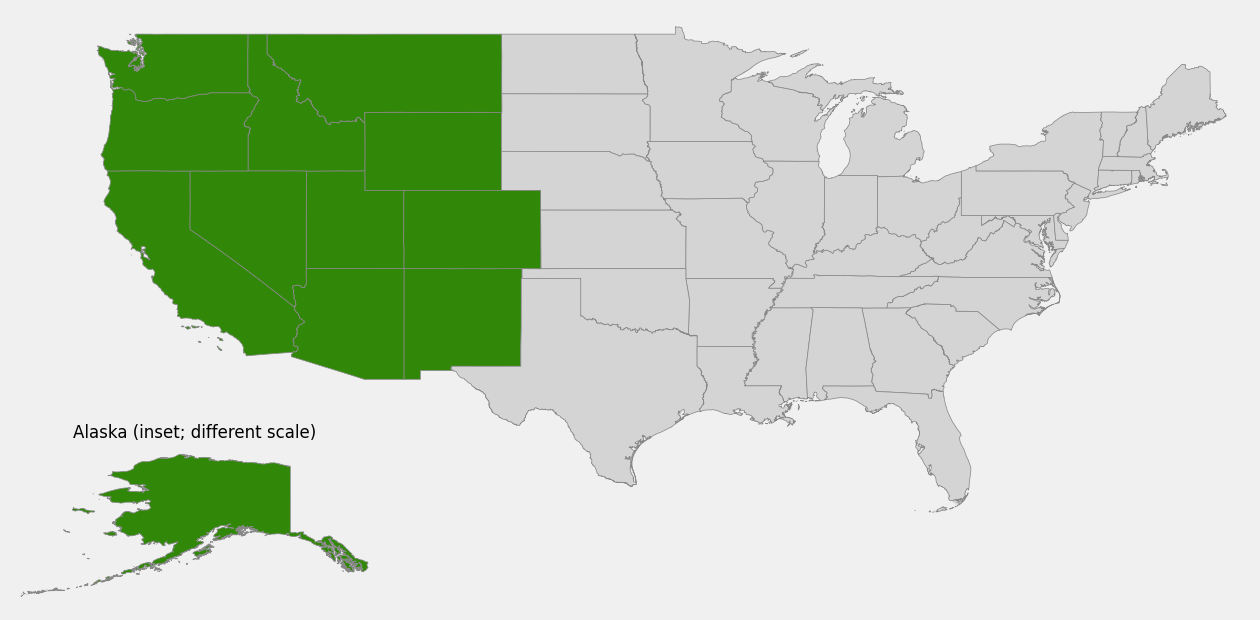
| U.S. States | Alaska, Arizona, California, Colorado, Idaho, Montana, Nevada, New Mexico, Oregon, Utah, Washington, Wyoming |
| Mexico / Canada / Other Range | Western Canada, including British Columbia, Alberta, Saskatchewan, Yukon and Northwest Territories |
| Ecoregion | Western riparian corridors, moist canyon bottoms and mountain stream margins |
| Elevation Range | Varies by latitude; Utah populations occur in moist canyon settings |
| Habitat | Streambanks, seeps, moist alluvial ground and cool canyon bottoms |
| Common Associates | Locally native willows, red-osier dogwood and other riparian plants; community varies |
Explore our regional native-plant lists: UT regional list. These lists cover several states; each species has its own native range.
Growing & Care Guide
Choose a site with reliable moisture
Observe the root zone through the dry season. A bed that is wet only during a spring storm may not support a moisture-loving alder in summer. Streamside, seep or naturally moist ground is the clearest starting point. If maintaining the tree would require continual irrigation in an otherwise dry landscape, a different native tree may be more appropriate.
Allow sun as the tree matures
Young thinleaf alders tolerate some shade, but an increasingly enclosed, heavily shaded site is not the same as an open riparian corridor. Place the tree where its crown will have room to develop. Avoid burying it beneath faster-growing neighbors and then interpreting its poor growth as a need for fertilizer.
Plant at the correct level
Set nursery stock at its existing root-collar level and water the root ball into the surrounding soil. Keep mulch away from the trunk bases, and check that ties or guards do not constrict the stems. A multi-stemmed specimen needs protection that accommodates all of its stems rather than squeezing them into a single-trunk guard.
Work with the natural form
Alder can make a broad, informal planting. Remove damaged or badly placed growth selectively, but avoid assuming that it must become a narrow ornamental standard. In a habitat planting, a thicket can be an asset; beside a narrow path, the same form may be inconvenient. Decide which role is wanted before planting.
Soil fertility and root relationships
Alders associate with nitrogen-fixing microorganisms in their roots. That ecological relationship does not mean that any stressed plant can be repaired by adding fertilizer, or that a home gardener needs to apply an unverified inoculant. Preserve a suitable rooting environment and diagnose specific problems before adding products.
Monitor water and wildlife
If leaves wilt or growth declines, check moisture, root disturbance and stem damage first. Browsing or rubbing animals can injure young stock even when mature trees persist nearby. Use temporary protection where needed without blocking light or airflow. Keep maintenance equipment away from the thin bark and exposed bases of multiple stems.
Landscape Uses
- A native riparian shrub or small tree on a reliably moist site in its western range.
- An informal screen or thicket where its natural multi-stemmed form has room.
- A teaching planting showing catkins, woody strobili and the difference between flowering trees and conifers.
- A restoration component selected with local hydrological and botanical guidance.
Wildlife & Ecological Value
For Pollinators
Alder flowers are not large nectar-rich blossoms like a showy garden perennial. Its ecological role should not be reduced to a generic claim that every native tree is a hummingbird flower. Leaves, twigs and the surrounding riparian community support interactions beyond the short flowering season.
For Birds
The small seeds and branching cover contribute to bird habitat. Preserve adjoining shrubs and ground-layer vegetation where appropriate, rather than expecting one isolated alder in a lawn to reproduce a streamside community. Persistent fruit clusters also add visible winter structure.
For Mammals
Browsing mammals may use alder, and beavers or other animals can alter streamside woody vegetation. In a garden, observe the actual damage before deciding on protection. A tree that supports wildlife may need temporary guarding while young; those goals are not contradictory.
Ecosystem Role
Along streams, woody vegetation helps create cover and a structured transition between water and upland ground. Planting should complement the site rather than be used as a substitute for repairing damaged hydrology. Do not dig wild alders from a streambank to supply a garden.
Cultural & Historical Uses
The common name thinleaf alder describes a foliage characteristic, while mountain alder points to a familiar western setting. Scientific references have treated it at species or subspecies rank. Including both Alnus tenuifolia and Alnus incana subsp. tenuifolia makes older and newer records easier to connect.
The persistent woody structures are often called cones in everyday language. A labeled garden offers an easy opportunity to explain that a cone-like fruit cluster does not make a plant a conifer. The hanging male catkins and deciduous broad leaves provide other parts of that botanical story.
Uses recorded for other alder species should not automatically be turned into instructions for this one. This guide focuses on landscape placement and habitat, not on medicinal preparation or harvesting. Nursery propagation and accurate provenance are the most useful practical priorities for a native planting.
Frequently Asked Questions
Is this the same as eastern speckled alder?
They belong to the broader Alnus incana complex but are different subspecies in this treatment. This page covers western subsp. tenuifolia, not eastern subsp. rugosa.
Can it grow in a dry Utah xeriscape?
It prefers moist, cool sites. Native to Utah does not mean adapted to every Utah soil and water regime; choose a drier-site tree for a dry landscape.
Are the little brown structures pine cones?
No. They are woody alder fruiting structures containing nutlets. Alder is a flowering tree in the birch family.
Why is Alaska shown separately?
It is part of the native range. The inset keeps Alaska visible without compressing the contiguous-state map; the two views use different scales.
Should I prune it to one trunk?
Only if that form is appropriate and can be developed without excessive intervention. Its natural multi-stemmed shape often works better in an informal habitat planting.
Sources & Further Reading
- Kew Plants of the World Online: identity, synonyms and native distribution
- USDA PLANTS profile
- Utah State University TreeBrowser: Thinleaf Alder
- USDA Forest Service: Alnus incana species review
- Utah State University: Logan Canyon Thinleaf Alder
- ITIS: Alnus incana subsp. tenuifolia
Find Native Plants Near You
Ask a native-plant nursery for correctly identified, nursery-propagated stock and information about regional provenance. Match the plant to your site rather than collecting it from a wild population.
Utah native plant nurseries · Colorado native plant nurseries