
Galleta (Hilaria jamesii)
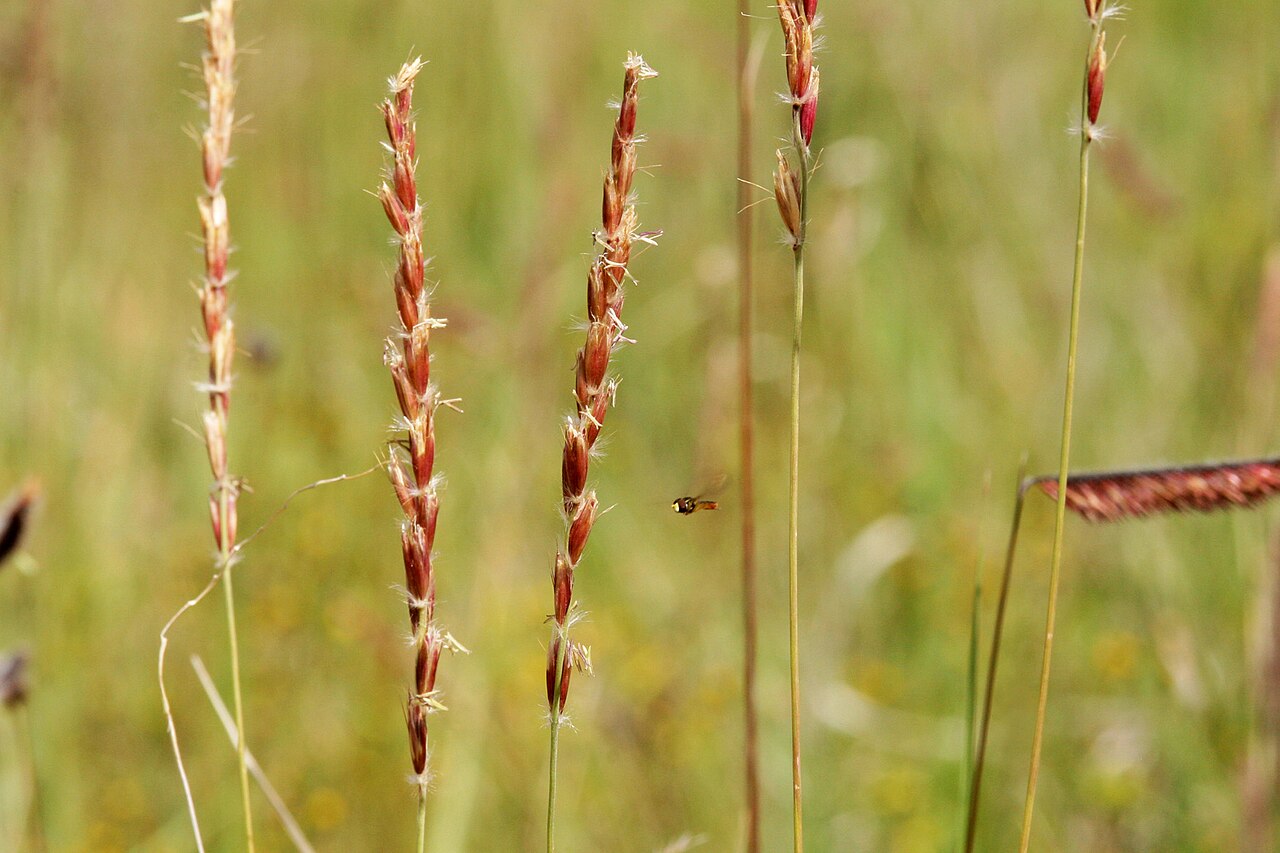
Galleta is one of the grasses that makes the Colorado Plateau look like itself. Short, wiry leaves, upright stems and small, closely arranged flowering clusters give it a restrained texture among sagebrush, saltbush and pinyon-juniper openings. It is a native warm-season perennial adapted to dry western landscapes, including Utah and western Colorado, where its spreading underground stems can help bind suitable soil.
Its scientific name is Hilaria jamesii, and many authoritative range and seed references use the synonym Pleuraphis jamesii. These names refer to the same galleta discussed here. Do not confuse it with big galleta, a different and much larger desert grass. This species often looks like separate clumps at first, but shallow rhizomes can connect those clumps and eventually create patches rather than isolated ornamental tufts.
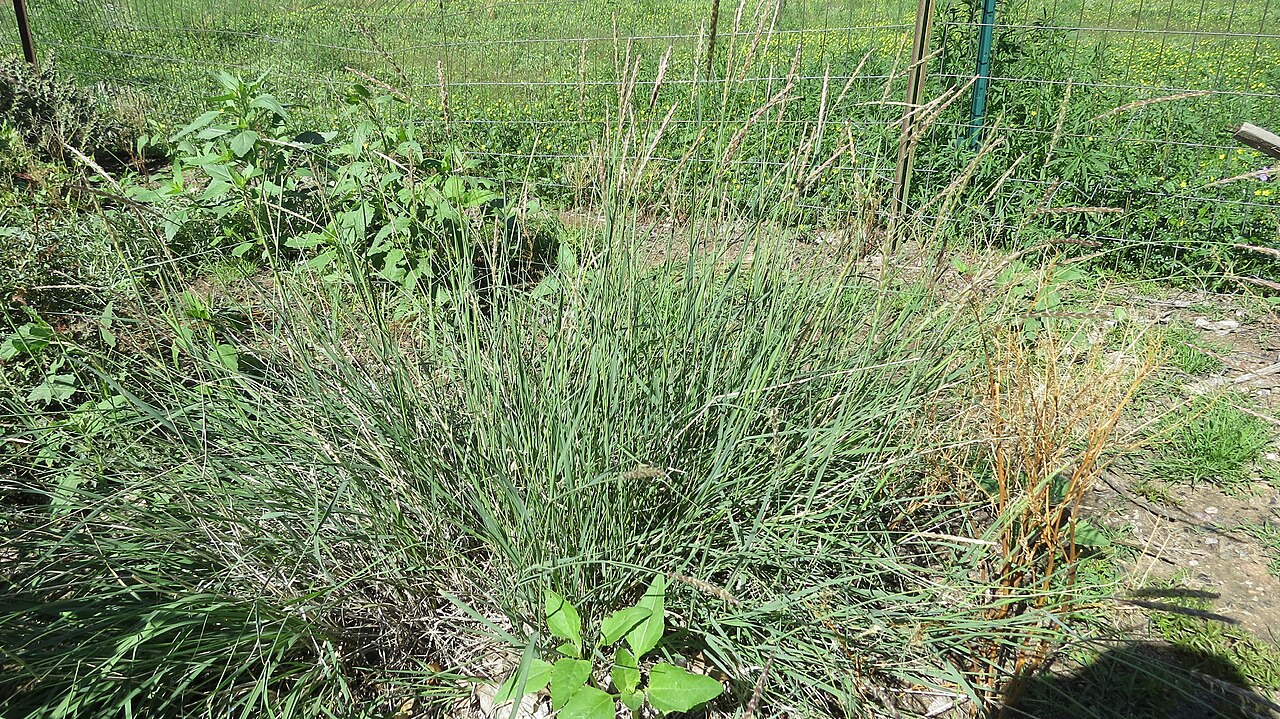
That growth habit is both its value and its design constraint. Galleta can contribute durable low structure in a dry native planting, yet it is not a neat, evergreen substitute for a conventional lawn. It responds to warmth and available moisture, cures in dry or cold periods, and needs room to spread. Use it where its seasonal appearance and lateral growth fit the site, not in a tiny bed where every new shoot would need removal.
Identification
Stems and spreading habit
Flowering stems are slender and upright, arising from a persistent base and a network of rhizomes just below the soil surface. A young patch may resemble a bunchgrass, but new shoots beyond the original crown reveal the spreading habit. Forest Service descriptions give a broad culm height of roughly 3–24 inches, depending on site and season. Many dry-site plants occupy the lower part of that range; a wet-year garden specimen can be appreciably taller than a six-inch table entry suggests.
Leaves
Leaf blades are narrow, firm and commonly curved or rolled as they dry. The foliage is much smaller in scale than that of big ornamental grasses. Look at a living shoot and a cured shoot together before interpreting stiffness or brown color as a disease symptom. In drought, reduced green leaf area is part of the plant's seasonal response. Leaf texture alone is insufficient to distinguish every southwestern grass, so use mature flowering material and a regional key when confirming an unfamiliar plant.
Flowers and spikelets
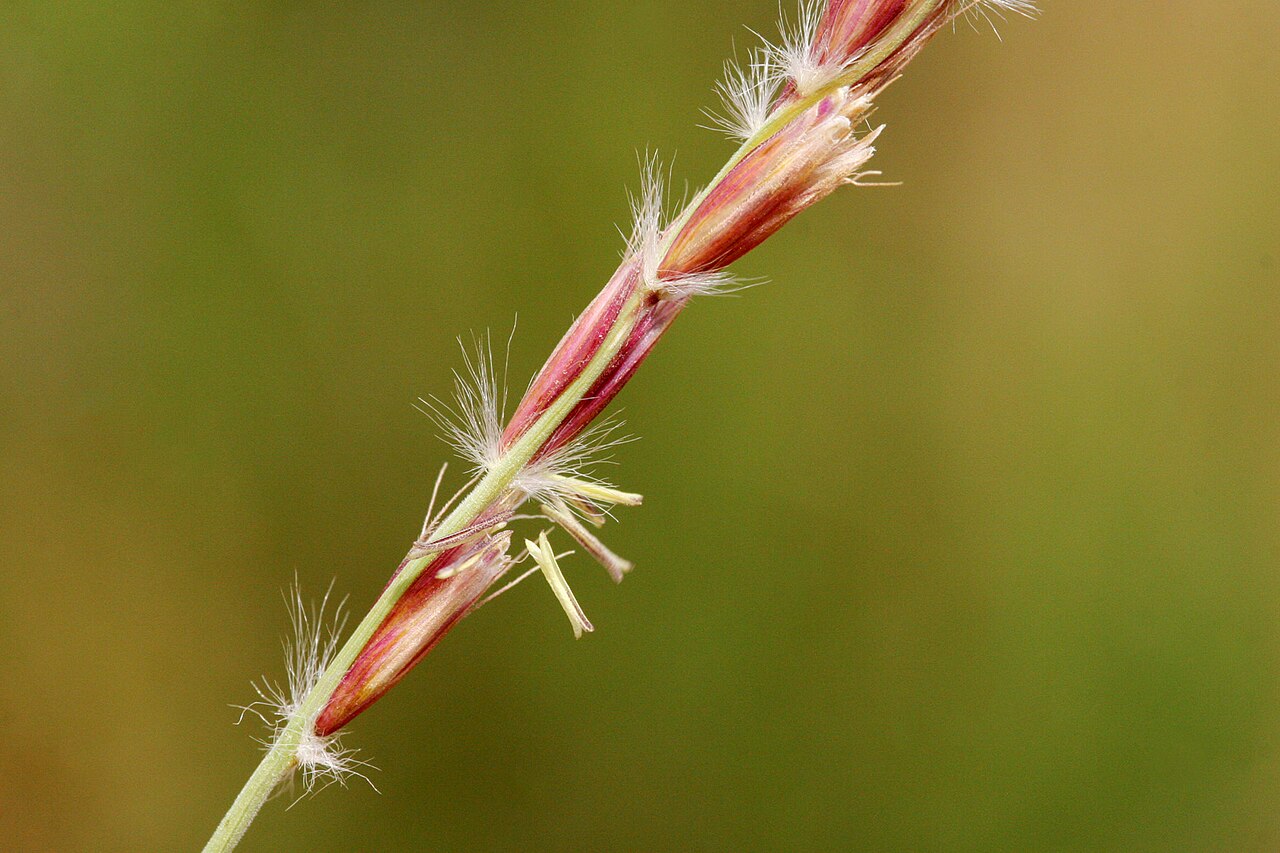
The flowering structure is a short, narrow series of spikelet groups along a central stalk. The groups have conspicuous hairs and a compact, almost jointed appearance rather than a broad, airy plume. Close examination reveals the characteristic three-spikelet grouping, with the central spikelet responsible for seed production. The photographs include an overview and a separate close view from New Mexico; they are useful for seeing the arrangement without expecting a tiny grass flower to resemble a showy garden bloom.
Seeds and lookalikes
As the flowering structures mature, small units break away from the axis. Seed production and establishment can be limited, so an established patch often expands vegetatively more conspicuously than it recruits seedlings. Big galleta, Hilaria rigida, is not an interchangeable purchase: it differs in size and morphology. Generic galleta seed should be checked for its full scientific name. The synonym Pleuraphis jamesii on a supplier's label is acceptable when identity and provenance are documented.
Quick Facts
| Scientific Name | Hilaria jamesii; synonym Pleuraphis jamesii |
| Family | Poaceae (grass family) |
| Plant Type | Warm-season perennial grass with spreading rhizomes |
| Mature Height | Approximately 3–24 inches in flower; often shorter on dry sites |
| Mature Spread | Expanding patches; rhizomes may extend several feet |
| Growth Rate | Seasonal; responds to warmth and available water |
| Sun Exposure | Full sun and open woodland gaps |
| Water Needs | Low once established; excellent drought tolerance on suitable sites |
| Soil Type | Well-drained sandy, loamy or clayey mineral soils |
| Soil pH | Often neutral to moderately alkaline; tolerates some salinity |
| Bloom Time | Warm season, variable with rainfall and elevation |
| Flower Color | Small green to tan or reddish-purple spikelets |
| Fall Color | Tan or straw colored as foliage cures |
| Fruit | Small dry grain in a hairy spikelet group |
| Deer Resistant | Not guaranteed; foliage may be grazed |
| USDA Hardiness Zones | Regional dryland adaptation; use locally appropriate provenance rather than a universal zone promise |
Native Range
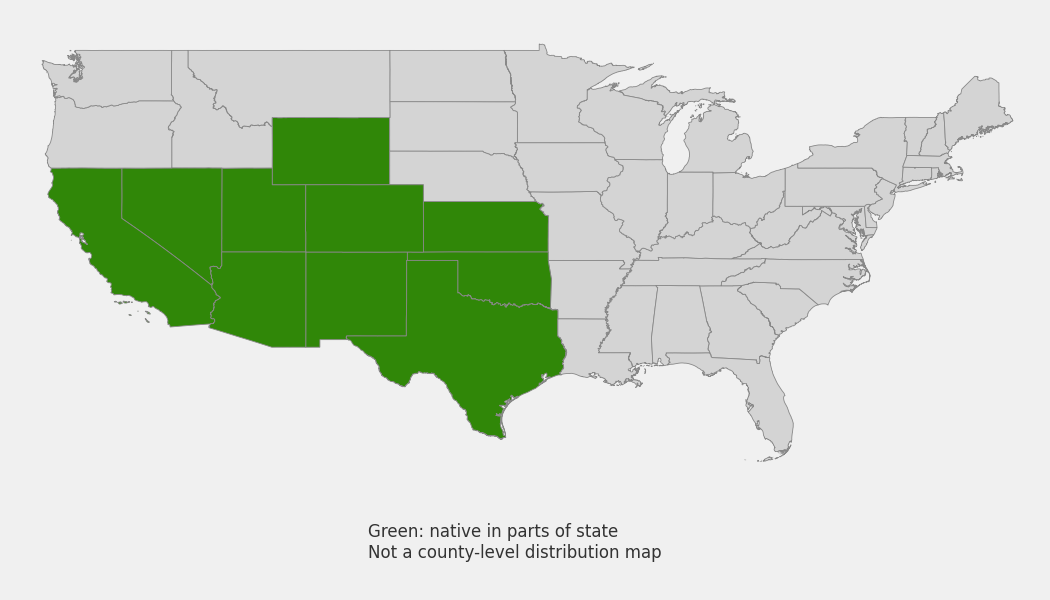
Galleta is native in the southwestern and south-central United States. Its documented range includes Arizona, California, Colorado, Kansas, Nevada, New Mexico, Oklahoma, Texas, Utah and Wyoming. This does not mean it is uniformly common across those states: its distribution is tied to dry plateaus, basins, foothills and associated grassland or shrubland habitats.
Utah is a particularly useful place to understand its habitat variety. It occurs with desert shrubs, sagebrush and pinyon-juniper vegetation, often on dry flats or foothill ground. Across its range it is frequently recorded at roughly 3,500–7,500 feet, but elevation limits differ by state and local environment. A habitat description is more informative for garden selection than altitude alone: consider drainage, available moisture, soil chemistry and the plants already thriving nearby.
The map shows states with native occurrences, not continuous cover or the suitability of every county. The USDA link retains PLJA, the code used for Pleuraphis jamesii, even though this page and the regional table use Hilaria. When ordering material, ask where it was collected and whether it was propagated from seed or division. Do not dig plants from public land or disturb intact soil crust to furnish a garden.
📋 Regional plant list: Utah and Western Colorado
Growing & Care Guide
Light
Place galleta in full sun or an open setting comparable to a woodland gap. Its dryland associations do not make it a dense-shade grass. In a mixed border, leave enough distance from shrubs for sunlight to reach the foliage as those shrubs mature. A shaded, heavily irrigated pocket under lush perennials is a different environment from the open ground where this grass is most useful.
Soil and water
Galleta tolerates several mineral soil textures, including clay, when the site otherwise suits it. That does not translate to tolerance of a persistently waterlogged planting hole. Observe drainage after rain before planting. Established plants can survive long dry intervals, but new divisions and plugs must first connect their roots to the surrounding soil. Water them in thoroughly, then adjust subsequent watering to actual root-zone moisture. Avoid turning a low-water planting into a small lawn with daily sprinkling.
Planting tips
Nursery-grown plugs or divisions provide visible starting points and reduce the uncertainty of seed establishment. Set the crown at the existing soil level, not under a mound of mulch. If planting several patches, plan where their edges can expand over the next few seasons. A practical trial group is often wiser than a large uniform planting on an unfamiliar site. Record the source and growing conditions so an initial success or failure can be interpreted rather than blamed only on the species name.
Propagation
Rhizomes are central to the way galleta persists and spreads. Division of cultivated stock can be useful, but a piece needs living shoots, roots and viable connecting tissue; a dry loose stem is not a cutting. Seed may be available from specialist suppliers, although viable seed and establishment can be variable. Use the supplier's germination and purity information, and seek regional guidance for larger revegetation work. Do not assume the sowing depth or rate of a fine lawn grass applies to its hairy seed units.
Pruning and maintenance
Remove collapsed material as needed while avoiding damage to the crowns and new warm-season shoots. Routine close mowing is not necessary for a naturalistic planting and changes its character. Allow the plant to show its seasonal tan foliage unless local access or fire-safety needs require clearing. Edging is a design decision: if rhizomes advance into a neighboring small perennial, cut or lift the unwanted cultivated growth rather than repeatedly watering and fertilizing the bed to force another outcome.
Seasonal expectations
A cool spring can leave galleta quiet while nearby cool-season grasses are already active. Conversely, summer moisture may renew its green growth when those grasses have cured. Compare a plant with its own previous season, not with a bluegrass lawn. After a severe dry period, wait for suitable warmth and moisture before declaring every brown shoot dead. At the same time, a crown that remains loose, rotten or rootless needs investigation rather than indefinite watering.
Working with other native plants
Combine it with species that tolerate a similar irrigation regime, leaving small flowering plants enough room outside the rhizome front. The aim is a varied dryland matrix, not a solid grass carpet around every wildflower. Inspect young companion plants during establishment: even two native species can compete strongly in a small irrigated bed. On a restoration site, the local reference community and seed availability should determine the mix rather than a generic list of southwestern natives.
Landscape Uses
- A spreading low matrix in an appropriately dry regional native garden.
- Open areas among drought-adapted shrubs where lateral growth is welcome.
- Suitable disturbed slopes and flats as one component of a restoration plan.
- A demonstration planting comparing warm-season galleta with cool-season western grasses.
- Informal landscape texture, rather than an evergreen, closely clipped recreational lawn.
Wildlife & Ecological Value
Pollinators and insects
Galleta is a grass, not a nectar-rich flowering perennial. Its value in a habitat garden lies in vegetation structure and the broader food web rather than a conspicuous floral display. Pair it with locally native flowering species to provide nectar and pollen resources. Avoid assigning a specific butterfly-host claim unless it is supported for this species, not just for grasses in general.
Birds
Low grass patches add cover and foraging structure to open native vegetation. Their value depends partly on the surrounding shrubs, bare ground and taller plants. Retaining some standing and fallen material can make a designed garden less uniform and more useful, but it need not mean allowing grass to block paths or accumulate beside structures.
Mammals and grazing
Galleta is part of southwestern range vegetation and can be grazed. Its forage usefulness changes with season and the condition of the foliage; dry, coarse material is different from new green growth. In gardens, do not promise that deer or rabbits will leave new plugs untouched. Temporary protection may be sensible where animals repeatedly remove the first growth needed for establishment.
Soil and ecological role
Shallow rhizomes and roots help maintain plant cover on appropriate dry sites. That cover is not a license to disturb intact desert surfaces: biological soil crust and other native vegetation can be damaged by unnecessary digging. In a constructed garden, direct runoff carefully so a newly planted patch is not scoured away before roots establish. Vegetation is one part of erosion management, not a substitute for resolving a concentrated drainage problem.
Cultural & Historical Uses
The names Hilaria jamesii and Pleuraphis jamesii occur in different botanical and range-management treatments. Keeping both in view is important because photographs, seed records and ecological studies may use either. A change in generic placement does not by itself mean that a nursery is offering a different grass.
Galleta has long been a recognizable component of southwestern rangelands, where it is evaluated as part of whole plant communities rather than solely as an ornamental. That perspective is useful in gardens: its drought survival, lateral growth and seasonal curing are traits to design with, not defects to eliminate through constant irrigation.
No medicinal or edible use is recommended here. A responsible native planting can value a grass for its place in a regional landscape without attaching an unsupported human-use story. For restoration, consult local practitioners about provenance, establishment methods and whether preserving existing vegetation is preferable to new seeding.
Frequently Asked Questions
Are Hilaria jamesii and Pleuraphis jamesii different grasses?
They are names used for the same galleta in the sources cited here. Keep the synonym on planting records so older USDA and nursery information remains traceable.
Will galleta remain a single small clump?
Not necessarily. Its rhizomes can produce new shoots beyond the original crown and connect clumps into patches. Give it space or plan for edge management.
Why is it brown when my spring grasses are green?
It is a warm-season grass and its activity follows warmth and available moisture. Brown foliage outside active growth is not by itself proof of death.
Is it suitable for every low-water garden?
No. Climate, drainage and source population still matter. Start with locally appropriate material and avoid persistently wet or deeply shaded conditions.
Can I mow it into a conventional lawn?
That is not the role described here. It is better used as an informal seasonal ground layer with room to flower and spread; a lawn specification has different appearance and traffic requirements.
Sources & Further Reading
- US Forest Service FEIS: Pleuraphis jamesii
- Santa Fe Botanical Garden: Hilaria jamesii
- ITIS: Hilaria jamesii taxonomy
- USDA PLANTS profile
Find Native Plants
Ask growers about nursery propagation and regional provenance. Browse our UT native plant nurseries, CO native plant nurseries directory for suppliers. Explore the native nursery finder.