
Scaly Blazing Star (Liatris squarrosa)
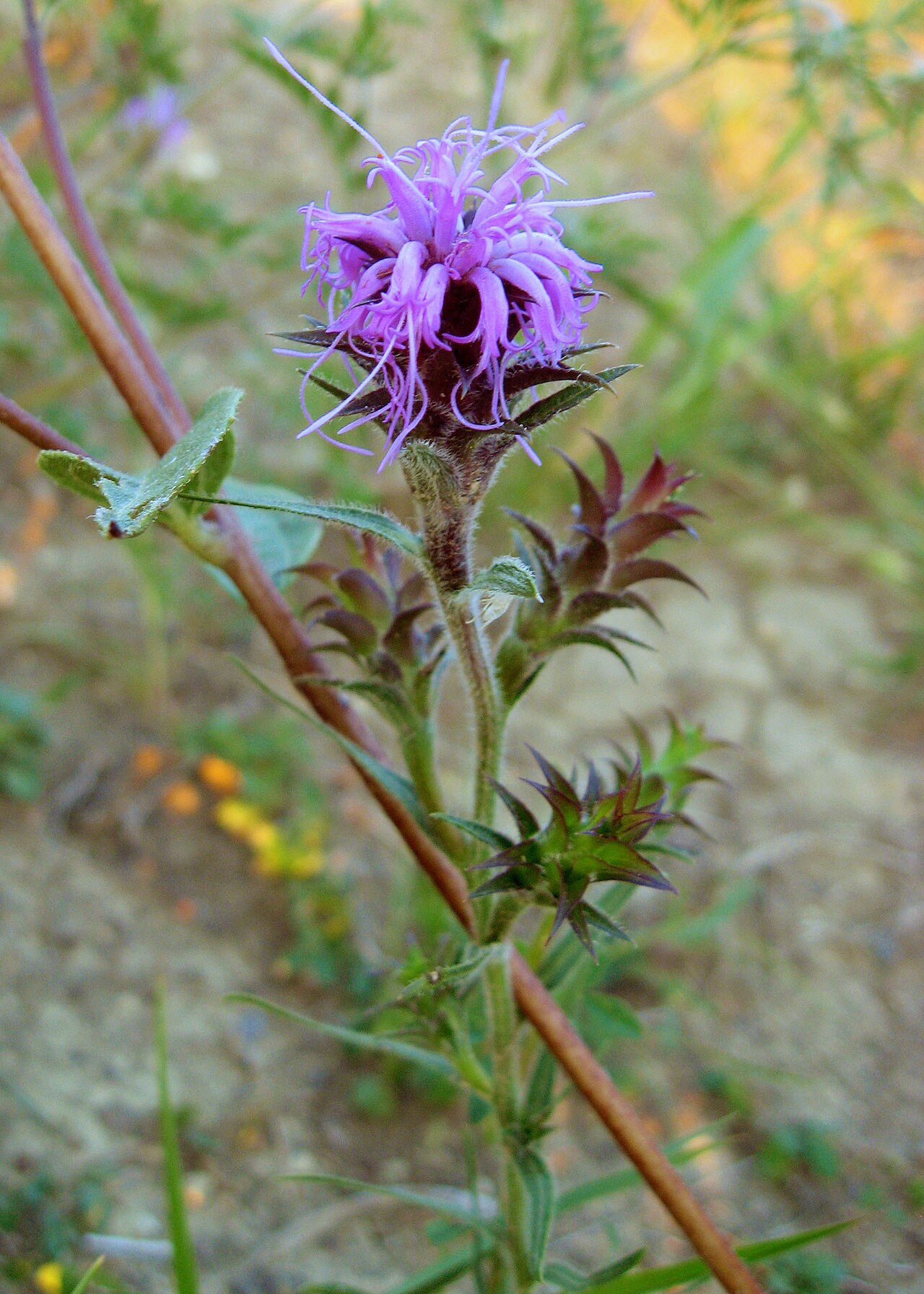
Scaly blazing star (Liatris squarrosa) is a compact native perennial that gives dry, sunny plantings a few well-spaced purple flower heads rather than the dense bottlebrush spikes associated with some other blazing stars. Its name points to the conspicuous overlapping bracts beneath each head. Seen close up, those bracts are as useful for identification as the bright florets. The plant rewards a place near the front or middle of an open native planting where its details are not hidden by taller neighbors.
The Lady Bird Johnson Wildflower Center describes stems approximately 10–30 inches tall and emphasizes dry, rocky or sandy habitats. It is among the earlier Liatris to flower, often beginning in early summer and continuing into the summer season according to locality. A plant suited to dry prairie is not a good replacement for a wet-meadow species simply because both have purple flowers. Drainage and light are more important than a rich amended planting hole.
This guide uses the species in the broader Flora of North America treatment, which includes named varieties and distinguishes related species such as Liatris compacta. Some modern regional accounts apply narrower concepts, particularly to Great Plains forms. The Arkansas & Louisiana table identifies only L. squarrosa; no variety is inferred from that old label. Purchase material with a documented scientific name and origin if local ecological restoration is the goal, and do not substitute another Liatris solely because a seller calls it blazing star.
Identification
Stems & Habit
One or several upright stems arise from the perennial underground structure. The flowering stems are generally simple rather than forming a broad many-branched spray. At roughly 10–30 inches they are shorter than many familiar tall prairie blazing stars. Stem hairiness varies in the broader species treatment and has been used to distinguish varieties, so a smooth stem does not automatically exclude the species.
Leaves
Leaves are narrow and arranged along the stems, with fewer leaves than on the densely leafy stems of some other Liatris. Lower foliage and upper stem leaves should be examined together. Do not judge an identification only from a flower photograph that leaves the basal part of the plant out of view. Leaf proportions, hairiness, and the bracts under the heads are especially helpful when comparing related taxa.
Flower Heads
The red-violet to purple heads contain tufted tubular florets rather than a ring of broad ray petals. Heads are relatively few and openly arranged toward the top of the stem. The scaly, spreading or recurved bracts around their bases explain the common name. A head is an entire cluster of small flowers; its appearance changes as florets open and styles extend, so flowering stage can make two photos of the same species look quite different.
Fruits & Winter Structure
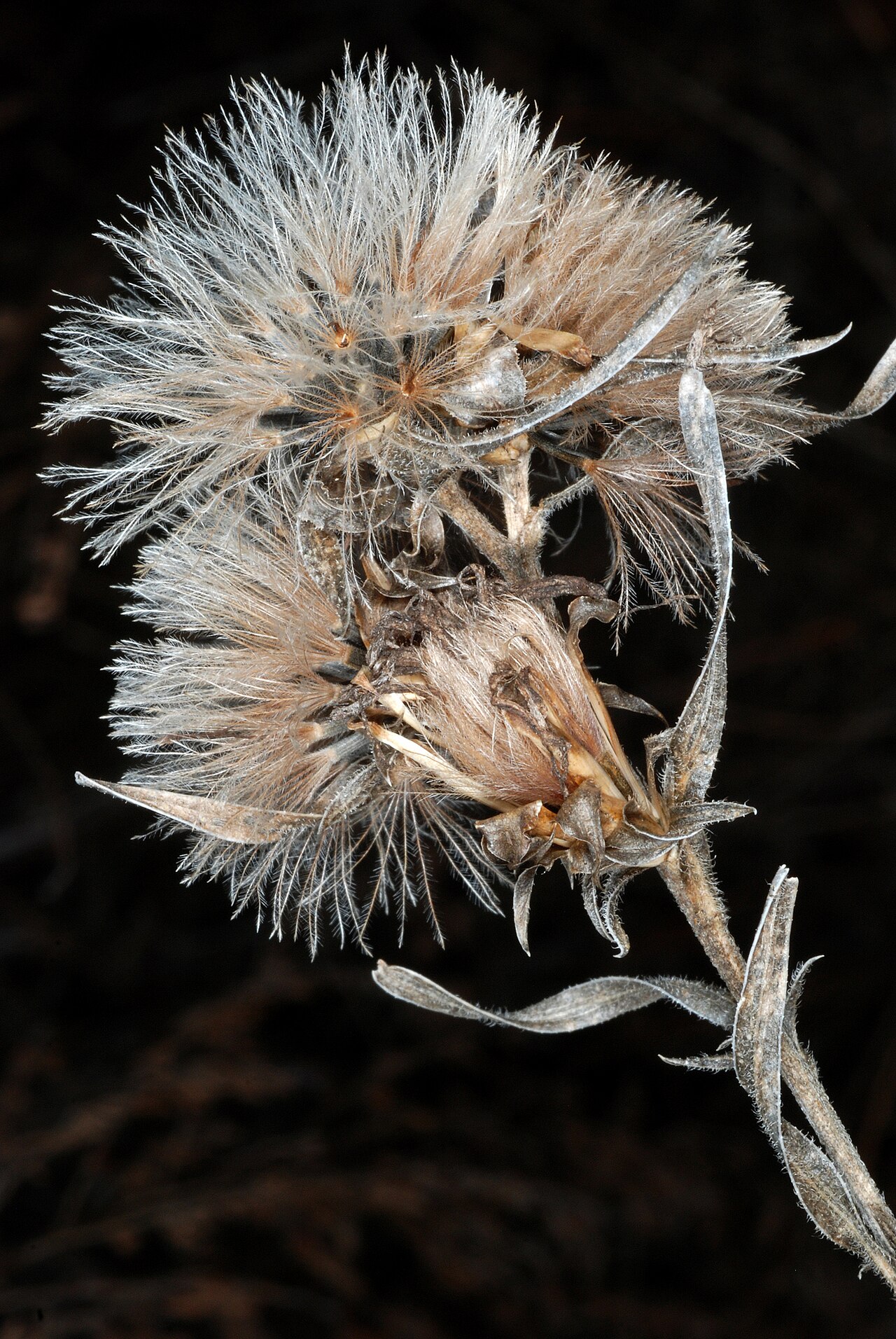
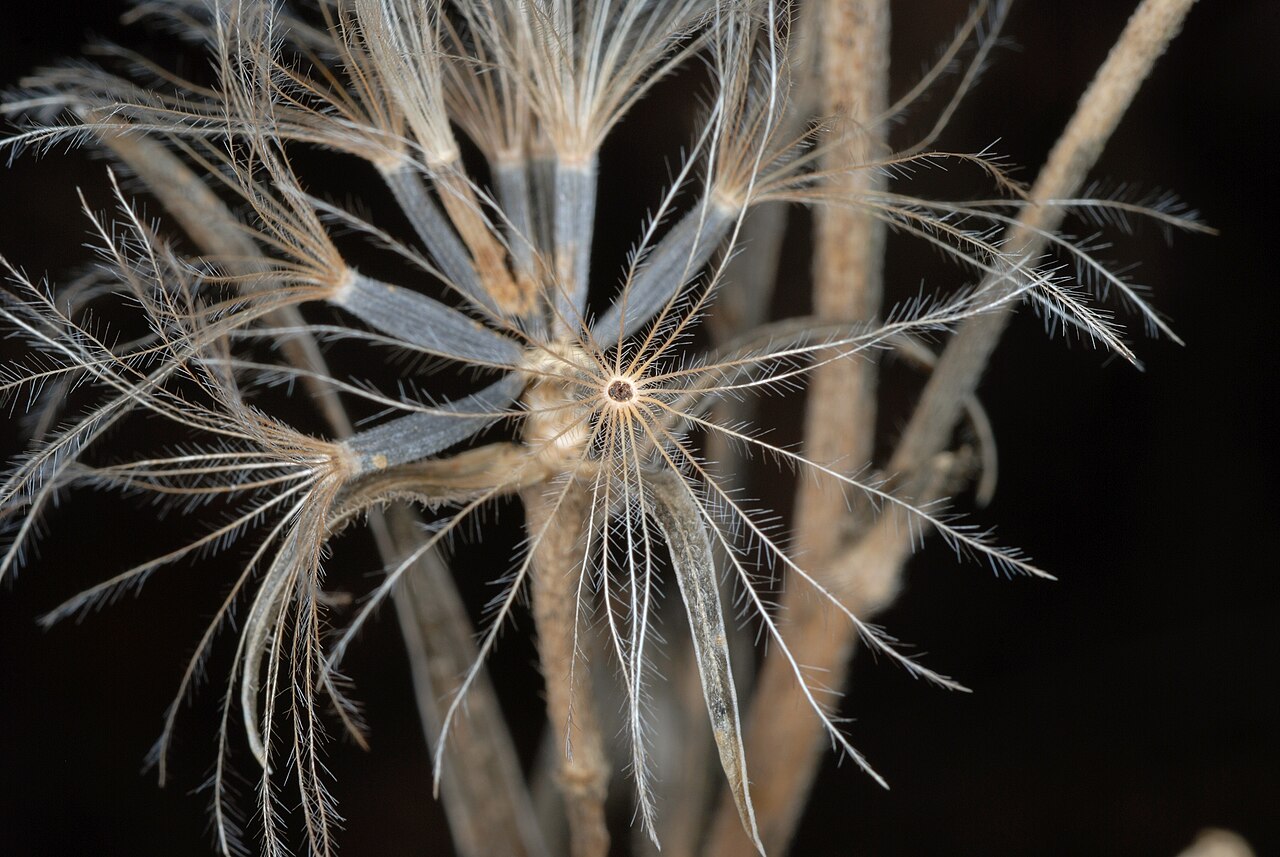
Mature heads become tan and fluffy as the small dry fruits develop their bristly attachments. These structures help the fruits disperse and make a useful late-season identification feature. The fruit photographs on this page show the whole mature head and individual bristled fruits at different scales. They are not flowers with white petals. Leave some heads to complete this transition if seed collection or natural renewal is desired.
Related Blazing Stars
Dense-spiked L. spicata and taller prairie species are not interchangeable with scaly blazing star. Liatris compacta has historically been associated with the squarrosa group but is treated separately in Flora of North America. The broader species also includes forms named at varietal rank. For a difficult specimen, use a regional flora and record the taxonomic treatment rather than forcing a determination from a generic common name.
Quick Facts
| Scientific Name | Liatris squarrosa, broad Flora of North America concept |
| Family | Asteraceae |
| Plant Type | Native herbaceous perennial |
| Mature Height | About 10–30 inches |
| Mature Spread | A modest clump; allow room for neighboring stems and seedlings |
| Growth Rate | Seasonal perennial growth |
| Sun Exposure | Full sun |
| Water Needs | Low to moderate during establishment; dry-site plant once established |
| Soil Type | Well-drained rocky or sandy soil |
| Soil pH | Use local habitat and provenance rather than a universal narrow target |
| Bloom Time | June–September across its range; often early for Liatris |
| Flower Color | Purple to red-violet |
| Fall Color | Foliage senesces; tan seed heads provide structure |
| Fruit | Small dry cypselae with bristly pappus |
| Deer Resistant | Browsing is possible; not reliably deer-proof |
| USDA Hardiness Zones | Match regional provenance and drainage; local conditions are decisive |
Native Range
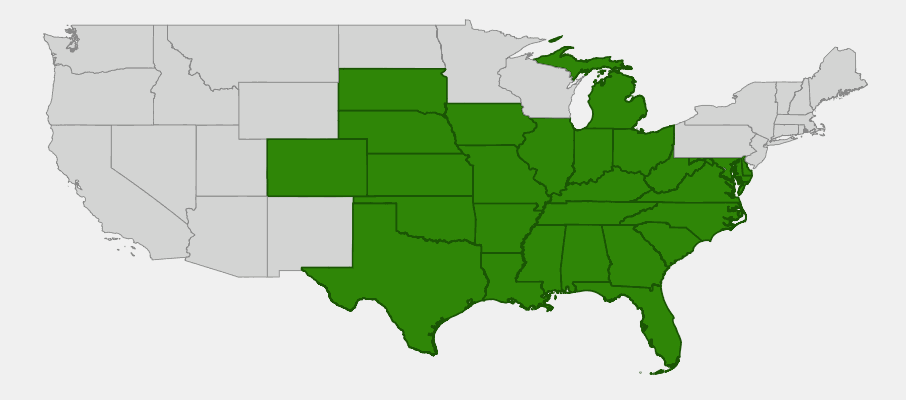
In the broader treatment used by the Wildflower Center and Flora of North America, scaly blazing star occurs across portions of the central and eastern United States, with a strong southeastern presence and Great Plains varieties extending westward. The state-level map follows that broader concept. It should not be mistaken for a map of the typical variety alone or for a map of every related taxon formerly grouped with it.
The published Wildflower Center state list includes Alabama, Arkansas, Colorado, Delaware, Florida, Georgia, Iowa, Illinois, Indiana, Kansas, Kentucky, Louisiana, Maryland, Michigan, Missouri, Mississippi, North Carolina, Nebraska, Ohio, Oklahoma, South Carolina, South Dakota, Tennessee, Texas, Virginia, and West Virginia. Within those states it is restricted to suitable habitats rather than evenly distributed. For a conservation planting, county and specimen information is more useful than a green state on a map.
Dry sandy prairie, rocky openings, and thin or open woods are characteristic settings. A woodland occurrence usually means enough light reaches the herb layer; it does not imply performance under dense year-round shade. The Kentucky flowering photograph illustrates a prairie-remnant plant. Regional taxonomy and provenance should be checked before moving seed between the Great Plains and the Southeast.
📋 Regional plant list: Arkansas & Louisiana
Growing & Care Guide
Light
Give the plant full sun and an open position where neighboring foliage will not bury its lower leaves. In a prairie-style planting, place it among shorter or moderately spaced companions rather than directly behind a wall of tall grasses. An open woodland edge may work where the canopy is sparse, but heavy shade can make stems weaker and flowering less effective. Observe summer shade, not only the light present before deciduous trees leaf out.
Soil & Water
Free drainage is the priority. Rocky or sandy soil can be an asset, while a low spot that stays saturated after storms is a poor choice. Water newly planted material until roots establish, then allow the site to function as a dry planting rather than keeping it constantly moist. Avoid large quantities of manure or rich compost that encourage lush growth and change the physical conditions the plant is adapted to.
Planting Tips
Use nursery-propagated plants or seed of verified identity. Set a potted plant at its existing crown level and water it in gently. Keep the immediate planting area free of vigorous turf while the plant establishes. A small group makes the sparse flower heads easier to see, but leave enough room for each plant to retain an open habit. Do not dig plants from an intact prairie remnant for a garden.
Mulch & Winter Drainage
A light mineral surface can fit a dry garden better than a deep, moisture-holding organic layer over the crown. Keep any mulch away from the growing point. In climates with wet winters, evaluate drainage during the dormant season as carefully as in summer. A plant may tolerate cold yet fail in a saturated crown; minimum temperature alone is not a complete measure of suitability.
Pruning & Maintenance
Routine pruning is unnecessary. Let stems flower at their natural height and retain some until the fruits become mature and fluffy. After seed has dispersed, old stems can be cut back when cleanup is needed. Mark the clump so that dormant crowns are not disturbed while planting nearby. If a plant leans, first check shading and fertility rather than immediately installing stakes around a species that normally has a compact habit.
Seed Propagation
The Wildflower Center describes fall sowing or a cold-stratification treatment before spring sowing, with about three months of cold moist treatment noted for seed. Follow a trusted supplier’s protocol for your seed lot. Collect only fully mature heads, dry them in a ventilated place, and keep cleaned seed labeled with locality. Germination and time to first bloom can vary, so use a protected nursery bed or pots where young plants can be recognized and cared for.
Troubleshooting
A missing second-year plant may have suffered crown rot, disturbance, or competition rather than lack of fertilizer. Check the planting site before replacing it. Sparse flowers can be normal for this species: it is not intended to look like a florist’s densely packed Liatris spike. If foliage or head structure seems wrong, revisit identity rather than changing care in an attempt to make a different species resemble the photograph.
Landscape Uses
- A compact purple accent in a sunny dry native border.
- A component of a locally appropriate prairie or glade planting.
- A close-view plant for studying composite flower heads and mature fruits.
- A seasonal companion to locally native grasses where competition remains manageable.
Wildlife & Ecological Value
For Pollinators
The purple tubular florets are visited by butterflies and bees. The Wildflower Center records special value to native bees, with that assessment attributed to the Xerces Society. A few plants can add a useful flowering period, but a garden should include other native flowers before and after this one blooms. Avoid spraying open flower heads, including with products marketed as routine garden treatments.
For Birds
Mature seed heads and associated insects contribute to a diverse planting. This does not establish a specific bird dependence on L. squarrosa, and the small clumps should not be described as major nesting cover. Leave some stems standing where practical and combine them with suitable native grasses and shrubs that provide complementary structure.
For Other Insects & Mammals
Liatris species support a variety of insects, but host records should be applied at the appropriate species or genus level rather than copied indiscriminately. Some browsing or herbivory is part of a functioning native garden. Protect new plants when necessary without treating every damaged leaf as a reason for broad insecticide use. This guide makes no food or medicinal recommendation.
Ecological Fit
The plant is most valuable when placed in a habitat that matches its provenance. Preserve existing remnant prairie rather than replacing intact vegetation with a garden mixture. In restoration, site preparation, invasive-plant control, and the source of propagules matter more than the ornamental appeal of a single flower. A state-level range map is only a starting point for that decision.
Cultural & Historical Uses
Blazing star and gayfeather are common names applied to several Liatris species. Scaly blazing star is the more informative name here because it draws attention to the bracts that distinguish the plant. Names in older regional lists often omit varieties and may reflect a broader taxonomic treatment than a modern local flora.
Flora of North America discusses the morphological separation of varieties and related species in this group. That history explains why two reputable sources can give different-looking ranges without either being a simple spelling error. This page states its broader scope explicitly rather than claiming that every historical record has been reassessed under a single modern classification.
No species-specific traditional medicinal or ceremonial practice is asserted without a traceable source. Its native-garden value is already clear in the combination of dry-site adaptation, purple summer flowers, and attractive fruit structure. Responsible cultivation uses propagated plants or permitted seed, leaving wild populations and their habitat intact.
Frequently Asked Questions
Why are the flower heads so widely spaced?
That open arrangement is characteristic of scaly blazing star. It is not the same garden form as the dense spikes of Liatris spicata.
Is it suited to wet soil?
No. Use a well-drained rocky or sandy site, with establishment watering but not persistent saturation.
How tall does it get?
The Wildflower Center gives approximately 10–30 inches. Local conditions and the broader species treatment account for some variation.
When should I collect seed?
Wait until heads are mature, tan, and fluffy. Collect only where permitted, dry the heads, and label the seed source.
Is every plant sold as blazing star equivalent?
No. Check the scientific name and provenance. Several species and varieties differ in size, habitat, and geographic range.
Sources & Further Reading
- Lady Bird Johnson Wildflower Center — Liatris squarrosa
- Flora of North America — Liatris squarrosa
- NC State Extension — scaly blazing star
- USDA PLANTS — LISQ
Find Native Plants
Ask growers about nursery propagation and regional provenance. Browse our AR native plant nurseries, LA native plant nurseries directory for suppliers. Explore the native nursery finder.