Mountain Maple (Acer spicatum)
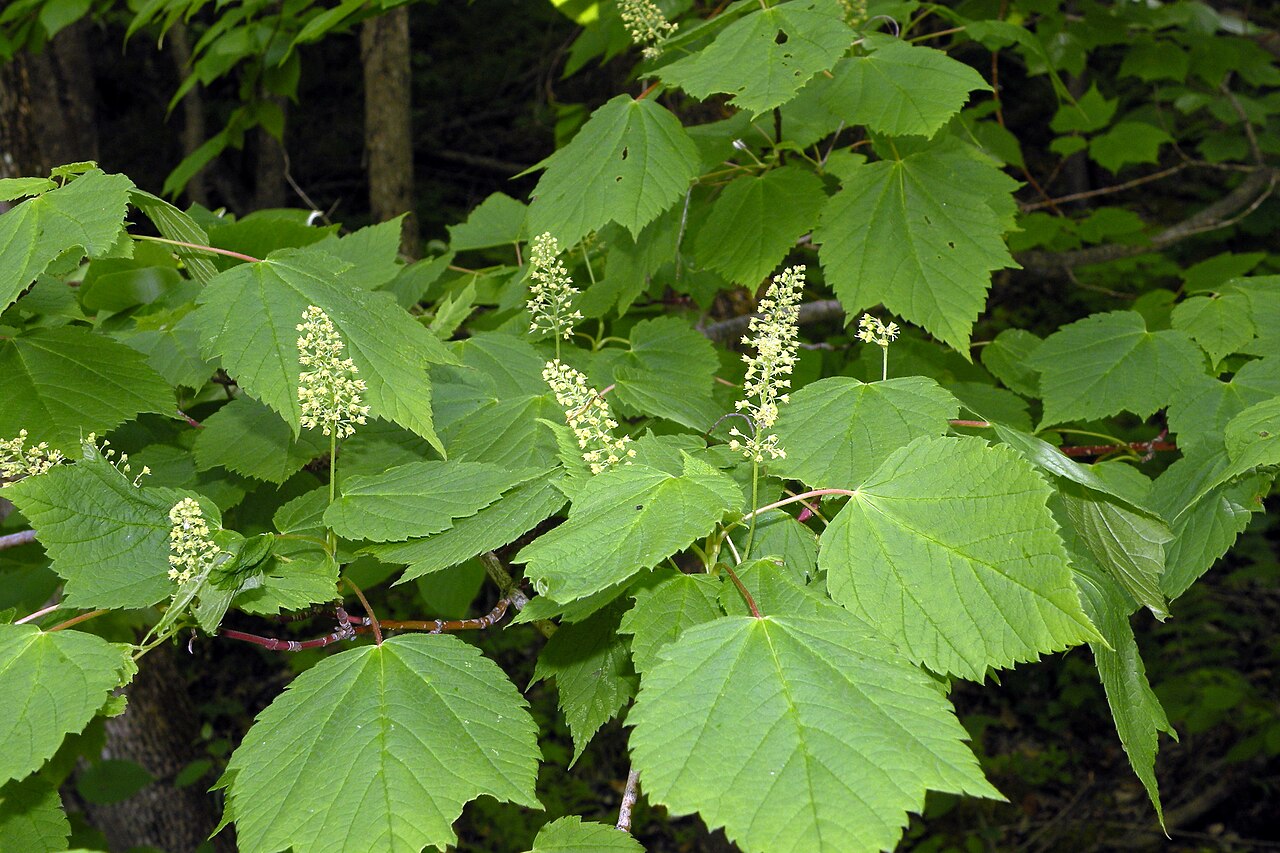
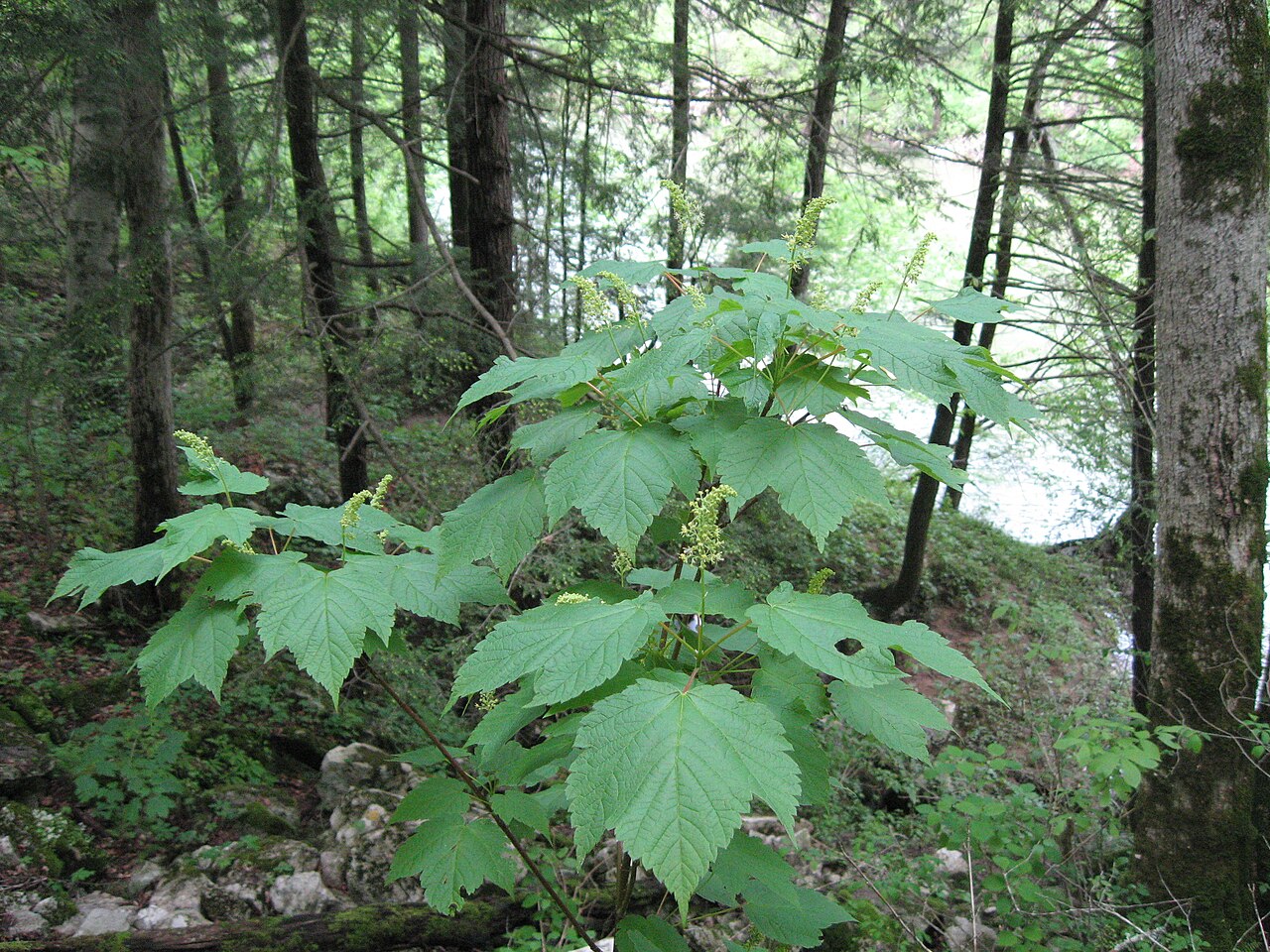
Mountain maple is a small woodland tree with a much different role from the great shade maples overhead. Its short trunk, branching stems and spreading crown fit beneath taller trees, where the pale spring flower clusters rise above broad green leaves. For a cool, shaded garden in northern New England, it offers a native middle layer between the canopy and the herbaceous woodland floor.
Acer spicatum usually grows 10 to 25 feet tall rather than becoming a large lawn tree. Its orange, yellow or red autumn leaves can be striking, but the species is worth growing for more than a brief color display. The irregular framework, flower panicles and developing winged fruits give it interest through the growing season, especially beside a woodland path where the details can be seen at eye level.
The most important condition is a cool root environment with dependable moisture and drainage. A dry street verge, an exposed paved courtyard or a hot southern lawn is not a substitute for its forest habitat. Think of it as a naturalizing tree for protected slopes and woodland edges, not as a compact version of a sun-loving ornamental maple.
Identification
Bark & Stems
Young stems are slender and the bark remains relatively smooth on smaller wood. Branching often begins low, so several upright stems may share the crown. Keep that natural architecture unless access demands selective pruning. Unlike striped maple, mountain maple is not identified by conspicuous green-and-white stripes on young trunks; compare leaves and flowering structures as well as bark.
Leaves
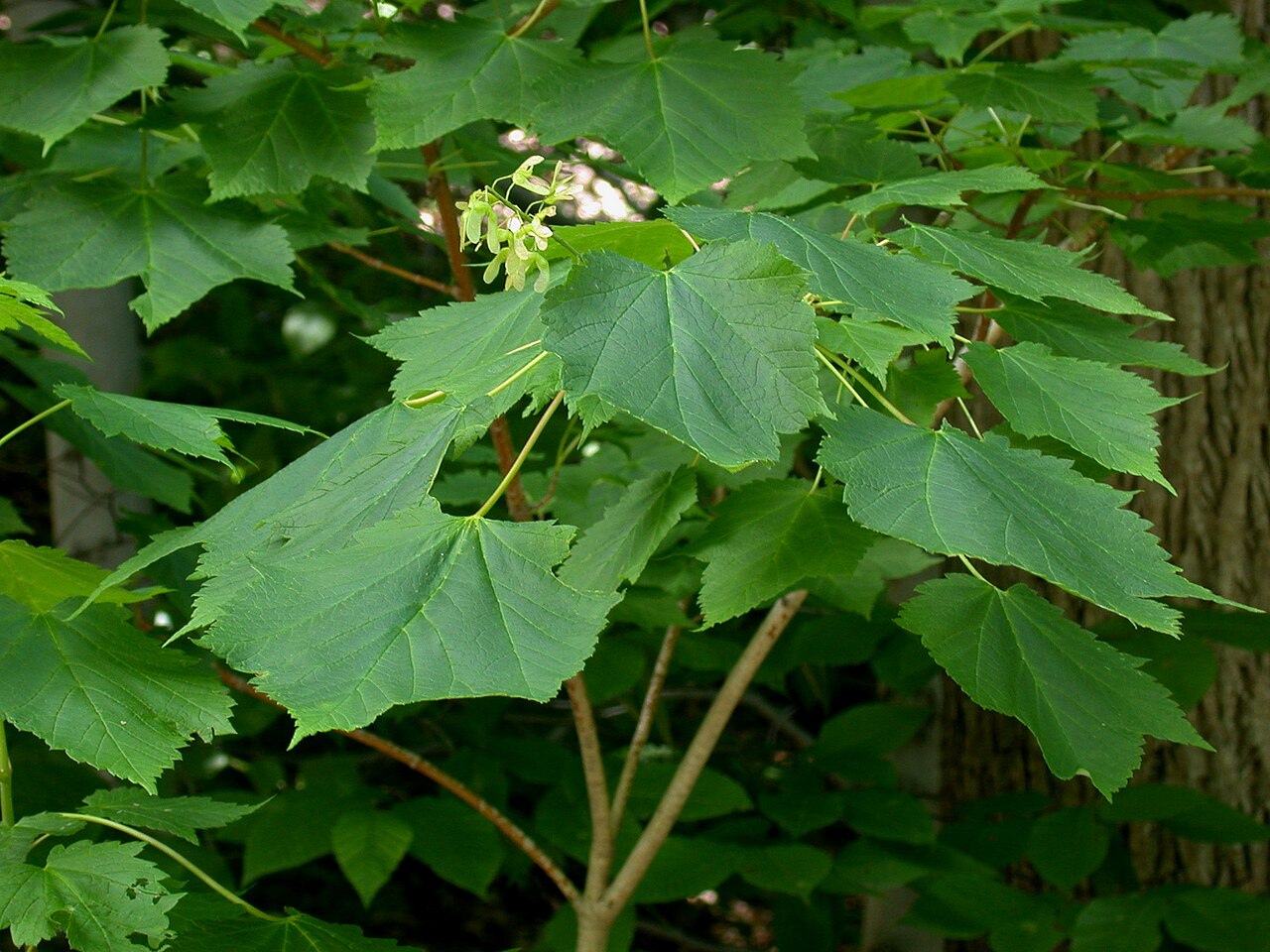
Leaves are opposite, broad and usually three-lobed, with sharply toothed margins and pointed lobe tips. They have a soft woodland texture rather than the small, leathery leaves of many drought-adapted shrubs. Look at several mature leaves because size and lobing vary on shaded and vigorous shoots. Seasonal color can include yellow, orange and red, sometimes in the same plant.
Flowers
The small flowers occur in upright, branched panicles after the leaves expand. Although the epithet spicatum suggests a spike, the inflorescence is branched, a distinction emphasized by Native Plant Trust. A flowering shoot is useful identification evidence: the pale cluster is held visibly above the new foliage rather than appearing as an inconspicuous early-season bloom on a bare twig.
Fruit & Seeds
Fruits are paired samaras, the familiar winged maple seeds. Their color changes as they mature, and clusters may remain visible against summer foliage. A winged fruit alone identifies the maple family better than it identifies this species: note its attachment, the leaves and the upright spring flower arrangement together. Seedlings need cool, moist conditions and room away from dense groundcover.
Quick Facts
| Scientific Name | Acer spicatum |
| Family | Sapindaceae |
| Plant Type | Deciduous understory tree or large shrub |
| Mature Height | 10–25 feet; occasional individuals approach 30 feet |
| Mature Spread | 10–20 feet |
| Growth Rate | Slow to moderate |
| Sun Exposure | Partial shade; sun where soil stays cool and moist |
| Water Needs | Even moisture; well-drained rather than permanently flooded |
| Soil Type | Humus-rich woodland loam, including rocky forest slopes |
| Soil pH | Slightly acidic to near neutral; prioritize cool woodland soil |
| Bloom Time | Late spring to early summer, generally after leaves expand |
| Flower Color | Creamy white to yellow-green |
| Fall Color | Yellow, orange or red |
| Fruit | Paired winged samaras |
| Deer Resistant | Not deer-proof; protect establishing plants where browsing is heavy |
| USDA Hardiness Zones | 3–7; provenance and summer heat matter |
Native Range
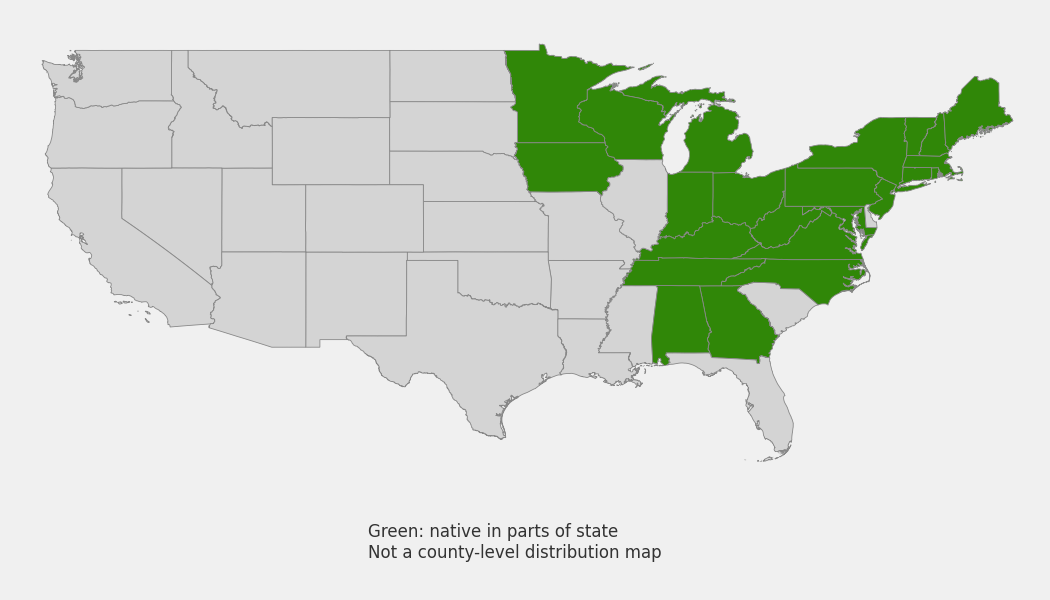
Kew places mountain maple in south-central and eastern Canada and the north-central and eastern United States. In the south, its distribution follows cool Appalachian habitats rather than forming a broad blanket across warm lowlands. The map summarizes Kew’s native state list; it does not imply that the plant occupies every county in a shaded state.
New Hampshire, Maine and Vermont are firmly within the species’ northeastern range. Forests, wooded ledges, talus, rocky slopes and water-adjacent woods are typical settings. The common thread is shelter and soil moisture, not simply elevation: a northern low-elevation site may offer the same cool conditions that restrict it to mountains farther south.
Choose regionally propagated stock where possible. A plant grown in a European arboretum can still be correctly identified as mountain maple, but a photograph or garden record there does not extend its native range. For restoration, check local floras and land-management guidance rather than treating a state-level map as a planting prescription.
📋 Regional plant list: New Hampshire, Maine & Vermont
Growing & Care Guide
Light
Filtered light beneath a deciduous canopy is a useful starting point. Morning sun can be suitable where soil remains moist, while reflected afternoon heat is a poor match. In a very dark understory the crown may be open and growth slow; creating a modest gap is generally more appropriate than moving it into a fully exposed lawn.
Soil & Water
Retain the moisture-holding woodland surface and avoid compacting the root area. The soil should hold moisture while allowing excess water to drain. Mulch with a modest layer of shredded leaves, keeping the trunk base clear. Check the original root ball during establishment: rain wetting the surrounding soil does not guarantee that nursery media inside the planting hole has rehydrated.
Planting Tips
Plant nursery-propagated material in spring or autumn when heat stress is low. Set the root flare at its previous level, spread circling roots carefully and backfill chiefly with site soil. Water thoroughly, then monitor during the first growing seasons. Leave enough horizontal room for a spreading 10–20 foot crown instead of promising that regular clipping will keep it in a narrow foundation bed.
Pruning & Maintenance
Remove dead, damaged or rubbing stems with clean cuts; do not routinely top the tree or shear it into a hedge. Its low branching is part of its woodland character. Watch for drought scorch and browse damage before assuming an insect disease. A protective cage can be more useful than fertilizer when deer repeatedly remove the ends of young shoots.
Propagation
Seed is the usual propagation route. Collect only with permission, from correctly identified plants and without stripping a wild population. Maple seed dormancy and storage response vary; follow a nursery protocol for Acer spicatum rather than copying a generic maple recipe. Keep seed lots labelled by source and allow for uneven germination. Purchasing an established propagated plant is often the simplest garden approach.
Landscape Uses
- A small understory tree along cool woodland walks
- A native transition between tall canopy trees and ferns
- Naturalizing on sheltered, moist rocky slopes
- Autumn color in a northern woodland garden
Wildlife & Ecological Value
For Pollinators
The accessible late-spring flowers add a seasonal resource within woodland vegetation. Keep pesticide sprays away from flowering shoots and nearby understory plants. A garden with several native flowering layers supplies a broader season than a single maple can provide; use this tree as one contribution rather than advertising it as a complete pollinator planting.
For Birds
The branching framework adds cover and foraging structure. Seed-bearing maples can contribute food, while insects on leaves provide another pathway into the food web. Preserve the surrounding leaf litter and shrub layer where practical; a lone tree over frequently mown grass supports a simpler habitat than a tree integrated into woodland planting.
For Mammals
Tender growth can be browsed. Browsing is an ecological relationship but may prevent a newly planted tree from establishing in a small garden. Protect young stems where deer pressure is strong, and remove or enlarge guards before they restrict growth. Do not assume a listing as a native understory plant means that it will withstand unlimited repeated browse.
Ecosystem Role
Its value lies in the middle story of the forest: foliage intercepts light, roots occupy the soil and fallen leaves return organic material. Retaining a mixture of tree ages and understory forms makes a planted woodland less dependent on a single canopy species. It is not a tree for stabilizing an actively failing bank without a broader engineering and restoration assessment.
Cultural & Historical Uses
Mountain maple has long been known under several scientific synonyms, including Acer montanum. Modern sources retain Acer spicatum as the accepted name. This matters when comparing older regional lists and nursery catalogues: matching the scientific synonym is more reliable than matching a loose label such as dwarf maple or moose maple.
NC State records historical uses of maple sap and tannin-bearing bark. Those records explain a plant’s human history, but they do not make harvesting a small woodland specimen a sensible garden practice. A newly planted mountain maple is more useful left intact to establish its crown and root system.
In contemporary gardens the species is a specialist rather than a mass-market street tree. Its relative scarcity in nursery production is a reason to order propagated stock early, not to dig up wild trees. Protecting naturally occurring seedlings and their woodland soil can be as valuable as planting a new specimen.
Frequently Asked Questions
Is mountain maple a large shade tree?
No. Plan around an understory tree or large shrub, usually 10–25 feet tall. An occasional taller wild individual does not make it an appropriate substitute for a broad-canopied lawn maple.
Can it grow in full sun?
Sometimes, especially in cool climates and moisture-retentive soil. Partial shade is a safer garden choice where summer heat or drying winds are significant. Light and root moisture need to be judged together.
Is mountain maple native throughout the southern states on the map?
No. Southern populations are associated mainly with Appalachian conditions. A state shaded green means native occurrence somewhere in that state, not suitability for every lowland garden.
Why are the leaves browning at the edges?
Check moisture in the original root ball, recent heat, reflected sun and root disturbance before applying treatment. Repeated drying can cause scorch even when the surrounding landscape looks green.
Should I remove all but one stem?
Not automatically. Multiple stems and a low crown are natural. Retain sound structure, removing only conflicts or damage, unless a carefully planned training approach is needed for the site.
Sources & Further Reading
- NC State Extension: mountain maple
- Native Plant Trust: Acer spicatum
- Kew: taxonomy and native distribution
Find Native Plants
Ask growers about nursery propagation and regional provenance. Browse our NH native plant nurseries, ME native plant nurseries, VT native plant nurseries directory for suppliers. Explore the native nursery finder.