
Shumard Oak (Quercus shumardii)
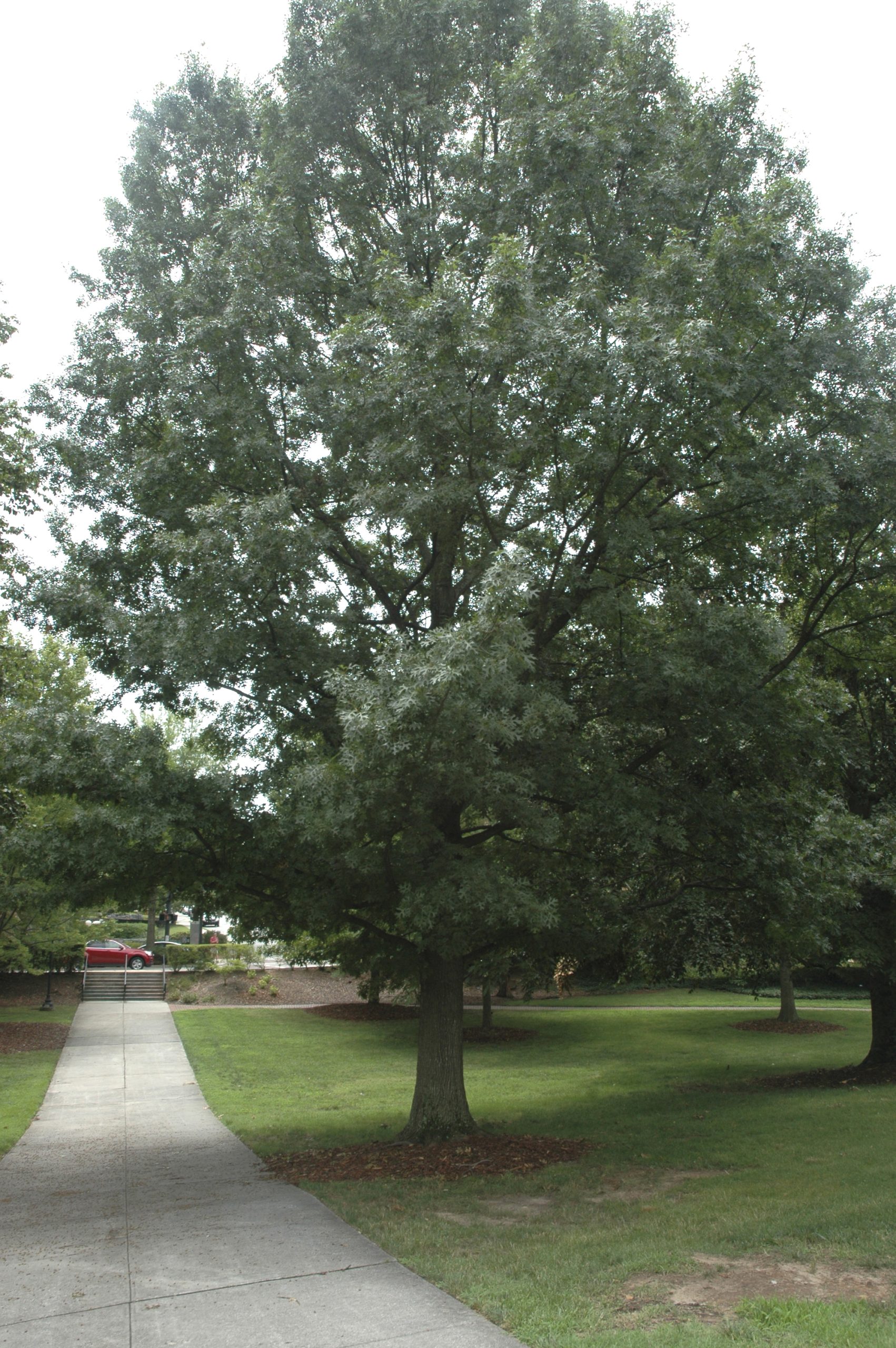
Quercus shumardii, commonly known as Shumard Oak or Shumard Red Oak, is one of the largest and most majestic members of the red oak group native to the central and southeastern United States. Named for Benjamin Franklin Shumard, a 19th-century Texas state geologist, this stately tree is prized by arborists and landscapers alike for its fast growth, strong wood, and brilliant fall color. A mature Shumard oak can reach 80 to 100 feet or more, with a broad, open crown that makes it one of the finest large shade trees available to gardeners anywhere within its native range.
In the wild, Shumard oak grows in bottomland forests, stream terraces, and upland woods from the Atlantic coastal plain of the Carolinas west to central Texas, and north through the Mississippi River Valley into the Ohio Valley and lower Great Lakes region. It tolerates both occasional flooding and considerable drought once established, a combination of traits that makes it unusually adaptable compared to many other large oaks. It is also noticeably more heat and alkaline-soil tolerant than its close relative the northern red oak, which is part of why it performs so well as a street and park tree across the South and Midwest.
For homeowners with the space, few native trees offer more long-term value. Shumard oak grows relatively quickly for an oak, develops a strong, well-anchored structure resistant to storm damage, and supports a long list of wildlife from acorn-eating songbirds and turkeys to the many insects whose larvae depend on oak foliage. Its scarlet-to-russet fall color, which often lingers into December in the South, adds a final seasonal bonus to a tree that is otherwise simply a dependable, long-lived shade giant.
Identification
Shumard oak develops a tall, straight trunk topped by a broad, rounded to pyramidal crown. Young trees have a more conical shape, filling out as they mature. The trunk is often buttressed and fluted near the base, especially on older trees growing in bottomland soils, and lower branches tend to grow nearly horizontal, giving large specimens an imposing, wide-spreading silhouette.
Bark
Bark on young trees and branches is light gray and notably smooth and reflective. As the tree ages, the bark darkens to gray-brown and develops shallow ridges and furrows, occasionally with pale, scaly patches. The combination of smooth young bark and ridged mature bark, along with the furrowed pattern running in fairly straight vertical lines, helps separate Shumard oak from other red oaks at a glance.
Leaves
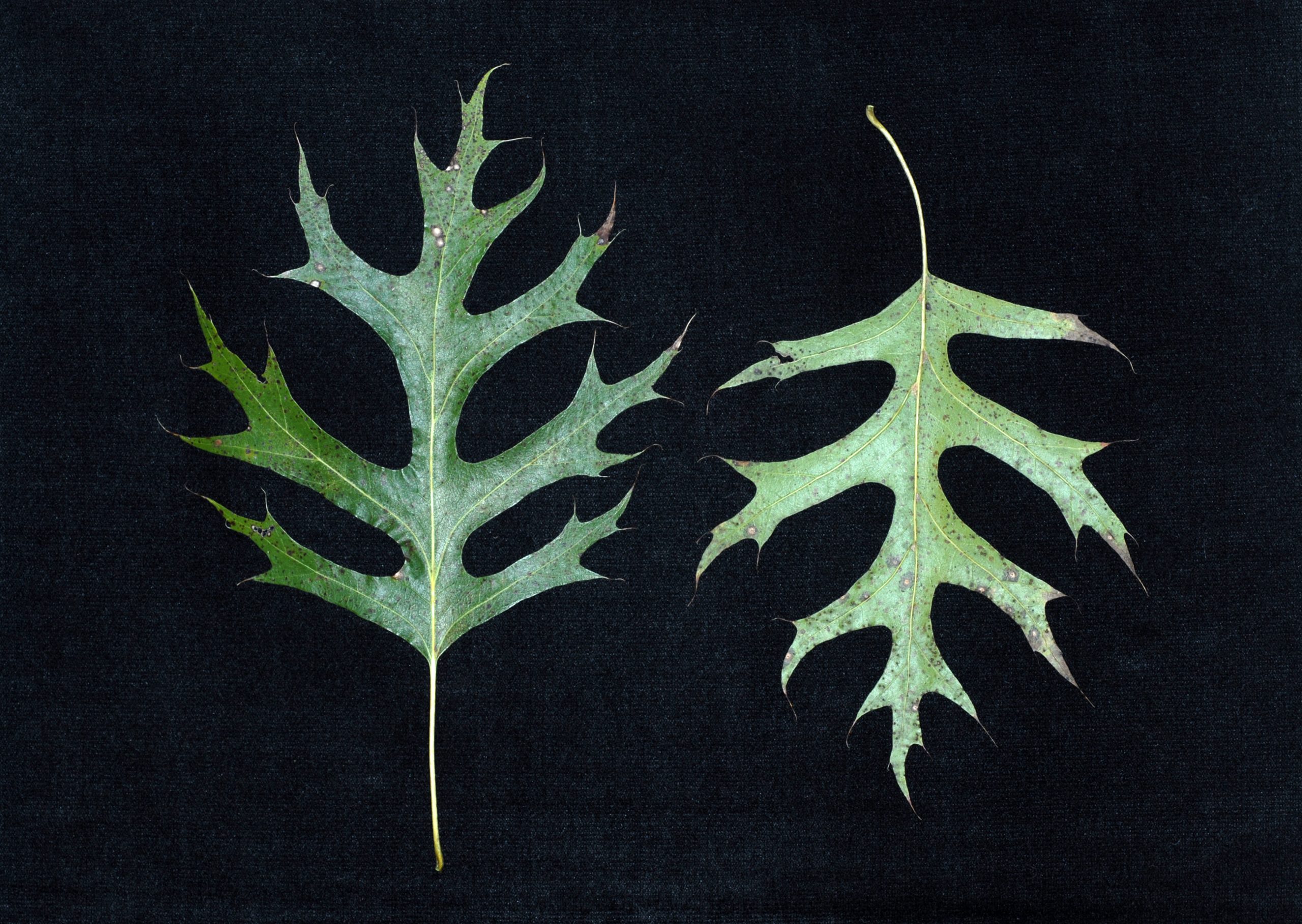
The leaves are alternate, broadly obovate, and 4 to 8 inches long, with 5 to 9 lobes separated by deep sinuses that typically reach half to three-quarters of the way to the midrib. Each lobe ends in several bristle-tipped teeth, a hallmark of the red oak group. Leaves are glossy dark green above and paler below, with small tufts of hair in the vein axils on the underside but otherwise smooth. Fall color ranges from yellow-bronze through scarlet to deep red-brown, and it develops late in the season, often not peaking until November or even December in the Deep South.
Flowers & Fruit
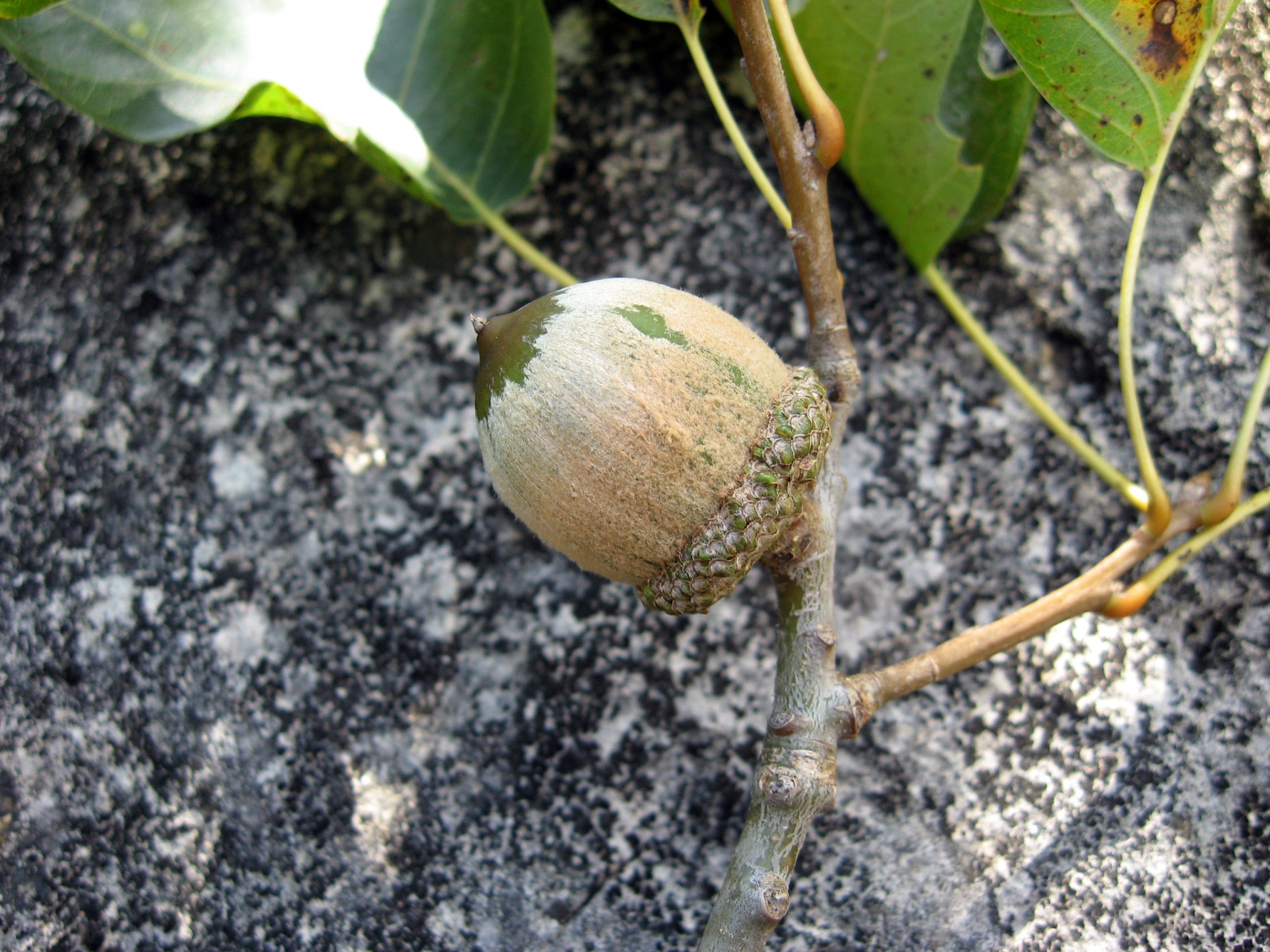
Like other oaks, Shumard oak is wind-pollinated, with inconspicuous yellow-green male catkins and tiny female flowers appearing as the leaves emerge in spring. The acorns are relatively large for a red oak, up to 1 inch long, broadly rounded with a flat base, and capped by a shallow, scaly cup covering about a quarter of the nut. Like all red oaks, Shumard oak’s acorns take two growing seasons to mature, so a single tree carries both this year’s small green acorns and last year’s larger, ripening ones at the same time.
Quick Facts
| Scientific Name | Quercus shumardii |
| Family | Fagaceae (Beech/Oak) |
| Plant Type | Large deciduous tree |
| Mature Height | 60–100 ft (occasionally more) |
| Mature Spread | 40–60 ft |
| Growth Rate | Fast for an oak |
| Sun Exposure | Full Sun to Part Shade |
| Water Needs | Average; tolerates both brief flooding and drought once established |
| Soil Type | Adaptable; loam, clay or sand, moist bottomland to upland |
| Soil pH | Tolerant of acidic to alkaline soils (about 5.0–8.0) |
| Bloom Time | March – May |
| Flower Color | Greenish-yellow (inconspicuous) |
| Fall Color | Yellow-bronze to scarlet and red-brown |
| Fruit | Acorns to 1 in, maturing over two years |
| Deer Resistant | No (young foliage browsed) |
| USDA Hardiness Zones | 5–9 |
Native Range
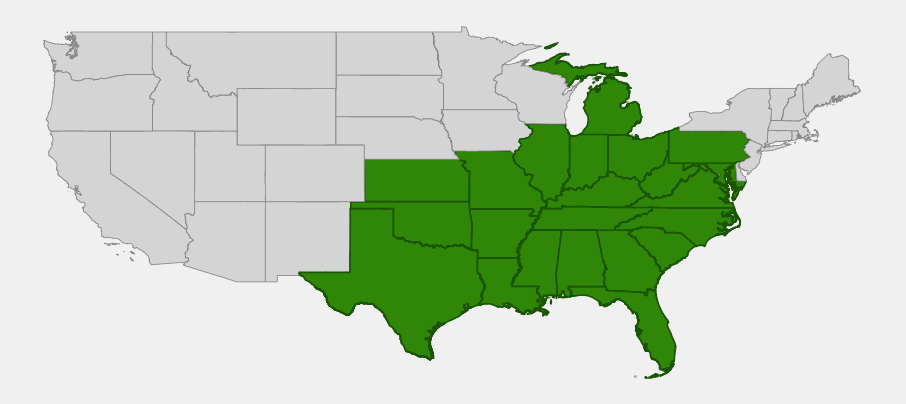
Shumard oak occupies a broad swath of the central and southeastern United States. Its range runs from the Atlantic coastal plain of southern Pennsylvania and Maryland south through the Carolinas, Georgia and into northern Florida, then west across Alabama, Mississippi and Louisiana to central Texas. A separate northward extension follows the Mississippi and Ohio River valleys through Arkansas, Missouri, Illinois, Indiana, Kentucky, Tennessee and Ohio, reaching into southern Michigan and extreme southern Ontario.
Across this range, Shumard oak favors moist bottomland forests, stream and river terraces, and the margins of swamps, though it also grows on better-drained upland sites where soils are deep. It tolerates seasonal flooding for several weeks at a time, which lets it hold ground in lowland hardwood forests where many other oaks cannot compete, and it is also notably drought tolerant once its roots are established, a trait that serves it well on drier upland clay and limestone soils in Texas and the Southeast.
Shumard oak hybridizes readily with other red oaks where ranges overlap, including northern red oak, black oak and pin oak, which can make field identification tricky at the edges of its range. The species itself is not rare or at risk; it remains common across its native range and is widely planted well beyond it as a durable shade and street tree.
📋 Regional plant lists featuring Shumard Oak: Georgia, Alabama & Mississippi · Arkansas, Louisiana, Eastern Oklahoma & Eastern Texas · Illinois, Iowa & Missouri · Ohio & Indiana · Nebraska, Kansas & Eastern Colorado · Kentucky & Tennessee · Maryland, Virginia & West Virginia · Michigan, Wisconsin & Eastern Minnesota · New York, Pennsylvania & Northern New Jersey
Growing & Care Guide
Shumard oak is one of the easiest large native oaks to establish, tolerant of the heat, clay soils and periodic drought that trouble many other shade trees. Given room to grow, it rewards patience with decades of reliable shade and striking seasonal color.
Light
Shumard oak grows best in full sun, which produces the strongest branch structure and best fall color. It tolerates part shade reasonably well, especially as a young tree in a forest gap, but develops a more open, lanky form and colors less reliably without several hours of direct sun each day.
Soil & Water
This oak is remarkably adaptable, growing in clay, loam or sandy soils across a wide pH range from acidic to distinctly alkaline, which is unusual among red oaks and one reason it performs so well on the limestone-influenced soils of Texas and the Midwest. It handles occasional standing water during wet spells and, once established with a deep root system, shrugs off summer dry spells better than many other large shade trees. Water deeply and regularly for the first two to three years after planting.
Planting Tips
Plant container-grown or balled-and-burlapped trees in fall or early spring. Because mature Shumard oaks become very large, give them at least 30 to 40 feet of clearance from buildings, driveways and overhead utility lines. Avoid disturbing or compacting soil near the root zone of established trees, since oaks are sensitive to grade changes and construction damage around their roots.
Pruning & Maintenance
Prune young trees to establish a strong central leader and well-spaced scaffold branches, working in late winter while the tree is dormant. As with all red oaks, avoid pruning from April through June in areas where oak wilt disease is present, since fresh wounds can attract the beetles that spread the fungus. Mature trees need little routine care beyond removing dead or crossing branches.
Propagation
Shumard oak is grown from acorns, which should be collected in fall as soon as they drop and planted promptly or cold-stratified, since they lose viability quickly if allowed to dry out. Acorns germinate the following spring; seedlings develop a long taproot early, so they establish best when planted directly in the landscape or in deep containers rather than transplanted repeatedly.
Landscape Uses
- Shade tree for large residential or park settings, where its spreading crown provides decades of cooling shade
- Street tree in cities across its range, valued for tolerating heat, pollution and alkaline urban soils
- Bottomland and riparian restoration alongside sweetgum and green ash
- Specimen tree for fall color in large open lawns
- Wildlife plantings, where its heavy acorn crops support game and songbirds
- Reforestation on cleared bottomland and upland sites within its native range
Wildlife & Ecological Value
As one of the largest oaks in its range, Shumard oak anchors the food web of the bottomland and upland forests where it grows, supporting wildlife across every season.
For Pollinators
Though wind-pollinated and not a nectar source, Shumard oak’s spring catkins shed large amounts of pollen that feeds early-season bees and other insects, and the tree hosts the caterpillars of numerous moth and butterfly species, including Horace’s duskywing, which in turn feed breeding birds.
For Birds
The large acorn crops feed wild turkey, quail, wood ducks and many songbirds, including jays, woodpeckers and nuthatches. Blue jays in particular cache large numbers of Shumard oak acorns, helping disperse the species well beyond where the parent tree’s own acorns would fall.
For Mammals
White-tailed deer browse young leaves and twigs, and acorns are a major fall and winter food source for squirrels, raccoons, and, within its range, feral hogs. Deer rely on the fat- and carbohydrate-rich acorns heavily in years when other mast crops are scarce.
Ecosystem Role
Shumard oak’s size and longevity, with some trees living several centuries, make it an important structural and canopy species in bottomland hardwood forests. Its root system helps stabilize streambanks and floodplain soils, while its dense canopy moderates understory temperature and moisture, creating habitat conditions many other forest species depend on.
Cultural & Historical Uses
Shumard oak was formally described in 1860 by Samuel Botsford Buckley, assistant state geologist of Texas, who named it in honor of his colleague Benjamin Franklin Shumard, a geologist who had studied at Miami University in Ohio before going on to serve as Texas state geologist. For much of the 19th and early 20th centuries, it was often overlooked or confused with other red oaks, and botanists of the era noted it was more often recognized by specialists than by loggers or the general public.
Commercially, Shumard oak lumber has long been sold and used interchangeably with other red oaks for flooring, furniture, cabinetry and interior trim. Some foresters and lumber guides consider its wood mechanically superior to many other red oaks, giving it value in regions where it is common enough to harvest in quantity.
In the landscape trade, Shumard oak’s reputation has grown considerably in recent decades as municipalities and homeowners have sought tough, adaptable native shade trees to replace species more vulnerable to pests, disease, and urban stress. Its tolerance for alkaline soils in particular has made it a favorite substitute for pin oak and other red oaks that struggle with chlorosis on high-pH soils in much of Texas and the Midwest.
Frequently Asked Questions
How fast does Shumard oak grow?
Shumard oak is one of the faster-growing large oaks, often adding 2 feet or more per year under good conditions once established. This is noticeably quicker than white oak or many other long-lived native oaks, which makes it a popular choice for gardeners who want substantial shade within a couple of decades rather than a lifetime.
How big does Shumard oak get?
Mature trees typically reach 60 to 100 feet tall with a spread of 40 to 60 feet, though exceptional specimens in the southern part of its range have grown considerably larger. Because of this eventual size, it needs a large, open planting site well away from structures and utility lines.
Is Shumard oak tolerant of alkaline soil?
Yes, more so than most other red oaks. Shumard oak handles limestone-based and alkaline clay soils without the yellowing (chlorosis) that often afflicts pin oak and other red oaks planted outside their preferred acidic soils, which is a major reason it is so widely planted across Texas and the Midwest.
Can Shumard oak tolerate wet soil?
Yes, within limits. In the wild it grows in bottomland forests that flood for several weeks each year, and it tolerates occasional standing water in the landscape better than many upland oaks. It does not, however, tolerate permanently waterlogged or poorly drained soil long-term.
Are Shumard oak acorns edible?
Like other red oak acorns, they are high in bitter tannins and are not palatable raw; wildlife and, historically, people have leached or boiled them to remove the bitterness before eating. They are not toxic in the way some plants are, but raw acorns can cause stomach upset if eaten in quantity, so they are best left for wildlife rather than treated as a foraged food.

Looking for a nursery that carries Shumard Oak?
Browse our native plant nursery directory: Alabama & Arkansas · Florida & Georgia · Illinois, Indiana & Kansas · Kentucky, Louisiana, Maryland, Michigan, Mississippi & Missouri · North Carolina, Ohio & Oklahoma · Pennsylvania, South Carolina, Tennessee, Texas & Virginia · West Virginia