Dutchman’s Pipe (Aristolochia macrophylla)
Aristolochia macrophylla (syn. Isotrema macrophyllum, Aristolochia durior), commonly called Dutchman’s Pipe or Pipevine, is a vigorous deciduous climbing vine native to the mountains and upland forests of the eastern United States. It belongs to the Aristolochiaceae (birthwort family) and is best known for two things: its enormous, overlapping heart-shaped leaves, which were a favorite of Victorian-era gardeners for screening porches, and its small, oddly shaped flowers that resemble a curved old-fashioned smoking pipe or a meerschaum bowl.
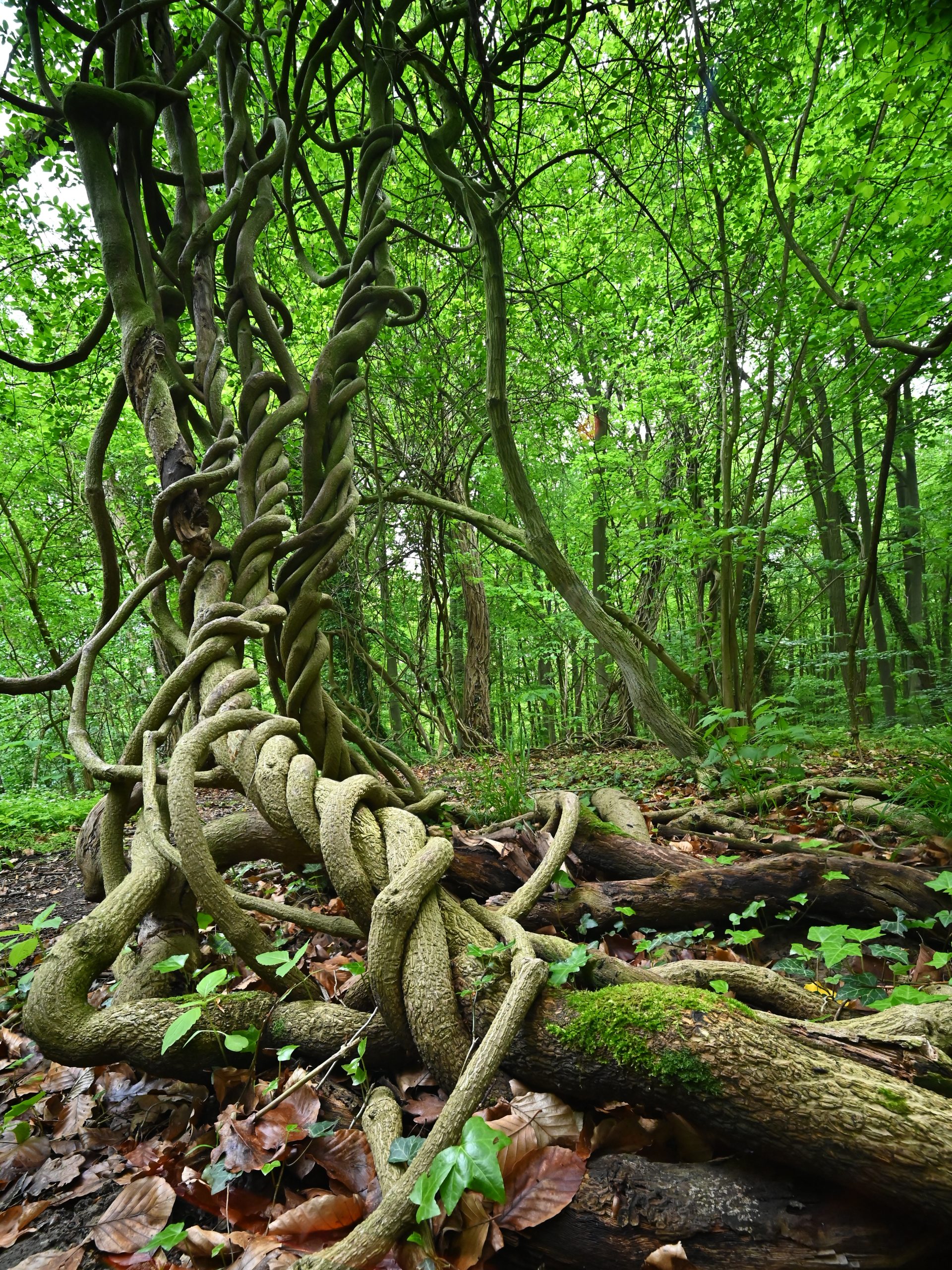
In the wild, Dutchman’s Pipe climbs through rich, moist woods along streams and on shaded mountain slopes, most commonly found along the Blue Ridge and Cumberland Mountains. A single vine can scale 20 to 30 feet into the forest canopy, twining its stems tightly around tree trunks, fence posts, or arbors — never gripping with tendrils, but wrapping its whole stem counterclockwise around whatever support it finds.
Beyond its ornamental value, Dutchman’s Pipe plays an outsized ecological role: it is one of the few larval host plants for the pipevine swallowtail butterfly (Battus philenor), whose caterpillars feed exclusively on Aristolochia species and sequester the plant’s toxic compounds as a lifelong defense against predators. Every part of the plant contains aristolochic acid and should never be eaten or used medicinally.
Identification
Dutchman’s Pipe is a woody, deciduous, twining vine that can eventually reach 20 to 30 feet in length, with older specimens developing thick, deeply furrowed, rope-like stems that look almost braided where multiple vines have wound around each other over the years. Young stems are slender, flexible, and green to reddish-brown, becoming woody and gray-brown with age.
Leaves
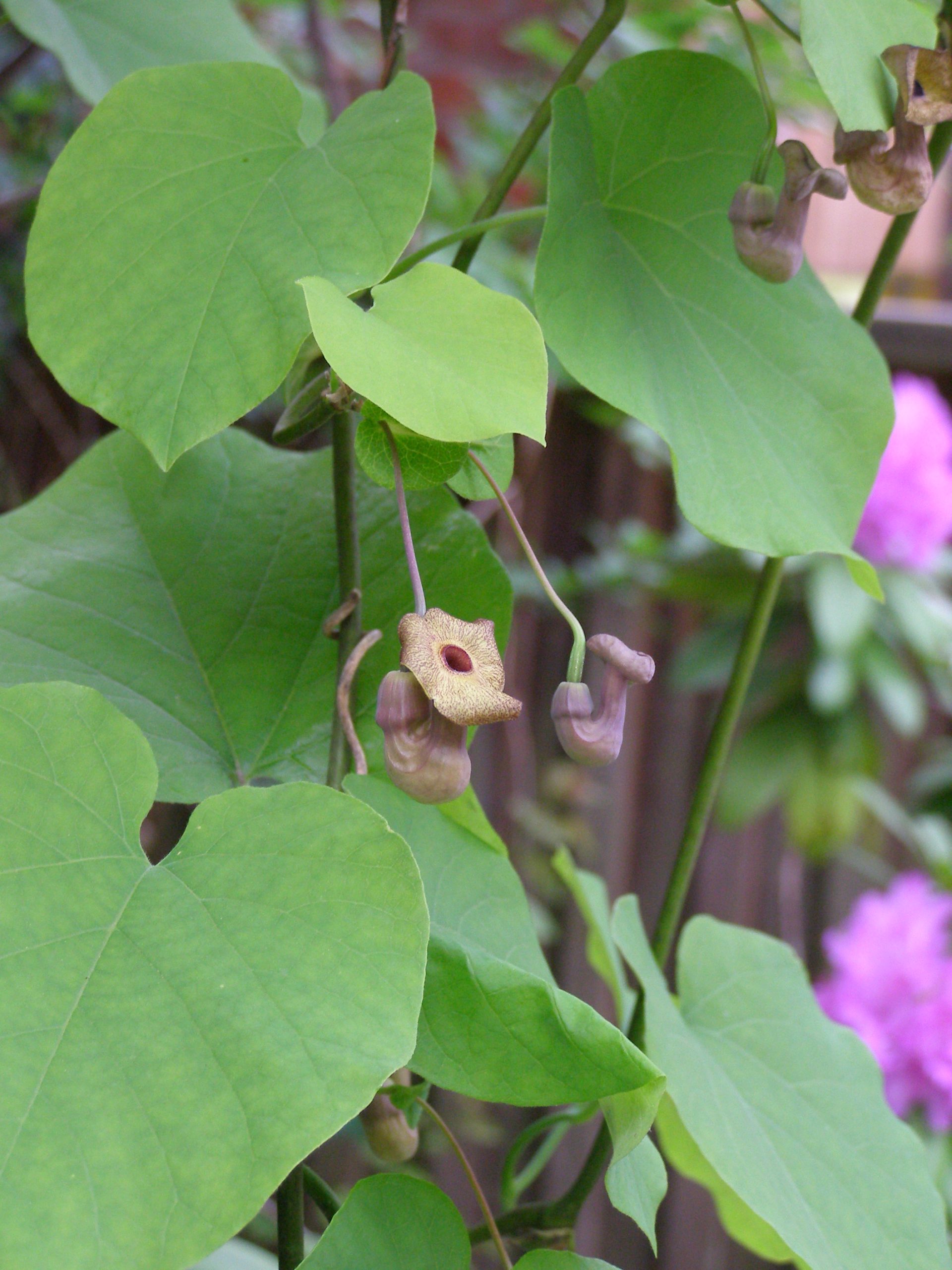
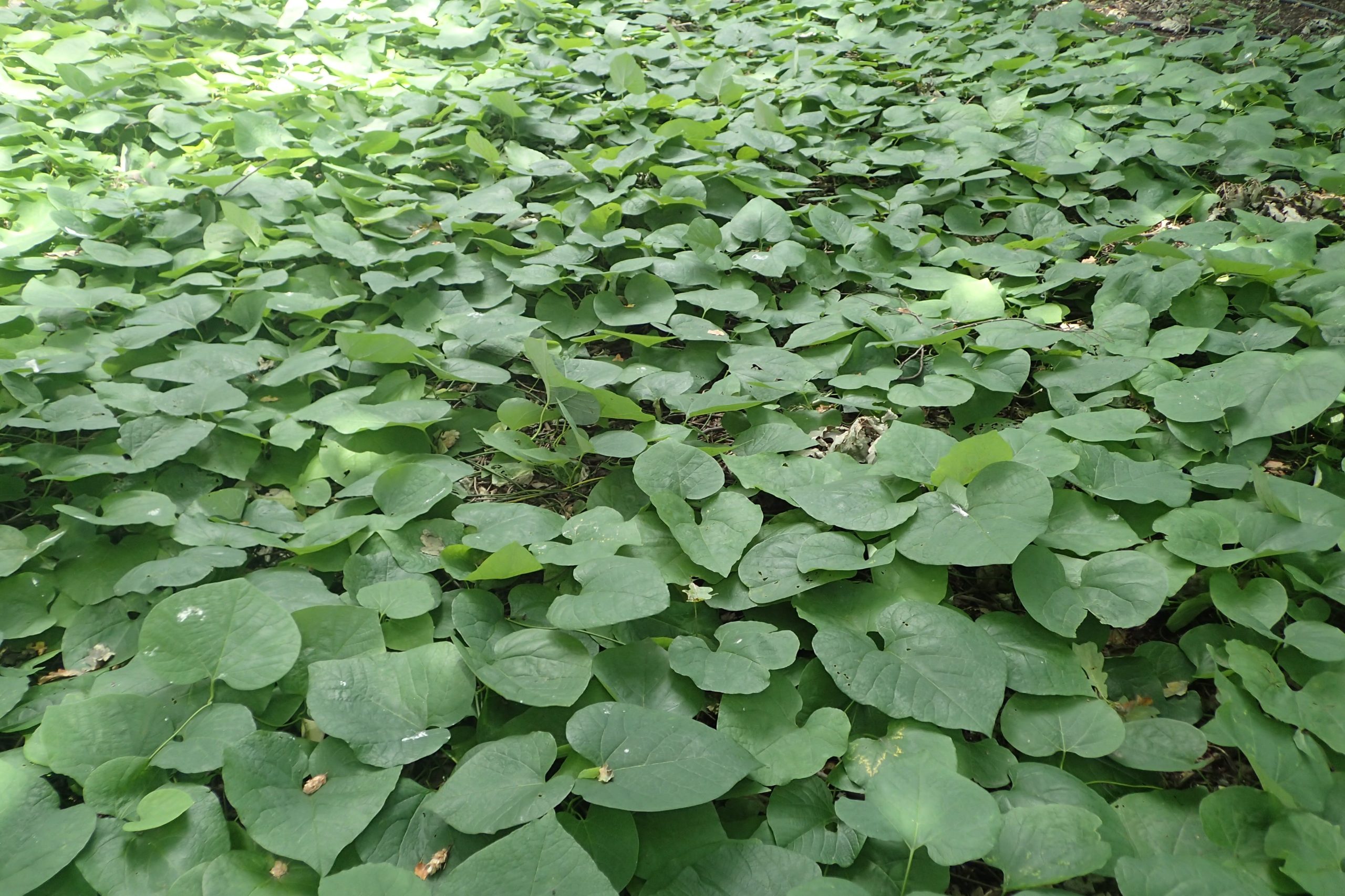
The leaves are the vine’s most recognizable feature: broadly heart-shaped (cordate), 5 to 12 inches across, with a deep basal notch and smooth (entire) margins. They are arranged alternately along the stem on long petioles and overlap so densely that a well-grown vine forms what looks almost like a solid green wall or curtain — the reason it was so prized for shading porches before air conditioning. The upper surface is dark green and slightly glossy; the underside is paler and may be faintly hairy along the veins. Leaves turn a muted yellow in autumn before dropping.
Flowers
Flowers emerge from the leaf axils in late spring, usually in pairs, on slender drooping stalks. Each flower is small — about 1 to 1.5 inches long — and distinctly S-curved, with a bulbous base, a narrow curved throat, and a flared, three-lobed, brownish-purple and yellow-green mottled opening that resembles a tiny curved pipe or a meerschaum bowl. Because the flowers hang beneath the dense leaf canopy, they are easy to overlook unless you part the foliage to look for them. They give off a faint, musty scent that attracts small flies, which the flower’s internal hairs briefly trap to ensure pollination before releasing them.
Fruit
The fruit is a hanging, six-sided (hexagonal) capsule, 2 to 3 inches long, green ripening to brown. In fall the capsule splits open from the base upward, like a tiny parachute, releasing flat, papery, triangular seeds that are dispersed by wind and gravity.
Quick Facts
| Scientific Name | Aristolochia macrophylla (syn. Isotrema macrophyllum) |
| Family | Aristolochiaceae (Birthwort) |
| Plant Type | Deciduous Woody Vine |
| Mature Length | 20–30 ft |
| Growth Rate | Fast once established |
| Sun Exposure | Full Sun to Full Shade |
| Water Needs | Moderate to High |
| Soil Type | Moist, rich, well-drained loam |
| Soil pH | 5.5–7.0 (slightly acidic to neutral) |
| Bloom Time | May – June |
| Flower Color | Yellow-green mottled brownish-purple |
| Fall Color | Muted yellow |
| Fruit | Hexagonal brown seed capsule |
| Toxicity | All parts toxic (aristolochic acid) — do not ingest |
| Deer Resistant | Yes, generally avoided |
| USDA Hardiness Zones | 4–8 |
Native Range
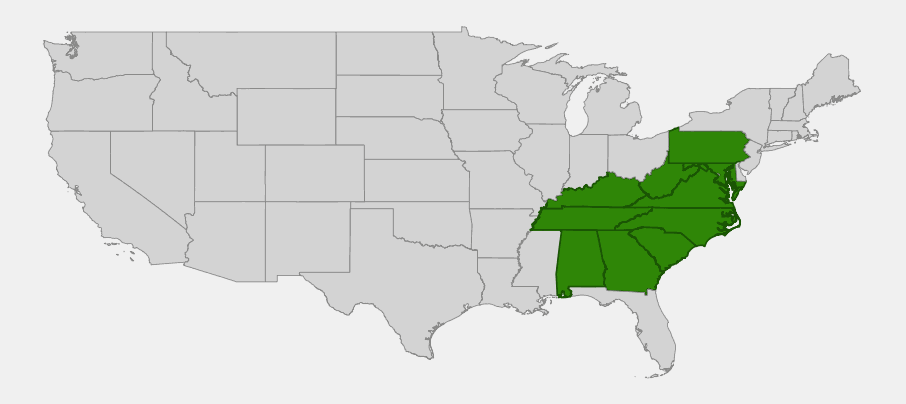
Dutchman’s Pipe is native to the uplands of the eastern United States, centered on the southern and central Appalachian Mountains. Its range runs from southwestern Pennsylvania and western Maryland south through West Virginia, along the Blue Ridge and Cumberland Mountains through Virginia, Kentucky, Tennessee, North Carolina, South Carolina, Georgia, and Alabama. It is an uncommon, scattered species through most of this range rather than an abundant one, and populations can be locally sparse even within otherwise suitable habitat.
Within its native range, Dutchman’s Pipe grows in rich, moist, well-drained woods, on shaded slopes, in cove forests, and along stream banks, often climbing into the subcanopy where larger trees provide support. It is noticeably absent from the Coastal Plain and prefers the cooler, moister conditions of mountain and piedmont forests. The species has also naturalized outside its native range in parts of southern Ontario and scattered locations in Europe, where it was introduced as an ornamental.
📋 Regional plant lists featuring Dutchman’s Pipe: Georgia, Alabama & Mississippi · Maryland, Virginia & West Virginia · North Carolina & South Carolina · Kentucky & Tennessee · New York, Pennsylvania & Northern New Jersey
Growing & Care Guide
Dutchman’s Pipe is a tough, long-lived vine once it is established, and it is still sold by specialty native plant nurseries for exactly the purpose it served a century ago: creating fast, dense, leafy shade on an arbor, pergola, or porch trellis.
Light
This vine tolerates an unusually wide range of light, from full sun to full shade. In cooler climates it can take full sun as long as the roots stay moist; in warmer parts of its range it performs best with afternoon shade. In deep shade it still grows, though more slowly and with a more open, less dense leaf cover.
Soil & Water
Give Dutchman’s Pipe rich, moist, well-drained soil similar to what it finds on wooded slopes and along streambanks in the wild — a slightly acidic to neutral loam with consistent organic matter works best. The vine does not tolerate prolonged drought well, especially while young, so plan on regular watering through the first two growing seasons. Once the root system is established, mature vines are more resilient to short dry spells.
Planting Tips
Install a sturdy support before planting — a wooden arbor, metal trellis, or thick wire framework, since mature vines become heavy and woody. Plant in spring or fall, spacing vines at least 6 to 8 feet apart if training more than one onto the same structure. Because the stems twine rather than cling, you may need to loosely tie new growth to the support until it finds something to wrap around.
Pruning & Maintenance
Prune in late winter while the vine is dormant to control size, remove dead wood, and thin congested growth. Dutchman’s Pipe responds well to hard pruning and will quickly regrow dense foliage the following season. Watch for aggressive spread onto nearby shrubs or small trees, since a vigorous vine can smother slower-growing neighbors if left unchecked.
Landscape Uses
Dutchman’s Pipe earns its keep in several garden roles:
- Porch and arbor screening — its traditional use, creating dense summer shade
- Butterfly gardens — the essential host plant for pipevine swallowtail caterpillars
- Privacy screens on fences and chain-link enclosures
- Woodland garden accents trained up a mature tree trunk
- Erosion control on shaded slopes where the dense root system helps stabilize soil
Wildlife & Ecological Value
Dutchman’s Pipe is far more ecologically significant than its modest flowers suggest, serving as a critical link in the life cycle of one of the Eastern forest’s most striking butterflies.
For the Pipevine Swallowtail
Dutchman’s Pipe is one of only a handful of native plants in the Aristolochiaceae that serve as a larval host for the pipevine swallowtail butterfly (Battus philenor). Female swallowtails lay clusters of eggs on new growth, and the resulting caterpillars feed exclusively on Aristolochia foliage. By eating the toxic leaves, the caterpillars — and later the adult butterflies — sequester aristolochic acid in their own tissues, making them unpalatable to birds and other predators. This defense is so effective that several other butterfly species, including the red-spotted purple and the black swallowtail, have evolved to mimic the pipevine swallowtail’s coloring even though they lack the toxin themselves.
For Pollinators
The small, hidden flowers are pollinated primarily by tiny flies and fungus gnats, which are drawn in by the flower’s faint, musty scent and briefly trapped by downward-pointing hairs inside the curved throat. As the flower matures and the hairs wilt, the insects are released, dusted with pollen to carry to the next bloom.
For Birds and Mammals
While the foliage is too toxic for most browsing mammals to eat, the dense tangle of vines and large leaf canopy provides excellent cover and nesting structure for songbirds, and the thick woody stems offer shelter for small mammals at the base of mature vines.
Cultural & Historical Uses
Dutchman’s Pipe earned its place in American gardens during the Victorian era, when homeowners across the eastern United States trained it over porches, verandas, and arbors to create natural summer shade before the advent of air conditioning. Its dense, overlapping leaves could completely cover a trellis within a few seasons, and the vine’s toughness and tolerance of poor city soils made it a dependable choice for urban and suburban yards alike.
The genus name Aristolochia comes from the Greek aristos (“best”) and locheia (“childbirth”), reflecting a long history of use by various cultures in traditional birthing-related remedies — practices that modern medicine now knows to be dangerous. Species in this genus contain aristolochic acid, a compound confirmed to cause kidney failure and classified as a human carcinogen. Historical medicinal use of Aristolochia plants is documented extensively, but it is presented here as history only — no part of this plant should ever be ingested or used as a home remedy.
Today, Dutchman’s Pipe is grown almost exclusively for its ornamental screening value and its importance to pipevine swallowtail conservation, with historical porch-vine plantings from the early 1900s still found climbing old arbors in parts of its native range.
Frequently Asked Questions
Is Dutchman’s Pipe the same as Pipevine?
Yes. “Pipevine” and “Dutchman’s Pipe” are both common names for Aristolochia macrophylla, named for the curved, pipe-bowl shape of its flowers.
Can you eat Dutchman’s Pipe?
No. Every part of the plant contains aristolochic acid, a compound known to cause kidney damage and linked to cancer. It should never be eaten, brewed, or used as a home remedy.
Why don’t I see flowers on my vine?
The flowers are small and dangle beneath the dense leaf canopy, so they are easy to miss. Part the foliage near the stem in May and June to look for them, especially on older, well-established vines — young vines may not flower for the first few years.
Does Dutchman’s Pipe attract butterflies?
Yes — it is the primary host plant for the pipevine swallowtail butterfly in much of the eastern United States. Planting it in a sunny to partly shaded spot with a sturdy support is one of the best ways to support this species in a home garden.
How fast does Dutchman’s Pipe grow?
Once established, it grows quickly, often adding several feet of new stem growth per year and reaching full coverage on an arbor or trellis within three to five seasons.

Looking for a nursery that carries Dutchman’s Pipe?
Browse our native plant nursery directory: Alabama · Georgia · Kentucky & Maryland · North Carolina · Pennsylvania, South Carolina, Tennessee & Virginia · West Virginia