
Pecan (Carya illinoinensis)
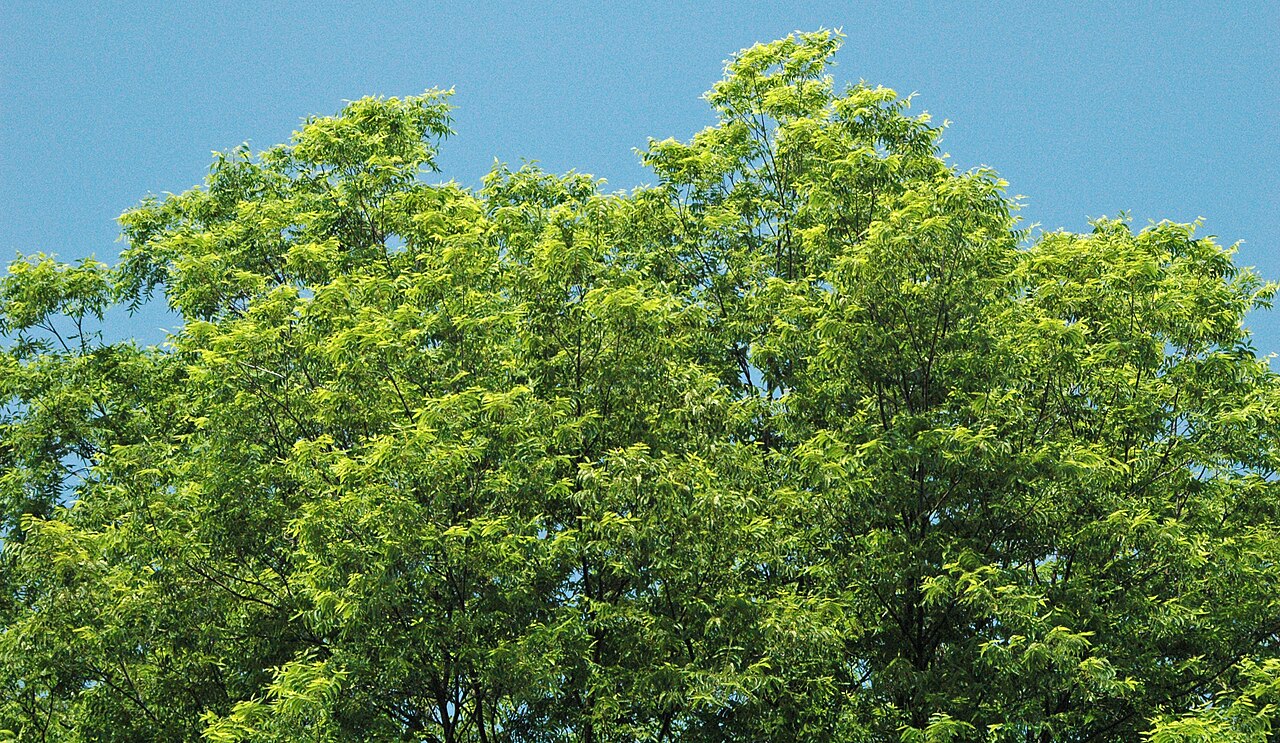
Carya illinoinensis, the Pecan, is a massive, long-lived hickory native to the bottomlands and river valleys of the south-central United States. It is the largest of all the hickories, capable of reaching well over 100 feet with a trunk several feet across, and it is also one of North America’s most economically important native trees — the source of the pecans sold in every grocery store and the state tree of Texas. Long before commercial orchards existed, wild pecan groves along the Mississippi, Red and Colorado River valleys fed wildlife and Native American communities for thousands of years.
In the landscape, pecan is a stately shade tree rather than a quick ornamental fix. It grows slowly at first, developing a deep taproot that makes young trees difficult to transplant, then speeds up once established, eventually casting dense shade from a broad, rounded crown. Its pinnately compound leaves, inconspicuous spring catkins, and husked nuts that drop in autumn are all familiar sights across its native range, where the tree is as much a part of the regional identity as it is a food source.
Pecan rewards patience. A tree planted today may take a decade or more before it bears a meaningful nut crop, and it needs a second genetically different pecan nearby to pollinate well, but the payoff is a long-lived shade tree — some wild pecans are known to live over 300 years — that feeds squirrels, deer, turkeys and generations of a family all at once.
Identification
Pecan is a large deciduous tree, typically 70 to 100 feet tall in cultivation and occasionally exceeding 130 feet in the wild, with a trunk up to 6 feet in diameter on old specimens. It develops a massive, rounded to oval crown with stout, spreading branches, and because it needs little pruning to form this shape, open-grown trees often look symmetrical without any training.
Bark
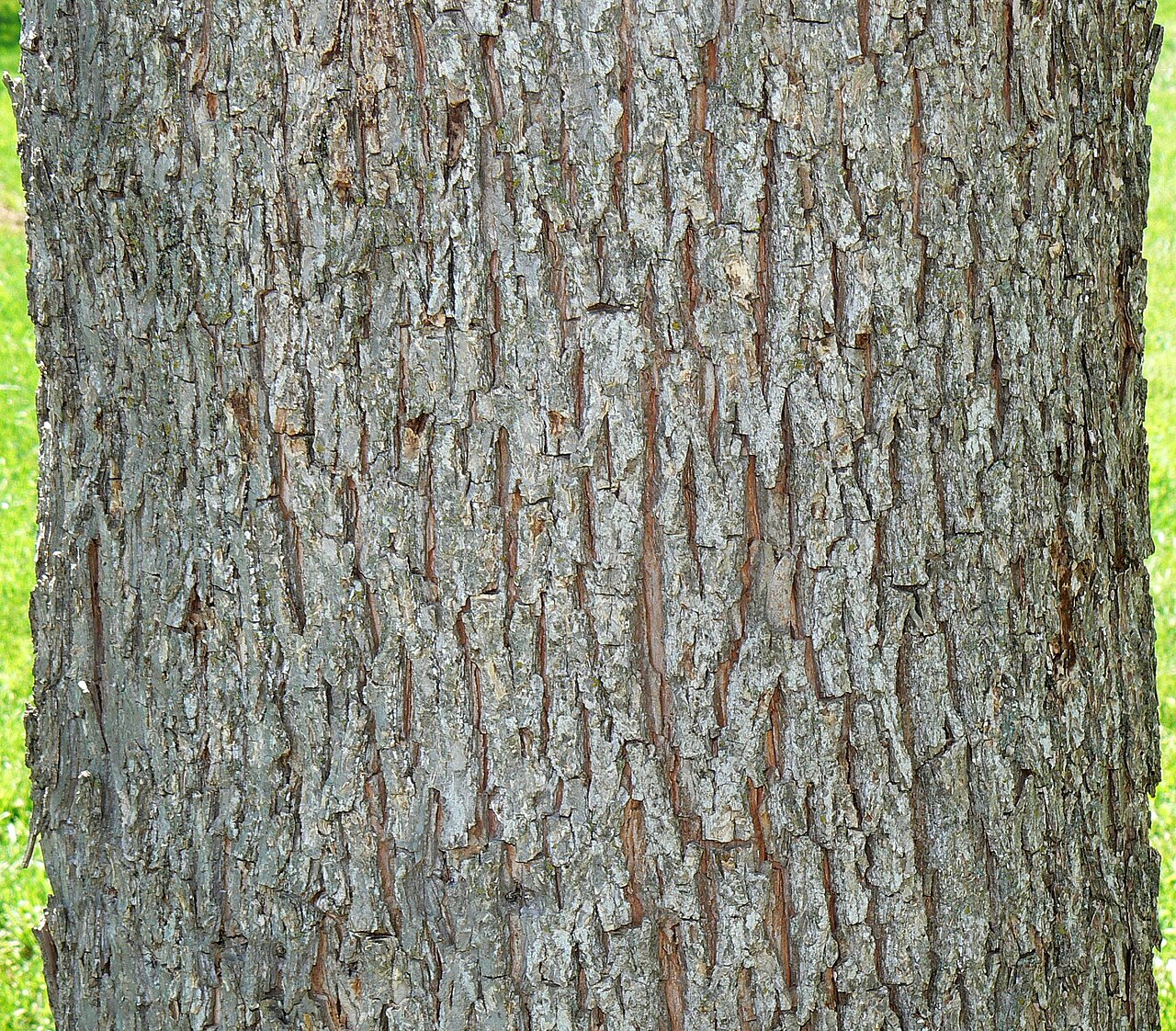
Young bark is smooth and gray, gradually becoming rough, gray-brown, and broken into narrow, interlacing ridges with shallow furrows as the tree matures. The ridged pattern runs in rough vertical lines up the trunk and is a useful winter identification feature once the leaves have dropped.
Leaves
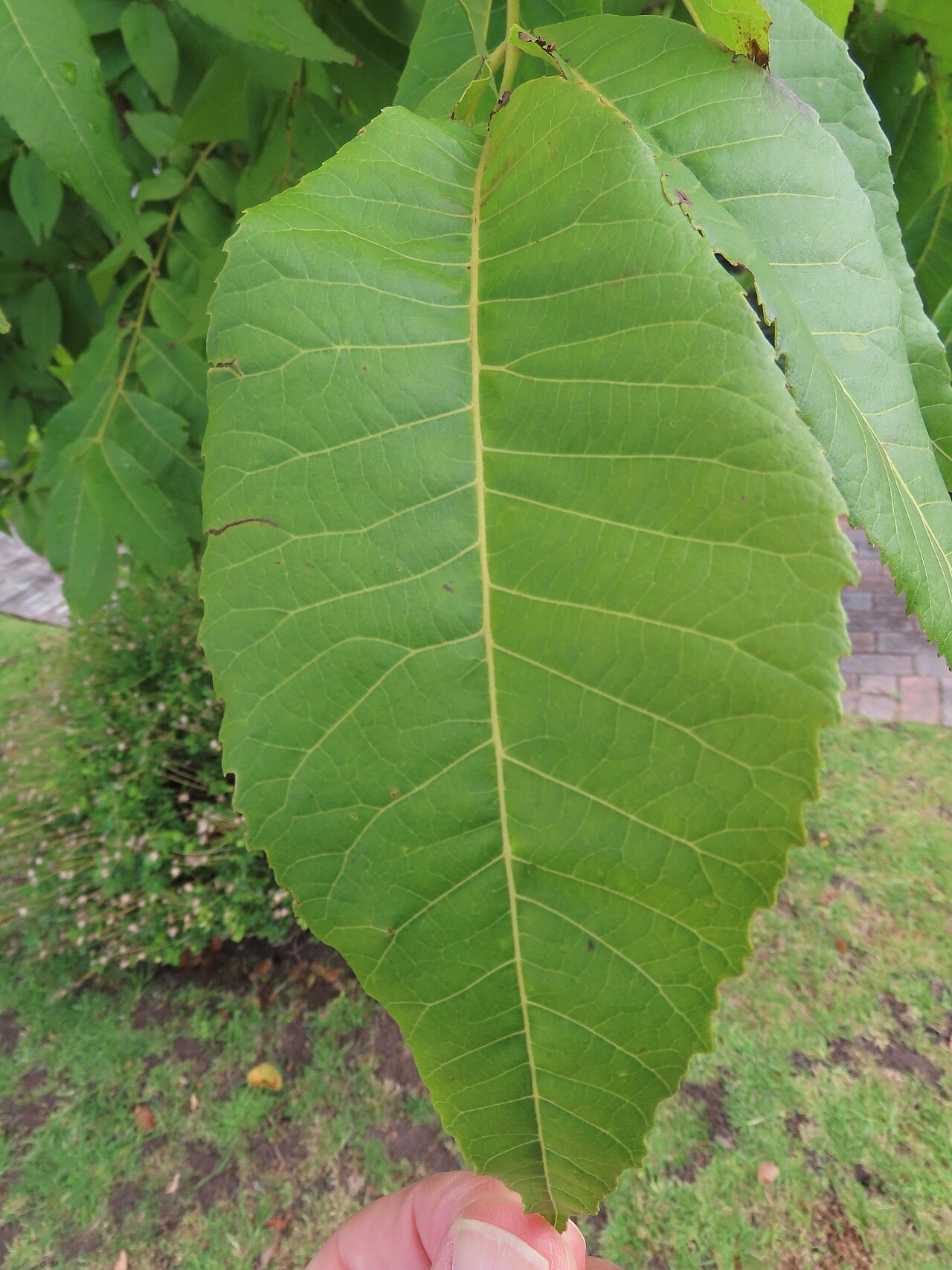
Leaves are alternate, pinnately compound, 12 to 20 inches long, with 9 to 17 lance-shaped leaflets that curve slightly like a sickle. Each leaflet is 3 to 7 inches long with a finely toothed margin and an off-center midrib, with more leaf blade on one side of the vein than the other — a reliable way to distinguish pecan leaflets from other hickories. The foliage is medium to yellow-green through summer, turning a soft yellow in fall before dropping.
Flowers & Fruit
Pecan is monoecious, meaning separate male and female flowers occur on the same tree. Male flowers hang in slender, yellow-green catkins 3 to 5 inches long, while female flowers are small, inconspicuous spikes at the tips of new growth. Both appear in spring as the leaves emerge, and because male and female flowers on an individual tree often mature at different times, a second pecan of a different variety nearby greatly improves nut production.
The fruit is technically a drupe rather than a true nut: a thin-shelled seed enclosed in a husk that splits into four sections at maturity. Husks are oblong, 1 to 2.5 inches long, green ripening to brown, and they typically split open in September and October to release the familiar oval, thin-shelled, edible pecan. A heavy mast year is often followed by a lighter one, a pattern called alternate bearing that is common in wild and unmanaged trees.
Quick Facts
| Scientific Name | Carya illinoinensis |
| Family | Juglandaceae (Walnut) |
| Plant Type | Deciduous Tree |
| Mature Height | 70–100 ft (rarely to 130+ ft in the wild) |
| Mature Spread | 50–75 ft |
| Growth Rate | Slow when young, moderate once established |
| Sun Exposure | Full Sun |
| Water Needs | Average to high; best with consistent moisture |
| Soil Type | Rich, deep, well-drained bottomland soils; sandy loam to clay loam |
| Soil pH | 6.0–7.5 (slightly acidic to neutral) |
| Bloom Time | March – May |
| Flower Color | Yellow-green (catkins) |
| Fall Color | Yellow |
| Fruit | Husked, thin-shelled edible nut, ripening September–November |
| Deer Resistant | No (deer browse young growth; squirrels and deer eat nuts) |
| USDA Hardiness Zones | 5–9 |
Native Range
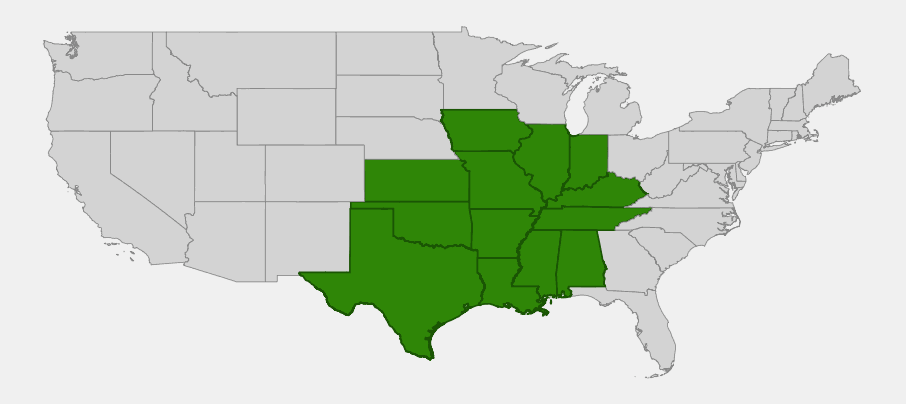
Pecan is native to the south-central United States, centered on the Mississippi River valley and its tributaries. Its range runs from the Gulf Coast states of Texas, Louisiana and Mississippi northward through Arkansas, Missouri, Kansas, Oklahoma and Kentucky, east through Tennessee into the lower Ohio Valley of southwestern Indiana, and across Mississippi into Alabama, with populations recorded as far north as southeastern Iowa. It also grows natively in adjacent northern Mexico. Farther east, in Georgia, the Carolinas, Florida and Virginia, pecan is a widely planted orchard and yard tree rather than a native one.
In the wild, pecan is a bottomland species, favoring the deep, periodically flooded alluvial soils of river terraces, floodplain forests and stream banks where it can send roots down to reliable groundwater. It does not tolerate soils that stay saturated for long stretches, so it is usually found on the slightly higher ground within a floodplain rather than in permanent wetlands. Common forest companions include sycamore, sugarberry, green ash, bur oak and various other hickories.
Pecan’s native range has been greatly extended by cultivation and planting well outside its original bottomland habitat, so trees are now a familiar sight across much of the Southeast and Southwest regardless of original nativity. Wild, naturally reproducing stands are still most common along the river systems of Texas, Oklahoma and the lower Mississippi Valley, where the species has grown for thousands of years.
📋 Regional plant lists featuring Pecan: Arkansas, Louisiana, Eastern Oklahoma & Eastern Texas · Georgia, Alabama & Mississippi · Kentucky & Tennessee · Ohio & Indiana · Illinois, Iowa & Missouri · Nebraska, Kansas & Eastern Colorado
Growing & Care Guide
Pecan is not a tree for a small yard or an impatient gardener, but for anyone with the space and a long view, it is one of the most rewarding native shade trees in its range, combining a stately form with a genuine food crop.
Light
Pecan needs full sun to develop a healthy crown and produce a worthwhile nut crop. Trees planted in shade grow weak and spindly and rarely fruit well. Give it an open site with at least 6 to 8 hours of direct sun and enough overhead and lateral room for a mature spread of 50 feet or more.
Soil & Water
Pecan performs best in deep, well-drained, moderately fertile soil with reliable moisture, echoing the bottomland conditions where it grows wild. It tolerates sandy loam to heavier clay loam as long as drainage is adequate, and it does not like soil that is either constantly waterlogged or droughty. Deep, infrequent watering during the first several years encourages the taproot to grow down rather than out, which improves long-term drought tolerance and wind stability.
Planting Tips
Because pecan develops a long taproot early in life, small bare-root or young container trees transplant far more successfully than larger ones; a 2- to 4-foot whip often outgrows a larger, more expensive tree within a few years. Plant in late winter or early spring while dormant, in a hole as deep as the root system and at least twice as wide. For a reliable nut crop, plant two different pecan varieties or seedlings within 100 to 200 feet of each other, since a single tree’s male and female flowers rarely overlap enough to self-pollinate well.
Pruning & Maintenance
Young trees benefit from light structural pruning to establish a single strong leader and well-spaced scaffold branches; mature trees need little beyond removing dead, damaged or crossing limbs in late winter. Avoid heavy pruning, which can reduce nut production and invite decay in the large wounds this species forms slowly. Established trees have few serious pest problems in a home landscape setting, though aphids, webworms and pecan scab can affect appearance in wet years.
Landscape Uses
- Shade tree for large properties, parks and rural homesteads
- Edible landscaping and home orchards, paired with a compatible pollinator variety
- Bottomland and riparian restoration alongside sycamore and bur oak
- Wildlife plantings, since the nuts feed a wide range of mammals and birds
- Long-term legacy trees for families and communities, given the species’ multi-century lifespan
Wildlife & Ecological Value
As a large, long-lived, nut-bearing tree, pecan is a cornerstone food source across the bottomland forests of its native range.
For Pollinators
Pecan is wind-pollinated rather than insect-pollinated, so its catkins do not rely on bees, but the tree still supports pollinators indirectly: its early pollen is a protein source for some native bees in spring, and the foliage hosts a variety of moth and butterfly caterpillars, including the hickory horned devil and luna moth, which in turn feed breeding songbirds.
For Birds
Wild turkeys, woodpeckers, jays and crows all feed on fallen pecans, and cavity-nesting birds use mature trees for nest sites. The dense summer canopy also provides nesting cover and shade for many forest and edge-dwelling bird species.
For Mammals
Pecans are a prized food for squirrels, which cache far more nuts than they recover and so help disperse the species. White-tailed deer browse young foliage and twigs, and deer, raccoons, and foxes all feed on fallen nuts in fall. Historically, wild pecan groves were important seasonal food sources for bison and other large herbivores along river corridors.
Ecosystem Role
As a dominant canopy species in bottomland hardwood forests, pecan helps stabilize streambanks, contributes heavily to the leaf litter that feeds floodplain soil ecosystems, and provides large-diameter trunks that, with age, develop cavities valuable to a range of wildlife. Its periodic heavy nut crops, known as mast years, are an important pulse of food energy through bottomland food webs.
Cultural & Historical Uses
Pecan has one of the longest records of human use of any North American native tree. Indigenous peoples throughout the Mississippi and Gulf Coast river valleys, including Caddo, Comanche and other nations, gathered wild pecans as a staple food for thousands of years, grinding them into meal, pressing them for oil, and using them in a fermented drink documented by early European explorers. The word “pecan” itself comes from an Algonquian-language term broadly used for hard-shelled nuts that required a stone to crack.
European colonists adopted the pecan quickly; Thomas Jefferson planted pecan seeds at Monticello and reportedly gave seedlings to George Washington, some of which are said to have grown into trees that still stand at Mount Vernon. Commercial pecan cultivation did not take off until the late 1800s, when grafting techniques allowed growers to propagate particularly productive wild trees, launching an industry now centered in Georgia, Texas and New Mexico.
Beyond food, pecan wood has long been valued for furniture, flooring and tool handles, and pecan wood chips and shells remain a favorite choice for smoking meats throughout the South. The pecan carries official status as the state tree of Texas and the state nut of several states, including Alabama, Arkansas, California, Louisiana and Texas.
Frequently Asked Questions
Do I need two pecan trees to get nuts?
Not strictly, but it helps enormously. A single pecan’s male and female flowers often mature at different times, so a second tree of a different variety nearby greatly improves pollination and nut set. Most orchards plant at least two compatible varieties for this reason.
How long does it take a pecan tree to produce nuts?
A seedling pecan typically needs 10 to 15 years before it bears a meaningful crop, though grafted nursery trees can begin producing somewhat sooner. Once established, trees can keep bearing for well over a century.
Are pecans native to my state if I see mature trees growing there?
Not necessarily. Pecan has been planted far outside its original bottomland range because of its popularity as a food and shade tree, so a mature tree does not always indicate a naturally occurring population. Its true native range is centered on the Mississippi River valley and nearby states.
How big of a yard does a pecan tree need?
Pecan grows very large, often 70 to 100 feet tall with an equally wide canopy, so it needs a spacious, open site well away from structures, power lines and septic systems. It is best suited to rural properties, large lots or parks rather than small urban yards.
Is pecan wood good for smoking meat?
Yes, pecan wood and shells are popular for smoking because they burn slow and give a mild, slightly sweet, nutty flavor that is less overpowering than hickory or mesquite, making it a favorite for poultry, pork and fish.

Looking for a nursery that carries Pecan?
Browse our native plant nursery directory: Alabama & Arkansas · Illinois, Indiana, Iowa & Kansas · Kentucky, Louisiana, Mississippi & Missouri · Oklahoma · Tennessee & Texas