
Chickasaw Plum (Prunus angustifolia)
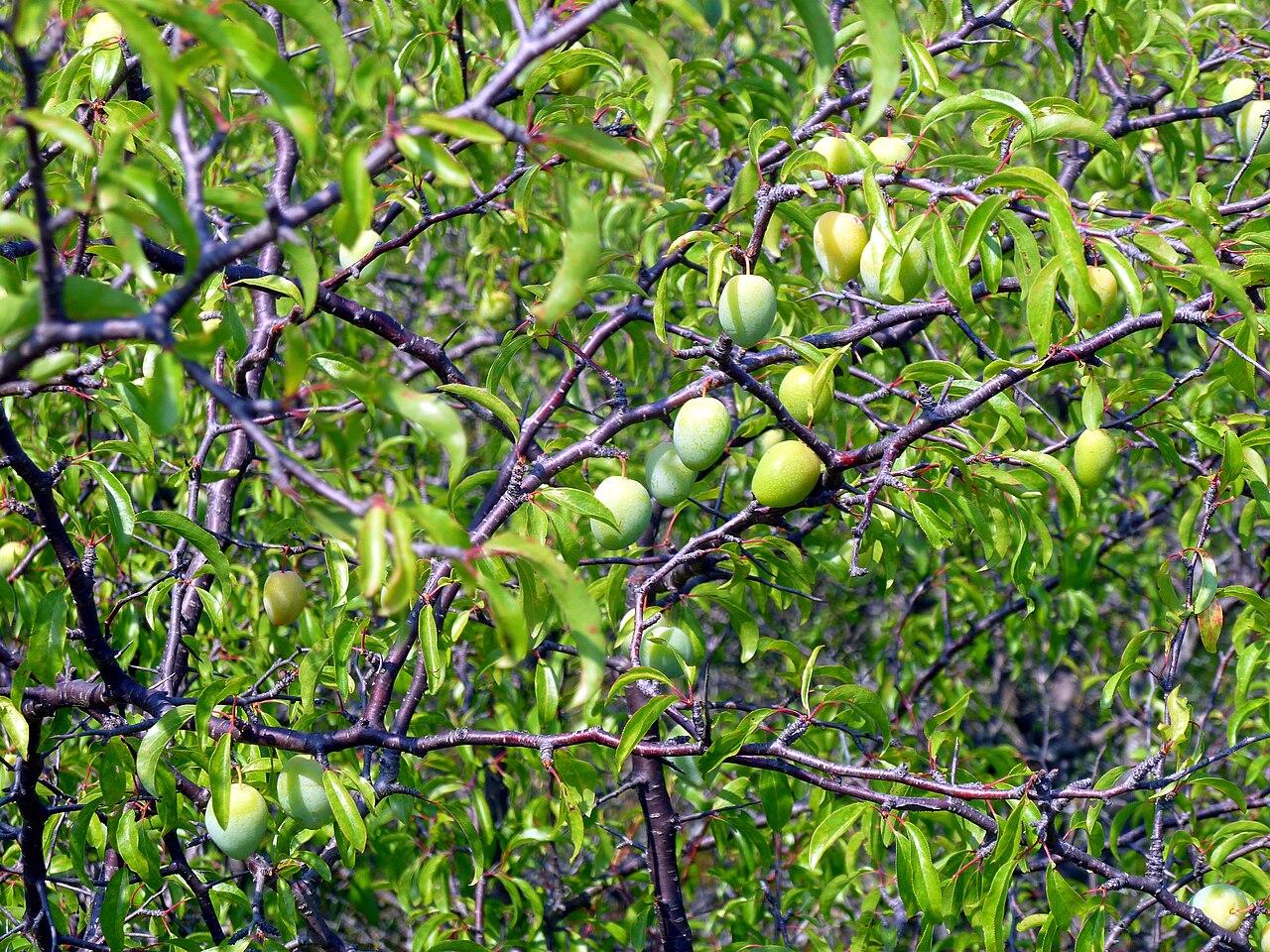
Prunus angustifolia, commonly called Chickasaw Plum (also known as Cherokee Plum, Florida Sand Plum, Sandhill Plum, or simply Sand Plum), is a thicket-forming small tree or large shrub native across the south-central and southeastern United States. A member of the rose family (Rosaceae), it takes its common name from the Chickasaw Nation, who were known to cultivate and spread it along trade routes long before European settlement — some botanists suspect its wide, somewhat disjunct range owes as much to centuries of Indigenous management as to natural seed dispersal by wildlife.
Chickasaw Plum typically grows 6 to 25 feet tall, suckering freely from the roots to form dense, thorny colonies that can spread many feet wide. In early spring, often before the leaves emerge, the bare branches erupt into a cloud of small white, five-petaled flowers that make the plant one of the showiest early bloomers on the southern landscape — and one of the most important early-season nectar sources for native bees. By midsummer the flowers give way to small, cherry-sized plums that ripen from green to yellow, red, or orange-red, beloved by wildlife and prized by foragers for jams and jellies.
Because it tolerates poor, sandy, droughty soils where few other fruiting shrubs can compete, Chickasaw Plum fills a valuable niche in old fields, fencerows, sandhills, and roadside thickets throughout its range. It is an excellent choice for wildlife hedgerows, erosion control on dry slopes, and naturalized plantings where its suckering habit is an asset rather than a nuisance — though gardeners with small, tidy beds should plan for its spreading tendency or site it where a thicket is welcome.
Identification
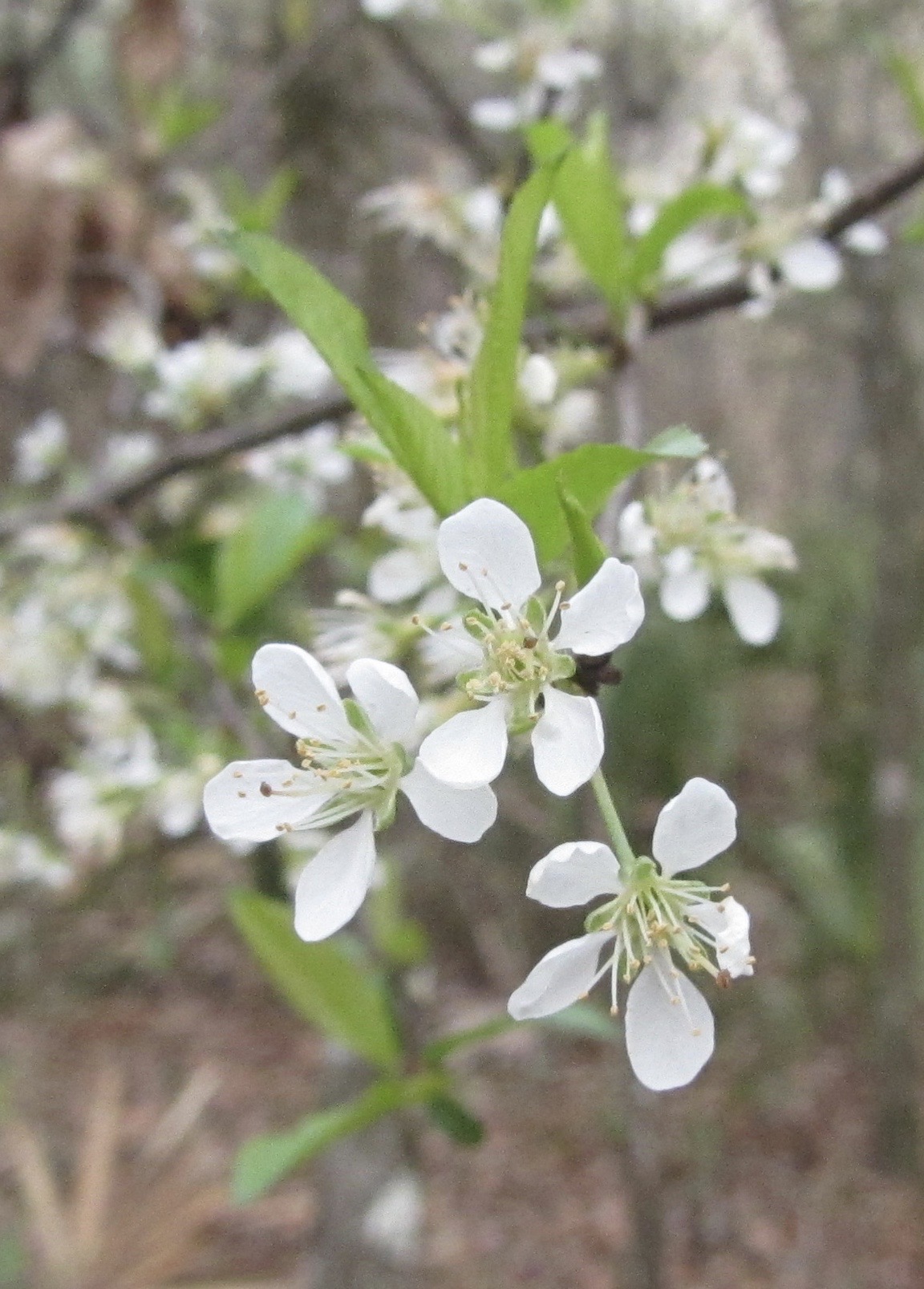
Chickasaw Plum is most easily recognized in late winter and early spring, when its bare, reddish-brown twigs are covered in a mass of small white flowers before any leaves appear. The plant grows as a many-stemmed, thicket-forming shrub or small tree, usually wider than it is tall, with slender branches that often terminate in sharp thorn-like spur shoots.
Bark & Stems
Young twigs are smooth, slender, and reddish-brown to chestnut in color, often with a slight sheen. Older stems and trunks develop a dark gray-brown, somewhat scaly bark. Many of the lateral twigs are modified into stiff, sharp spines, especially on vigorous young growth and on plants growing in full sun — a useful identification trait that distinguishes Chickasaw Plum from the less thorny Wild Plum (Prunus americana).
Leaves
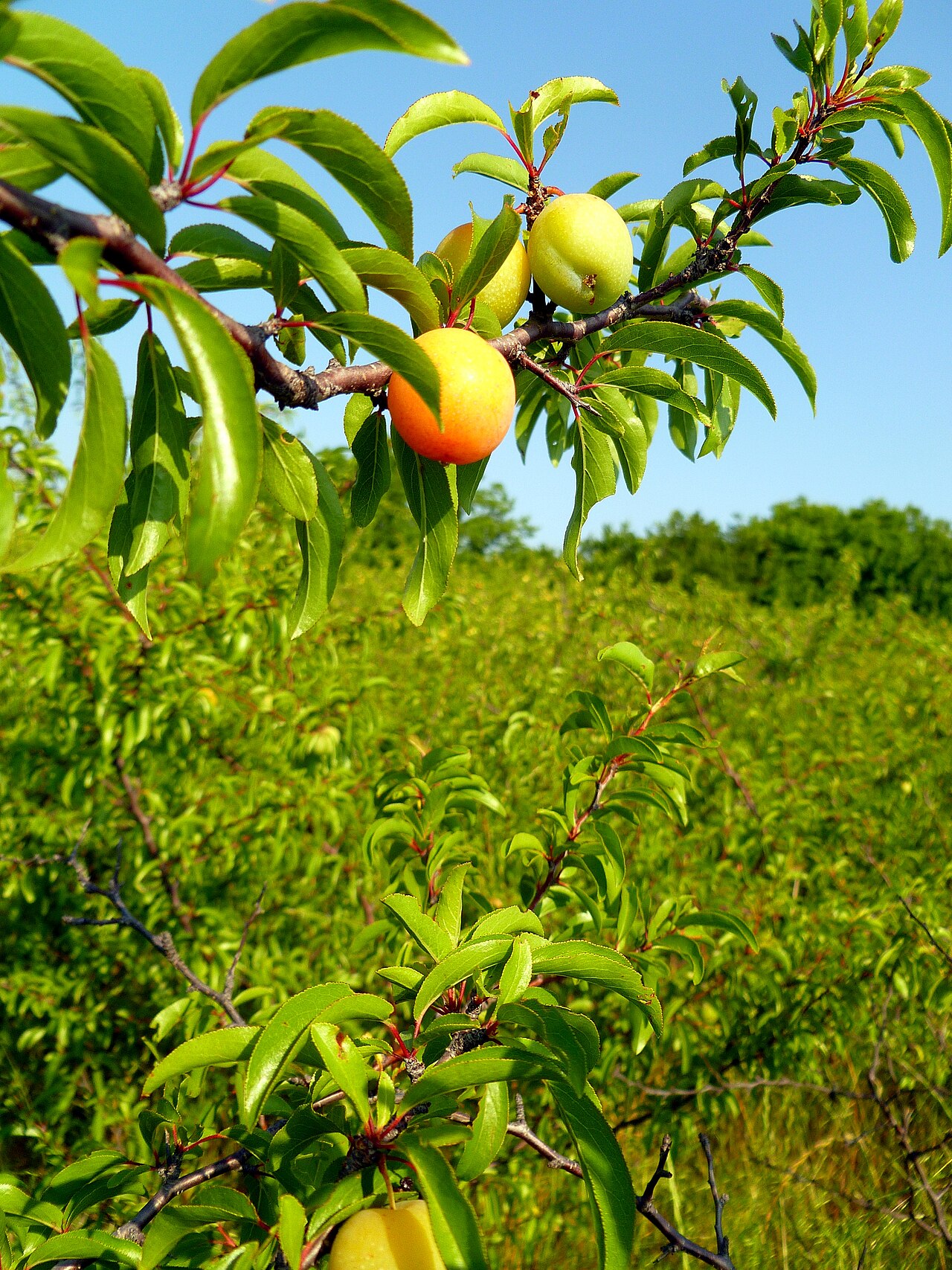
The leaves are simple, alternate, and narrowly lance-shaped to elliptic — hence the species name angustifolia, meaning “narrow leaf.” They run 1 to 2½ inches long and about ½ to 1 inch wide, with finely toothed margins and a glossy, bright green upper surface that pales beneath. Leaves emerge folded along the midrib and unfold as the flowers fade, giving the shrub a two-stage spring display of bloom followed by fresh foliage.
Flowers
Flowers appear in late winter to early spring (typically February through April, earlier in the Deep South), usually opening before or just as the leaves emerge. Each flower is about ½ inch across with five white petals and a cluster of yellow-tipped stamens, borne singly or in small clusters of two or three directly along the previous year’s twigs. A mature thicket in full bloom is strikingly showy, almost appearing snow-dusted from a distance.
Fruit & Seeds
The fruit is a small drupe, ½ to ¾ inch in diameter, ripening from green to yellow, red, or orange-red (occasionally purplish) from late spring into midsummer depending on latitude. The skin has a light waxy bloom, and the juicy flesh surrounds a single hard, flattened stone. The plums are tart but sweeten as they fully ripen and are readily eaten by wildlife and foraged by people for preserves.
Quick Facts
| Scientific Name | Prunus angustifolia |
| Family | Rosaceae (Rose) |
| Plant Type | Thicket-forming Small Tree / Large Shrub |
| Mature Height | 6–25 ft |
| Mature Spread | 10–20 ft (spreads by root suckers) |
| Growth Rate | Fast |
| Sun Exposure | Full Sun to Part Shade |
| Water Needs | Low to Moderate |
| Soil Type | Dry, sandy or rocky; well-drained |
| Soil pH | 5.5–7.5 (acidic to neutral) |
| Bloom Time | February – April |
| Flower Color | White |
| Fall Color | Yellow to bronze (not showy) |
| Fruit | Red, yellow or orange-red edible plums, ½–¾ in |
| Deer Resistant | No (browsed by deer; thorns deter heavier damage) |
| USDA Hardiness Zones | 6–9 |
Native Range
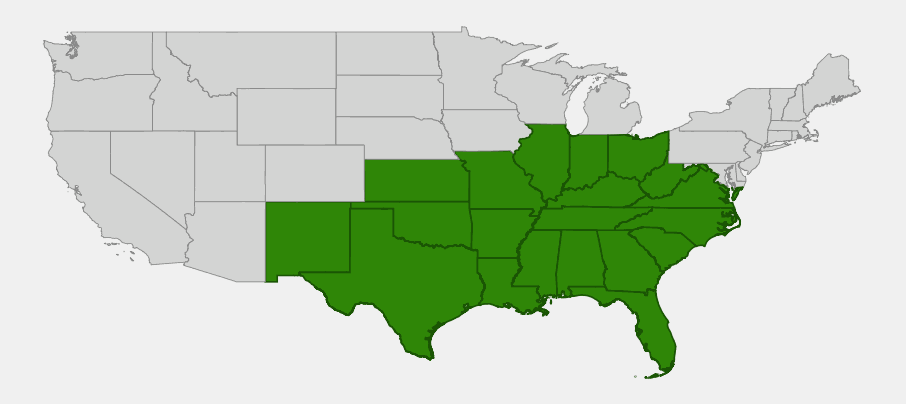
Chickasaw Plum is native across the south-central and southeastern United States, from Kansas, Oklahoma, and eastern New Mexico east through Missouri, Arkansas, Louisiana, and Texas, and on through the Mississippi and Ohio valleys into Illinois, Indiana, Ohio, Kentucky, and Tennessee. Its range continues east and south through the Carolinas, Georgia, Alabama, Mississippi, and Florida, with scattered native populations reaching into Virginia and West Virginia. It is absent as a native plant from the Northeast, the Upper Midwest, and the West outside this core region; where it turns up elsewhere, it has typically been planted or has escaped cultivation.
Across this range, Chickasaw Plum favors open, sunny, disturbed ground: old fields, fencerows, roadsides, sandhills, dry prairie margins, and the edges of woodlands. It is especially characteristic of deep sandy soils in the southern Great Plains and the Gulf Coastal Plain, where it often forms extensive thickets on sites too dry and infertile for most other fruiting trees. It also colonizes abandoned agricultural land readily, making it a common early-successional species across much of the rural South.
Many botanists believe the species’ broad, somewhat patchy distribution reflects a long history of Indigenous cultivation and trade — the Chickasaw and other Southeastern nations are documented to have propagated and traded the fruit — layered atop its natural range as a plains and woodland-edge shrub. Today it remains common and secure throughout its native range, and it has also become naturalized well beyond it, including parts of the Northeast and West, where plantings have escaped into the wild.
📋 Regional plant lists featuring Chickasaw Plum: Georgia, Alabama & Mississippi · Arkansas, Louisiana, Eastern Oklahoma & Eastern Texas · North Carolina & South Carolina · Maryland, Virginia & West Virginia · Kentucky & Tennessee · Ohio & Indiana · Illinois, Iowa & Missouri · Nebraska, Kansas & Eastern Colorado · Arizona & New Mexico
Growing & Care Guide
Chickasaw Plum is remarkably easy to grow and thrives on the kind of lean, droughty soil that stunts most ornamental fruit trees. Once established, it needs almost no supplemental care, making it a favorite for low-maintenance wildlife plantings, erosion control, and naturalized hedgerows.
Light
Full sun produces the heaviest bloom and fruit set and the densest, most thorny thickets. Plants tolerate part shade but flower and fruit more sparingly and grow in a looser, more open form as they stretch toward available light.
Soil & Water
This species is built for dry, sandy, or rocky soils and is notably drought tolerant once established — a trait that sets it apart from most other native plums. It adapts to a range of pH from acidic to neutral and tolerates poor fertility without complaint. Good drainage matters more than soil richness; heavy, waterlogged clay is the one condition it dislikes. Water young plants during their first year or two, then let nature take over.
Planting Tips
Plant bare-root or container stock in late fall through early spring while dormant. Because it suckers aggressively from the roots, give Chickasaw Plum plenty of room — 15 to 20 feet in any direction — or plan to mow or cut back suckers at the edges of the desired thicket each year. It is an excellent choice for stabilizing dry, eroding slopes and for filling in sunny fencerows where a dense, thorny barrier is welcome.
Pruning & Maintenance
Little pruning is required beyond removing dead wood and controlling the spread of root suckers. Older, overgrown thickets can be rejuvenated by cutting a portion of the stems to the ground in late winter; the plant resprouts vigorously. Because flowers form on old wood, avoid heavy pruning immediately before bloom if fruit production is a goal.
Landscape Uses
Chickasaw Plum earns its keep in several garden roles:
- Wildlife hedgerows — dense, thorny cover plus food in one plant
- Erosion control on dry, sunny banks and slopes
- Naturalized thickets at the edge of meadows or woodlands
- Pollinator gardens — an early and reliable nectar source
- Living fences where its thorns discourage foot traffic
- Edible landscaping for home jam- and jelly-making
Wildlife & Ecological Value
Few native shrubs pack as much wildlife value into a single plant as Chickasaw Plum, which offers both an early pollen and nectar source and a reliable midsummer fruit crop.
For Pollinators
The late-winter to early-spring flowers open before most other nectar sources are available, making the plant a critical early-season resource for native bees, honeybees, and other pollinating insects emerging from dormancy. It also serves as a larval host plant for several moth and butterfly species, including tiger swallowtails and coral hairstreaks.
For Birds
The dense, thorny thickets provide excellent nesting cover and protection from predators for songbirds such as Northern Mockingbirds, Brown Thrashers, and various sparrows. The ripening plums are eaten by a wide range of birds, including Northern Bobwhite, American Robins, and Cedar Waxwings.
For Mammals
White-tailed deer browse the foliage and twigs, and the fruit is relished by raccoons, opossums, foxes, and coyotes, which help disperse the seeds. Small mammals also use the thorny thickets for cover from predators.
Ecosystem Role
As an early-successional, thicket-forming shrub, Chickasaw Plum plays an important role in stabilizing disturbed, sandy, or eroding soils and in providing structural habitat diversity in open landscapes that might otherwise lack woody cover. Its suckering growth habit, often seen as a maintenance challenge in gardens, is precisely what makes it so effective at knitting together loose soil on slopes and colonizing bare ground.
Cultural & Historical Uses
Chickasaw Plum carries one of the more intriguing botanical histories among native southeastern fruits. The species is named for the Chickasaw Nation, and early American botanists and settlers observed that the plant’s wide, somewhat scattered distribution across the South closely tracked old Indigenous trade and travel corridors — leading many to conclude that Southeastern peoples actively cultivated, selected, and traded superior fruiting plants well before European contact.
The fruit has long been gathered for fresh eating and for preserves; its naturally tart flavor and high pectin content make it especially well suited to jams and jellies, a use that continues in home kitchens across its native range today. Rural fencerows and old homesteads throughout the South still commonly harbor old Chickasaw Plum thickets, remnants of generations of informal cultivation and foraging.
Beyond food use, the dense, thorny growth of Chickasaw Plum was historically valued as a living fence or barrier planting, and its early, abundant bloom made it a familiar harbinger of spring in rural communities long before ornamental flowering trees became common in home landscapes.
Frequently Asked Questions
Can you eat Chickasaw Plum fruit?
Yes. The ripe plums are edible fresh, though quite tart, and are most often used for jams, jellies, and preserves once fully ripe and sweetened. Wait until the fruit has turned fully yellow, red, or orange-red and softened slightly before eating.
Why does my Chickasaw Plum keep spreading into new areas?
Chickasaw Plum spreads by root suckers, forming expanding thickets over time. This is a natural and often desirable trait for wildlife hedgerows and erosion control, but in small gardens it requires annual mowing or cutting at the thicket’s edge to contain it.
Is Chickasaw Plum the same as Wild Plum?
No. Wild Plum (Prunus americana) is a related but distinct species, generally growing taller with fewer thorns and larger fruit. Chickasaw Plum is smaller, more thorny, more drought-tolerant, and tends to form denser thickets.
How fast does Chickasaw Plum grow, and when does it bloom?
It is a fast-growing shrub, often reaching flowering size within just a few years. Bloom occurs in late winter to early spring, typically February through April depending on latitude, usually before or just as the leaves emerge.
Does Chickasaw Plum need another plant nearby to produce fruit?
Most populations benefit from cross-pollination between genetically distinct plants, so a thicket with multiple seedling-origin stems (rather than a single clone) will generally set fruit more reliably than an isolated single plant.

Looking for a nursery that carries Chickasaw Plum?
Browse our native plant nursery directory: Alabama & Arkansas · Florida & Georgia · Illinois, Indiana & Kansas · Kentucky, Louisiana, Mississippi & Missouri · North Carolina, New Mexico, Ohio & Oklahoma · South Carolina, Tennessee, Texas & Virginia · West Virginia