
Purple Pitcher Plant (Sarracenia purpurea)
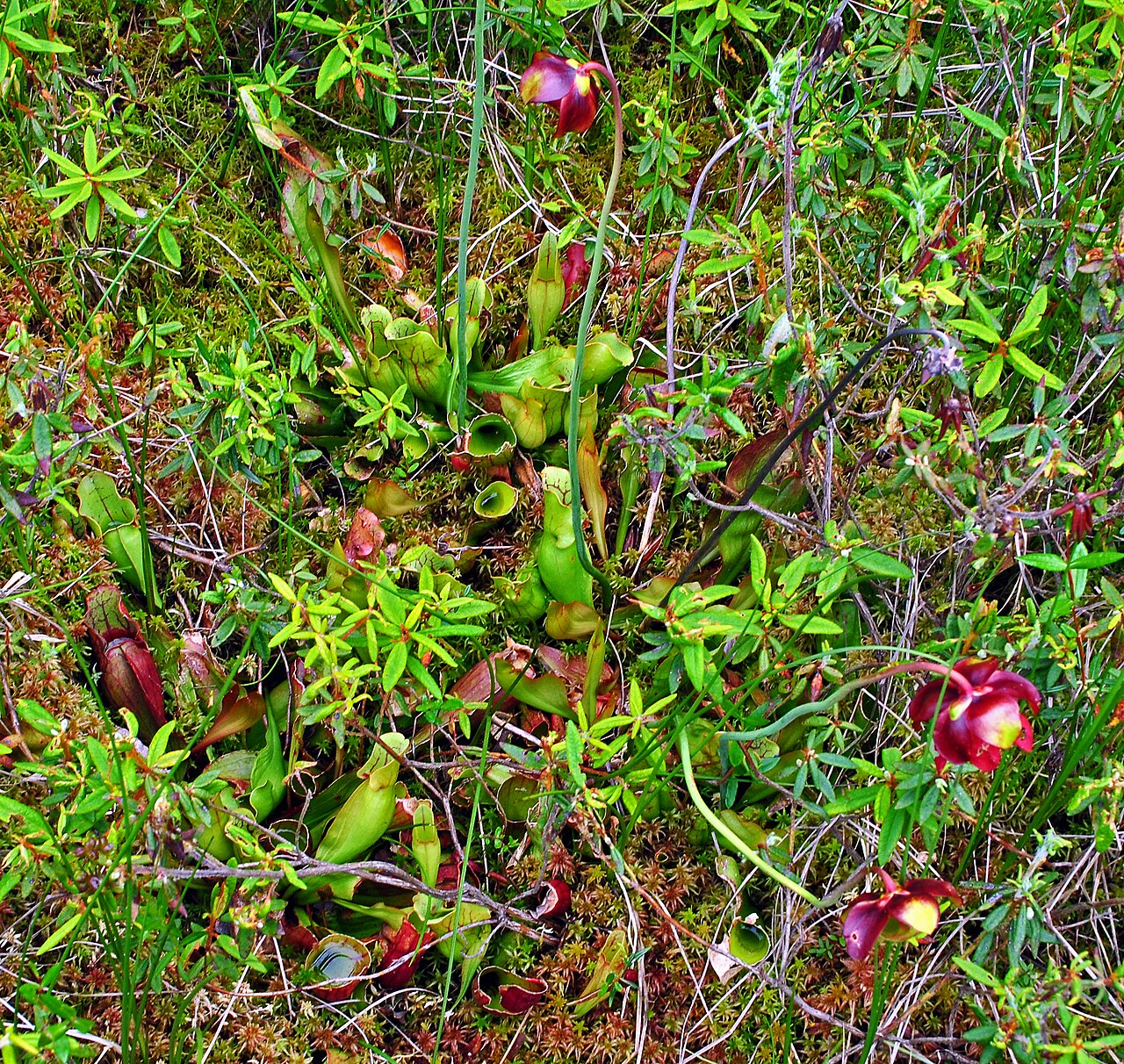
Sarracenia purpurea, the Purple Pitcher Plant (also called Northern Pitcher Plant or Side-saddle Plant), is one of North America’s most recognizable carnivorous plants and the only member of its genus with a range extending into the cold boreal regions of Canada and the northern United States. Unlike the tall, trumpet-shaped pitchers of its southeastern relatives, this species holds its squat, curved pitchers low in a flattened rosette, making it an easy plant to spot — and often tread on — when exploring an open sphagnum bog.
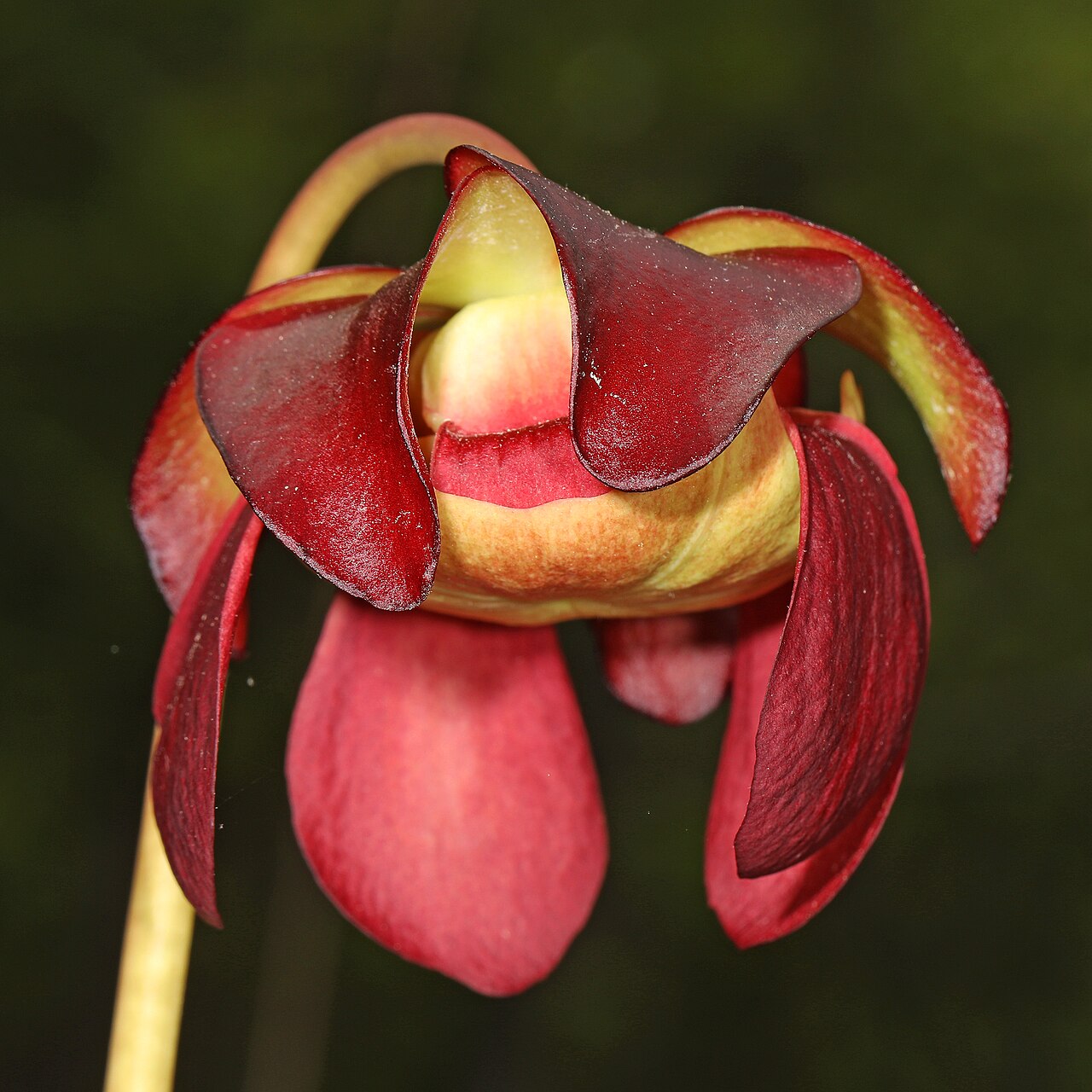
Each pitcher is a modified leaf that forms a water-holding trap: insects lured by nectar and the pitcher’s reddish coloring lose their footing on the slick, hair-lined interior and slide down into a pool of rainwater and digestive fluid at the base, where they drown and slowly break down to supply the plant with nitrogen and other nutrients its boggy, nutrient-poor habitat cannot provide. In late spring, each plant sends up a single leafless flower stalk topped by one nodding, deep maroon-red flower with an umbrella-like style that is as strange and striking as the pitchers themselves.
Because it depends on undisturbed, acidic wetlands — a habitat type that has been drained and developed across much of its range — Purple Pitcher Plant is uncommon to rare across significant parts of the eastern United States and is legally protected or listed as a species of concern in several states. Gardeners who want to grow it should always buy nursery-propagated plants, never specimens collected from the wild.
Identification
Purple Pitcher Plant forms a low, flattened rosette of pitcher-shaped leaves radiating out from a central point, typically 4 to 12 inches (10–30 cm) across, with flower stalks rising 8 to 20 inches (20–50 cm) above the rosette.
Pitchers (Leaves)
The pitchers are the plant’s most distinctive feature: short, squat, strongly curved tubes 4 to 6 inches long, held more or less horizontally or gently upturned rather than erect. They are typically yellow-green with maroon to deep purple veining, intensifying in color with greater sun exposure. Each pitcher has a wavy, wing-like keel down the front and a hood-like lid that stands upright rather than arching over the opening, which allows rainwater to collect inside — a key difference from the trumpet pitcher plants of the Southeast, whose hoods shed rain.
Flowers
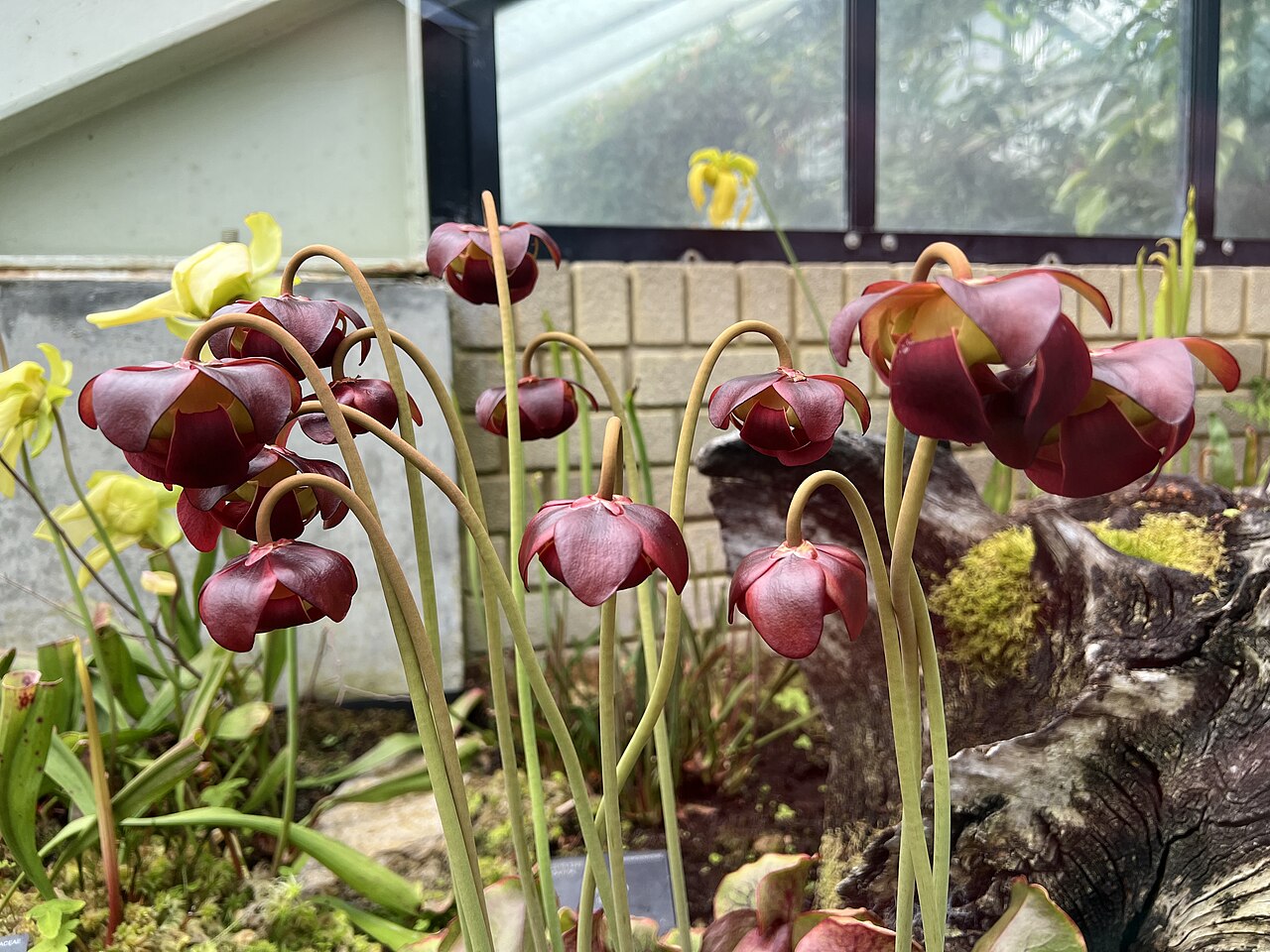
A single, nodding flower roughly 2 inches across tops each leafless stalk in late spring. Five deep maroon-red petals droop downward around a distinctive umbrella-shaped central style, which catches pollen falling from the petals above and directs visiting insects in a path that maximizes cross-pollination. The flowers have a faint, somewhat unpleasant scent that nonetheless attracts the bees and flies that pollinate them.
Fruit & Seeds
After flowering, a round, five-chambered seed capsule develops atop the persistent style, ripening and splitting open in autumn to release numerous small seeds, which are dispersed short distances by wind and water within the bog.
Quick Facts
| Scientific Name | Sarracenia purpurea |
| Family | Sarraceniaceae (Pitcher Plant) |
| Plant Type | Carnivorous Herbaceous Perennial |
| Mature Height | 4–12 in rosette; flower stalks to 20 in |
| Mature Spread | 8–12 in (20–30 cm) |
| Growth Rate | Slow |
| Sun Exposure | Full Sun to Part Sun |
| Water Needs | Constantly Wet (bog conditions) |
| Soil Type | Living sphagnum moss or peat; nutrient-poor |
| Soil pH | 3.5–5.5 (strongly acidic) |
| Bloom Time | May – June |
| Flower Color | Deep maroon-red |
| Fall Color | Pitchers deepen to maroon-purple |
| Fruit | Round, five-chambered dry seed capsule |
| Deer Resistant | Yes |
| USDA Hardiness Zones | 3–8 |
Native Range
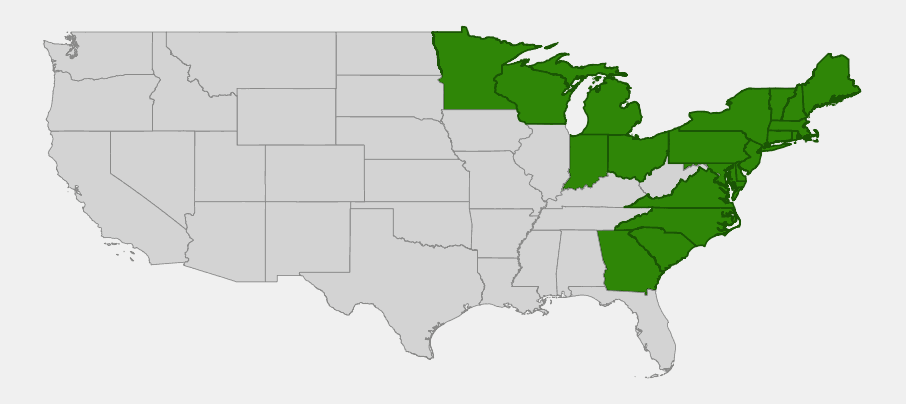
Purple Pitcher Plant has by far the largest range of any species in its genus, native from the Canadian boreal forest — Saskatchewan east to Labrador and Nova Scotia — south through New England and the Great Lakes states into the mid-Atlantic and the Carolina Piedmont and coastal plain. Within the United States it is most consistently found in New England, New York, New Jersey, Pennsylvania, and the upper Midwest’s bog country (Michigan, Wisconsin, and Minnesota), with increasingly scattered, localized, and often rare populations as its range extends south into Maryland, Virginia, Ohio, Indiana, North Carolina, South Carolina, and Georgia.
The species has also been deliberately introduced into bogs in California, Washington, and parts of Europe, where naturalized populations now persist; these introduced colonies are not part of its original native distribution. Within its true native range, wetland drainage and development have eliminated many historic bog populations, especially toward the southern and inland edges of its range.
Purple Pitcher Plant is an obligate wetland species, found almost exclusively in open, sunny sphagnum bogs, acidic fens, and seepage areas on nutrient-poor, highly acidic substrates. It rarely strays from these specialized wetland conditions, which makes it a reliable indicator of high-quality bog habitat wherever it is found.
📋 Regional plant lists featuring Purple Pitcher Plant: New Hampshire, Maine & Vermont · Connecticut, Massachusetts & Rhode Island · New York, Pennsylvania & Northern New Jersey · Delaware, Southern New Jersey & Long Island · Maryland, Virginia & West Virginia · North & South Carolina · Georgia, Alabama & Mississippi · Ohio & Indiana · Michigan, Wisconsin & Eastern Minnesota
Growing & Care Guide
Purple Pitcher Plant is rewarding but genuinely specialized: it needs bog-like conditions that are quite different from an ordinary garden bed, so success depends on replicating its native wetland chemistry rather than trying to adapt the plant to average soil.
Light
Give it full sun to very light shade. More sun produces shorter, more richly colored pitchers and better flowering; shaded plants etiolate into pale, floppy, less colorful pitchers.
Soil & Water
This is a true bog plant: it requires constantly moist to wet, highly acidic, nutrient-poor growing medium, traditionally a mix of living or milled sphagnum peat moss and coarse sand, with no fertilizer or compost added. Never use tap water, which is often too alkaline or mineral-rich; use rainwater, distilled water, or reverse-osmosis water instead. In the ground, it needs a true bog garden with a impermeable liner to hold water, or a container bog garden kept standing in a tray of water.
Planting Tips
Plant nursery-propagated divisions or seedlings in spring, setting the crown at the same depth it was growing previously, directly into living or chopped sphagnum moss. Because the species is winter-hardy into USDA zone 3, it benefits from a cold winter dormancy and should not be kept indoors year-round; outdoor bog gardens or unheated cold frames work well in most of its native range.
Pruning & Maintenance
Remove old, blackened, or rotted pitchers in early spring before new growth emerges, but otherwise avoid disturbing the rosette. Keep the growing medium wet at all times during the growing season; allowing a true bog planting to dry out, even briefly, can kill the plant.
Propagation
Divide established clumps in early spring by separating rosettes that have developed their own root systems. Seed requires a period of cold, moist stratification and is slow to reach flowering size, often taking three to five years, so division is the faster route to new plants.
Landscape Uses
- Bog gardens — the signature plant of a constructed sphagnum bog garden
- Container water gardens — grows well in a pot kept standing in water
- Wetland restoration — appropriate for restoring degraded acidic bogs within its native range
- Educational and wildlife gardens — a conversation-starting carnivorous plant
Wildlife & Ecological Value
Purple Pitcher Plant plays an unusual dual ecological role: predator of the bog’s insect life and, at the same time, host to a specialized community of organisms that live nowhere else.
For Pollinators
The flowers are pollinated mainly by bumblebees and other bees, which are large enough to push past the overlapping petals to reach the pollen and nectar without falling into the pitchers — unlike the smaller insects the pitchers are built to trap.
For Birds
While not a significant direct food source for birds, the insect-rich bogs that support healthy pitcher plant populations also support rich invertebrate communities that feed insectivorous bog-dwelling birds.
For Mammals
The plant holds little direct value for mammals, but its presence signals an intact, high-quality bog ecosystem that supports a wide range of specialized wetland wildlife.
Ecosystem Role
Remarkably, the water held inside each pitcher hosts its own miniature food web: mosquito larvae, midge larvae, mites, rotifers, and bacteria that help break down trapped insects, with at least one specialized fly species (the pitcher plant mosquito, Wyeomyia smithii) completing its entire life cycle only inside Sarracenia pitchers. By capturing and recycling nitrogen from insect prey, the plant also helps sustain the broader nutrient-poor bog ecosystem in which it grows.
Cultural & Historical Uses
Several Indigenous peoples of northeastern North America, including the Mi’kmaq, historically used preparations of Purple Pitcher Plant roots as a treatment within their traditional medicine systems; this history is well documented in ethnobotanical records as part of Indigenous knowledge, not as a currently recommended remedy. The plant’s striking, unusual form also made it an object of fascination for early botanists and naturalists, and it was formally described and illustrated repeatedly through the eighteenth and nineteenth centuries as European science grappled with the existence of a plant that ate insects.
Purple Pitcher Plant holds further historical significance as the provincial flower of Newfoundland and Labrador, where it appears on the province’s coat of arms and currency, reflecting its deep association with the boreal bog landscapes of eastern Canada.
In the twentieth and twenty-first centuries, growing interest in carnivorous plants has made Purple Pitcher Plant a popular subject for hobbyist growers and bog garden enthusiasts, though this popularity has also driven illegal poaching from wild populations in some areas, reinforcing the importance of buying only nursery-propagated stock.
Frequently Asked Questions
Is Purple Pitcher Plant dangerous to people or pets?
No. It is not toxic to touch or be near; its carnivory is limited to trapping and digesting insects and other small invertebrates in its pitchers, and it poses no hazard to people, pets, or larger animals.
Can I grow Purple Pitcher Plant in regular garden soil?
No. It requires constantly wet, acidic, nutrient-poor conditions similar to a natural bog — typically live or milled sphagnum peat moss kept saturated with rainwater or distilled water. Regular garden soil and tap water will kill it over time.
Is it legal to dig up Purple Pitcher Plant from the wild?
In most of its range, no — wild bog habitat is sensitive and often protected, and several states list the species as rare, threatened, or a species of special concern. Always buy nursery-propagated plants and never collect from wild populations.
Does the plant need to actually catch insects to survive?
Not strictly for day-to-day survival, but captured insects supply nitrogen and other nutrients that are scarce in bog soils, supporting healthier growth and more vigorous flowering over time.
Does Purple Pitcher Plant die back in winter?
The pitchers persist through winter in a dormant state in most of its hardy range, though they may blacken or collapse with hard freezes. New pitchers emerge from the rosette’s center each spring.

Looking for a nursery that carries Purple Pitcher Plant?
Browse our native plant nursery directory: Connecticut, Delaware & Georgia · Indiana · Maine, Maryland, Massachusetts, Michigan & Minnesota · New Hampshire, New Jersey, New York, North Carolina & Ohio · Pennsylvania, Rhode Island, South Carolina, Vermont & Virginia · Wisconsin