
American Groundnut (Apios americana)
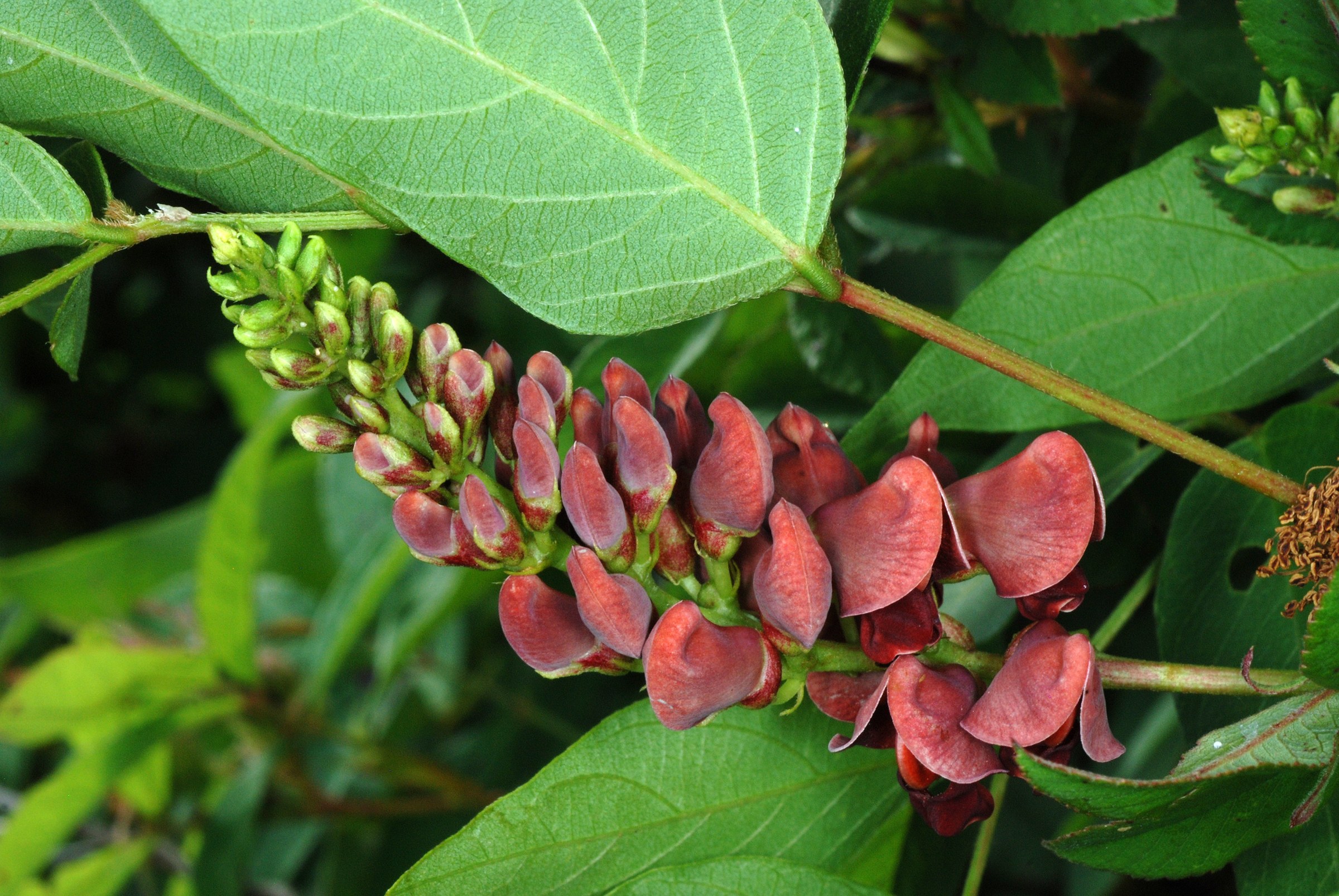
Apios americana, known as American Groundnut, Potato Bean, Hopniss, or simply Groundnut, is a twining herbaceous perennial vine in the pea family (Fabaceae) and one of the few North American native plants that was a genuine dietary staple for Indigenous peoples across its enormous eastern range. It climbs over neighboring shrubs and fences using thin, wiry stems, producing dense clusters of unusual maroon-brown, intensely fragrant flowers in mid- to late summer, followed underground by strings of starchy, protein-rich tubers that gave the plant its common names.
Groundnut is found across nearly the entire eastern half of North America, from the Canadian Maritimes and southern Quebec south to Florida and west to the edge of the Great Plains in eastern Texas, Kansas, and the Dakotas border country. Within that enormous range it is a plant of damp, fertile ground — streambanks, floodplain thickets, pond margins, and the edges of wet woods — where it threads itself through willows, dogwoods, and other moisture-loving shrubs.
Modern gardeners grow Groundnut for three different reasons that rarely overlap in one plant: as an unusual, deeply fragrant flowering vine for a trellis or fence; as a tough, low-maintenance native for rain gardens and wet edges; and, increasingly, as an edible perennial for food-forest and permaculture plantings, where its tubers are harvested much like a small, nutty potato. Give it moist soil and something to climb, and it asks for very little else.
Identification
American Groundnut is a non-woody, twining perennial vine that dies back to its underground tubers and rhizome each winter and resprouts from the same root system every spring. Climbing stems can reach 6 to 10 feet in a single season, winding counterclockwise around whatever support is available — shrub branches, fences, or other tall herbaceous plants.
Stems
Stems are thin, wiry, and twining, round in cross-section, light green to reddish, and mostly smooth or very lightly hairy. They have no tendrils or clinging structures; the vine climbs purely by twining its whole stem around a support, so it needs something to wrap around rather than a flat surface to cling to.
Leaves
Leaves are pinnately compound with 5 to 7 leaflets (occasionally 3), each leaflet 1½ to 3 inches long, ovate to lance-shaped with a pointed tip, and a smooth margin. The overall compound leaf has a somewhat feathery look reminiscent of other legume-family vines such as wisteria, to which Groundnut is related.
Flowers
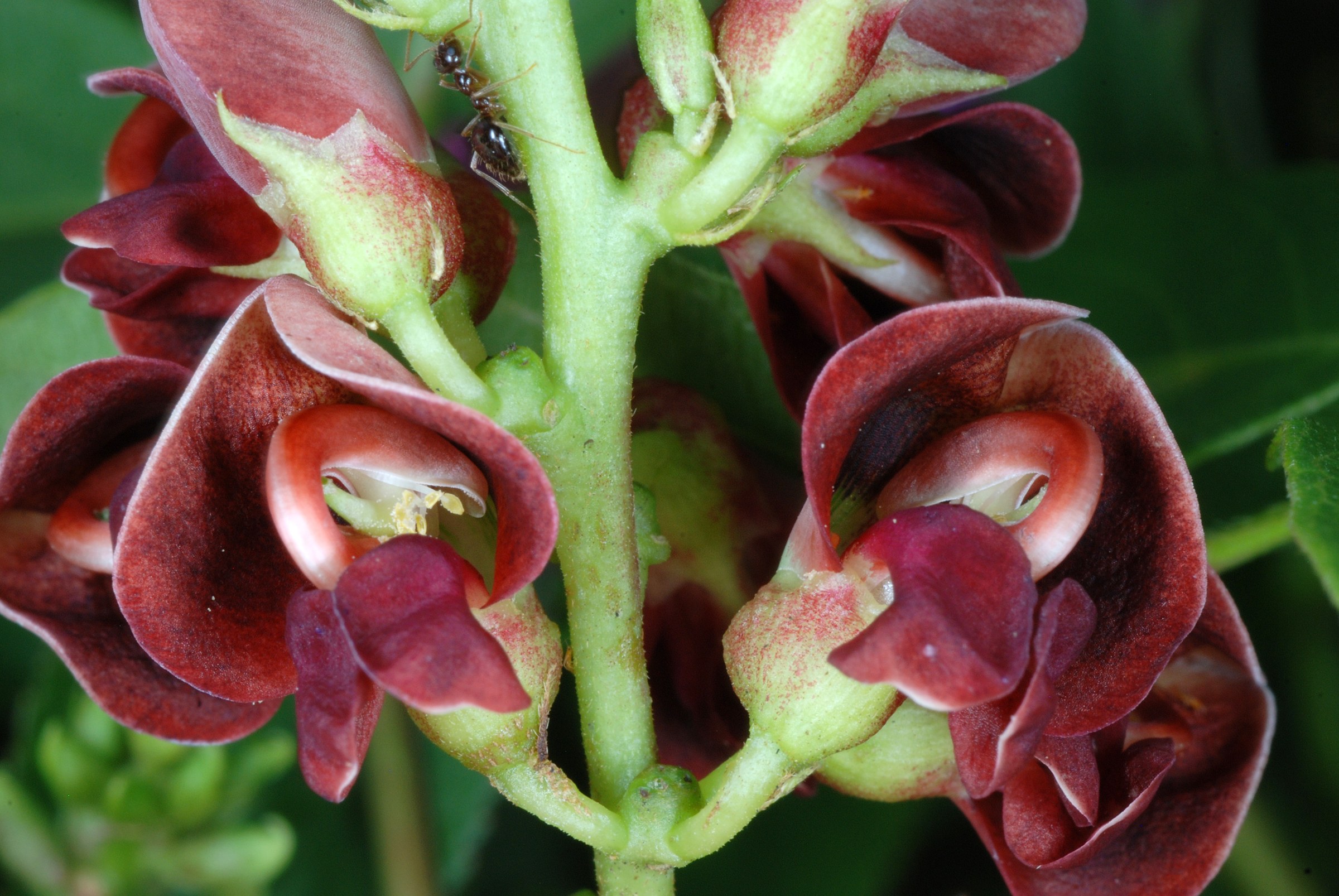
The flowers are the plant’s most distinctive feature: small, pea-shaped, and an unusual dusky maroon-red to brownish-purple color, packed into dense, rounded to elongated racemes 2 to 4 inches long that arise from the leaf axils. Individually the flowers resemble tiny, curled snail shells. They bloom from mid-summer into early fall and release a strong, sweet fragrance, often compared to violets or grape soda, that is most noticeable on warm, still evenings and tends to surprise people who don’t expect such a showy scent from such an understated flower color.
Fruit & Tubers
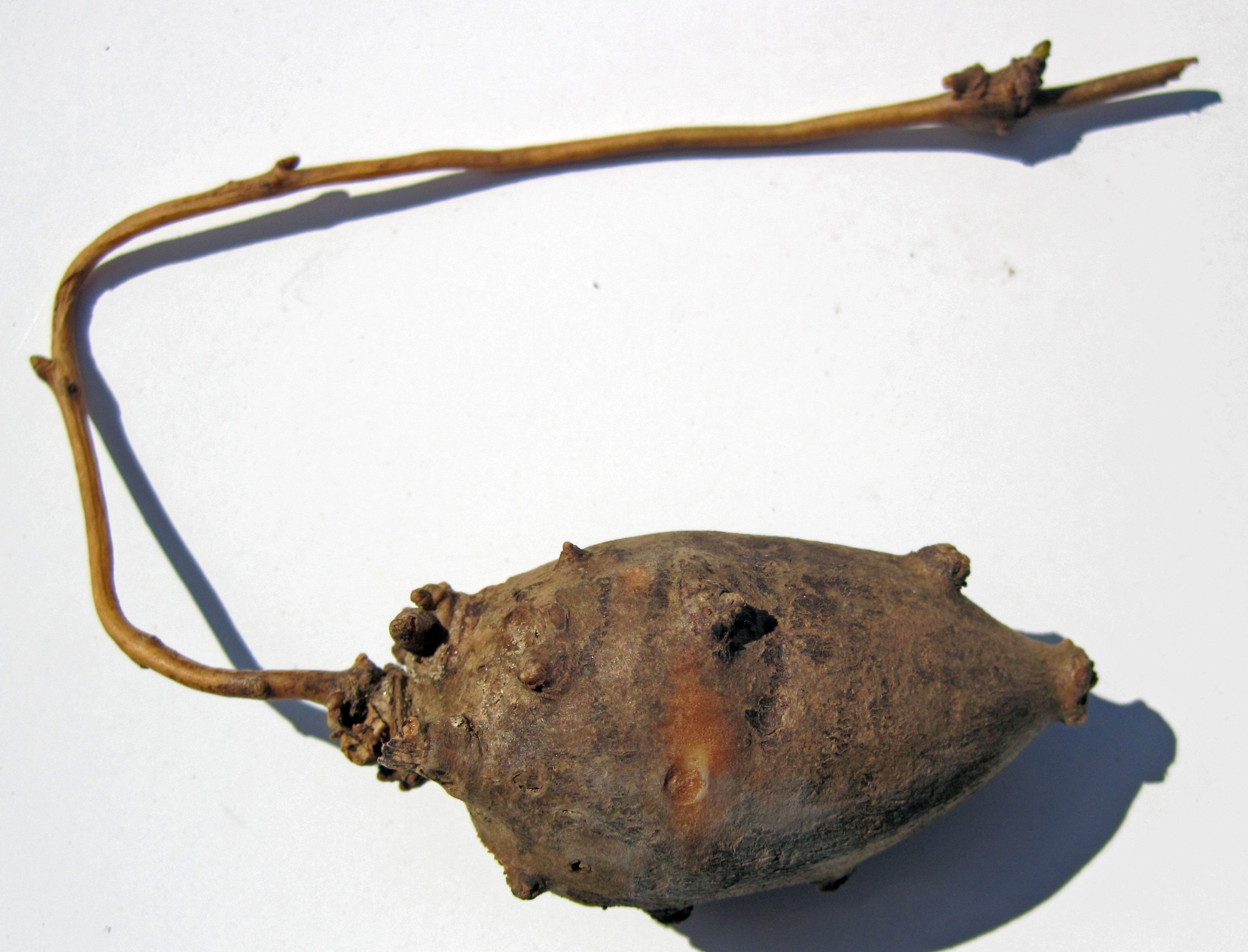
Flowers are followed by narrow, bean-like seed pods 2 to 4 inches long, though in many populations fruit set is light and most of the plant’s energy goes into vegetative spread. Below ground, the rhizome produces a string of tubers — rounded to elongated, 1 to 2 inches across, with a thin brown skin and starchy white flesh — spaced several inches apart along the root, giving rise to the “string of beads” description used in older accounts. These tubers are the plant’s most historically significant feature and the reason for its common names.
Quick Facts
| Scientific Name | Apios americana |
| Family | Fabaceae (Pea/Legume) |
| Plant Type | Herbaceous Perennial Twining Vine |
| Mature Height | 6–10 ft of climbing growth per season |
| Mature Spread | Spreads by rhizome; can form colonies 3–6 ft wide |
| Growth Rate | Fast once established |
| Sun Exposure | Full Sun to Partial Shade |
| Water Needs | Moderate to High; thrives in consistently moist soil |
| Soil Type | Moist, fertile loam; tolerates occasional flooding |
| Soil pH | 5.5–7.0 (slightly acidic to neutral) |
| Bloom Time | Mid-summer – early fall |
| Flower Color | Dusky maroon-red to brownish-purple |
| Fall Color | None notable; vine dies back to the ground |
| Fruit | Narrow bean-like pods; underground tubers along the rhizome |
| Deer Resistant | Moderate (occasionally browsed) |
| USDA Hardiness Zones | 3–9 |
Native Range
American Groundnut has one of the broadest native ranges of any eastern vine, extending from the Canadian Maritime provinces and southern Quebec/Ontario south through virtually the entire eastern United States to Florida, and west through the Great Lakes states, the Ohio and Mississippi valleys, and the southern Plains to eastern Texas, eastern Oklahoma, and eastern Kansas. It is absent from the drier short-grass prairie and Rocky Mountain states further west, where the moist bottomland habitat it depends on simply does not occur.
Throughout this range, Groundnut is tied closely to water: streambanks, the margins of ponds and sloughs, floodplain forests, wet thickets, and low, periodically flooded ground. It is shade-tolerant enough to grow in open woodland edges but flowers most heavily where it gets at least a half day of sun, typically where it has scrambled up over a shrub into better light.
Because it spreads readily by rhizome in favorable moist soil, Groundnut can form dense colonies over time, and it is sometimes mistaken for an aggressive or even non-native vine where it shows up unexpectedly in a garden bed — gardeners west of its native range, or in drier upland sites within it, should not assume a vigorous twining legume in damp soil is automatically this species without confirming leaflet count and the distinctive maroon flower color.
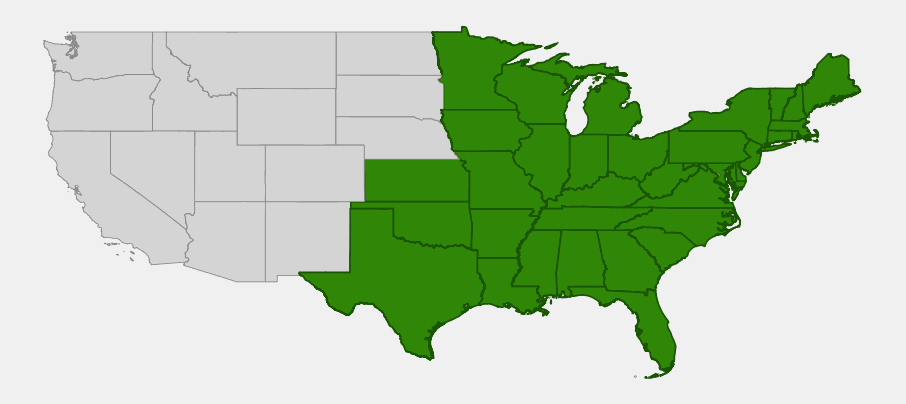
📋 Regional plant lists featuring American Groundnut: New Hampshire, Maine & Vermont · Connecticut, Massachusetts & Rhode Island · Delaware, Southern New Jersey & Long Island · Maryland, Virginia & West Virginia · Arkansas, Louisiana, Eastern Oklahoma & Eastern Texas · North Dakota, South Dakota & Western Minnesota. It is also native (without a matching Vines table) to the areas covered by New York, Pennsylvania & Northern New Jersey, North & South Carolina, Georgia, Alabama & Mississippi, Kentucky & Tennessee, Ohio & Indiana, Illinois, Iowa & Missouri, Michigan, Wisconsin & Eastern Minnesota, and Nebraska, Kansas & Eastern Colorado.
Growing & Care Guide
American Groundnut is a forgiving vine once it has the two things it needs most: consistent moisture and something to climb. It is not a plant for a formal trellis arrangement so much as a rambling presence along a damp fence line or through a shrub border.
Light
Full sun produces the heaviest bloom, but Groundnut tolerates partial shade well, especially where it can climb up into better light through the branches of a host shrub. In deep shade it survives but flowers sparsely.
Soil & Water
Consistently moist, fertile soil is the single most important factor for success. Groundnut grows naturally along streambanks and pond edges and is one of the few native vines genuinely suited to a rain garden or the wet edge of a water feature. It tolerates brief flooding but performs poorly in soil that dries out completely between waterings, especially during the first year while the tuber system is establishing.
Planting Tips
Plant tubers or container stock in spring, 12 to 18 inches from a sturdy support such as a fence, arbor, or established shrub. Because it spreads by rhizome, give it either a contained bed or room to roam — it is well suited to a naturalized wet corner where spreading is welcome but can be too vigorous for a small, tidy border. A simple string or wire trellis works well if no shrub is available for it to climb.
Pruning & Maintenance
No pruning is needed during the growing season beyond directing new growth onto its support. The top growth dies back completely with the first hard frost and can be cut to the ground or simply left to break down over winter. In beds where spread needs to be controlled, dig around the rhizome perimeter in fall or early spring and remove or relocate excess tubers.
Landscape Uses
American Groundnut fits a specific but valuable niche in native landscaping:
- Rain gardens and wet-edge plantings where few other flowering vines perform well
- Fragrant vine for a fence or arbor near a patio or path where its evening scent can be enjoyed
- Wildlife and pollinator gardens, especially where bumblebees are a priority
- Edible/food-forest plantings, where the tubers are grown as a perennial root crop
- Naturalized streambank and pond-margin restoration
Wildlife & Ecological Value
American Groundnut’s ecological value is concentrated in its unusual flowers and its role as a reliable late-summer nectar and pollen source in wet habitats.
For Pollinators
The curled, snail-shaped flowers are specially adapted for large bees, particularly bumblebees, which are strong enough to force the keel open and trigger pollen release; the flowers are a documented important late-summer forage source for bumblebee colonies building up stores before fall. The strong, sweet fragrance helps draw pollinators from a distance.
For Birds
The tangled vine growth over shrubs provides additional cover in streamside thickets, and the dense foliage mass supports the insect populations that many songbirds rely on through the summer.
For Mammals
The tubers are eaten by a range of wildlife where they occur close to the surface, including rodents and, historically, foraging animals disturbing streambank soil. Deer browse the foliage occasionally but generally do not favor it heavily.
Ecosystem Role
As a nitrogen-fixing legume, Groundnut enriches the soils of the wet thickets and floodplain edges where it grows, and its spreading rhizome network helps bind loose, periodically flooded streambank soil, contributing modestly to erosion control in the damp habitats it favors.
Cultural & Historical Uses
American Groundnut holds a genuinely significant place in the food history of eastern North America. Indigenous peoples across the plant’s entire range — including Algonquian, Iroquoian, and many other nations — cultivated, harvested, and relied on Groundnut tubers as a staple starch for centuries, often more important seasonally than maize in some areas because the tubers could be dug through much of the year, including by digging through snow in winter in the northern part of the range.
Early European colonists, including the Pilgrims at Plymouth, were taught to harvest and eat Groundnut by Indigenous neighbors and relied on it during difficult early seasons when other food crops failed; some historical accounts credit it with helping prevent starvation in several early colonial settlements. The tubers were traditionally boiled or roasted, similar to potatoes, with a nutty, slightly sweet flavor, and they are notably higher in protein than true potatoes.
Interest in Groundnut as a perennial food crop has continued into the modern era, including 20th-century breeding programs at Louisiana State University that selected larger-tubered lines for potential cultivation. Today it remains primarily a backyard and permaculture curiosity in the U.S. rather than a commercial crop, though related species are cultivated more seriously in Japan, where the plant was introduced and is grown as “hopniss” or “American-hodoimo.”
Frequently Asked Questions
Can you eat American Groundnut tubers?
Yes — the tubers have a long history as a food source for Indigenous peoples and early colonists and are still eaten today, typically boiled or roasted like a small, nutty potato. As with any wild or home-grown food plant, properly identify the species and cook the tubers before eating; this page describes historical and documented food use, not a foraging guide, so confirm identification carefully before harvesting.
Will American Groundnut take over my garden?
It can spread steadily by rhizome in consistently moist, fertile soil, forming expanding colonies over a few years. In a contained bed or where some spread is welcome — a naturalized wet corner, for instance — this is an asset; in a small, tidy border it may need yearly root management.
Why does my Groundnut vine smell so strong?
The maroon flowers produce a notably sweet, violet-like fragrance, especially in the evening — a feature many gardeners don’t expect from such an understated-looking bloom and one of the plant’s most-loved traits when grown near a patio or walkway.
What can American Groundnut climb on?
It twines around any narrow support — shrub branches, fence wire, string trellises, or arbors. It cannot climb a flat wall or wide post on its own because it has no tendrils or clinging structures; it needs something thin enough to wrap around.
Is American Groundnut native to my state?
It is native very broadly across the eastern U.S. and eastern Canada — see the state list and map above — but it is not native in the drier Great Plains, Rocky Mountain, or western states. Outside its native range, treat it strictly as a garden plant, not a restoration species.

Looking for a nursery that carries American Groundnut?
Browse our native plant nursery directory: KY/LA/ME/MD/MA/MI/MN/MS/MO · NH/NJ/NY/NC/OH/OK · PA/RI/SC/TN/TX/VT/VA · CT/DE/FL/GA · WV/WI · AL/AR · IL/IN/IA/KS