
Climbing Fumitory (Adlumia fungosa)
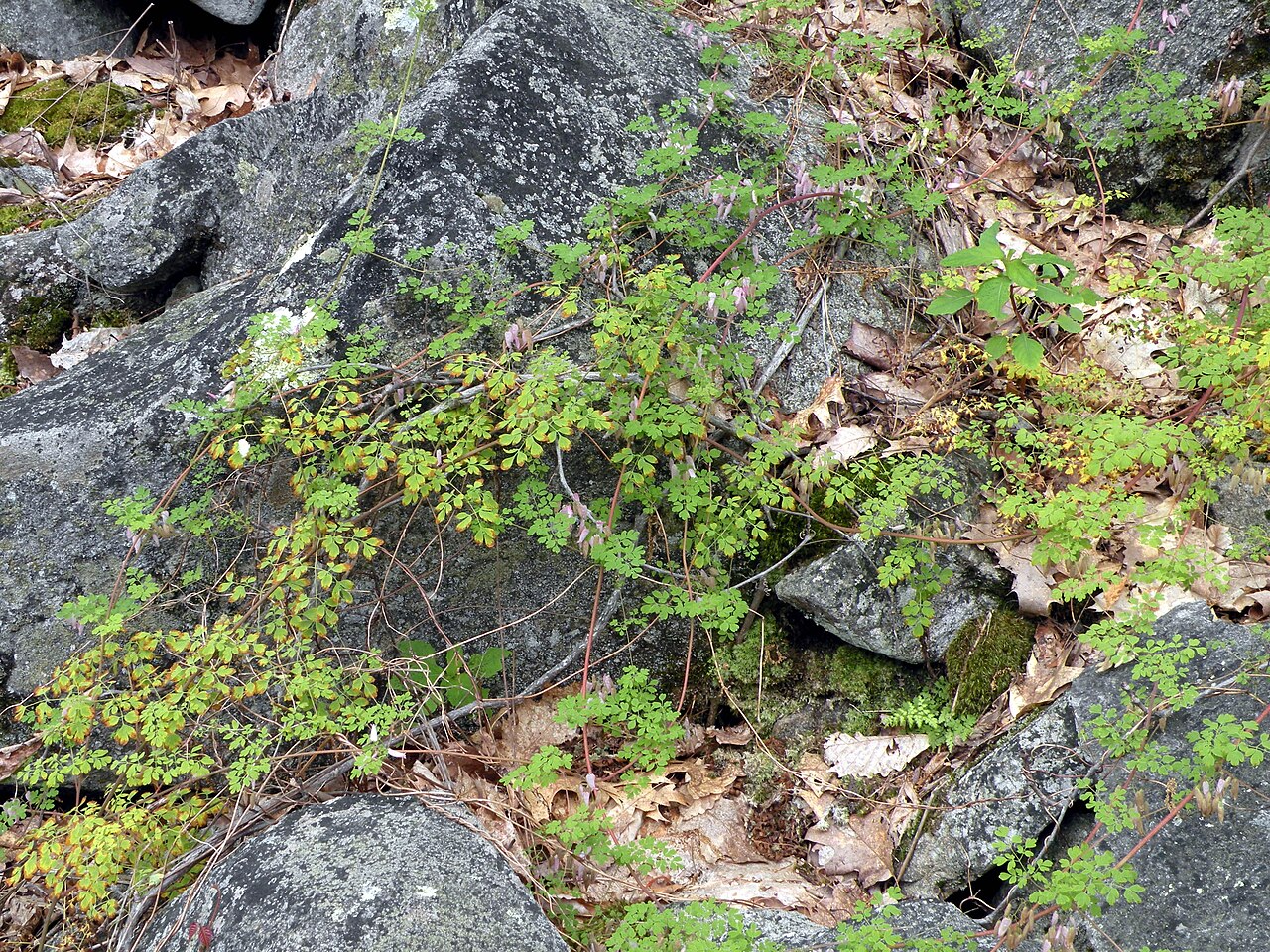
Adlumia fungosa, commonly called Climbing Fumitory or Allegheny-vine, is a gentle, self-limiting climbing vine native to cool, rocky woodlands of the Northeast and Appalachians. Unlike aggressive twining vines, it climbs by wrapping thread-thin leaf-stalk tendrils around whatever support it finds, draping itself over shrubs, fences, and boulders in a soft curtain of blue-green, lacy foliage that looks more like a fern or a maidenhair frond than a flowering plant.
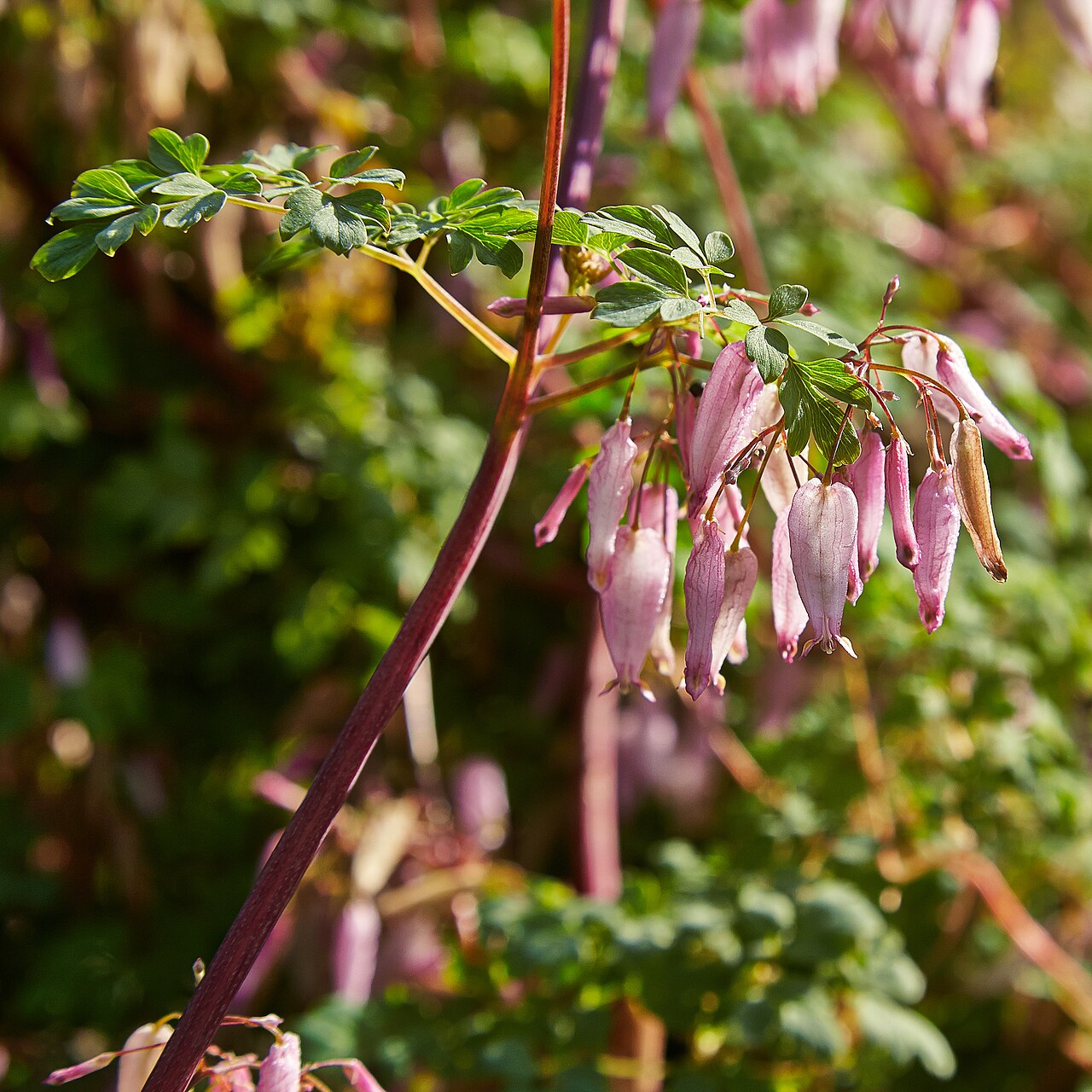
From midsummer into fall, the vine produces clusters of small, pale pink to white, heart-shaped flowers that dangle from slender stalks, closely resembling — and closely related to — the familiar garden Bleeding Heart and the woodland native Dutchman’s Breeches (Dicentra cucullaria), all members of the poppy family’s fumitory subfamily. Climbing Fumitory is a biennial: it spends its first year as a low rosette of ferny leaves, then sends up its climbing stems, flowers, sets seed, and dies in its second year, relying entirely on self-sown seedlings to persist from year to year.
Though easy to overlook when not in bloom, Climbing Fumitory has a devoted following among native-plant gardeners for its airy texture and old-fashioned, cottage-garden charm on a trellis, stone wall, or brush pile in a partly shaded spot. In parts of its range it has become uncommon enough to be considered a plant of conservation concern, which makes growing it from responsibly sourced seed a genuinely useful way to support the species.
Identification
Climbing Fumitory is an herbaceous biennial vine with slender, hollow, often reddish stems that can climb 6 to 13 feet (2–4 m) in a single season by means of twining leaf tendrils, with no true tendrils, hooks, or twining stems of its own — the leaf stalks themselves do the climbing.
Leaves
The leaves are two to three times pinnately compound, finely divided into small, rounded to oval leaflets, giving the whole plant a soft, blue-green, fern-like or lace-like appearance that is one of its best identifying features even before flowering. The terminal leaflets and leaf-stalk tips are modified into thread-like, coiling tendrils that wrap around twigs, wire, or other supports as the vine climbs.
Flowers
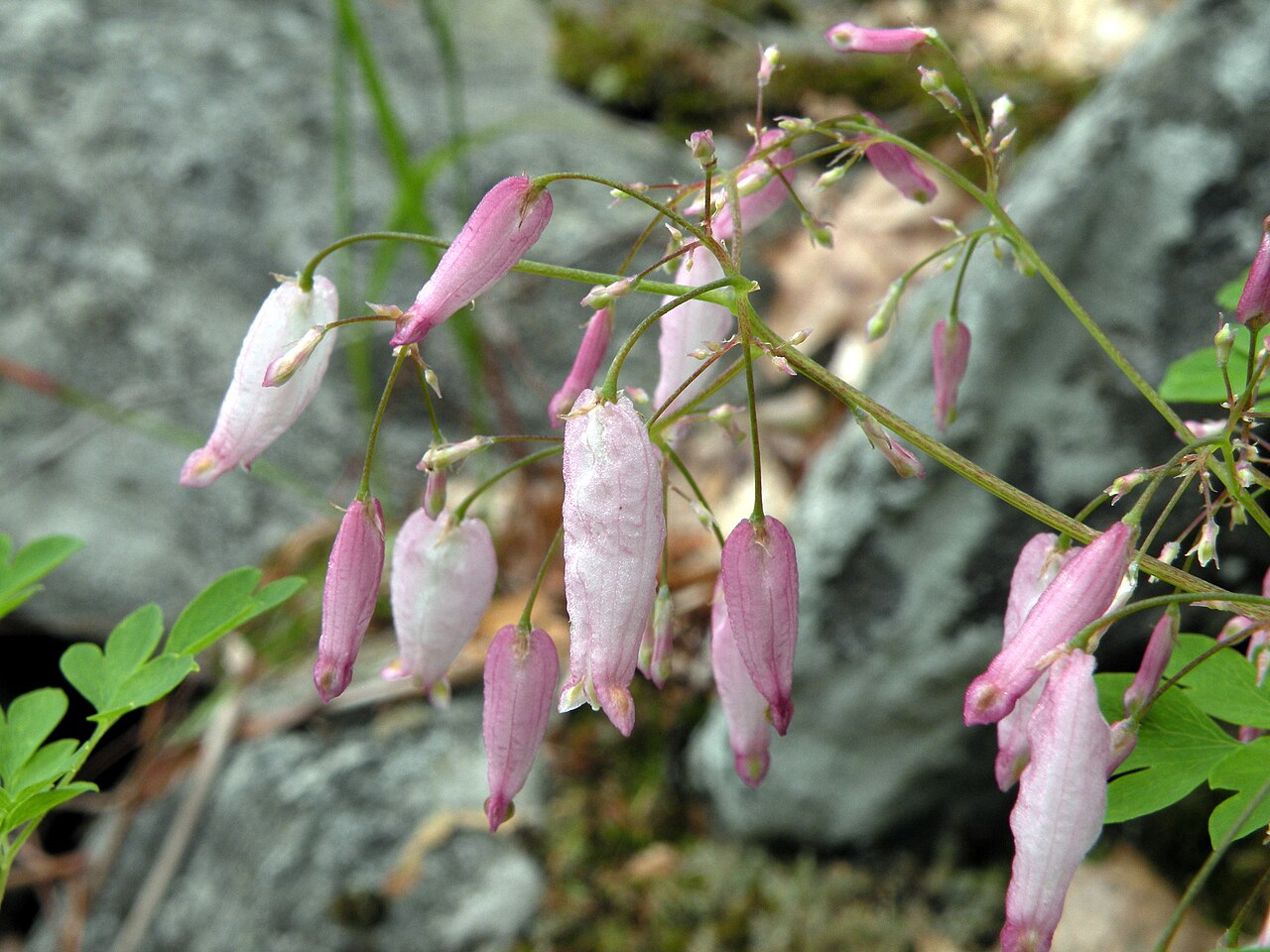
Flowers appear in loose, drooping clusters (panicles) from the leaf axils from June through September. Each flower is tubular and flattened, about ½ to ¾ inch (1–2 cm) long, pale pink to nearly white with a flared, four-petaled shape reminiscent of a tiny, narrow bleeding-heart blossom. The flowers hang on thin pedicels and are visited mainly by long-tongued bees able to reach the nectar at the base of the tube.
Fruit & Seeds
After flowering, each bloom is replaced by a narrow, dry capsule that splits open to release small, flattened, shiny black seeds. A single robust second-year plant can produce abundant seed, which is how Climbing Fumitory maintains itself as a biennial from one generation to the next, often appearing in a new spot a short distance from the parent plant.
Quick Facts
| Scientific Name | Adlumia fungosa |
| Family | Papaveraceae (Poppy, Fumitory subfamily) |
| Plant Type | Biennial Climbing Vine |
| Mature Height | 6–13 ft (2–4 m) climbing vine |
| Mature Spread | 2–4 ft, sprawling over its support |
| Growth Rate | Fast in its second (flowering) year |
| Sun Exposure | Part Shade to Shade |
| Water Needs | Moderate; consistent moisture, good drainage |
| Soil Type | Cool, humus-rich, rocky or loamy |
| Soil pH | Neutral to slightly acidic, often on limestone or calcareous rock |
| Bloom Time | June – September (second year only) |
| Flower Color | Pale pink to white |
| Fall Color | Foliage yellows and the plant dies after seed-set |
| Fruit | Narrow dry capsule with small black seeds |
| Deer Resistant | Yes, generally unpalatable |
| USDA Hardiness Zones | 3–7 |
Native Range
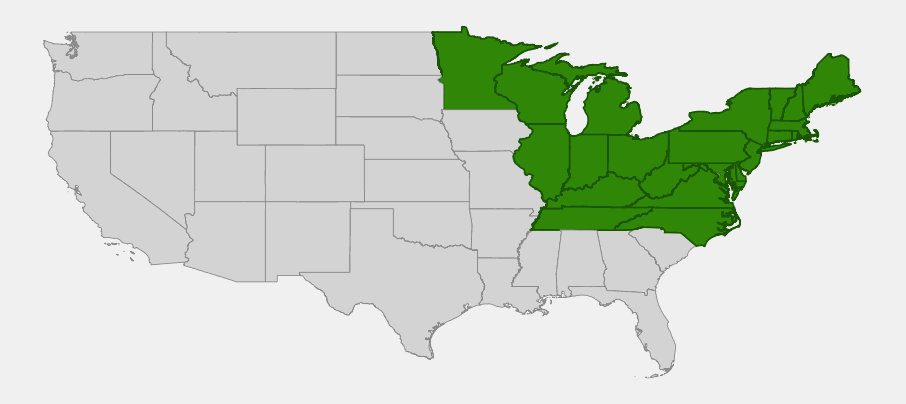
Climbing Fumitory is native to a broad swath of the northeastern quarter of the United States and adjacent Canada, from Minnesota, Wisconsin, and Michigan east through the Great Lakes states and New England, and south along the Appalachian spine through Pennsylvania, West Virginia, Virginia, Kentucky, Tennessee, and into the mountains of North Carolina. It reaches the coast in New England and the mid-Atlantic, including Connecticut, Rhode Island, Massachusetts, New York, New Jersey, Delaware, and Maryland.
Across this range it favors cool, rocky woods: talus slopes, rocky streambanks, the shaded base of cliffs, and the margins of upland forests, usually over limestone or other calcium-rich bedrock. It is almost always found scrambling over something — a boulder, a fallen log, low shrubs — rather than growing as a free-standing plant, since it depends on a support to climb and display its flowers.
Climbing Fumitory has also become naturalized outside its native range in parts of southwestern British Columbia, where it has escaped cultivation; that Pacific Coast population is not native and should not be treated as part of its wild range. Within its native Eastern range, the species is regarded as uncommon to rare in several states, and it is tracked as a plant of conservation concern in some New England jurisdictions because of habitat loss and its reliance on consistent, undisturbed seed rain to persist.
📋 Regional plant lists featuring Climbing Fumitory: New Hampshire, Maine & Vermont · Connecticut, Massachusetts & Rhode Island · New York, Pennsylvania & Northern New Jersey · Delaware, Southern New Jersey & Long Island · Maryland, Virginia & West Virginia · North Carolina & South Carolina · Kentucky & Tennessee · Ohio & Indiana · Illinois, Iowa & Missouri · Michigan, Wisconsin & Eastern Minnesota
Growing & Care Guide
Climbing Fumitory rewards a gardener willing to work with its biennial habit rather than against it. Because individual plants live only two years, a sustained planting depends on letting some flowers go to seed each year so new rosettes keep appearing.
Light
Part shade to full shade best mimics its native woodland-edge habitat. Morning sun with afternoon shade is ideal; deep, all-day shade under dense evergreens tends to produce weak, sparse-flowering plants, while hot, exposed full sun will scorch the delicate foliage.
Soil & Water
A cool, humus-rich soil with reliable but not waterlogged moisture suits it best, echoing the talus slopes and streambank rock where it grows wild. Good drainage at the root zone is important — this is a plant of rocky slopes, not low, poorly drained ground. A neutral soil, especially one with some limestone influence, tends to produce the sturdiest plants.
Planting Tips
Start Climbing Fumitory from fresh seed sown in fall, since the seed benefits from a period of cold, moist stratification over winter to germinate well the following spring. Give young plants a trellis, low shrub, brush pile, or rock pile to climb from the start, since the leaf-tendrils need something to grasp as soon as the vine begins to lengthen in its second spring. Because it self-sows readily in the right conditions, a few established plants will typically keep a colony going indefinitely once sited well.
Pruning & Maintenance
Little maintenance is needed beyond removing spent, dead second-year vines after they finish seeding and allowing their seed to scatter nearby. Thin crowded seedlings in spring if a tidier look is wanted, but leave enough to replace the plants that will die after flowering.
Propagation
Propagation is almost always by seed, since the biennial lifecycle makes division impractical. Collect ripe, blackened seed from dry capsules in late summer or fall and sow immediately outdoors, or cold-stratify moist seed in a refrigerator for 60 to 90 days before spring sowing indoors.
Landscape Uses
Climbing Fumitory suits several garden niches where its light, airy habit can be appreciated up close:
- Shaded trellis or arbor — a lighter-textured alternative to vigorous twining vines
- Rock gardens and stone walls — scrambling naturally over boulders and ledges
- Woodland garden edges — paired with Dutchman’s Breeches and other spring ephemerals
- Brush pile or fence screening — softening a rustic support with ferny texture and summer flowers
Wildlife & Ecological Value
Though modest in stature, Climbing Fumitory contributes real value to the shaded woodland-edge community it is part of.
For Pollinators
The tubular, nectar-rich flowers are adapted for long-tongued bees, including bumblebees, which can reach the nectar at the base of the flared petals while pollinating the blossom. Short-tongued insects are generally excluded by the flower’s shape, making this a somewhat specialized nectar source within its woodland habitat.
For Birds
Small songbirds and sparrows that forage in shaded understory and rocky cover use the tangled vine growth for shelter, and some may take the small seeds once capsules split open in fall.
For Mammals
Like other members of the fumitory subfamily, Climbing Fumitory contains isoquinoline alkaloids that make the foliage bitter and unpalatable, so it is rarely browsed by deer or rabbits — a practical advantage in gardens with heavy browsing pressure.
Ecosystem Role
As a short-lived biennial that depends on open microsites among rocks and at woodland edges to germinate, Climbing Fumitory is part of the fine-grained mosaic of small, opportunistic plants that colonize disturbed or exposed ground in an otherwise closed-canopy forest, adding structural and seasonal diversity to the shrub and herb layer without competing aggressively with longer-lived natives.
Cultural & Historical Uses
Climbing Fumitory was introduced to cultivation in Britain and continental Europe in the 19th century, where it became a popular, lacy-leaved cottage-garden vine valued for its delicate texture and ability to soften stonework and fences — a role it still fills in native-plant gardens today. The genus name Adlumia honors John Adlum, an early American viticulturist and plant collector active in the early 1800s; the species name fungosa refers to the soft, spongy texture of the seed capsules.
Like its relatives in the fumitory group, including Dutchman’s Breeches and Squirrel Corn, the plant contains alkaloids that have historically been studied for mild sedative and antispasmodic properties in traditional herbal use. These are historical uses only; the plant is not considered food-safe, and no part of it should be eaten or used as a home remedy.
Beyond its garden history, the plant has long served as a quiet botanical indicator: because it favors undisturbed, calcium-rich rocky woods, its presence on a site is often taken by field botanists as a sign of relatively intact, high-quality forest habitat.
Frequently Asked Questions
Does Climbing Fumitory come back every year?
Not as the same individual plant. It is a true biennial: each plant lives two years, flowering and setting seed only in its second year before dying. A planting persists over time only because new seedlings germinate each year to replace the plants that have finished their cycle.
Is Climbing Fumitory the same as Dutchman’s Breeches?
No, though they are closely related members of the same fumitory group within the poppy family and share a similar flower structure and alkaloid chemistry. Dutchman’s Breeches is a low, non-climbing spring ephemeral with white, pantaloon-shaped flowers, while Climbing Fumitory is a true climbing vine that flowers later, from summer into fall.
Is Climbing Fumitory invasive?
No. Within its native range in the northeastern and Appalachian United States it is a well-behaved, often uncommon native plant. It has become naturalized outside its range in parts of southwestern British Columbia, where it is not native and should not be intentionally introduced.
Can I eat Climbing Fumitory or use it medicinally?
No part of this plant should be eaten. Like its fumitory relatives, it contains alkaloids, and while historical herbal traditions used related species for mild sedative effects, there is no established, safe home use, and it should be treated strictly as an ornamental.
What does Climbing Fumitory need to climb?
It climbs using sensitive, thread-like tendrils formed from modified leaf tips, so it needs something no thicker than a twig, wire, or fine trellis to grasp — thick posts or solid walls will not work. A brush pile, shrub, low fence, or garden trellis is ideal.

Looking for a nursery that carries Climbing Fumitory?
Browse our native plant nursery directory: New York · Pennsylvania · Kentucky