
Narrowleaf Bluestar (Amsonia ciliata)
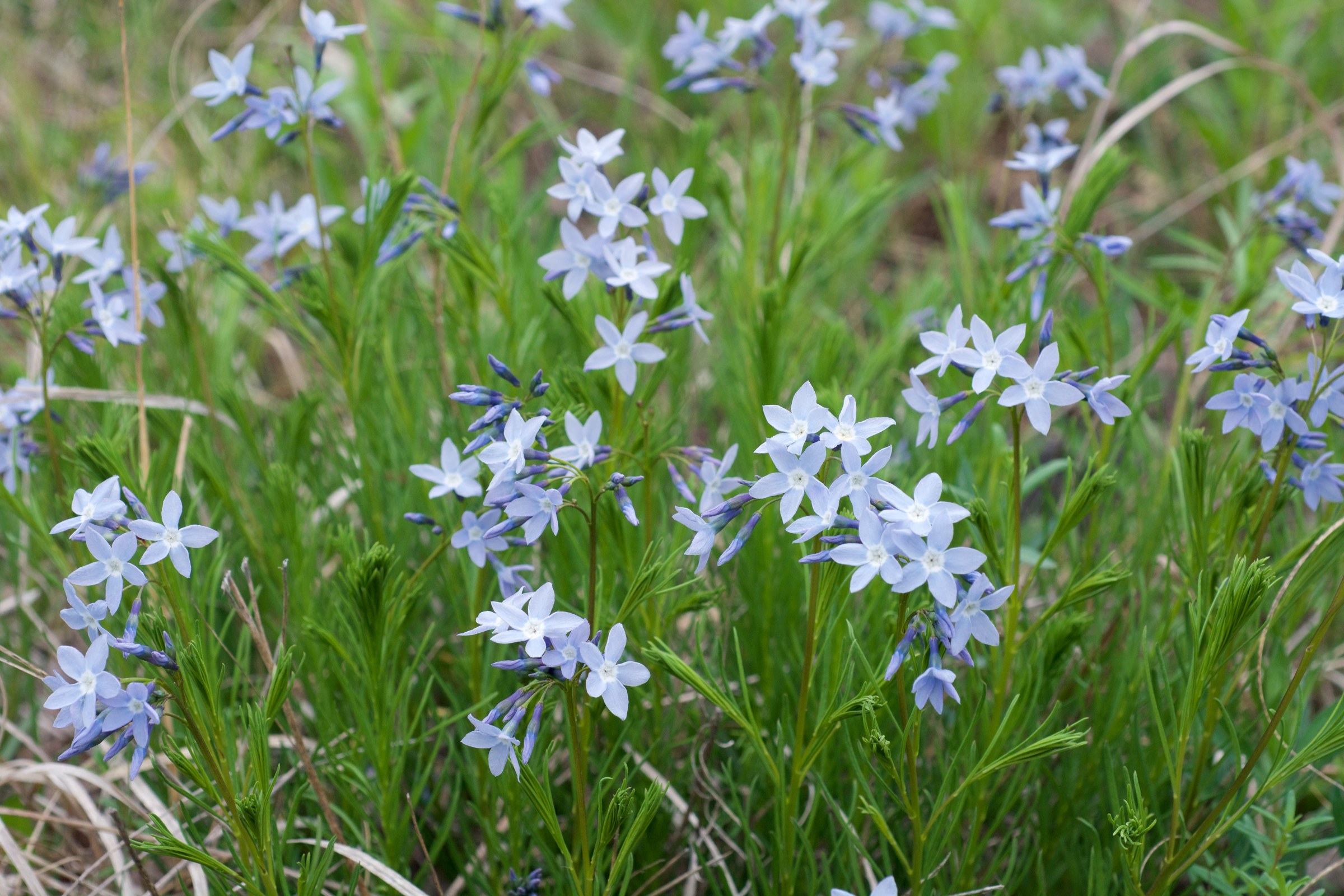
Amsonia ciliata, commonly known as Narrowleaf Bluestar (also called fringed bluestar or Texas bluestar), is a clump-forming native perennial wildflower of the South-Central and Southeastern United States. A member of the dogbane family (Apocynaceae), it is a smaller, finer-textured relative of the better-known Eastern bluestar (Amsonia tabernaemontana), distinguished by its narrow, needle-like leaves that give the whole plant a soft, almost grass-like texture even when it is not in flower.
In spring, narrowleaf bluestar sends up airy clusters of pale blue, star-shaped flowers atop upright stems, usually before most of the surrounding prairie and woodland-edge vegetation has fully greened up. The flowers fade as the thin, willowy leaves fill in through summer, and the whole clump finishes the growing season with a show of soft gold fall color. It is a long-lived, deer-resistant, low-maintenance plant that asks for very little once established in the dry, well-drained, often sandy or chalky soils it favors in the wild.
Narrowleaf bluestar has become a popular choice in native and xeric gardens well beyond its natural range because of its reliable spring bloom, fine foliage texture, and tolerance of poor, dry soils. Within its home range in the South, it remains an excellent, low-water choice for naturalistic plantings, rock gardens, and the front of a sunny native border.
Identification
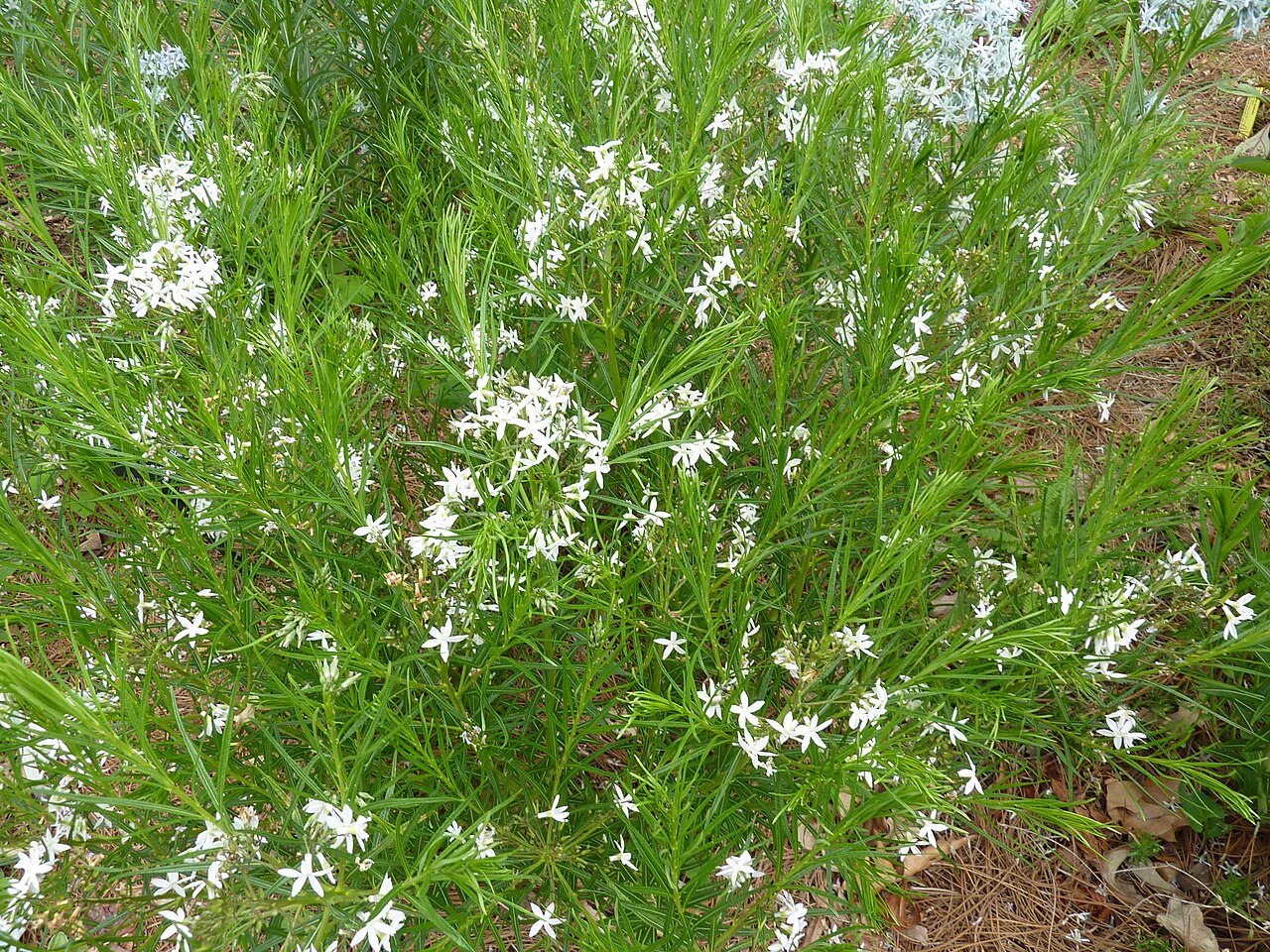
Narrowleaf bluestar is an herbaceous perennial that forms an upright, multi-stemmed clump 1.5 to 2 feet tall and about as wide, dying back to the ground each winter and resprouting from a woody crown in spring. All parts of the plant exude a milky, latex-like sap when cut or broken, a trait shared across the dogbane family.
Stems
Stems are slender, numerous, and upright to slightly arching, clothed for most of their length in the narrow leaves, with branching mainly confined to the upper flowering portion of the stem. New growth in spring is often covered in fine, soft hairs that thin out as the stems mature.
Leaves
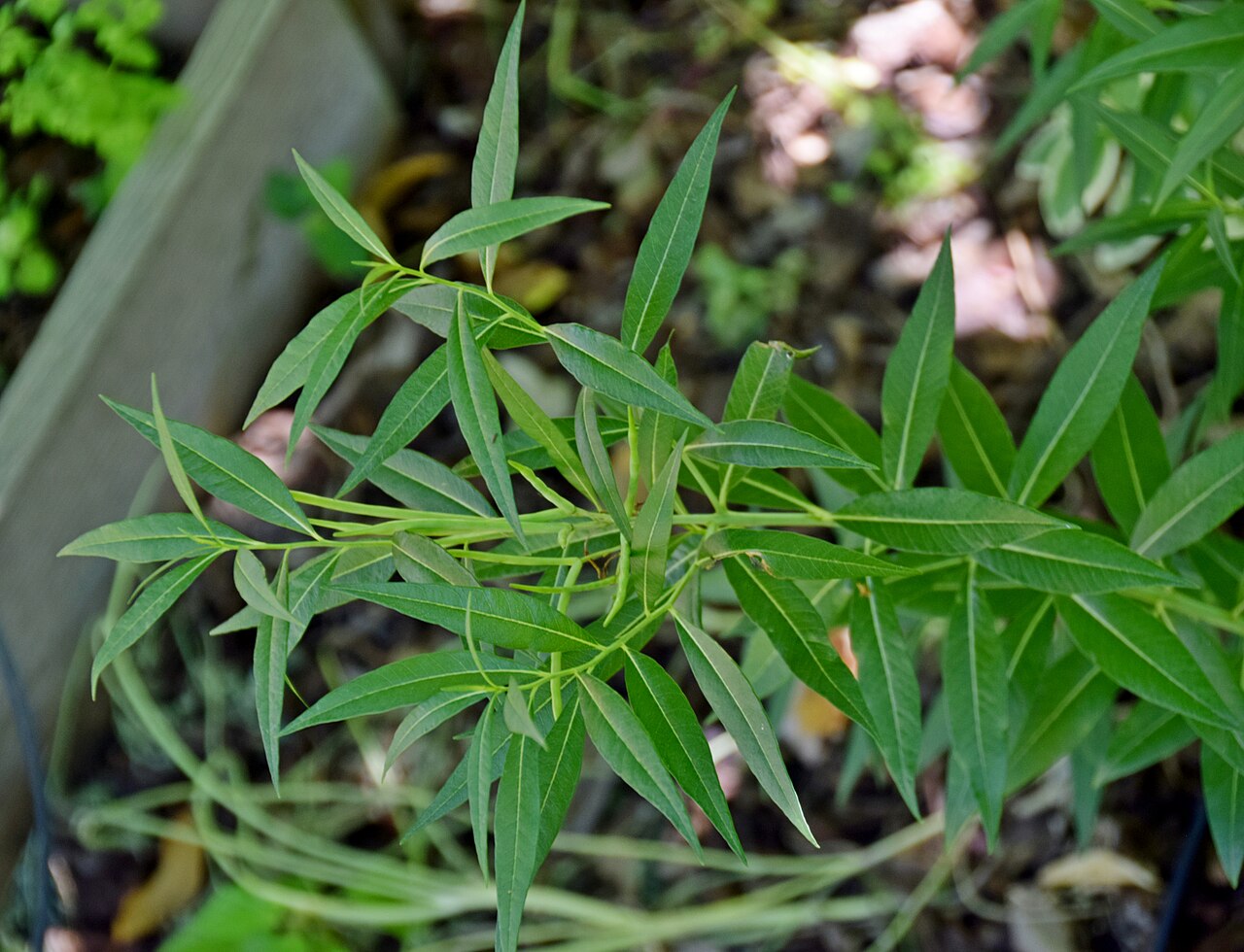
The leaves are simple, alternate, and strongly linear to thread-like — about ½ inch wide and up to 2 inches long — set close together along the stem without a petiole, each with a single prominent vein running its length. This fine, needle-like foliage, often softly hairy (ciliate) along the margins, is the source of both the species name ciliata and the plant’s narrow-leaved common name, and is the easiest way to separate it from the broader-leaved Eastern bluestar.
Flowers
In mid- to late spring, narrow tubular flowers about ½ inch long open into five pointed, star-shaped lobes of pale, powdery blue with a small white eye at the center. The flowers are carried in loose, open clusters at the stem tips, and a well-grown clump can produce dozens of blooms over several weeks.
Fruit & Seeds
After flowering, narrow, slender seed pods (follicles) develop, splitting open when ripe to release cylindrical seeds. Seed set is often light in garden settings, and most gardeners increase their stock by division rather than by seed.
Quick Facts
| Scientific Name | Amsonia ciliata |
| Family | Apocynaceae (Dogbane) |
| Plant Type | Herbaceous perennial |
| Mature Height | 1.5–2 ft |
| Mature Spread | 1.5–2 ft |
| Growth Rate | Slow to moderate |
| Sun Exposure | Full Sun to Part Shade |
| Water Needs | Low |
| Soil Type | Dry, well-drained sandy or limestone-based soils |
| Soil pH | 6.0–7.5 |
| Bloom Time | March – June |
| Flower Color | Pale blue |
| Fall Color | Golden yellow |
| Fruit | Slender seed pods (follicles); not a food plant |
| Deer Resistant | Yes (milky sap deters browsing) |
| USDA Hardiness Zones | 6–9 |
Native Range
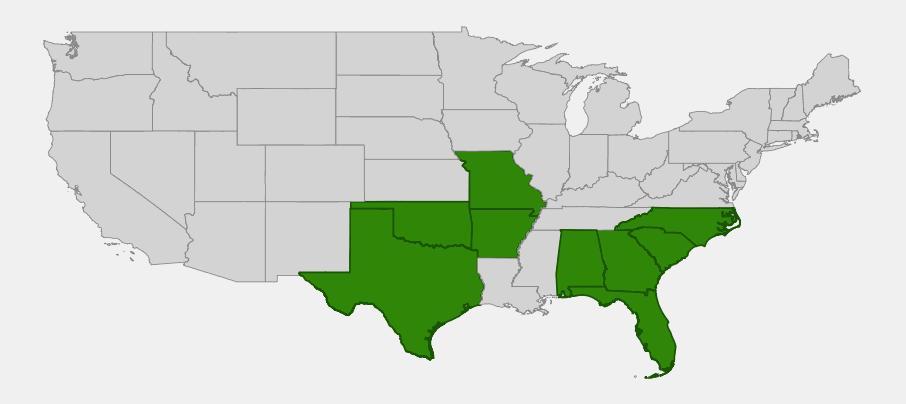
Narrowleaf bluestar occurs in two somewhat separate native strongholds: a south-central cluster centered on east Texas and Oklahoma, with a disjunct outlier population in Missouri, and a southeastern coastal plain cluster running from the Carolinas through Georgia, Florida, and Alabama. It is native to Alabama, Arkansas, Florida, Georgia, Missouri, North Carolina, Oklahoma, South Carolina, and Texas.
Across this range, narrowleaf bluestar is a plant of dry, open woods, sandy pinelands, limestone glades, and chalky prairie hillsides, favoring well-drained, often nutrient-poor soils where it faces less competition from lusher, more aggressive vegetation. It is notably absent from the wetter, heavier-soiled country of the Mississippi and Louisiana coastal plain that lies between its two main population centers, which is why the species shows this disjunct, two-part distribution rather than one continuous range.
Narrowleaf bluestar has become popular in cultivation outside this native range, including in gardens well to the north, but it should not be assumed native anywhere outside the states listed above; always confirm regional native status before using the “native plant” label for garden specimens grown outside its natural range.
📋 Regional plant lists featuring Narrowleaf Bluestar: North Carolina & South Carolina · Georgia, Alabama & Mississippi · Arkansas, Louisiana, Eastern Oklahoma & Eastern Texas · Illinois, Iowa & Missouri
Growing & Care Guide
Narrowleaf bluestar is one of the easier native perennials to grow well, provided it gets the dry, sharply drained conditions it evolved with. It is not a plant for rich, moist garden beds; give it lean soil and sun, and it will reward you for years with minimal care.
Light
Full sun produces the best flowering and the most compact, upright habit. In part shade the plant still performs reasonably well but tends to flop more and bloom a little less heavily, so stake or grow it among supporting neighbors if light is limited.
Soil & Water
This species wants dry to average, well-drained soil — sandy loam, sandy clay loam, or limestone-based soils are all ideal, mirroring the glades and sandy pinelands where it grows wild. It tolerates drought very well once established but becomes floppy, overly lush, and short-lived in rich, consistently moist garden soil, so resist the urge to pamper it with regular fertilizer or heavy irrigation.
Planting Tips
Plant in spring or fall in a site with excellent drainage; raised beds or slopes work well on heavier soils. Space plants 18 to 24 inches apart to allow each clump to fill out fully. Narrowleaf bluestar is slow to establish in its first year or two, as it is building a deep, drought-tolerant root system below ground before much happens above it — be patient.
Pruning & Maintenance
Cut the plant back by about a third to a half after flowering finishes in late spring to keep the clump compact, bushy, and less likely to splay open in late summer. Old flowering stems can be cut to the ground in late winter before new growth emerges. Established clumps need little further attention and are not bothered by deer or most garden pests.
Propagation
Division of established clumps in early spring, just as new growth begins, is the fastest and most reliable way to increase narrowleaf bluestar. Seed can also be sown outdoors after collection, but it benefits from a period of cold, moist stratification and germinates better the following spring; seedlings typically do not flower until their second year.
Landscape Uses
- Xeric and rock gardens, where its drought tolerance and fine texture shine
- Front-of-border plantings in sunny native perennial beds
- Prairie and glade restoration on dry, sandy, or limestone soils
- Mass plantings for a soft, airy foliage texture from spring through fall
- Pollinator gardens, as an early-season nectar source
Wildlife & Ecological Value
Narrowleaf bluestar offers real, if specialized, wildlife value, concentrated mainly around its spring bloom period.
For Pollinators
The spring flowers attract a range of native bees, bee flies, and occasionally butterflies seeking an early-season nectar source, blooming at a time when relatively few other dry-site prairie and glade wildflowers are yet in flower.
For Birds
Narrowleaf bluestar is not a major food source for birds, but the dense, fine-textured clumps it forms provide some low cover for ground-foraging songbirds and insects that birds in turn feed on.
For Mammals
The milky, bitter latex sap that runs through the stems and leaves makes narrowleaf bluestar unpalatable to deer and rabbits, which is one reason it persists so well in grazed landscapes and remains a reliably deer-resistant choice for home gardens.
Ecosystem Role
As a long-lived, deep-rooted perennial of dry glades and sandy pinelands, narrowleaf bluestar helps stabilize thin, erosion-prone soils and contributes to the diversity of early-spring-blooming plants that sustain pollinator populations before the main flush of summer wildflowers begins.
Cultural & Historical Uses
Narrowleaf bluestar has little documented history of use by Indigenous peoples or early settlers as a food, medicine, or material plant, likely owing in part to the bitter, milky, latex-rich sap characteristic of the dogbane family, which generally discouraged such uses across related species. It appears in the historical record mainly as a botanical curiosity noted by nineteenth-century naturalists exploring the Southern pinelands and prairies.
Its modern cultural significance is primarily horticultural. Since the mid-twentieth century, narrowleaf bluestar and its relatives in the genus Amsonia have steadily grown in popularity among perennial gardeners for their reliable spring flowers, fine summer foliage, and outstanding golden fall color, with narrowleaf bluestar in particular valued for the finest, most delicate texture in the genus.
Several named cultivars selected for compact habit or especially fine foliage have entered the nursery trade, helping popularize this species well beyond its native southern range even as the wild populations themselves remain a regionally distinctive and somewhat localized component of Southern dry woodlands and glades.
Frequently Asked Questions
Is narrowleaf bluestar the same as Eastern bluestar?
No, though they are closely related. Narrowleaf bluestar (Amsonia ciliata) has much finer, thread-like leaves than Eastern bluestar (Amsonia tabernaemontana), which has broader, more typical leaf shapes; narrowleaf bluestar is also generally a smaller, more compact plant.
Why won’t my narrowleaf bluestar bloom well?
Too much shade or overly rich, moist soil are the most common causes. This species performs best in full sun and lean, dry, well-drained soil that mirrors the sandy pinelands and limestone glades where it grows wild; rich garden beds tend to produce lush but floppy, sparsely flowering plants.
Is narrowleaf bluestar deer resistant?
Yes. The milky, bitter sap in its stems and leaves generally deters deer and rabbit browsing, making it a reliable choice in areas with heavy deer pressure.
How long does narrowleaf bluestar take to establish?
Expect slow visible growth for the first one to two years while the plant builds a deep, drought-tolerant root system. Patience during this period pays off with a long-lived, low-maintenance perennial once established.
Can narrowleaf bluestar handle clay soil?
It is best suited to sandy or limestone-based soils with sharp drainage and struggles in heavy, poorly drained clay, where it is prone to crown rot in wet winters. On clay sites, plant it on a raised bed or slope to improve drainage.

Looking for a nursery that carries Narrowleaf Bluestar?
Browse our native plant nursery directory: Alabama & Arkansas · Florida & Georgia · Missouri · North Carolina & Oklahoma · South Carolina & Texas