
Dotted Hawthorn (Crataegus punctata)
Crataegus punctata, commonly known as Dotted Hawthorn or White Haw, is a tough, thorny small tree of the rose family (Rosaceae) native to the northeastern quarter of the United States and adjacent Canada. It takes its common names from the pale, dot-like lenticels scattered across its red or yellow fruit, and from the distinctive whitish-gray, ridged bark that stands out sharply against the dark woods and old fields where it grows. Few native trees are as instantly recognizable in winter: the pale, almost ashy twigs and long, straight thorns are a signature feature of this species.
Dotted Hawthorn typically grows as a broad, flat-topped small tree or large shrub, 15 to 30 feet tall, with a dense, thorny crown that makes it an excellent choice for wildlife thickets, hedgerows, and barrier plantings. In spring it is covered in flat-topped clusters of white flowers; by autumn those flowers have become clusters of showy, apple-like red, scarlet, or occasionally yellow fruit that persist into winter and feed dozens of bird species.
This is a sun-loving, adaptable tree of forest edges, fencerows, successional fields, and open woodlands, and it tolerates a wide range of soils once established. South of New Jersey, Dotted Hawthorn is restricted to higher elevations in the southern Appalachians rather than lowland or coastal sites, so gardeners outside its mountain range to the south should look to other regional hawthorns instead.
Identification
Dotted Hawthorn is a shrub or small tree reaching 15 to 30 feet in height, often developing a broad, flat-topped or tabulate branching habit when grown in the open — a distinctive silhouette among native hawthorns. Young twigs are densely covered in numerous slender, usually straight or slightly curved thorns, 1 to 2 inches long.
Bark & Stems
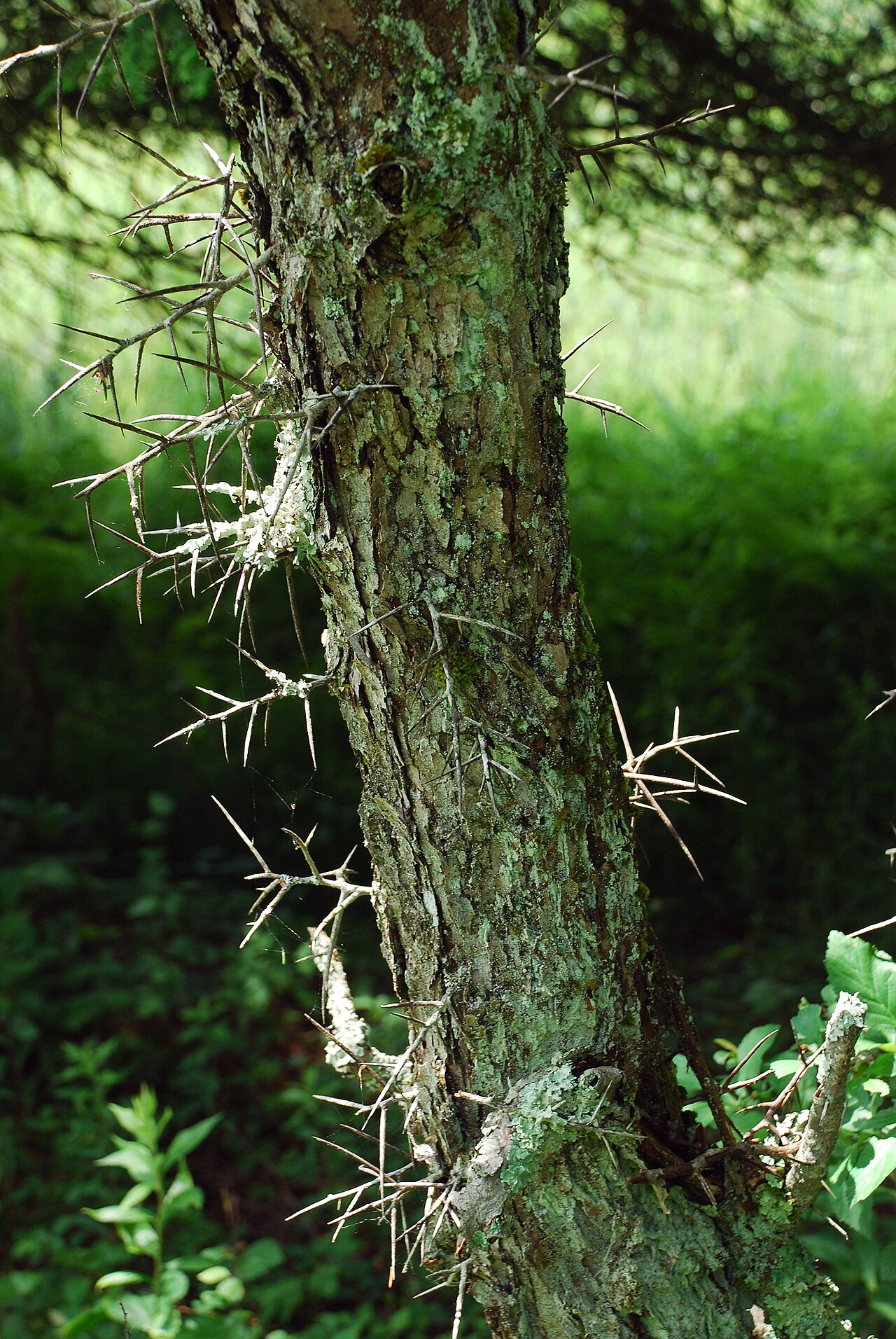
The bark is one of the species’ most identifiable features: pale gray to whitish, becoming ridged and scaly with age, and often lightly coated with lichen. First-year twigs are pale gray and noticeably hairy, giving the whole crown a slightly ashy, “white” look in winter that is the source of the common name White Haw. Numerous straight gray thorns line the trunk and branches, offering excellent cover for nesting birds but demanding care when pruning or working near the tree.
Leaves
Leaves are simple, alternately arranged, 1.5 to 2.5 inches long, and narrowly obovate to elliptic in outline — widest above the middle and tapering to a narrow, wedge-shaped base. The margins are sharply toothed toward the tip, sometimes with shallow lobes on vigorous shoots, and the upper surface has a matte, slightly dull green texture with noticeably impressed veins, a useful field mark that separates it from the glossier-leaved Cockspur Hawthorn (Crataegus crus-galli). Leaves drop in autumn without significant fall color.
Flowers
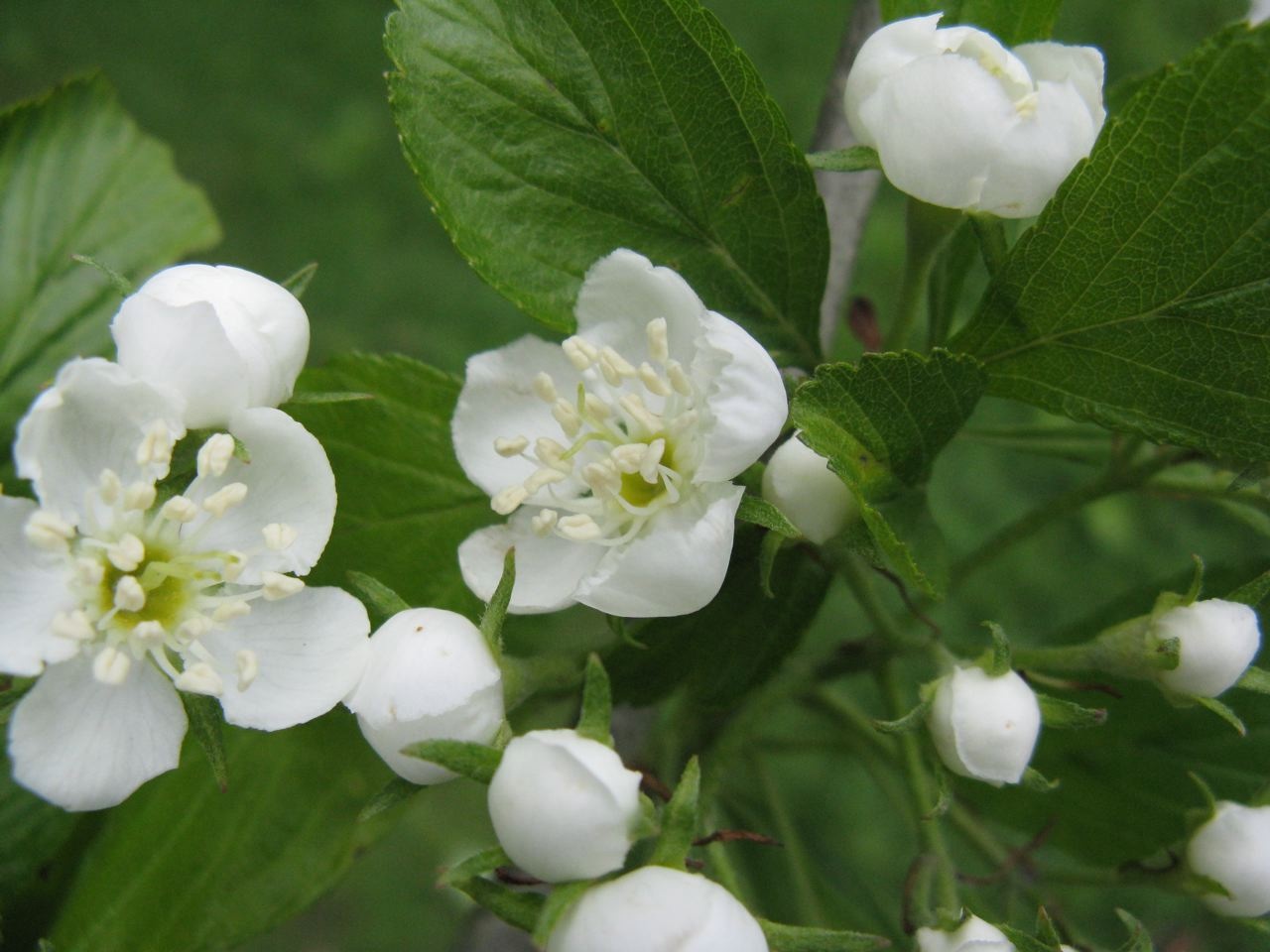
In May and June, Dotted Hawthorn produces flat-topped clusters (corymbs) of 10 to 25 flowers, each about ½ to ¾ inch across with five white petals. Anther color is variable even within a single population, ranging from cream or white through pink to deep purple-red, giving some trees a subtly different look in bloom. The flowers have a notably strong, somewhat unpleasant scent typical of many hawthorns, which attracts flies and beetles as well as bees.
Fruit & Seeds
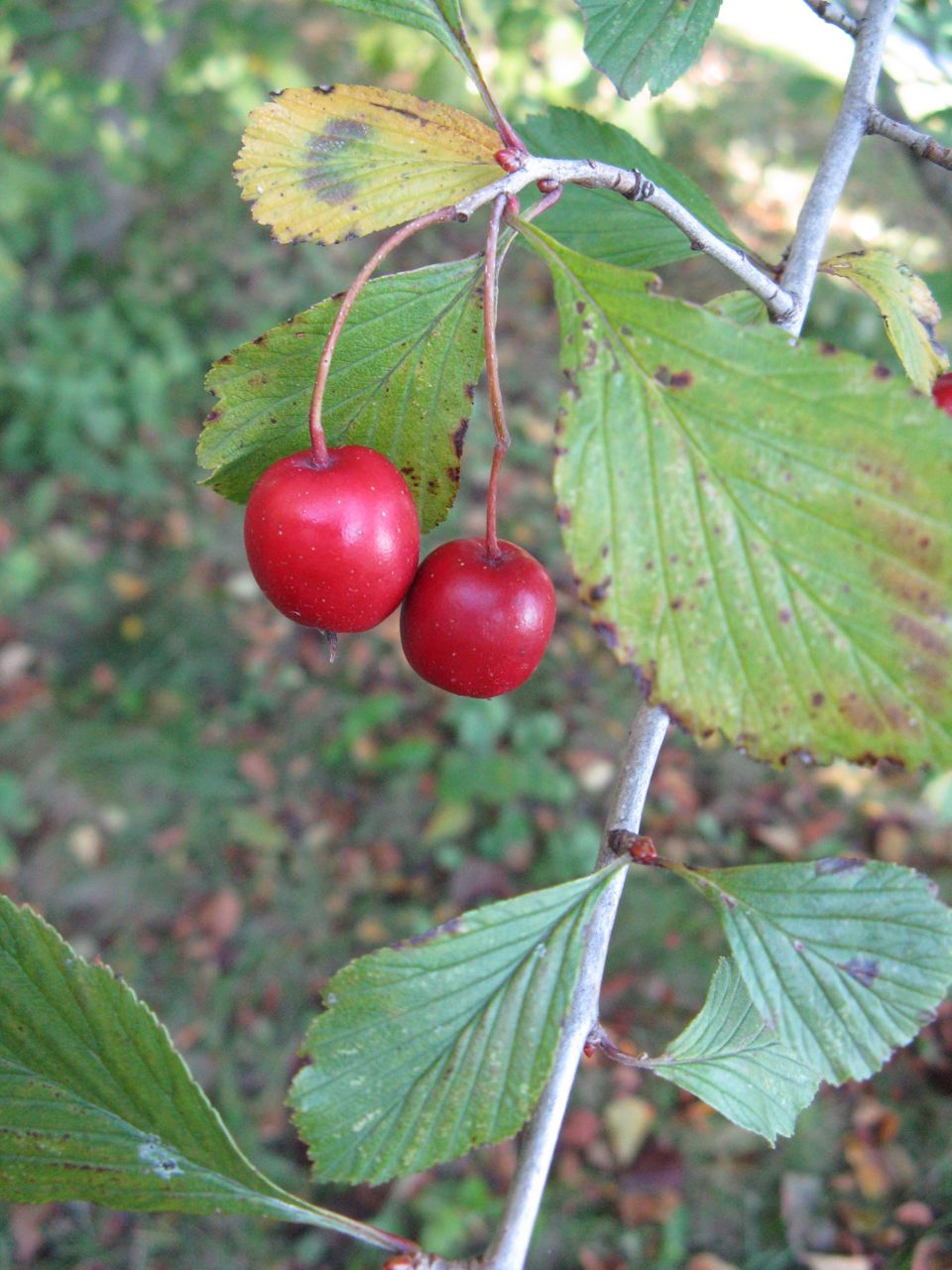
The fruit is a rounded pome, ½ to ¾ inch across, ripening in September and October. Color is variable — usually deep burgundy-red or scarlet, sometimes orange or yellow — and the surface is dotted with small pale lenticels, the “dots” for which the species is named. Each fruit contains three to five hard nutlets. Fruit often persists on the tree well into winter, softening after frost and becoming an important late-season food source for wildlife.
Quick Facts
| Scientific Name | Crataegus punctata |
| Family | Rosaceae (Rose) |
| Plant Type | Deciduous Small Tree / Large Shrub |
| Mature Height | 15–30 ft |
| Mature Spread | 15–25 ft, often flat-topped |
| Growth Rate | Slow to Moderate |
| Sun Exposure | Full Sun to Part Sun |
| Water Needs | Average to Moist; adaptable once established |
| Soil Type | Adaptable; loam, sand, or clay-loam |
| Soil pH | 5.5–7.5 |
| Bloom Time | May – June |
| Flower Color | White |
| Fall Color | Yellow-green, not showy |
| Fruit | Red to scarlet (sometimes yellow) pomes, persisting into winter |
| Deer Resistant | Yes — dense thorns discourage browsing |
| USDA Hardiness Zones | 3–7 |
Native Range
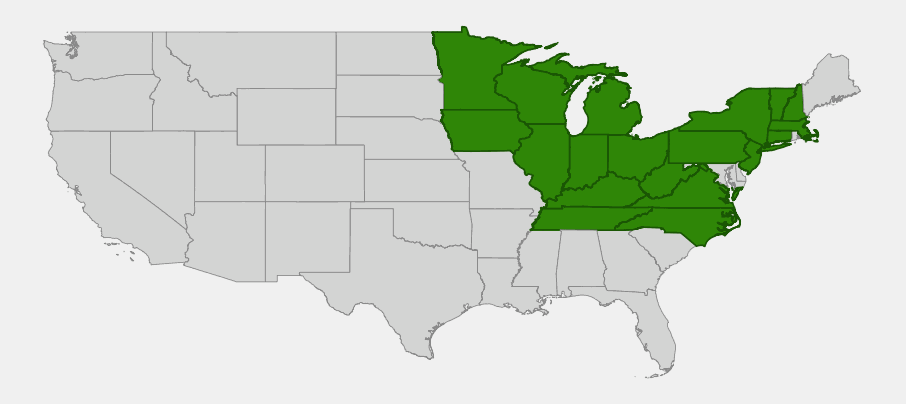
Dotted Hawthorn occurs across the northeast quarter of the United States and adjacent Canada, from New Brunswick, Quebec, and Ontario south through New England, New York, and Pennsylvania, west through the Great Lakes states to Iowa and Minnesota, and south along the Appalachians to North Carolina and Tennessee. Within this broad range it is common, forming dense, nearly pure stands of up to several thousand individuals in favorable sites.
The species has a notable elevation pattern in its southern range: south of New Jersey it is not found near the coast, occurring instead mainly above 1,000 meters (roughly 3,300 feet) in the cooler, moister habitats of the southern Appalachians, including the high country of the North Carolina Blue Ridge, where it often grows alongside Cockspur Hawthorn (Crataegus crus-galli) and other hawthorns in “hawthorn orchards” and thickets. In the northern part of its range it grows from near sea level in New England to moderate elevations further inland, reaching the northwestern edge of its distribution in roughly the eastern half of Minnesota.
Typical habitat includes open, sunny sites: forest edges, old fencerows, successional fields and brushy pastures, light shade in open woodlands, and the margins of mesic hardwood forests. It thrives best in sunny sites near streams and does not tolerate deep, permanent shade.
📋 Regional plant lists featuring Dotted Hawthorn: New Hampshire, Maine & Vermont · Connecticut, Massachusetts & Rhode Island · New York, Pennsylvania & Northern New Jersey · Maryland, Virginia & West Virginia · North Carolina & South Carolina · Kentucky & Tennessee · Ohio & Indiana · Illinois, Iowa & Missouri · Michigan, Wisconsin & Eastern Minnesota
Growing & Care Guide
Dotted Hawthorn is a rugged, low-maintenance native tree once established, well suited to difficult sites where showier ornamental trees struggle. Its thorns demand a bit of planning in placement, but its wildlife value and toughness make it a rewarding addition to the right landscape.
Light
Full sun produces the densest flowering and fruiting and the most compact, well-shaped crown. The tree tolerates light shade along a woodland edge but becomes thinner and less floriferous as shade increases.
Soil & Water
Dotted Hawthorn adapts to a wide range of soils, from sandy loam to heavier clay-loam, and tolerates average garden conditions once established. It performs best with consistent moisture but handles brief dry spells well. Good drainage is helpful, though the species is more forgiving of occasional wet feet than many other hawthorns.
Planting Tips
Plant balled-and-burlapped or container stock in spring or fall, siting it well away from walkways, patios, and areas with foot traffic because of its thorns. Allow 15 to 20 feet of space for the mature, flat-topped crown. It makes an outstanding component of a thorny wildlife hedgerow when planted in a row with 8 to 10 feet of spacing between trees.
Pruning & Maintenance
Prune in late winter while dormant to remove dead, crossing, or low-hanging thorny branches, wearing heavy gloves and eye protection. Established trees need little routine care. Dotted Hawthorn can be susceptible to the same rust, fire blight, and leaf spot issues that affect other hawthorns and apples; siting it with good air circulation and avoiding proximity to susceptible junipers helps minimize rust problems.
Propagation
Propagate from seed, which typically requires a period of warm then cold stratification to break dormancy and may take a year or more to germinate. Scarifying the hard seed coat can improve germination rates. Named selections are occasionally grafted, though most garden and restoration plantings use seed-grown stock.
Landscape Uses
Dotted Hawthorn’s thorny, dense habit and heavy fruit set make it especially valuable for:
- Wildlife hedgerows and thorny barrier plantings
- Bird gardens — persistent fruit and dense cover for nesting
- Naturalized field edges and old pasture restoration
- Winter interest plantings, for its pale bark and lingering fruit
- Security plantings where its thorns discourage foot traffic
Wildlife & Ecological Value
Dotted Hawthorn is a standout wildlife plant, combining abundant persistent fruit with dense, thorny cover that few predators can penetrate.
For Birds
The fruit is eaten by a wide range of birds, including American Robins, Cedar Waxwings, Northern Cardinals, Ruffed Grouse, and various thrushes, especially once it softens after fall frosts. Because the fruit persists into winter, Dotted Hawthorn is an important late-season and winter food source when other soft fruits are gone. The dense, thorny branching also provides some of the safest nesting and roosting cover available to small songbirds, largely protected from climbing predators.
For Mammals
Small mammals and browsing deer occasionally eat the fruit, though the thorny branches generally protect the foliage from heavy deer browsing, making this one of the more deer-resistant native flowering trees.
For Pollinators
The strongly scented spring flowers, though not especially attractive to humans, draw large numbers of bees, flies, and beetles, making Dotted Hawthorn a valuable, if unglamorous, early-season pollinator resource.
Ecosystem Role
As an early- to mid-successional tree of old fields and forest edges, Dotted Hawthorn helps stabilize disturbed ground and creates the thorny thicket structure that many edge-dependent wildlife species rely on. Its ability to form dense, nearly pure stands makes it an important structural component of old-field succession across much of its northeastern range.
Cultural & Historical Uses
Like other native hawthorns, Dotted Hawthorn’s hard, dense wood was historically prized by rural communities for tool handles, mallet heads, and other small items requiring a tough, close-grained timber, though the tree’s small size limited large-scale lumber use. Its long, sharp thorns led to practical use in farm hedgerows, where rows of hawthorn were planted and maintained as living fences to contain livestock before wire fencing became widespread — a tradition carried over from European hawthorn hedging practice and applied to this and other American Crataegus species.
The fruit of hawthorns generally has a long history of use in jellies, syrups, and wines in both European and North American folk traditions, valued for its tart flavor and high pectin content, though Dotted Hawthorn fruit is mealy and seedy and considered a minor, informal use compared to larger-fruited hawthorn species.
Today, Dotted Hawthorn’s significance is mostly ecological and horticultural: it remains a mainstay of native hedgerow and wildlife plantings throughout its range, valued more for the shelter and food it provides to birds than for any direct human use.
Frequently Asked Questions
Are Dotted Hawthorn’s thorns dangerous?
The thorns are long, straight, and sharp enough to puncture skin or thin clothing, so plant it away from walkways and wear sturdy gloves when pruning. They are not toxic, just mechanically sharp, and they are exactly what makes the tree such effective cover for nesting birds.
Can you eat Dotted Hawthorn fruit?
The small red pomes are not toxic, and hawthorn fruits generally have a history of use in jellies and syrups, but Dotted Hawthorn’s fruit is mealy, seedy, and not particularly flavorful compared to cultivated hawthorns. It is best left for the birds, which rely on it as an important winter food source.
Why doesn’t Dotted Hawthorn grow near the coast in the southern part of its range?
South of New Jersey, Dotted Hawthorn is restricted mainly to higher elevations above about 1,000 meters in the southern Appalachians, where conditions stay cooler and moister. It is essentially absent from the warmer coastal plain and Piedmont in that part of its range.
How fast does Dotted Hawthorn grow?
It is a slow-to-moderate grower, typically adding under a foot per year, which is normal for hawthorns and part of why the wood is so dense and durable.
Is Dotted Hawthorn susceptible to cedar-apple rust?
Like many members of the rose family, it can be affected by rust diseases that cycle through junipers, as well as fire blight and leaf spot. Siting it with good air circulation and away from susceptible eastern red cedar helps reduce problems, though the tree is generally considered relatively tough and low-maintenance.

Looking for a nursery that carries Dotted Hawthorn?
Browse our native plant nursery directory: Connecticut · Massachusetts, Kentucky, Michigan & Minnesota · New Hampshire, New York, New Jersey, North Carolina & Ohio · Vermont, Pennsylvania, Virginia & Tennessee · West Virginia & Wisconsin · Indiana, Illinois & Iowa