
Pineapple Weed (Matricaria discoidea)
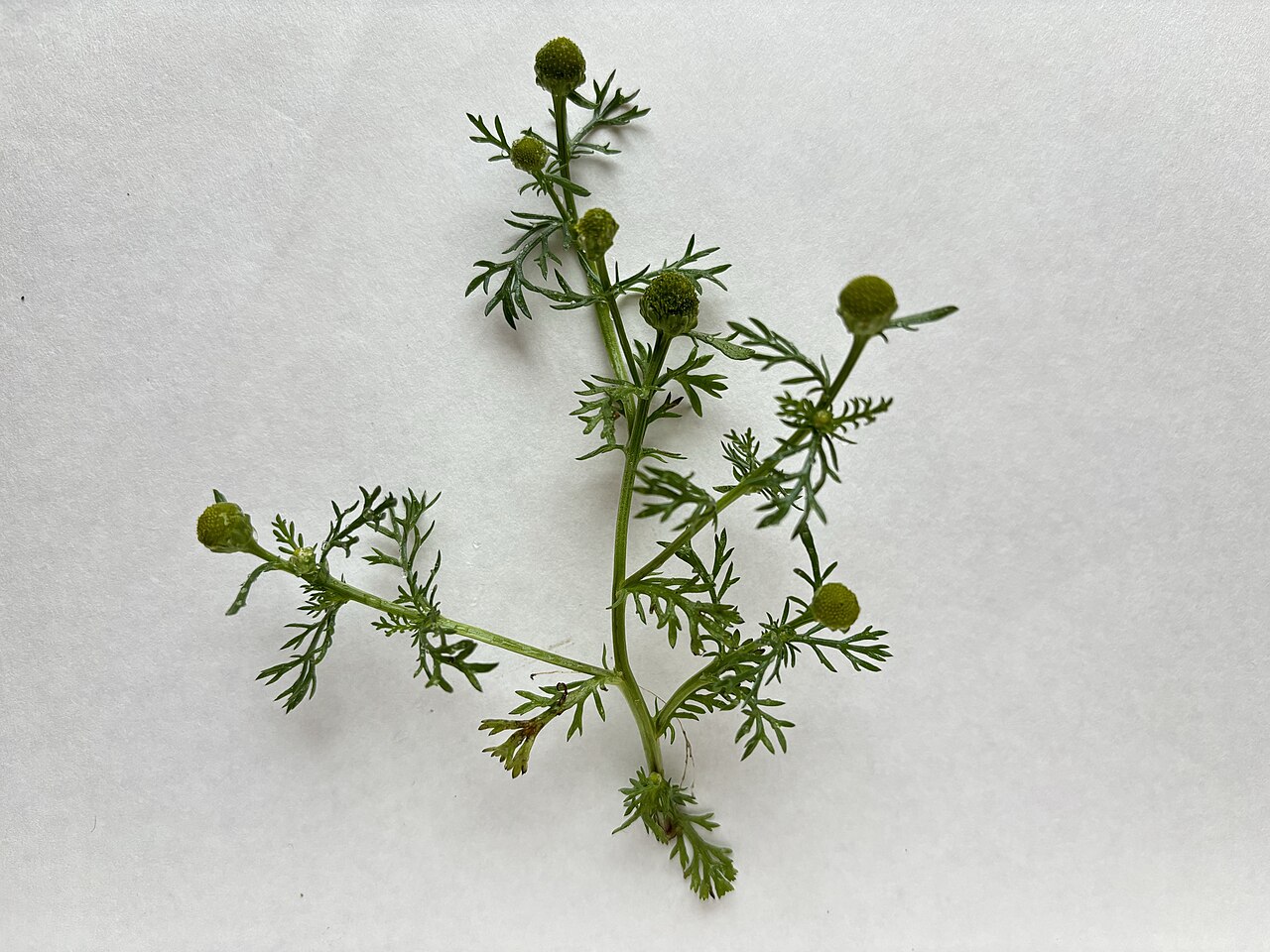
Matricaria discoidea, commonly known as Pineapple Weed, is a low, mat-forming annual in the aster family (Asteraceae) best recognized by its cone-shaped, petal-less flower heads and the sweet, pineapple-like scent released when the foliage or flowers are crushed. It is one of the most familiar small plants of disturbed ground across North America, turning up in gravel driveways, sidewalk cracks, compacted trail edges, and farmyards wherever soil has been trampled or scraped bare.
Pineapple Weed is native to western North America, where it grows naturally in open, sometimes seasonally wet or disturbed ground from the coast to the interior mountains. From that native range it has spread — mostly along roads, railways, and other human-disturbed corridors — across the rest of the continent and, eventually, around much of the temperate world, so today it also turns up as an introduced weed far outside its original western range, including throughout the eastern United States, Europe, and northern Asia.
Because it tolerates foot traffic, compacted soil, and even the drought and poor fertility of gravel parking areas, Pineapple Weed is sometimes left in place or lightly encouraged rather than weeded out, and its flower heads are a well-known foraging and tea plant where it occurs naturally. It is a humble, low-growing annual rather than a garden centerpiece, but within its native western range it is a true wildflower worth knowing and, where appropriate, worth leaving be.
Identification
Pineapple Weed is a low, branching annual typically 2 to 12 inches tall, often sprawling or mat-forming where it is repeatedly trampled, and more upright where left undisturbed. The whole plant has a smooth, hairless appearance, and all parts release a distinctive sweet pineapple-and-chamomile fragrance when crushed or bruised.
Stems
Stems are smooth, light green, hairless, and freely branching from the base, giving the plant a bushy, rounded outline. In compacted or frequently walked-on ground, stems lie flat and spread outward; in looser soil, the plant grows more upright.
Leaves
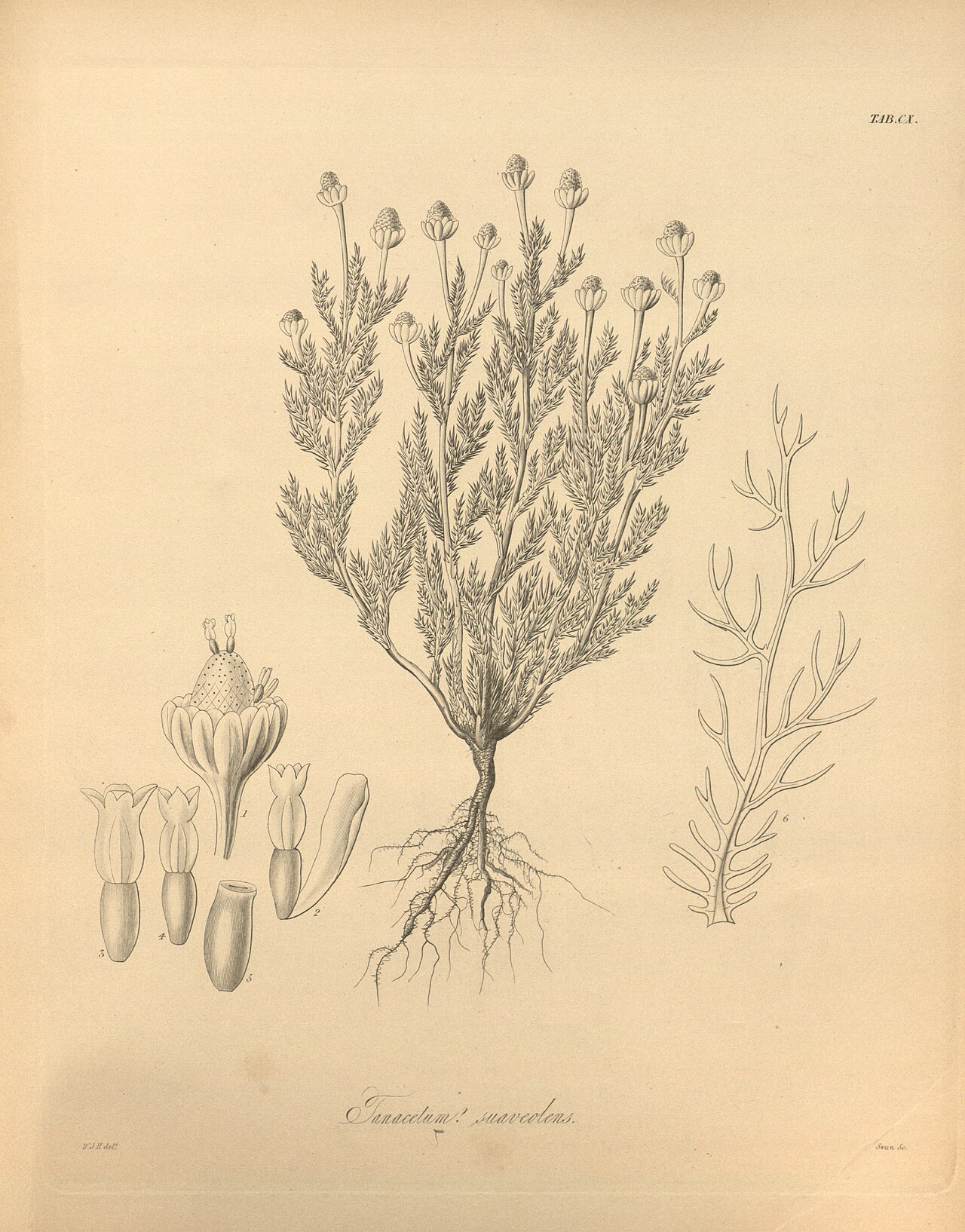
The leaves are alternate, 1 to 2 inches long, and finely divided two or three times into narrow, thread-like segments, giving them a feathery, almost carrot-top or fennel-like texture. This finely dissected foliage, combined with the fruity scent when crushed, is one of the most reliable field marks for the species.
Flowers
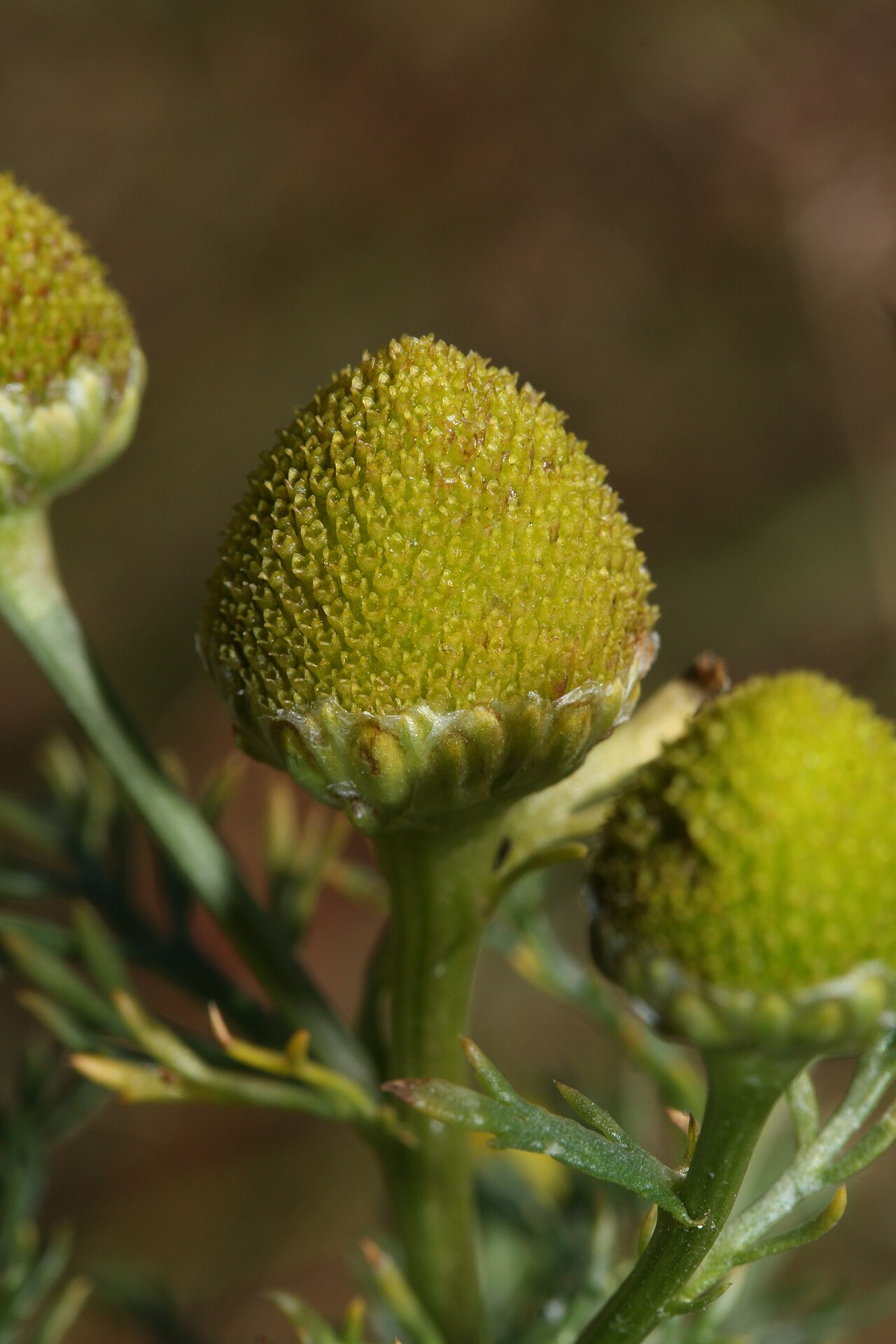
Flower heads are the plant’s signature feature: small, dome- to cone-shaped, greenish-yellow, and entirely lacking the white ray petals (“petals”) typical of daisies and chamomiles — hence the alternative name “disc mayweed.” Each head is composed of densely packed tiny disc florets only, roughly ¼ to ½ inch across, borne singly at the tips of branching stems. Bloom runs from spring through fall, often continuously in cooler climates or wherever the plant gets repeated mowing or trampling that triggers fresh flushes of growth.
Fruit & Seeds
The fruit is a tiny, ribbed achene produced in large numbers inside the spent flower head, which dries and releases seed through summer and fall. Seed production is prolific, which is part of why the species spreads so readily along disturbed, compacted ground; a single plant growing in a gravel lot or along a well-used path can shed thousands of seeds by season’s end.
Quick Facts
| Scientific Name | Matricaria discoidea |
| Family | Asteraceae (Aster/Daisy) |
| Plant Type | Annual Forb/Herb |
| Mature Height | 2–12 in |
| Mature Spread | 6–12 in, often mat-forming when trampled |
| Growth Rate | Fast (completes life cycle in a single season) |
| Sun Exposure | Full Sun to Part Shade |
| Water Needs | Low |
| Soil Type | Compacted, disturbed, gravelly, or bare mineral soil |
| Soil pH | Adaptable; neutral to slightly alkaline |
| Bloom Time | Spring – Fall |
| Flower Color | Greenish-yellow (no ray petals) |
| Fall Color | None; plant dries tan and dies with frost |
| Fruit | Tiny ribbed achenes, produced in abundance |
| Deer Resistant | Yes (low palatability, aromatic foliage) |
| USDA Hardiness Zones | 3–9 (where native); grows as a weed well beyond this range |
Native Range
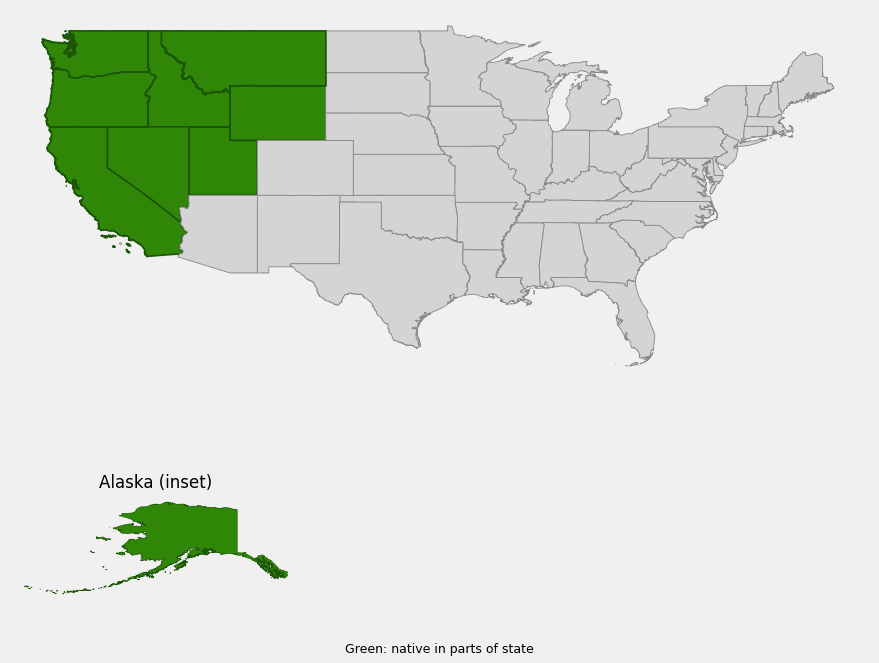
Pineapple Weed’s native range lies in western North America, spanning from Alaska south along the Pacific Coast through Washington, Oregon, and California, and east through the interior mountain West into Idaho, Montana, Wyoming, Nevada, and Utah. Within this region it grows naturally on open, often seasonally damp or periodically disturbed ground — the kind of bare mineral soil created by flooding, animal trails, or natural erosion long before pavement and plows arrived.
Because it thrives on disturbance and compacted soil, Pineapple Weed took eagerly to the new habitats that roads, railways, farms, and towns created across the rest of the continent, and it is now found as an introduced, weedy annual far beyond its native western range — including throughout the eastern United States and southern Canada — as well as across much of Europe and northern Asia, where it is similarly considered a non-native, cosmopolitan weed of paths and waste ground. On this site, only the western states listed below are treated as native range; elsewhere in North America the species should be considered introduced, even though it is extremely common there.
Within its native western range, Pineapple Weed is typically found at low to middle elevations, from coastal flats to mountain valleys, wherever open, compacted, or periodically flooded ground keeps taller, more competitive vegetation from taking over.
📋 Regional plant lists featuring Pineapple Weed: Alaska, Western Oregon & Western Washington, Idaho, Eastern Oregon & Eastern Washington, Montana & Wyoming, Utah & Western Colorado
Growing & Care Guide
Pineapple Weed is not a plant most gardeners deliberately cultivate in a border, but within its native western range it is a useful, low-maintenance volunteer for tough spots, and a genuinely interesting small wildflower to recognize and, where it shows up on its own, allow to stay.
Light
Full sun to light part shade suits Pineapple Weed best; it grows most vigorously in open, sun-exposed ground, which is exactly the kind of site — driveways, paths, and disturbed margins — where it tends to appear unassisted.
Soil & Water
This species thrives precisely where many garden plants struggle: compacted, gravelly, or bare mineral soil with little organic matter. It needs very little supplemental water once established and tolerates both brief waterlogging in spring and summer drought. Rich, loose garden soil with heavy competition from other plants is actually less hospitable to it than a hard-packed gravel path.
Planting Tips
Pineapple Weed is rarely planted from nursery stock; it is almost always allowed to self-seed from existing populations or collected as wild seed within its native range. If you want it in a particular spot, scatter ripe seed heads over bare, compacted soil in fall and let winter moisture and foot or vehicle traffic do the rest — ground that is too loose or too heavily mulched tends to favor other species instead.
Pruning & Maintenance
No pruning is needed. Because it is a fast-maturing annual, mowing or trampling during the growing season often triggers fresh flushes of low, compact growth rather than killing the plant outright, which is part of why it persists so well on paths and lightly used turf.
Landscape Uses
Within its native western range, Pineapple Weed has a few practical niches rather than a classic ornamental role:
- Gravel paths and parking areas — fills bare, compacted ground that few other plants will use
- Children’s gardens — the crushed-pineapple scent makes it a memorable, safe plant for kids to discover
- Foraging and tea gardens — dried flower heads are traditionally steeped as a mild, chamomile-like tea where the species is native
- Low-input turf alternatives on compacted, poor soil where conventional lawn struggles
Wildlife & Ecological Value
Though small and easy to overlook, Pineapple Weed contributes modestly but consistently to the insect life of open, disturbed ground throughout its native range.
For Pollinators
The dense disc flowers attract small native bees, flies, and occasionally butterflies seeking nectar, especially valuable because the plant often blooms continuously through summer in places with little other floral resource, such as gravel lots and hard-packed paths.
For Birds
Small seed-eating birds, including sparrows and finches, forage on the abundant tiny achenes produced by spent flower heads, particularly in fall when the plant has gone to seed in open ground.
For Mammals
Pineapple Weed is not a significant browse plant for large mammals, but its seeds contribute modestly to the diet of small rodents foraging in open, disturbed habitats within its native range.
Ecosystem Role
As a true pioneer species, Pineapple Weed is among the first plants to colonize bare, compacted, or disturbed mineral soil, helping stabilize ground and begin the process of vegetation recovery after flooding, grazing, or mechanical disturbance in its native western habitats.
Cultural & Historical Uses
Within its native range, Pineapple Weed has a long history of use by Indigenous peoples of western North America, who historically dried the aromatic flower heads for use as a mild beverage tea and recognized the plant’s pleasant fragrance, using it in various traditional preparations documented in regional ethnobotanical records.
The common name itself reflects its most memorable trait — the sweet, fruity scent released when the flower heads or foliage are crushed, which many people compare to fresh pineapple. This same aromatic quality has made the plant a familiar, informally foraged “chamomile substitute” for tea in parts of its native range, historically steeped much like true chamomile (Matricaria chamomilla), to which it is closely related.
As the species spread into disturbed habitats across the rest of North America and overseas, it became equally well known simply as a persistent, scent-releasing weed of paths and parking areas — a humble but genuinely useful plant to recognize wherever you encounter it.
Frequently Asked Questions
Is Pineapple Weed native to my state?
Only in parts of the West: Alaska, Washington, Oregon, California, Idaho, Montana, Wyoming, Nevada, and Utah. Everywhere else in North America — including most of the eastern and central United States — it grows as an introduced, naturalized weed rather than a native plant.
Why does Pineapple Weed smell like pineapple?
The foliage and flower heads contain aromatic compounds that are released when the plant is crushed or bruised, producing a scent many people describe as similar to fresh pineapple or chamomile.
Does Pineapple Weed have ray petals like a daisy?
No. Its flower heads are made up entirely of small disc florets packed into a cone shape, with no surrounding white ray petals — this is why it is sometimes called “disc mayweed” or “rayless chamomile.”
Can I get rid of Pineapple Weed if I don’t want it?
Yes — hand-pulling is easy since it is a shallow-rooted annual, and because it depends on repeated seeding, preventing flower heads from maturing for a season or two greatly reduces it. Loosening and amending compacted soil, or replacing it with denser ground cover, also makes a site less hospitable to it.
Is Pineapple Weed the same as chamomile?
No, though they are close relatives in the same family and genus-adjacent group. True chamomile (Matricaria chamomilla) has white ray petals around its flower heads; Pineapple Weed lacks them entirely.

Looking for a nursery with native plants for tough, disturbed sites?
Browse our native plant nursery directory: California · Oregon · Washington · Idaho · Wyoming · Utah · Nevada · Alaska · Montana