
Desert Mountain Phlox (Phlox austromontana)
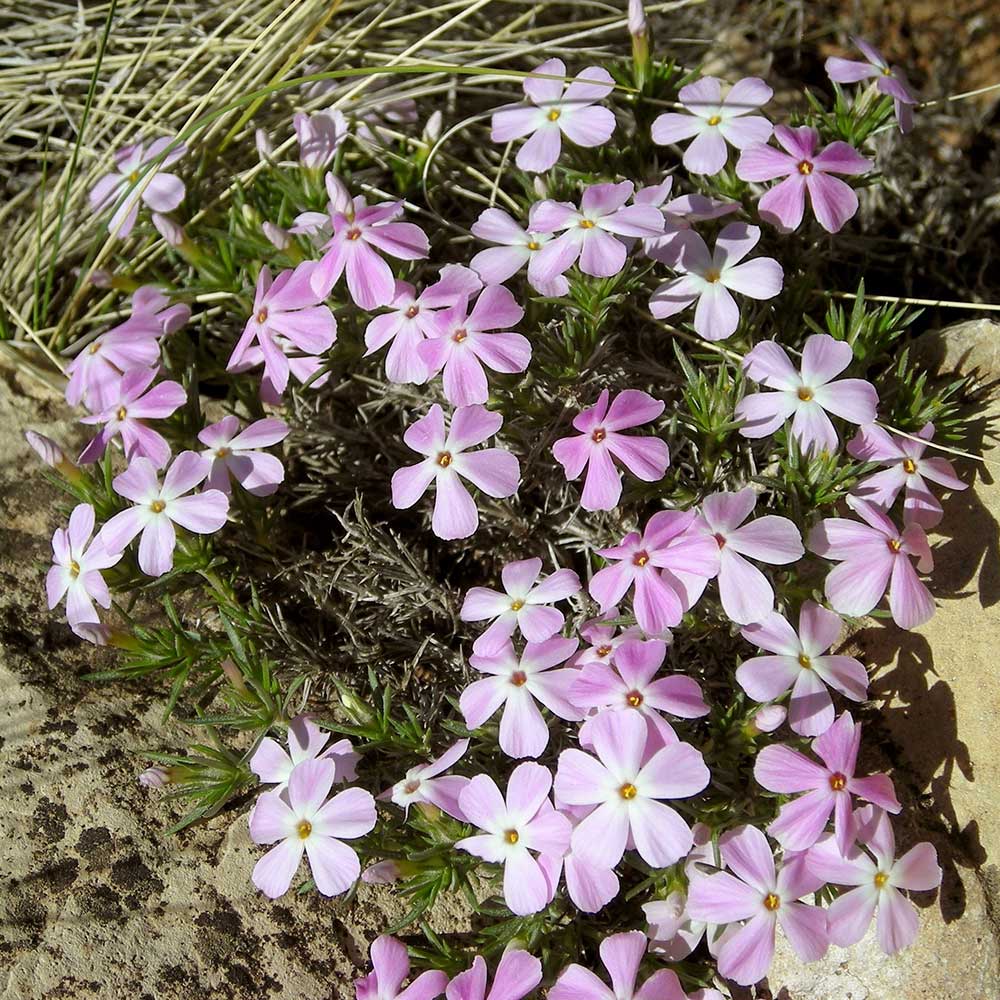
Phlox austromontana, commonly called Desert Mountain Phlox or simply Mountain Phlox, is a tough, low-growing, mat- to cushion-forming perennial of the dry mountains and high deserts of the interior Southwest. It belongs to a group of needle-leaved phlox species adapted to thin, rocky soils and intense sun, and it announces itself each spring with a dense flush of small, five-petaled flowers that can nearly hide the gray-green foliage beneath.
Unlike the taller garden phlox familiar from perennial borders, Desert Mountain Phlox hugs the ground in tight, spiny-looking cushions rarely more than a few inches tall, an adaptation shared with many plants of exposed, rocky, high-elevation sites where wind, cold, and drought are constant pressures. Its flowers range from white to shades of pink and lavender, sometimes on the same mountainside, giving rock gardens built around it a naturally varied palette.
For gardeners in the Intermountain West and Southwest, Desert Mountain Phlox is an outstanding, long-lived choice for rock gardens, gravel beds, and other spots that stay hot and dry — conditions that would quickly kill most eastern garden perennials but that this species is built for.
Identification
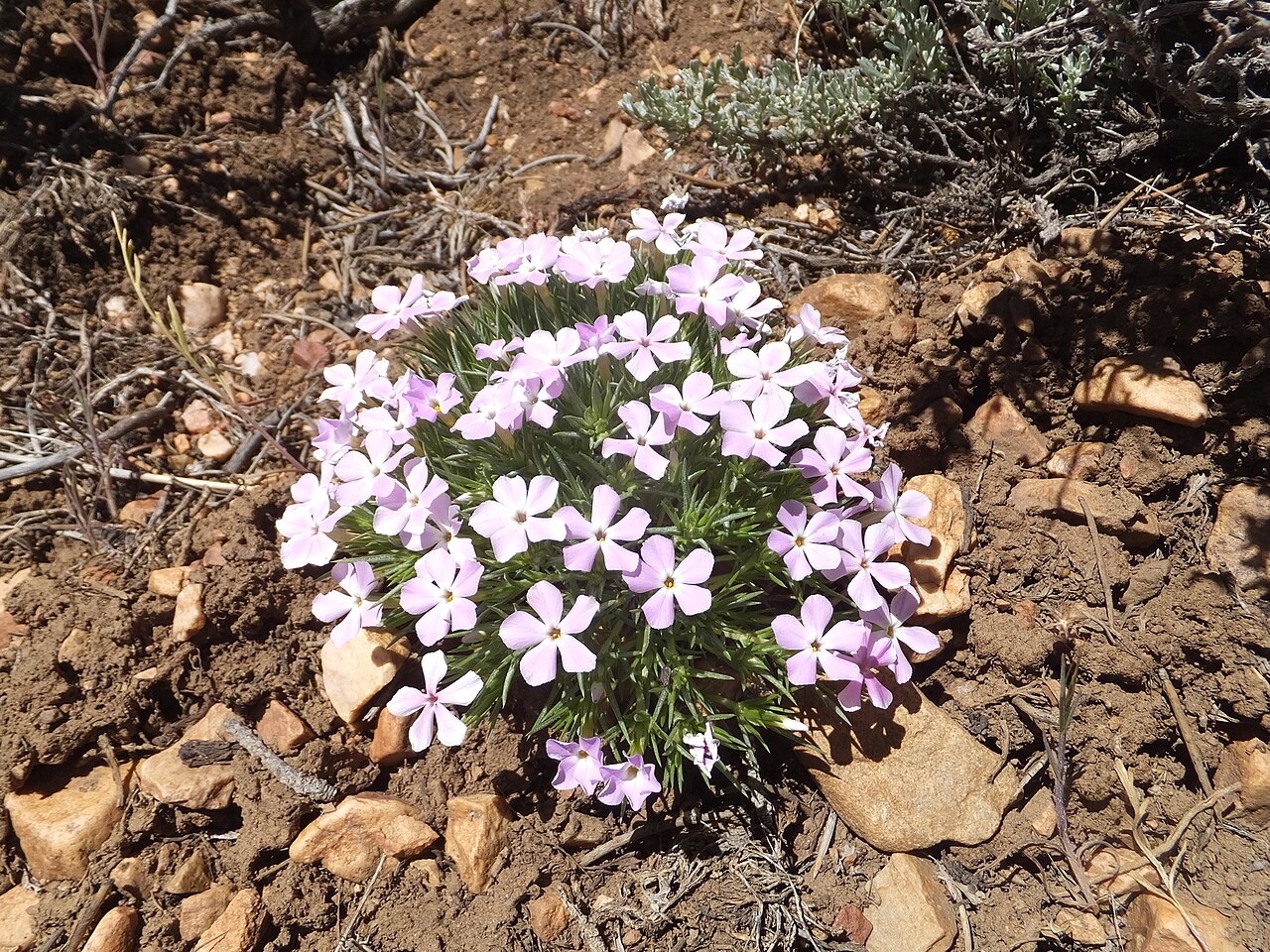
Desert Mountain Phlox forms a dense, tangled mat or low cushion, typically 2 to 6 inches tall and spreading 8 to 16 inches across over time, made up of many short, woody-based stems packed closely together.
Foliage
Leaves are narrow, stiff, and needle-like, ¼ to ¾ inch long, opposite along the stems, and sharply pointed at the tip — a texture that gives the whole plant a bristly, almost conifer-like appearance even when not in bloom. The gray-green to blue-green foliage is evergreen in mild winters, persisting as a tight, textured mound through the off season.
Flowers
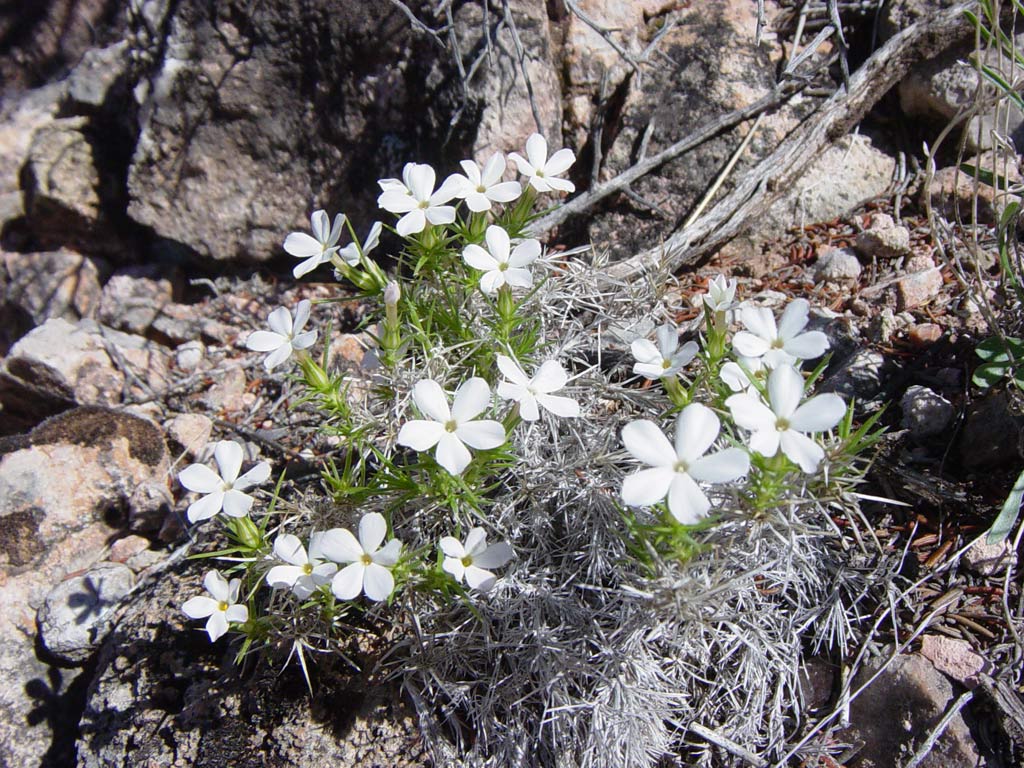
Flowers are produced in great abundance in spring, each about ½ to ¾ inch across with five flat, rounded petal lobes fused at the base into a slender tube. Color varies by population from pure white to pale pink, lavender, or occasionally a deeper rose-pink, and it is common to see both white- and pink-flowered cushions growing within sight of each other on the same slope. Flowers are held just above the foliage on very short stalks, so in full bloom the entire cushion can appear solid with color.
Fruit & Seeds
After flowering, small three-chambered seed capsules form, each releasing a handful of tiny seeds when ripe in early summer. The capsules are inconspicuous and not an ornamental feature; most gardeners never notice them forming beneath the fading flowers.
Quick Facts
| Scientific Name | Phlox austromontana |
| Family | Polemoniaceae (Phlox) |
| Plant Type | Evergreen Mat-Forming Perennial Subshrub |
| Mature Height | 2–6 in |
| Mature Spread | 8–16 in |
| Growth Rate | Slow |
| Sun Exposure | Full Sun |
| Water Needs | Low |
| Soil Type | Rocky, gravelly, or sandy; well-drained |
| Soil pH | 6.5–8.0 (neutral to alkaline) |
| Bloom Time | April – June |
| Flower Color | White, pink, or lavender |
| Fall Color | None; foliage stays gray-green year-round |
| Fruit | Small inconspicuous seed capsule |
| Deer Resistant | Yes |
| USDA Hardiness Zones | 5–9 |
Native Range
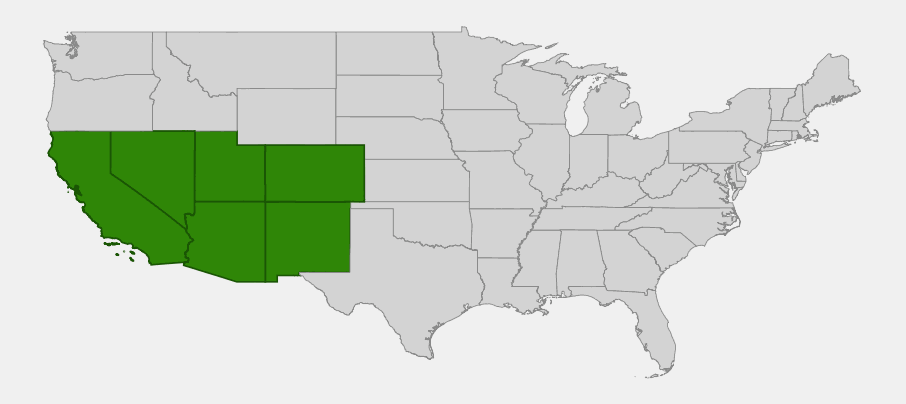
Desert Mountain Phlox is native to the dry interior mountains and high desert ranges of the Southwest, found across California, Nevada, Utah, Arizona, Colorado, and New Mexico, with its range continuing south into Baja California, Mexico. Within this area it is strongly associated with elevation: it is a plant of pinyon-juniper woodland, dry montane forest edges, and exposed rocky slopes rather than true low-desert floor.
Typical sites include rocky outcrops, canyon rims, open rocky flats, and thin soils over bedrock from roughly 4,000 to 10,000 feet in elevation, which is why it is such a familiar sight along popular overlooks and rim trails in places like Grand Canyon National Park. It often grows in the company of sagebrush, pinyon pine, and junipers, forming colorful spring carpets on otherwise sparse, rocky ground.
Desert Mountain Phlox is not native to the Pacific Northwest, the Great Plains, or anywhere east of the Rocky Mountains, and gardeners outside its arid, high-elevation range should not expect it to tolerate humid summers or heavy, moisture-retentive soils.
📋 Regional plant lists featuring Desert Mountain Phlox: Utah & Western Colorado · Arizona & New Mexico
Growing & Care Guide
Desert Mountain Phlox rewards gardeners who can offer it the lean, fast-draining, sun-baked conditions of its native rocky slopes, and it struggles quickly wherever those conditions are not met — this is a plant for rock gardens and gravel beds, not for a typical irrigated perennial border.
Light
Full sun is essential. In the wild it grows fully exposed on open rock and thin soil, and it will become sparse, leggy, and reluctant to bloom in shaded or even lightly shaded sites.
Soil & Water
Sharp drainage is the single most important factor for success. Rocky, gravelly, or sandy soils with little organic matter suit it far better than rich garden loam, and standing winter moisture or heavy clay will quickly rot the roots. Water sparingly; established plants are highly drought tolerant and often need no supplemental water at all once rooted in, beyond what naturally falls in a dry mountain climate.
Planting Tips
Plant in spring or fall into a raised bed, rock garden, or gravel mulch where water will not pool around the crown. Amending heavy soil with coarse sand or crushed rock before planting makes a meaningful difference in long-term survival. Space plants 10 to 15 inches apart to allow the cushions to fill in without crowding.
Pruning & Maintenance
Very little maintenance is required. Shearing spent flowers lightly after bloom can encourage a tidier mound and occasionally a modest rebloom, though it is not necessary for plant health. Avoid overhead watering and mulches that trap moisture against the woody crown, which is the most common cause of decline in cultivation.
Propagation
Division of rooted side-shoots in early spring is the most reliable method for home gardeners, since seed germination can be slow and uneven. Semi-hardwood cuttings taken in early summer will also root with a well-drained propagation mix, though patience is required.
Landscape Uses
Desert Mountain Phlox is a natural fit for several dry-garden settings:
- Rock gardens tucked between and atop boulders where drainage is sharp
- Gravel and xeriscape beds needing low, drought-tolerant color
- Slope and crevice plantings on sunny, well-drained banks
- Container and trough gardens for alpine and rock garden enthusiasts
- Pollinator-friendly groundcover in high-elevation native plant gardens
Wildlife & Ecological Value
Desert Mountain Phlox contributes meaningfully to the ecology of the dry, rocky plant communities it inhabits, particularly as an early, reliable nectar source on otherwise sparse ground.
For Pollinators
The tubular flowers are well suited to long-tongued pollinators, especially native bees, butterflies, and day-flying moths, which visit for nectar during the spring bloom when few other flowers are available on exposed rocky terrain. Hummingbirds have also been observed visiting the flowers opportunistically where populations are dense.
Birds
While not a major food source itself, the dense, low cushions provide small songbirds and ground-foraging species with cover and foraging structure among the rocks, and the insects it attracts in turn support insectivorous birds in these sparsely vegetated habitats.
Mammals
The tough, resinous, needle-like foliage is not a preferred browse for mule deer or other large herbivores, which helps explain why Desert Mountain Phlox persists so well on grazed rangeland and exposed slopes where more palatable plants are quickly eaten back.
Ecosystem Role
As a mat-forming perennial on thin, rocky soils, Desert Mountain Phlox helps stabilize small pockets of soil against erosion on steep, exposed slopes, and its dense root system and persistent cushion provide a modest but valuable anchor point for soil and organic matter to accumulate in an otherwise harsh, rocky environment.
Cultural & Historical Uses
Desert Mountain Phlox was formally described by American botanist Frederick Vernon Coville in the late 19th century, part of the broader scientific effort to catalog the flora of the arid Southwest during early federal survey expeditions. Like many low-growing phlox species of the region, it does not carry an extensive record of food or medicinal use among Indigenous peoples, likely owing to its small size and limited biomass compared to more substantial food and fiber plants of the same dry landscapes.
Its primary historical significance has been botanical and horticultural rather than practical: taxonomists have long used features like its needle-like leaves and cushion growth form to distinguish it from closely related regional phlox species, and in more recent decades it has become a sought-after plant among rock garden and alpine plant enthusiasts specifically for its ability to thrive in conditions that defeat most ornamental perennials.
Today, Desert Mountain Phlox is valued almost entirely for its ornamental and ecological role in dry native gardens, prized by gardeners in the Intermountain West for bringing reliable, low-water spring color to rock gardens and xeriscapes built around the region’s naturally rocky terrain.
Frequently Asked Questions
Why do some Desert Mountain Phlox plants have white flowers and others pink?
Flower color in this species is naturally variable across its range and even within a single population, with white, pink, and lavender forms often growing side by side on the same slope. This is a normal feature of the species rather than a sign of a different variety or hybrid.
Can Desert Mountain Phlox survive in humid, rainy climates?
It generally struggles outside dry, high-elevation climates. Humid summers and wet, poorly drained soils are the most common causes of failure in cultivation, so gardeners east of the Rockies or in coastal, rainy regions should not expect reliable long-term success without exceptional drainage.
Is Desert Mountain Phlox the same as creeping garden phlox?
No. Common garden “creeping phlox” sold at nurseries is usually Phlox subulata or Phlox stolonifera, eastern species adapted to more moisture. Desert Mountain Phlox is a distinct western species adapted specifically to arid, rocky, high-elevation conditions and generally performs poorly where those eastern species thrive.
How long does it take Desert Mountain Phlox to form a full cushion?
Growth is slow; a small division or nursery plant may take two to three years to fill out into a dense, mature cushion, though established plants are quite long-lived once they reach that point.
Does Desert Mountain Phlox need fertilizer?
No. It is adapted to thin, nutrient-poor rocky soils, and fertilizing typically produces weak, floppy growth and reduced bloom rather than improved performance. Lean soil is actually an advantage for this species.

Looking for a nursery that carries Desert Mountain Phlox?
Browse our native plant nursery directory: California · Nevada & New Mexico · Utah · Arizona · Colorado