Broad Beech Fern (Phegopteris hexagonoptera)
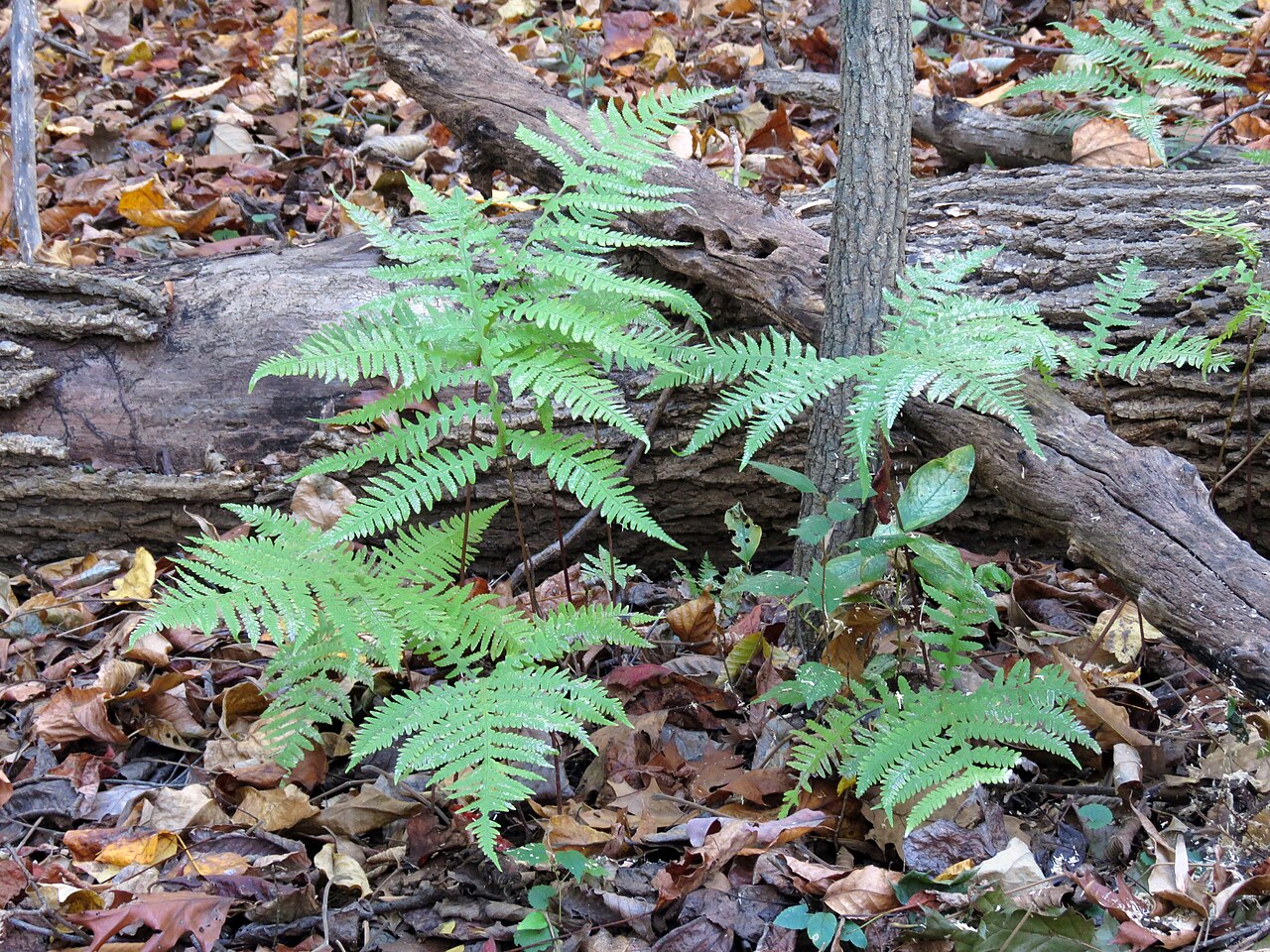
Phegopteris hexagonoptera, commonly known as Broad Beech Fern, is a deciduous, colony-forming fern of rich eastern hardwood forests. Older field guides and some nursery catalogs still list it under its former names, Thelypteris hexagonoptera or Dryopteris hexagonoptera, a reminder of how often fern taxonomy has shifted; all three names refer to the same familiar woodland fern.
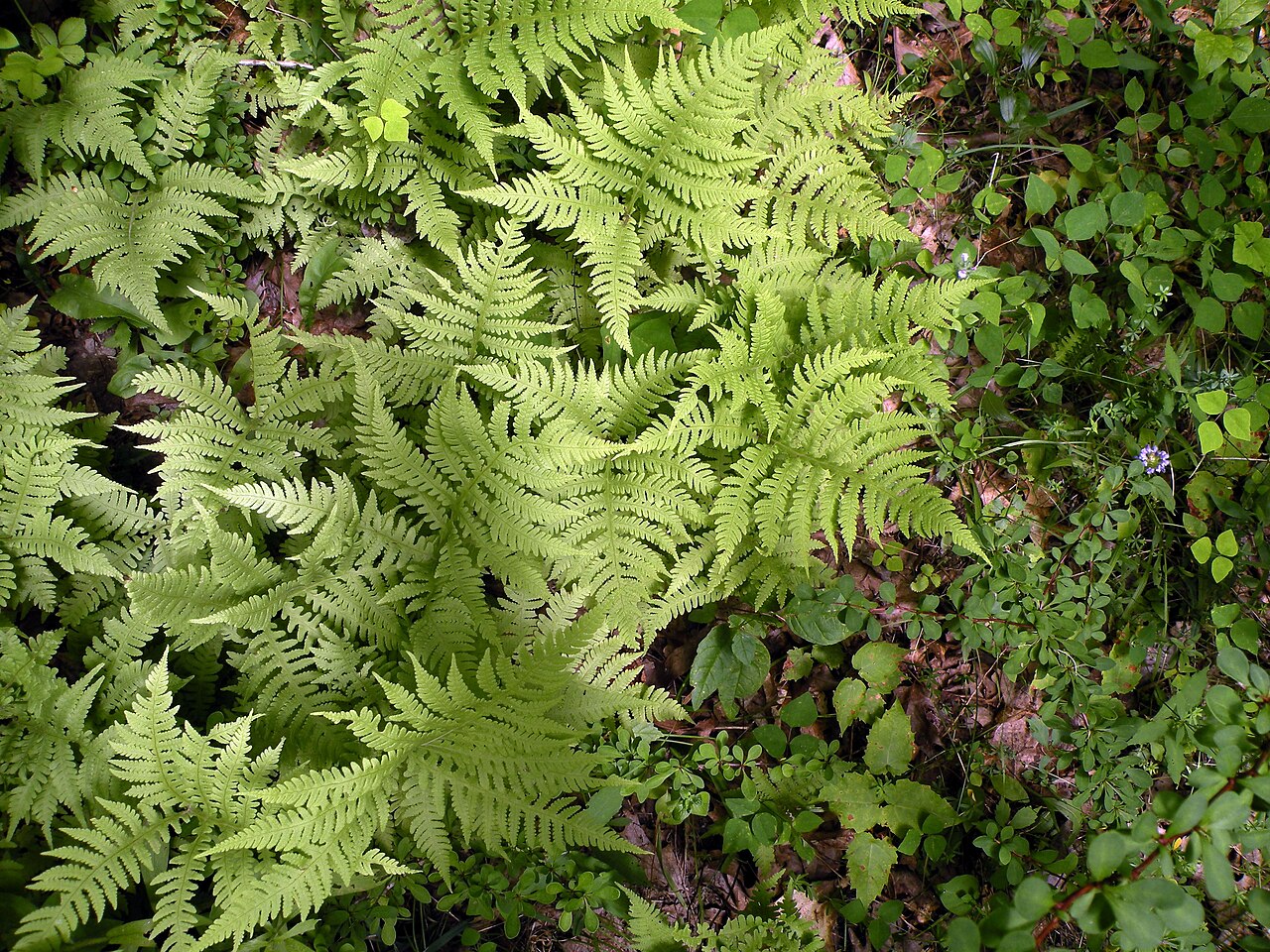
The “broad” in its common name refers to its triangular, wide-based frond, and the species name hexagonoptera — roughly “six-angled wing” — describes the narrow green wing of tissue that runs continuously along the main leaf stalk (rachis) connecting the lowest pairs of leaflets, a feature that instantly separates it from the similar-looking long beech fern. In the woods, broad beech fern rarely grows as an isolated specimen; it spreads by shallow, creeping rhizomes into loose, airy colonies that carpet the ground beneath a hardwood canopy.
For a native shade garden, Broad Beech Fern is an easy, well-behaved spreader that fills in bare ground beneath trees with soft, light-green texture from spring through fall, asking only for consistent moisture and some shade in return.
Identification
Broad Beech Fern produces individual, deciduous fronds rather than dense tufted clumps, each arising singly from a slender, wide-creeping rhizome rather than from a central crown. This spreading growth habit, combined with its distinctive frond shape, makes it fairly easy to recognize once you know what to look for.
Fronds
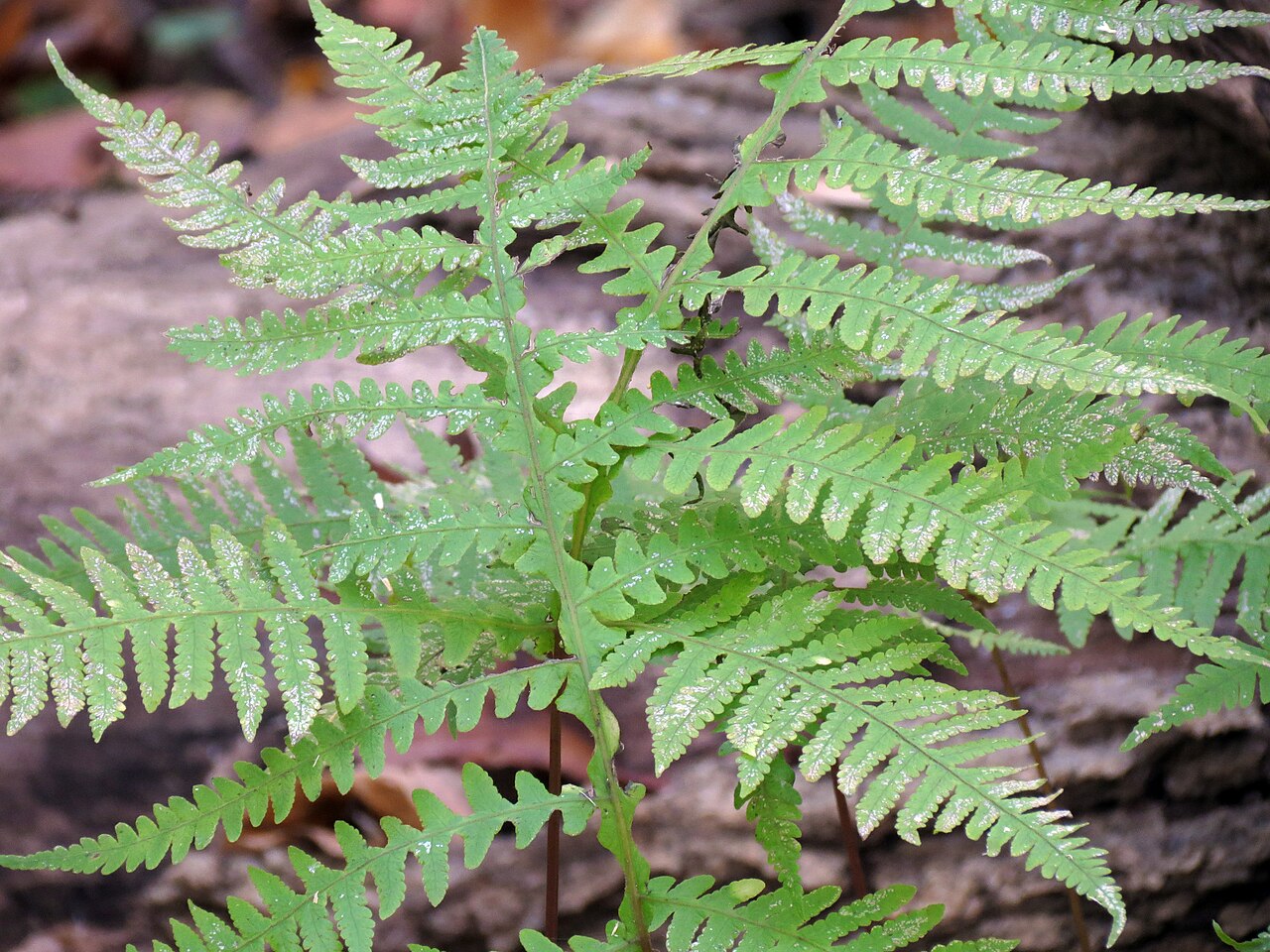
Fronds are broadly triangular, 8 to 20 inches long including the stalk, and cut twice (bipinnatifid) into narrow, blunt-tipped lobes. The lowest pair of pinnae (leaflets) is noticeably the largest, pointing somewhat forward and downward, which gives the whole frond its broad, almost arrowhead-shaped outline rather than the narrower lance shape typical of many other ferns. The frond surface is light to medium green and finely hairy, giving it a slightly soft, matte texture rather than a glossy one.
Winged Rachis
The single best identification feature is the narrow strip of green leaf tissue — a wing — that runs along the main stalk between the bases of the lowest two or three pairs of pinnae, effectively fusing them together at their bases. No other common eastern fern combines this winged rachis with the broad, triangular frond shape, making it a reliable mark even for beginners.
Spores
Spore-producing structures (sori) are small, round, and borne without the protective flap (indusium) found in many other ferns, scattered near the margins of the leaflet lobes on the frond undersides. Spores mature in mid to late summer.
Quick Facts
| Scientific Name | Phegopteris hexagonoptera (syn. Thelypteris hexagonoptera) |
| Family | Thelypteridaceae (Marsh Fern) |
| Plant Type | Deciduous, Colony-Forming Fern |
| Mature Height | 8–20 in |
| Mature Spread | Spreading indefinitely by rhizome, 2+ ft colonies |
| Growth Rate | Moderate |
| Sun Exposure | Part Shade to Full Shade |
| Water Needs | Moderate to High |
| Soil Type | Moist, humus-rich woodland soil |
| Soil pH | 5.0–6.5 (acidic to slightly acidic) |
| Bloom Time | Non-flowering (fern; spores mature mid–late summer) |
| Flower Color | None (reproduces by spores) |
| Fall Color | Fronds yellow, then die back with frost |
| Fruit | None (spore-bearing sori on frond undersides) |
| Deer Resistant | Yes |
| USDA Hardiness Zones | 3–8 |
Native Range
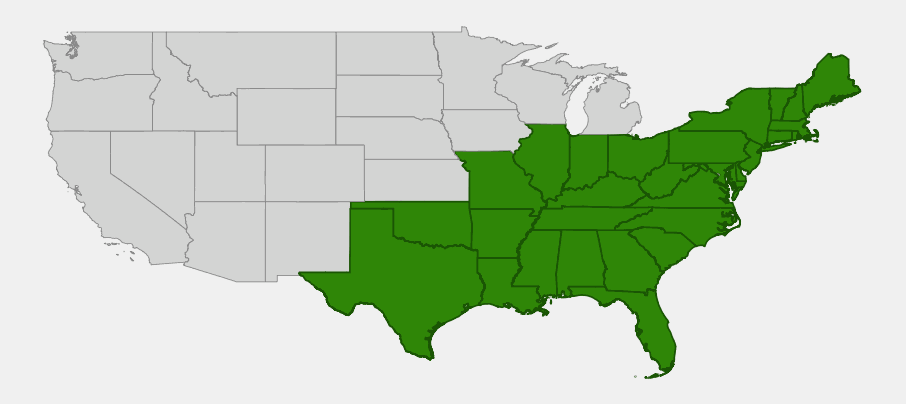
Broad Beech Fern is widespread across the eastern United States and adjacent Ontario, Canada. Its range runs from New England and New York south through the Mid-Atlantic and Appalachians to the Gulf Coast states, and west through the Ohio Valley and the Midwest as far as Illinois and Missouri, reaching into the eastern portions of Oklahoma and Texas and across Arkansas and Louisiana.
Within this broad range it is consistently a plant of rich, mesic deciduous and mixed forests rather than open ground: it favors the lower slopes and ravine bottoms of hardwood woodlands, often growing near streams, in coves, and on the moist, humus-rich soil found under beech, maple, and oak canopies. It is typically found from near sea level up to around 4,000 feet in the southern Appalachians.
Although it is common through most of its range, gardeners in the upper Midwest and far northern New England should note that reliable populations thin out toward the northern and western edges of this range, where colder winters and drier soils limit it to the most favorable, sheltered sites.
📋 Regional plant lists featuring Broad Beech Fern: New Hampshire, Maine & Vermont · Connecticut, Massachusetts & Rhode Island · New York, Pennsylvania & Northern New Jersey · Delaware, Southern New Jersey & Long Island · Maryland, Virginia & West Virginia · North Carolina & South Carolina · Georgia, Alabama & Mississippi · Arkansas, Louisiana, Eastern Oklahoma & Eastern Texas · Kentucky & Tennessee · Ohio & Indiana · Illinois, Iowa & Missouri
Growing & Care Guide
Broad Beech Fern is one of the easier native ferns to establish in a shaded garden bed, provided it gets consistent moisture and a loose, humus-rich soil to spread through. It is not a clumping specimen fern for a single accent spot — it wants room to wander.
Light
Part shade to full shade suits it best, mimicking the dappled to deep shade of a hardwood forest floor. It tolerates somewhat more light in consistently moist, cool climates, but direct afternoon sun in warmer regions will scorch the delicate fronds.
Soil & Water
Give it moist, well-drained, humus-rich soil on the acidic side, similar to the leaf-litter-covered forest floor where it naturally grows. It does not tolerate prolonged drought well — fronds will brown and collapse in dry spells — so supplemental watering during hot, dry stretches keeps colonies looking fresh. It is not a bog or standing-water plant; soil should stay moist but not waterlogged.
Planting Tips
Plant divisions or nursery starts in spring or fall, spacing them 12 to 18 inches apart if a filled-in look is wanted sooner, since the rhizomes will knit the gaps together within a couple of seasons regardless. A 2-inch layer of leaf mold or shredded leaf mulch helps retain moisture and replicates the natural litter layer it thrives in.
Pruning & Maintenance
Maintenance is minimal. Cut back or rake away the dead fronds in late fall or early spring before new growth emerges, both for tidiness and to reduce overwintering fungal spores. Because it spreads by rhizome, gardeners wanting to keep it contained should install a buried edging barrier or simply plan to pull or divide out unwanted sections each year or two.
Propagation
The easiest method is rhizome division in early spring, lifting a section of the shallow, creeping rhizome with attached roots and replanting it immediately in prepared soil. Spore propagation is possible but slow and best left to fern specialists; division gives faster, more predictable results for home gardeners.
Landscape Uses
Broad Beech Fern earns its keep in several shaded garden situations:
- Woodland ground cover beneath deciduous trees, filling in bare shaded soil
- Naturalized shade gardens paired with other eastern native ferns
- Erosion control on shaded, moist slopes and stream banks
- Understory restoration in hardwood forest plantings
- Soft textural contrast against broadleaf shade perennials like wild ginger or foamflower
Wildlife & Ecological Value
As a fern, Broad Beech Fern does not provide the nectar or fruit resources that flowering plants do, but it plays a quiet, important structural role in the understory of eastern forests.
For Pollinators
Ferns reproduce by spores rather than flowers, so Broad Beech Fern offers no nectar or pollen and does not directly attract pollinating insects. Its ecological value for insects lies instead in the moist, sheltered microhabitat its colonies create at ground level.
Birds
Ground-foraging birds such as thrushes and towhees use fern colonies like this one as cover while searching the leaf litter beneath for insects and invertebrates, and dense fern patches can offer some nesting concealment for ground-nesting species in undisturbed forest.
Mammals
Broad Beech Fern is not a preferred browse for white-tailed deer, which makes it a useful, deer-resistant ground cover in woodland gardens under heavy deer pressure — a meaningful advantage in much of its eastern range where many more palatable natives struggle to survive.
Ecosystem Role
Spreading fern colonies like Broad Beech Fern help stabilize the thin topsoil on forest slopes and ravine edges, and their fronds contribute to the leaf-litter layer that supports fungi, invertebrates, and the broader soil food web of the hardwood forest floor.
Cultural & Historical Uses
Broad Beech Fern does not have a significant documented history of Indigenous food, medicinal, or craft use compared to some larger or more conspicuous eastern ferns, and it is not known to be edible. Its chief historical significance has been botanical rather than practical: the shifting classification of the species among the genera Dryopteris, Thelypteris, and finally Phegopteris reflects more than a century of changing ideas about how ferns are related to one another, and the species is frequently cited in fern identification guides as a classic example of a diagnostic winged rachis.
In more recent decades, Broad Beech Fern has become a staple of eastern native plant horticulture, valued by woodland gardeners for its reliable spread and soft texture rather than for any historical use. It remains primarily an ecological and ornamental plant rather than one with a strong cultural tradition.
Frequently Asked Questions
How is Broad Beech Fern different from Long Beech Fern?
The two are closely related and often confused, but Broad Beech Fern has a broader, more triangular frond with the lowest pair of leaflets pointing forward and down, while Long Beech Fern (Phegopteris connectilis) has a narrower, more lance-shaped frond with the lowest pair of leaflets angled backward. Broad Beech Fern also tends to favor richer, slightly less acidic soils.
Will Broad Beech Fern take over my garden bed?
It spreads steadily by shallow rhizomes and can cover a good amount of ground over a few seasons, but it is not aggressive in the sense of smothering established shrubs or perennials. In a dedicated woodland bed this spreading habit is usually a welcome, low-maintenance ground cover rather than a problem.
Does Broad Beech Fern need acidic soil?
It prefers soil on the acidic to slightly acidic side, similar to typical hardwood forest floor conditions, but it is reasonably adaptable and will grow in near-neutral soils as long as moisture and organic matter are adequate.
Is Broad Beech Fern evergreen?
No, it is deciduous. Fronds emerge in spring, stay green through summer and into fall, then yellow and die back to the ground with the first hard frosts, re-emerging from the rhizome the following spring.
Can Broad Beech Fern grow in full sun?
Not reliably. It is adapted to the shaded forest floor, and fronds in full, direct sun — especially in warmer parts of its range — tend to scorch, yellow, and decline. Part shade to full shade gives the best results.

Looking for a nursery that carries Broad Beech Fern?
Browse our native plant nursery directory: Kentucky, Louisiana, Maine & Maryland · New Hampshire, New Jersey, New York, North Carolina & Ohio · Pennsylvania, Rhode Island, South Carolina, Texas & Virginia · Connecticut, Delaware, Florida & Georgia · Alabama & Arkansas · Illinois & Indiana · West Virginia