
Mexican Pinyon (Pinus cembroides)
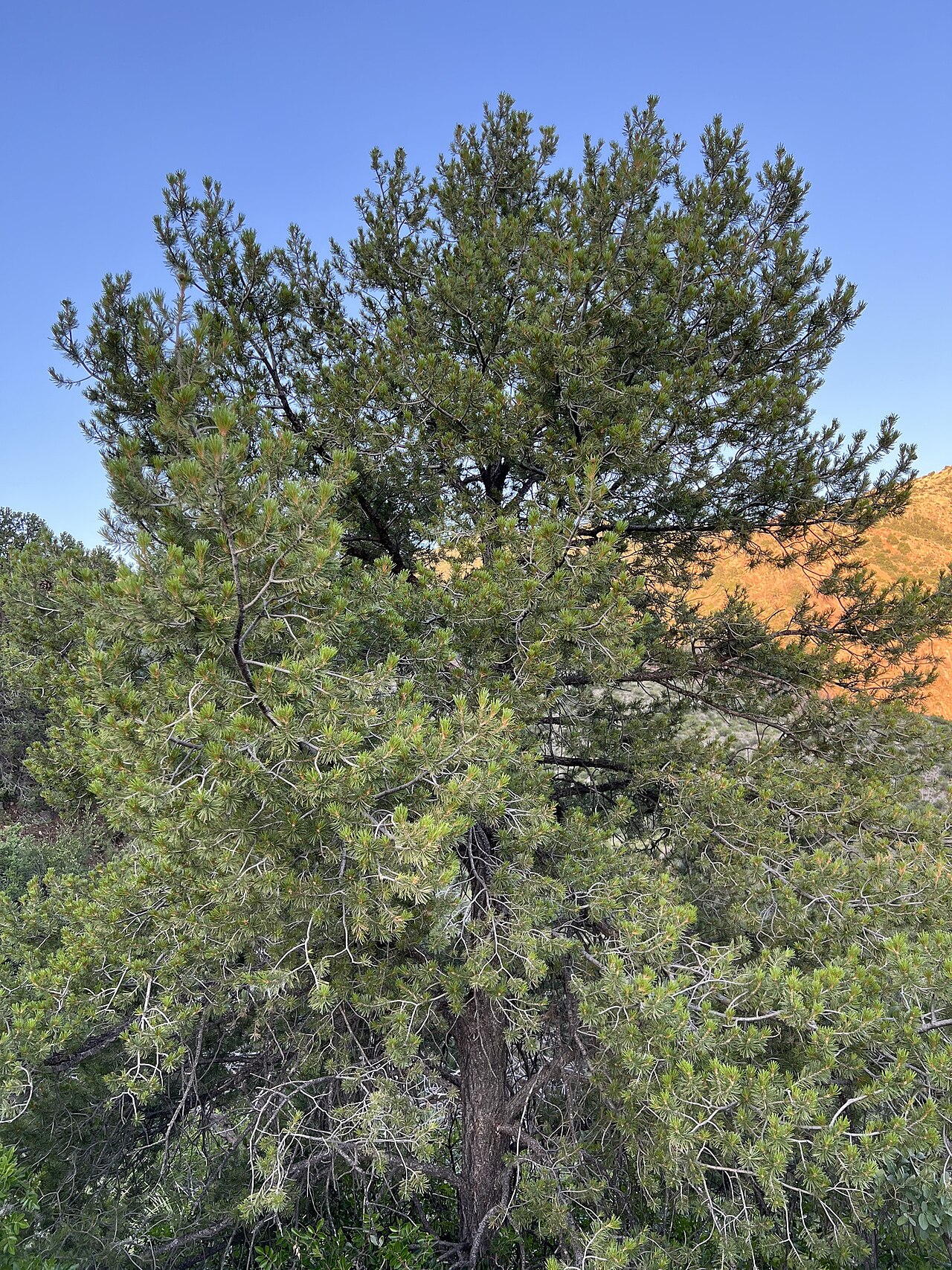
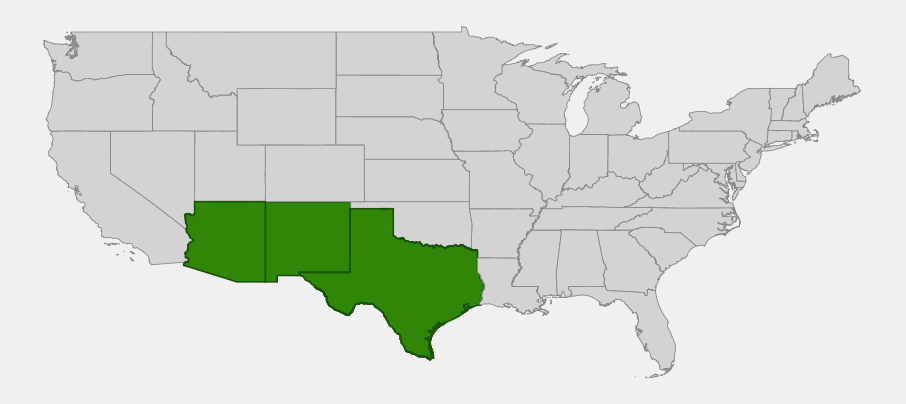
Pinus cembroides, commonly called Mexican Pinyon, is a small, rounded evergreen pine of the desert mountains along the U.S.–Mexico border. In this country it reaches the northern edge of its range in the sky-island ranges of southeastern Arizona, the bootheel ranges of southwestern New Mexico, and the Chisos and Davis Mountains of West Texas — the same high, dry country made famous by Big Bend National Park and the McDonald Observatory. South of the border it becomes far more widespread, climbing the Sierra Madre Occidental and Sierra Madre Oriental deep into central Mexico, but within the United States it stays confined to a handful of isolated mountain ranges where elevation brings enough moisture and cooler temperatures for it to survive.
Mexican Pinyon is a slow-growing, long-lived tree, typically 15 to 30 feet tall with a dense, rounded or irregular crown that often branches low and wide, sometimes closer to a large shrub than a conventional tree. Its short, slightly curved needles are usually bundled in groups of three — an identification feature that separates it from the two-needle Colorado Pinyon (Pinus edulis) and the one-needle Singleleaf Pinyon (Pinus monophylla), both of which it can grow alongside at the edges of its range. Like other pinyons, it produces an edible seed, and its nuts have been gathered for food for centuries wherever the tree grows.
In the garden, Mexican Pinyon is a tree for hot, dry, rocky sites rather than typical irrigated landscaping. It is slow to establish and slower to grow, but it is exceptionally drought-tolerant once rooted and tolerates heat, alkaline soil, and poor rocky ground that would stress most ornamental conifers. For desert gardeners in its native range who want a true native pine rather than an imported ornamental species, it is one of relatively few options.
Identification
Mexican Pinyon is most easily recognized by its small stature, dense rounded crown, and three-needle fascicles — a combination that is unusual among the pinyon pines, most of which carry one or two needles per bundle.
Bark & Stems
Young trees have smooth, gray-brown bark that becomes increasingly furrowed and scaly with age, breaking into irregular plates of reddish-brown to gray-brown bark on older trunks. Branches tend to arise low on the trunk and spread widely, giving older trees a broad, flat-topped or rounded silhouette rather than the tall, straight form typical of timber pines. Twigs are slender and often slightly resinous.
Leaves
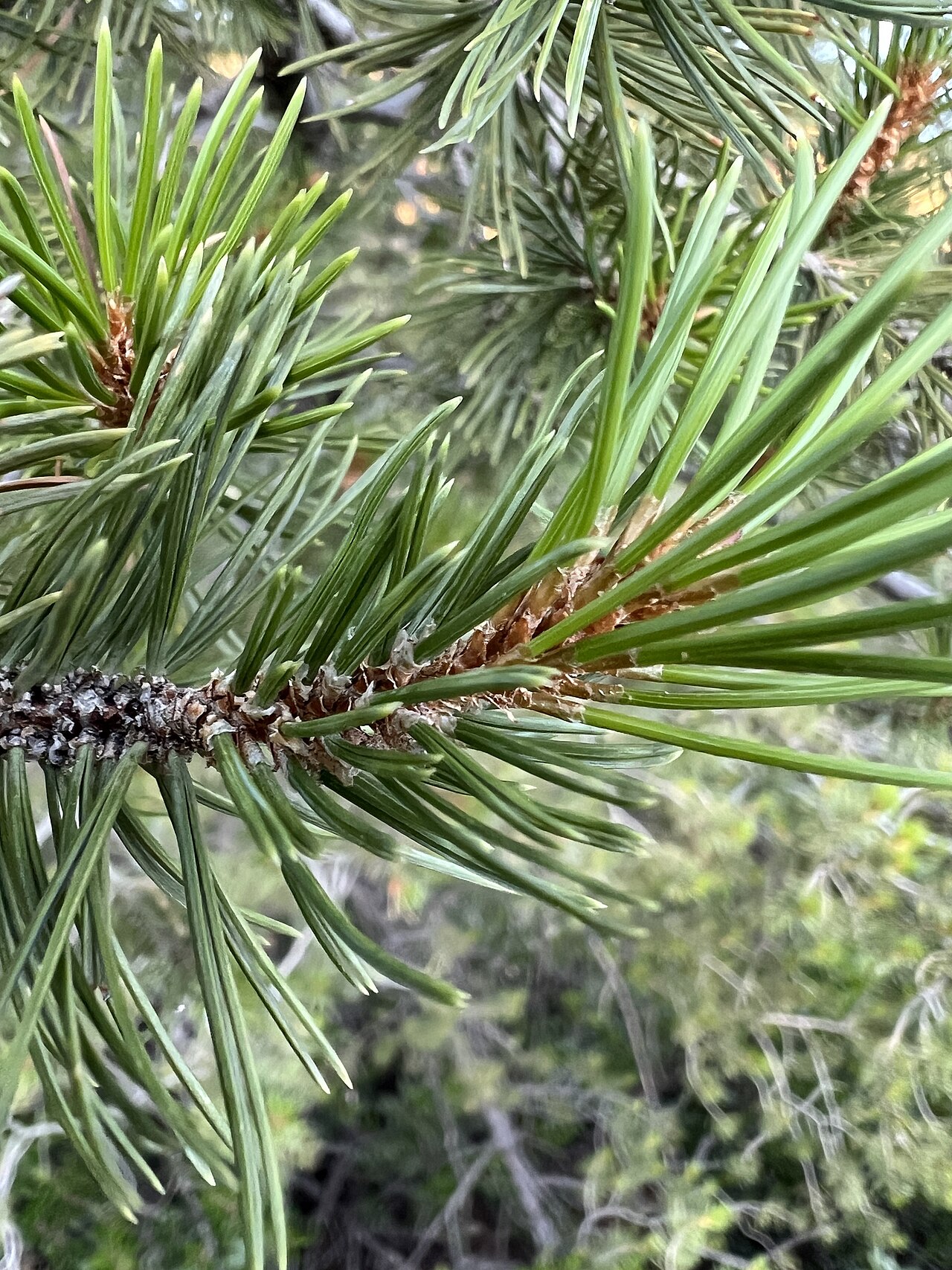
Needles are borne in fascicles of three (occasionally two), each needle 1 to 2 inches long, stiff, slightly curved, and sharply pointed, with a blue-green to yellow-green color. The needle sheath is deciduous, falling away as the needle matures, which is typical of pinyon pines generally. Needles persist on the tree for several years, giving the crown a consistently dense, tufted look at the branch tips.
Flowers & Cones
Like all pines, Mexican Pinyon is wind-pollinated, with small yellow-brown male cones releasing pollen in spring and inconspicuous female cones developing at branch tips. The seed cones are small, roughly 1 to 2 inches long, nearly round when open, with thick woody scales. They take about two years to mature, turning from green to yellow-brown to brown as the large, thin-shelled seeds inside ripen. Each cone produces relatively few but unusually large, wingless seeds — the pine nuts that give the species its economic and culinary importance.
Quick Facts
| Scientific Name | Pinus cembroides |
| Family | Pinaceae (Pine) |
| Plant Type | Evergreen Conifer Tree |
| Mature Height | 15–30 ft |
| Mature Spread | 15–25 ft |
| Growth Rate | Slow |
| Sun Exposure | Full Sun |
| Water Needs | Low |
| Soil Type | Rocky, well-drained; limestone or igneous |
| Soil pH | 6.5–8.0 (neutral to alkaline) |
| Bloom Time | Spring (pollen cones) |
| Flower Color | Yellow-brown (male cones) |
| Fall Color | None (evergreen) |
| Fruit | Small round cones with large edible seeds |
| Deer Resistant | Yes |
| USDA Hardiness Zones | 7–9 |
Native Range
In the United States, Mexican Pinyon reaches only the southern edge of its range, growing in isolated mountain ranges close to the Mexican border. It occurs in the sky-island ranges of southeastern Arizona, in scattered ranges of southwestern New Mexico, and in West Texas, where it is restricted to the Chisos Mountains of Big Bend National Park and the Davis Mountains near the McDonald Observatory. It is not found across the broader expanse of either state — only in these specific mountain woodlands at elevation.
South of the border, Mexican Pinyon becomes far more common and widespread, extending along both the Sierra Madre Occidental and Sierra Madre Oriental well into central Mexico, where it forms extensive pinyon-oak and pinyon-juniper woodlands. The U.S. populations are essentially a northern outlier of this much larger Mexican range, persisting in isolated “sky island” mountains that offer the cooler, slightly wetter conditions the species needs.
Throughout its U.S. range, Mexican Pinyon grows in open woodlands between about 4,000 and 7,000 feet in elevation, typically on rocky slopes, ridgetops, and foothills. Stands are often dense on cooler, moister north-facing slopes and more open and scattered on warmer south- and east-facing exposures, reflecting the species’ sensitivity to available moisture even within a generally arid landscape.
📋 Regional plant lists featuring Mexican Pinyon: Arizona & New Mexico
Growing & Care Guide
Mexican Pinyon is a tree for patient gardeners in hot, dry, rocky climates. It will not thrive in moist, fertile garden beds or heavily irrigated landscapes — it wants the same lean, rocky, sun-baked conditions it experiences in the wild.
Light
Mexican Pinyon needs full sun. In the wild it grows in open woodland rather than dense shade, and container or nursery-grown trees planted in partial shade will grow weak and leggy. Choose the sunniest, most exposed site available.
Soil & Water
This pine is adapted to shallow, rocky soils over limestone or igneous bedrock and tolerates alkaline pH without difficulty. Good drainage is essential — standing water or heavy clay soils that stay wet will kill the roots. Established trees need very little supplemental water and are among the more drought-tolerant conifers available for southwestern gardens; young trees benefit from occasional deep watering during their first few years while roots establish.
Planting Tips
Plant container-grown stock in fall or early spring to allow roots to establish before summer heat arrives. Because Mexican Pinyon grows slowly and resents root disturbance, choose a permanent site from the start rather than planning to transplant later. Avoid amending the planting hole with rich organic matter, which can hold excess moisture around the roots; native, unamended rocky soil is preferable.
Pruning & Maintenance
Little pruning is needed beyond removing dead or damaged branches. The tree’s naturally rounded, low-branching form is part of its character and does not need to be corrected. Because growth is so slow, heavy pruning is rarely necessary and can set a tree back for years.
Landscape Uses
Mexican Pinyon suits a specific but valuable niche in southwestern landscaping:
- Xeriscape and rock gardens where low water use is a priority
- Native specimen tree for desert mountain gardens in its home range
- Wildlife gardens — the seeds draw birds and small mammals
- Screening or windbreak in arid landscapes, given its dense rounded crown
- Low-maintenance evergreen for rocky slopes and foothill properties
Wildlife & Ecological Value
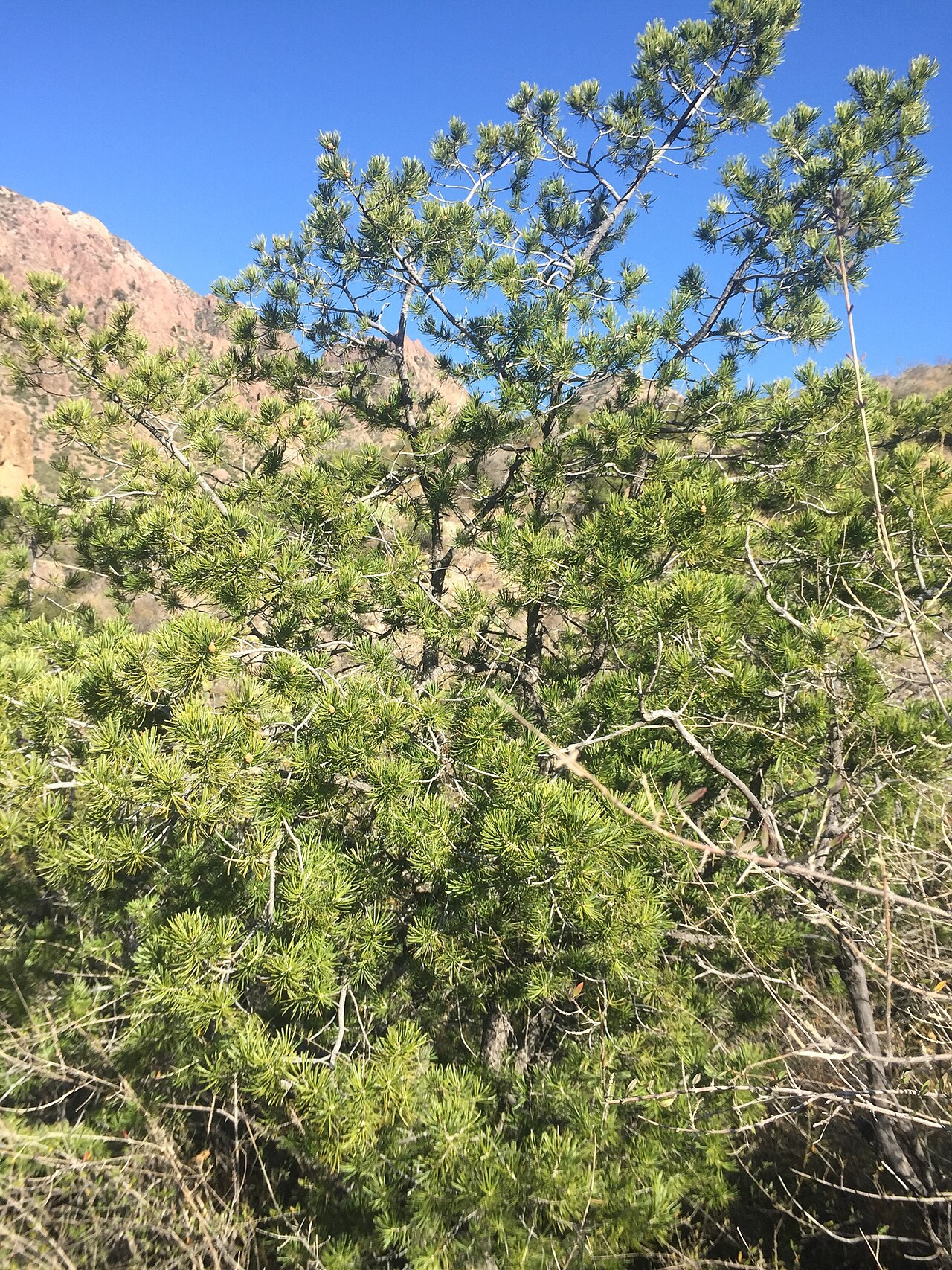
Mexican Pinyon provides year-round food and cover in the sparse, sky-island woodlands where it grows, playing a role disproportionate to its limited U.S. range.
For Birds
The large seeds are an important food source for pinyon jays, scrub jays, acorn woodpeckers, and a variety of other resident and migrant birds in the Southwest’s mountain woodlands. The dense evergreen crown also provides year-round roosting and nesting cover in otherwise open, exposed terrain.
For Mammals
Rock squirrels, pinyon mice, and other small mammals feed heavily on the seeds and help disperse them. Black bears in the sky-island ranges of Arizona and New Mexico are known to feed opportunistically on pinyon seed caches, and javelina and deer use the woodlands for browse and cover.
For Pollinators
As a wind-pollinated conifer, Mexican Pinyon does not rely on insect pollinators, but its dense branching structure and persistent needles provide shelter for insects that in turn support insect-eating birds in these dry mountain woodlands.
Ecosystem Role
Mexican Pinyon is a foundational species of Madrean pinyon-juniper-oak woodland, one of the characteristic plant communities of the sky-island mountain ranges that connect the Sierra Madre of Mexico to the Rocky Mountains of the United States. These woodlands support exceptional biodiversity, and the long-lived, slow-growing pinyons that anchor them are slow to recover from disturbance such as fire or clearing.
Cultural & Historical Uses
Mexican Pinyon seeds — large, oily, and nutritious — have been gathered as food for centuries by Indigenous peoples and later by Mexican and American settlers throughout the species’ range. The nuts were traditionally harvested from ripe cones in late summer and fall, roasted, and eaten whole or ground, much as other pinyon pine nuts have been used across the Southwest.
In Mexico, where the species is far more abundant, pine nuts from Pinus cembroides and related pinyon species have long been and remain a significant local food crop, gathered commercially in some regions and sold in local markets. The wood, while not large enough for substantial lumber, has been used locally for fuel and small construction.
In the United States, the species’ limited and isolated distribution has made it more a subject of botanical and ecological interest than of commercial use, though its pine nuts are edible and have been gathered informally by hikers and residents in the Chisos and Davis Mountains for generations.
Frequently Asked Questions
Is Mexican Pinyon the same as Colorado Pinyon?
No. Mexican Pinyon (Pinus cembroides) typically carries three needles per bundle and is restricted to isolated mountains in southeastern Arizona, southwestern New Mexico, and West Texas. Colorado Pinyon (Pinus edulis) has two needles per bundle and ranges much more broadly across the Four Corners region. The two can grow near each other at the edges of their ranges but are distinct species.
Can you eat Mexican Pinyon nuts?
Yes. Like other pinyon pines, Mexican Pinyon produces large, edible seeds that have been gathered and eaten for generations in both Mexico and the southwestern United States. They are typically harvested from ripe cones in late summer or fall and can be eaten raw or roasted.
How fast does Mexican Pinyon grow?
Very slowly. Like most pinyon pines, it may take decades to reach a modest mature size, which is part of why old trees in the wild are valued and why nursery-grown specimens are typically small and relatively expensive.
Is Mexican Pinyon cold hardy?
It is reasonably cold hardy within its native elevation range (roughly USDA zones 7–9) but is adapted to the mild winters of its mountain habitat rather than to the severe cold of higher, more northern ranges. It is not a substitute for cold-hardy pines in colder climates.
Where can I see Mexican Pinyon in the wild in the U.S.?
The most accessible U.S. populations are in Big Bend National Park’s Chisos Mountains and in the Davis Mountains near Fort Davis and the McDonald Observatory in West Texas, as well as scattered sky-island ranges in southeastern Arizona and southwestern New Mexico.

Looking for a nursery that carries Mexican Pinyon?
Browse our native plant nursery directory: Alabama to Arkansas · Nebraska to Oklahoma · Pennsylvania to Virginia