Great Basin Bristlecone Pine (Pinus longaeva)
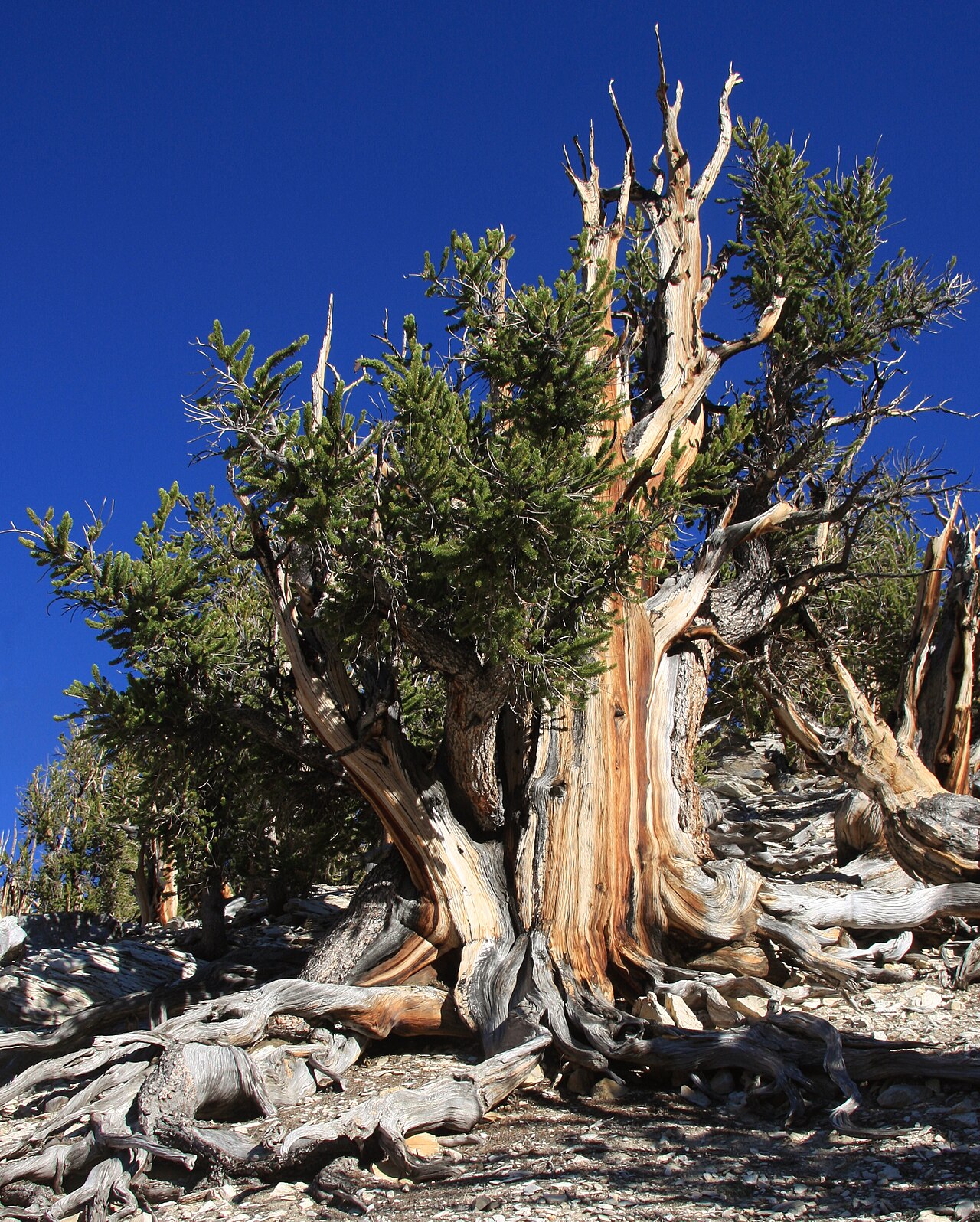
Pinus longaeva, the Great Basin Bristlecone Pine, is the longest-lived tree species known on Earth, with individuals in California’s White Mountains verified at well over 4,000 years old. It grows at the harsh upper edge of tree line, typically between about 9,500 and 11,500 feet, in a narrow band of high mountain ranges in eastern California, Nevada, and southwestern Utah. Its extreme age comes from extreme adversity: short growing seasons, thin dolomite or limestone soils, punishing wind, and bitter winters produce wood so dense and resin-rich that the tree grows only a hair’s breadth each year, resisting rot, insects, and fire for millennia.
This is a distinct species from the Rocky Mountain Bristlecone Pine (Pinus aristata), a related but separate tree of Colorado, New Mexico, and Arizona. The two are often confused because both share the name “bristlecone pine” and the same distinctive five-needle clusters with tiny white resin flecks, but their native ranges do not overlap, and botanists have treated them as separate species since the 1970s. If you are gardening or restoring habitat anywhere east of Utah, the plant you want is almost certainly Rocky Mountain Bristlecone Pine, not this one.
Great Basin Bristlecone Pine is essentially never planted as a conventional landscape tree — it grows too slowly and is too specifically adapted to harsh alpine conditions to make sense in most gardens. Its real value is ecological, scientific, and symbolic: as a living record of millennia of climate history, a keystone species of the highest timberline woodlands in the Great Basin, and one of the most recognizable ancient organisms on the planet. Many groves, including the oldest known individuals, are protected, and the exact location and identity of the single oldest living tree are kept confidential to protect it from damage.
Identification
Great Basin Bristlecone Pine is most easily recognized by its combination of five-needle fascicles densely packed along the twig (“bottlebrush” foliage), weathered, often partly dead trunks, and small cones armed with long, needle-like bristles on each scale.
Bark & Stems
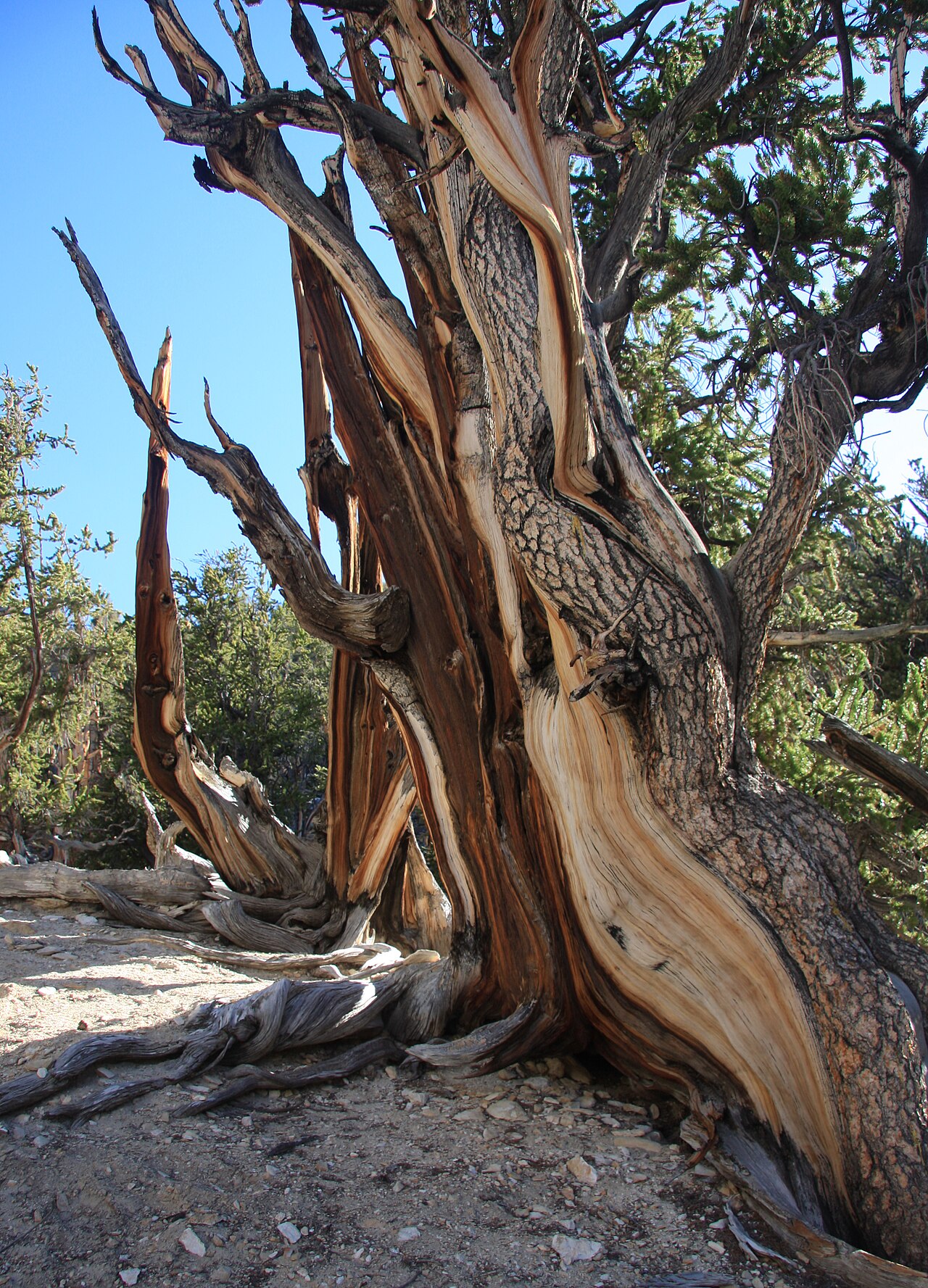
Young trees have smooth, gray bark, but with age the bark and wood become deeply furrowed, twisted, and sculptural, often with long strips of living bark (sometimes just a single narrow strip) connecting roots to a crown of green foliage, while the rest of the trunk is bare, sun-bleached deadwood. This partial dieback is a normal survival strategy, not disease — it lets the tree reduce its living tissue to only what it can support in extreme conditions, which is a major reason individual trees live so long.
Leaves
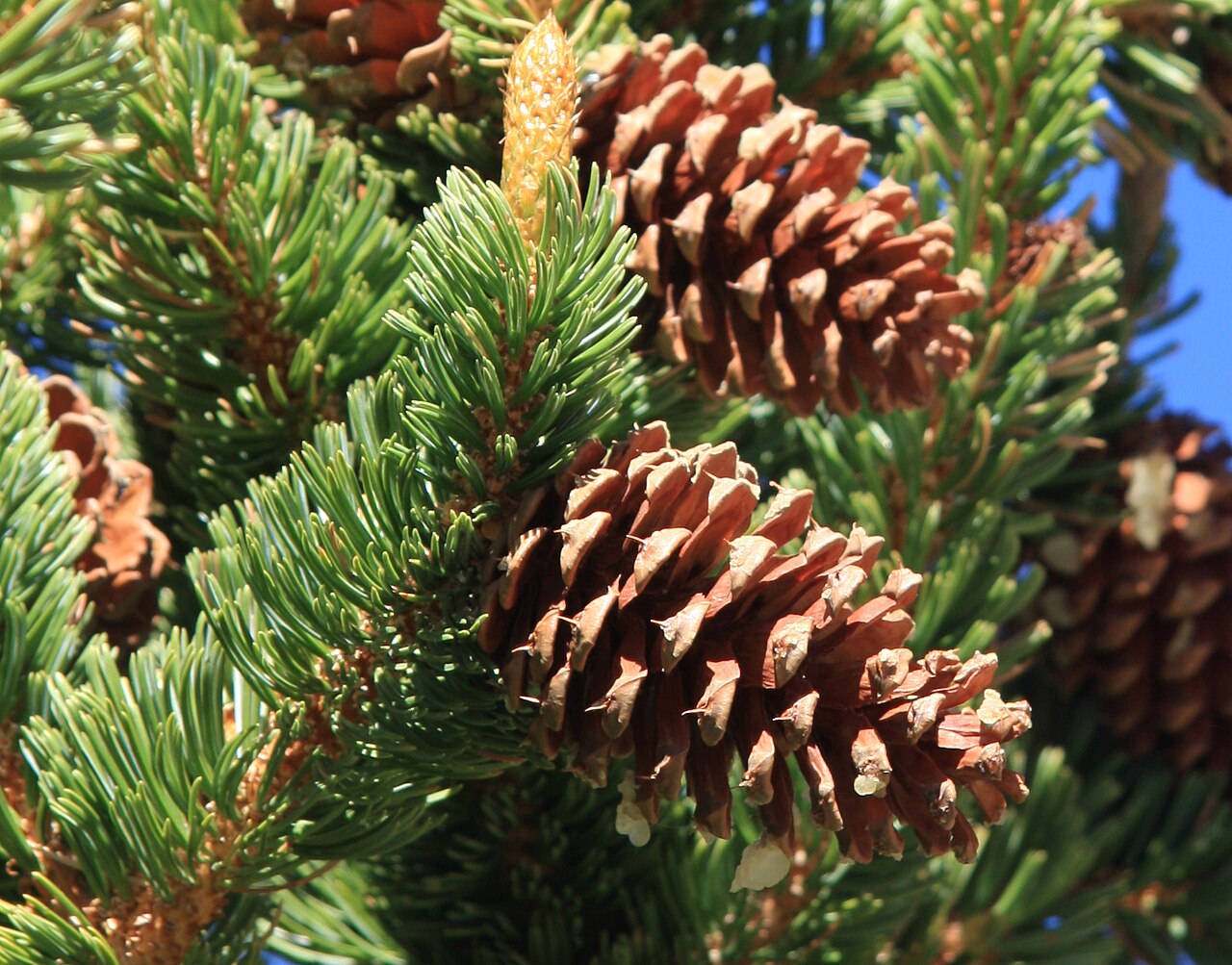
Needles grow in fascicles of five, each needle 1 to 1.5 inches long, dark green, and densely clustered along the stem for 8 to 10 years or more, giving branches a thick, bottlebrush-like appearance unlike the more open needle arrangement of most pines. Tiny white dots of resin are often visible on the needle surfaces.
Flowers & Cones
Like other pines, Great Basin Bristlecone Pine is wind-pollinated, with small reddish-purple male cones releasing pollen in early summer. Seed cones are small, 2.5 to 3.5 inches long, cylindrical, and purple-brown when young, ripening to a lighter brown. Each cone scale bears a slender, incurved bristle up to a quarter-inch long — the feature that gives bristlecone pines their name and distinguishes mature cones at a glance from the pinyon pines they sometimes grow alongside.
Quick Facts
| Scientific Name | Pinus longaeva |
| Family | Pinaceae (Pine) |
| Plant Type | Evergreen Conifer Tree |
| Mature Height | 15–30 ft (occasionally taller in sheltered sites) |
| Mature Spread | 15–25 ft |
| Growth Rate | Extremely slow |
| Sun Exposure | Full Sun |
| Water Needs | Low |
| Soil Type | Thin, rocky; dolomite or limestone preferred |
| Soil pH | 7.0–8.5 (neutral to alkaline) |
| Bloom Time | Early summer (pollen cones) |
| Flower Color | Reddish-purple (male cones) |
| Fall Color | None (evergreen) |
| Fruit | Small cones with bristle-tipped scales |
| Deer Resistant | Yes |
| USDA Hardiness Zones | 3–7 |
Native Range
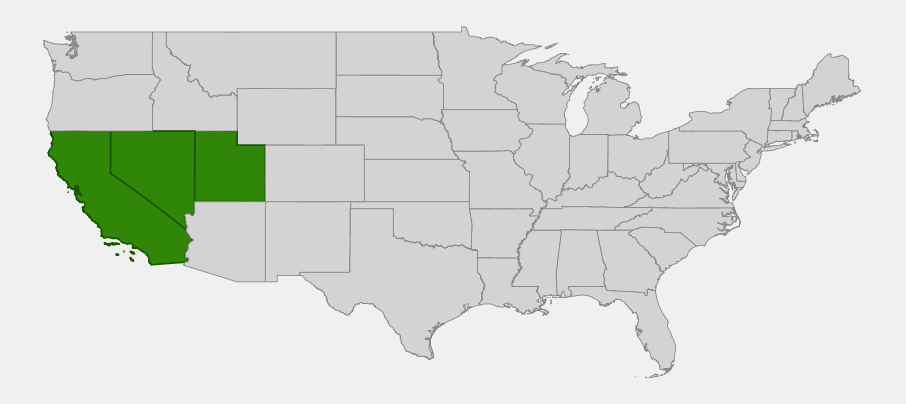
Great Basin Bristlecone Pine occupies a narrow, scattered range of high mountain ranges in the Great Basin region: the White and Inyo Mountains and a few other ranges of eastern California, numerous isolated ranges across central and eastern Nevada, and the high plateaus and ranges of southwestern Utah. It does not occur in Colorado, New Mexico, Arizona, or Wyoming — those states are instead home to the related but separate Rocky Mountain Bristlecone Pine (Pinus aristata).
Within this range, the species is confined to the highest, harshest timberline zones, typically between about 9,500 and 11,500 feet, often on exposed ridges and slopes with thin, rocky, dolomitic soils that support little other vegetation. The famous “Ancient Bristlecone Pine Forest” in the White Mountains, including the Schulman and Patriarch Groves, and sites in the Spring Mountains and Snake Range of Nevada are among its best-known and most accessible stands.
The species’ extreme longevity and tight habitat requirements make its native groves ecologically and scientifically irreplaceable. Many of the oldest known individuals are in federally protected areas such as Inyo National Forest and Great Basin National Park, and visitors are asked to stay on trails and never remove wood, cones, or bark — a single cut can expose centuries of dense, slow-grown wood to decay in a way the tree may never recover from.
📋 Regional plant lists featuring Great Basin Bristlecone Pine: Utah & Western Colorado
Growing & Care Guide
Great Basin Bristlecone Pine is rarely planted outside botanical collections, arboreta, and specialty high-elevation gardens. It is not well suited to typical home landscapes at lower elevations, where summer heat, humidity, and richer soils run contrary to everything the species has adapted to over thousands of years. Gardeners within its native elevation range who want to try growing one should understand it as a multi-generational project, not a quick landscape addition.
Light
Full sun is essential; this is a tree of open, exposed alpine ridgelines with no tolerance for shade.
Soil & Water
Thin, rocky, alkaline soil with excellent drainage is critical — the species is specifically adapted to nutrient-poor dolomitic substrates and performs poorly in rich, well-watered garden soil, where it is prone to root problems and excessive, weak growth. Water needs are low once established; the tree is built to survive on whatever moisture its harsh native sites provide.
Planting Tips
This species should only be attempted at higher elevations with cold winters and short, cool growing seasons similar to its native range. Container-grown nursery stock, where available, should be planted in lean, rocky, unamended soil. Growth will be extremely slow from the outset — this is normal and not a sign of a struggling tree.
Pruning & Maintenance
Little to no pruning is needed. The gnarled, partly dead form that develops with age is a natural and desirable characteristic, not something to correct. Avoid wounding the bark or removing deadwood, since the tree’s partial dieback is part of how it survives for millennia.
Landscape Uses
Because of its extreme slow growth and specific needs, Great Basin Bristlecone Pine is used in only a few landscape contexts:
- Botanical and arboretum collections at appropriate high-elevation sites
- Bonsai, where its naturally twisted, ancient-looking form is prized
- High-elevation native plantings within or near its natural range
- Educational and interpretive plantings highlighting extreme longevity
Wildlife & Ecological Value
Great Basin Bristlecone Pine anchors one of the most extreme and specialized plant communities in North America, the high-elevation timberline woodlands of the Great Basin.
For Birds
Clark’s nutcrackers are especially important associates, feeding on and caching the seeds of bristlecone and limber pines at these elevations; some cached seeds are never retrieved and go on to germinate, helping the species colonize new sites. Mountain chickadees and other high-elevation birds also use the dense foliage for cover.
For Mammals
Golden-mantled ground squirrels and chipmunks feed on the seeds, and mule deer may use the open subalpine woodlands for summer range. Wildlife use of these sparse, high-elevation stands is limited compared to lower-elevation forests, simply because so little else grows there.
For Pollinators
As a wind-pollinated conifer, the species does not depend on insect pollinators, though its foliage provides shelter for insects at these harsh elevations.
Ecosystem Role
Beyond its direct ecological role, Great Basin Bristlecone Pine is scientifically invaluable: because its growth rings respond so precisely to annual climate conditions and some trees preserve wood records spanning thousands of years, dendrochronologists have used bristlecone pine ring sequences to build some of the longest continuous climate records on Earth, extending and calibrating radiocarbon dating well beyond what written records can reach.
Cultural & Historical Uses
Great Basin Bristlecone Pine has no significant history of harvest or consumptive use — its value has always been more scientific and symbolic than practical. The species was only formally distinguished from Rocky Mountain Bristlecone Pine in 1970, when botanist Dana K. Bailey described it as a separate species based on differences in cone, needle, and growth characteristics.
The species gained wide public attention in the mid-20th century as researchers, including Edmund Schulman, used increment cores to document individual trees far older than any other known living organism, with some exceeding 4,000 years. This discovery transformed bristlecone pines into subjects of major scientific interest in dendrochronology and climate science, and groves such as the Schulman Grove in the White Mountains were later protected and named in his honor.
Today, Great Basin Bristlecone Pine is primarily significant as a conservation and scientific resource rather than a horticultural or economic one. Because individual ancient trees can be damaged or killed by cutting, carving, or even repeated foot traffic around their shallow root systems, visitors to groves such as those in the Ancient Bristlecone Pine Forest and Great Basin National Park are asked to stay on designated trails and never remove any part of the tree.
Frequently Asked Questions
Is Great Basin Bristlecone Pine the same as Rocky Mountain Bristlecone Pine?
No. They are closely related but separate species. Great Basin Bristlecone Pine (Pinus longaeva) grows in California, Nevada, and Utah; Rocky Mountain Bristlecone Pine (Pinus aristata) grows in Colorado, New Mexico, and Arizona. Their ranges do not overlap, and they were only recognized as separate species in 1970.
How old can a Great Basin Bristlecone Pine get?
Verified ages exceed 4,000 years, making this the longest-lived known tree species on Earth. The location of the single oldest confirmed living individual is kept confidential to protect it from damage.
Can I plant Great Basin Bristlecone Pine in my yard?
It can be grown outside its native range in appropriate climates, typically in botanical collections or by specialist growers at higher, cooler elevations, but it is not a practical choice for typical home landscaping because of its extremely slow growth and very specific soil and climate requirements.
Is it legal to collect cones, wood, or bark from bristlecone pines?
No. Ancient bristlecone pines on public land are protected, and removing any part of a living or dead tree — cones, wood, or bark — is prohibited and can seriously damage trees that took millennia to grow. Admire and photograph these trees, but never collect from them.
Why do old bristlecone pines look half-dead?
The gnarled, partly bare wood on ancient trees is a survival strategy, not disease. Trees reduce living tissue to a narrow strip of bark connecting roots to a small crown of foliage, allowing them to support only as much growth as scarce resources allow — a key reason they can survive for thousands of years.

Looking for a nursery that carries native high-elevation conifers?
Browse our native plant nursery directory: California · Nevada · Utah