
Tobosa (Pleuraphis mutica)
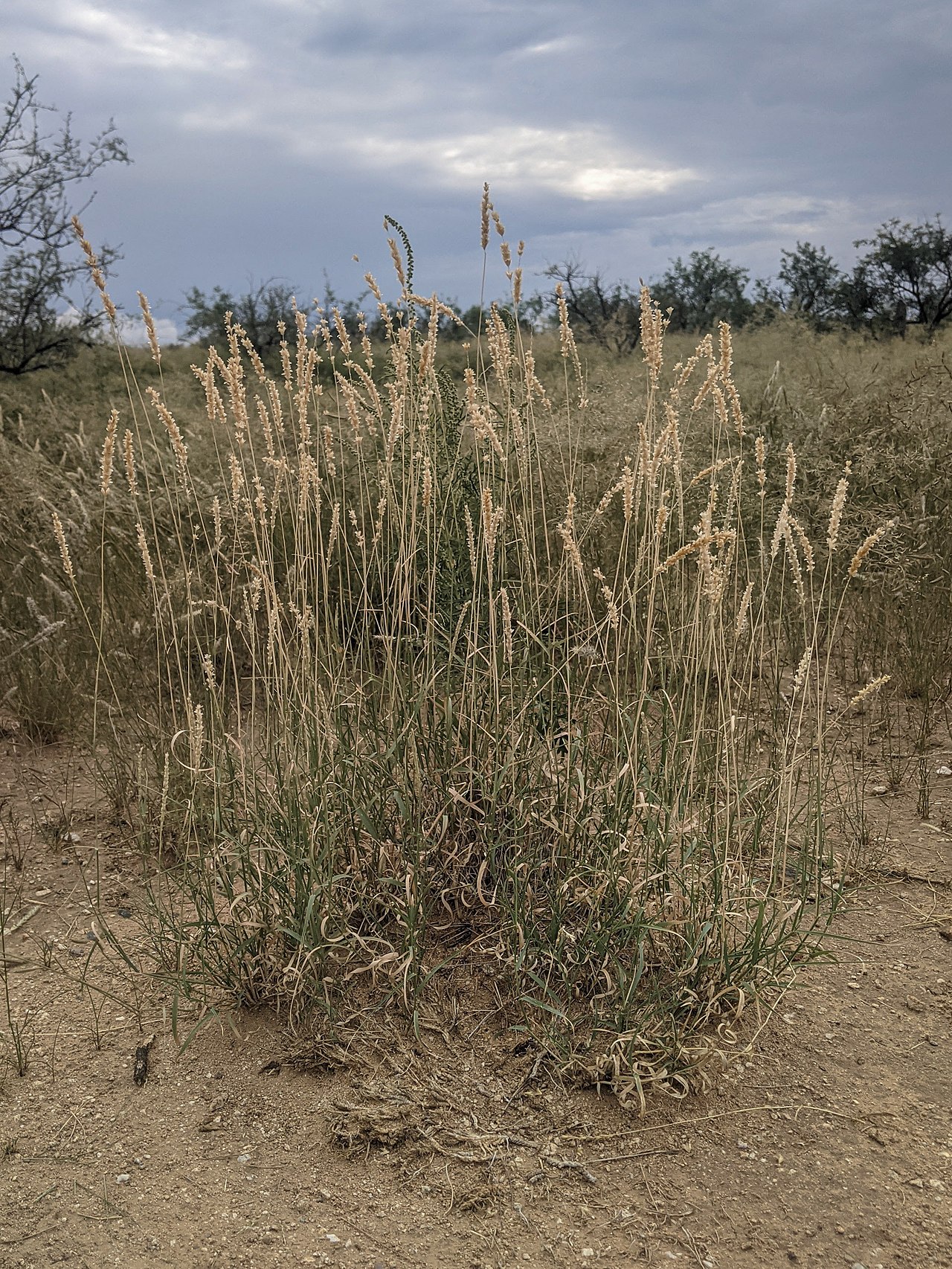
Pleuraphis mutica (also published as Hilaria mutica, and sometimes still sold under that older name), commonly called Tobosa or tobosagrass, is a tough, sod-forming perennial grass of the semidesert grasslands of the American Southwest. It belongs to the Poaceae, or grass family, in the warm-season Chloridoideae subfamily, the same group that includes gramas and buffalograss. Tobosa is less a garden ornamental than a working-landscape grass: it is one of the most important native forage and erosion-control grasses on the clay flats and swales of Arizona, New Mexico, Oklahoma, and Texas, prized for persisting through drought long after showier grasses have gone dormant.
What sets Tobosa apart is its relationship with water. It thrives on heavy clay soils that pond water for a few days after a summer thunderstorm and then bake hard and dry for weeks afterward — conditions that would kill many other grasses. Thick, wiry rhizomes anchor the plant and let it spread into dense, uniform sod, while a deep, far-reaching root system taps moisture most neighboring plants cannot reach. The result is a grass that looks unassuming most of the year, tan and wiry, but that explodes into pale, bristly seed clusters after rain and that cattle and horses seek out as a drought-season lifeline.
In a home landscape, Tobosa is a specialist’s plant: it is not showy, and it is slow to establish from seed because viable seed is uncommon — the species spreads mainly by rhizome. But for restoration plantings, erosion control on clay drainage swales, and naturalistic xeric landscapes in its native range, it has few equals for toughness. It is best reserved for large, sunny, low-input areas rather than foundation plantings or small beds.
Identification
Tobosa is a rhizomatous, sod-forming perennial bunchgrass that typically reaches 1 to 2 feet (30–60 cm) tall, occasionally to 3 feet (90 cm) in wetter years. The stems have bent, trailing bases that root where they touch moist soil, with stiffly upright flowering tops.
Stems & Growth Habit
Thick, woody rhizomes creep just below the soil surface, knitting individual tufts into a continuous sod over time. A deep, coarse root system can extend 5 to 6 feet (1.5–1.8 m) into the soil profile, which is the main reason Tobosa survives drought that kills shallower-rooted grasses. Stem bases are decumbent (lying flat before turning upward), giving older clumps a somewhat sprawling, matted look at the center.
Leaves
Leaves are mostly basal, stiff, hairless, and up to about 6 inches (15 cm) long, rolling inward (involute) in dry weather to reduce water loss — a classic drought adaptation. Foliage is gray-green when actively growing and fades to straw-tan through the dry season and winter dormancy.
Flowers & Seedheads
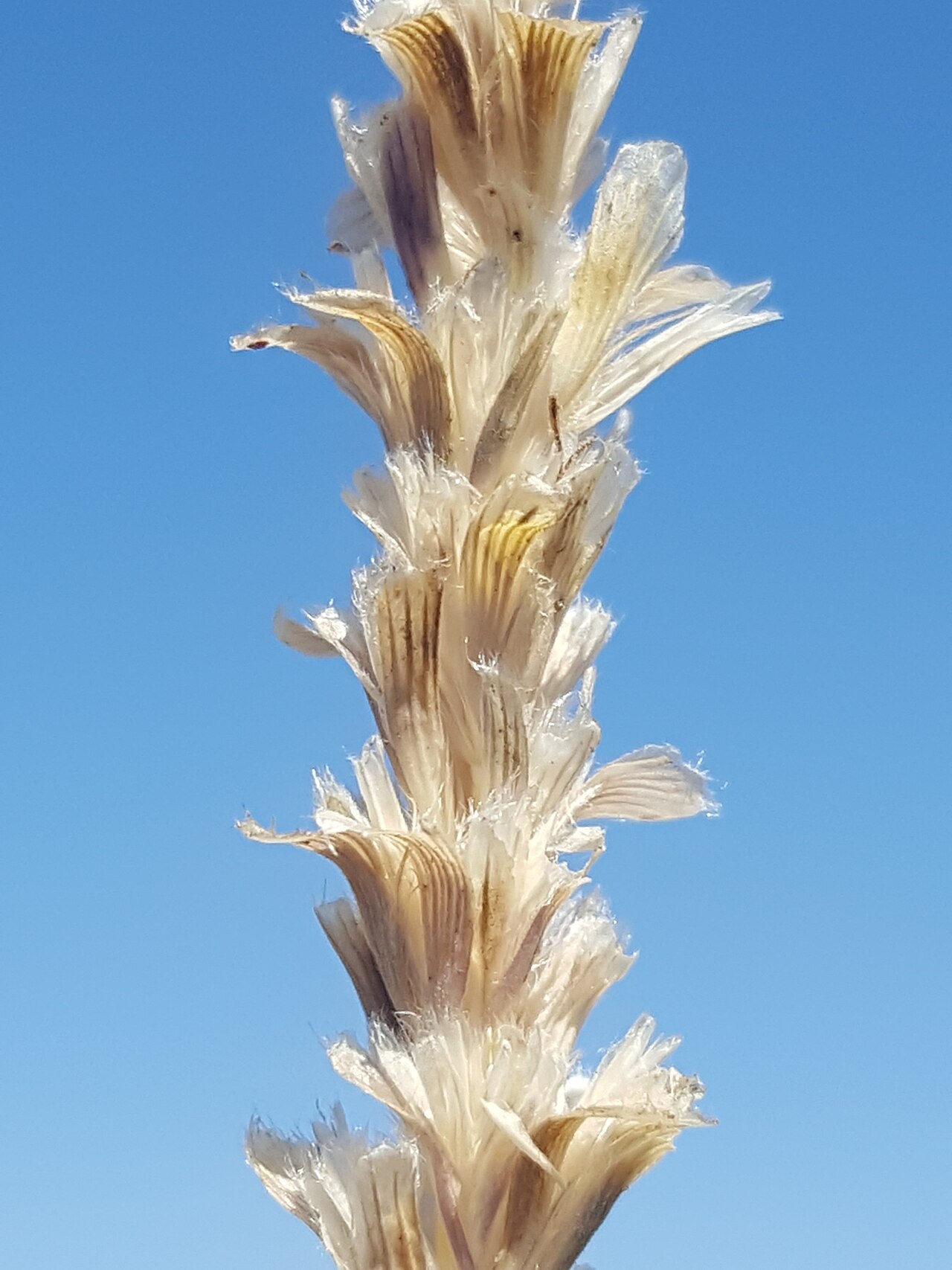
The flowering stalks carry a dense, bristly spike a few inches long, with spikelets clustered in groups of three, the central spikelet perfect and the two side spikelets staminate. Fresh seedheads range from white to straw-colored to faintly purplish, maturing into the shaggy, papery, cream-colored heads that give dried stands their distinctive look late in the season. Tobosa flowers mainly in response to summer rainfall rather than on a fixed calendar, and it only rarely sets viable seed — most expansion happens vegetatively through the rhizomes.
Quick Facts
| Scientific Name | Pleuraphis mutica (syn. Hilaria mutica) |
| Family | Poaceae (Grass) |
| Plant Type | Perennial, rhizomatous, sod-forming grass |
| Mature Height | 1–2 ft (30–60 cm), to 3 ft (90 cm) |
| Mature Spread | Indefinite; spreads by rhizome into continuous sod |
| Growth Rate | Slow to establish, moderate once rooted |
| Sun Exposure | Full sun |
| Water Needs | Low once established; tolerates brief flooding |
| Soil Type | Heavy clay, clay loam; tolerates compaction |
| Soil pH | Neutral to alkaline, 7.0–8.5 |
| Bloom Time | Summer, following rainfall |
| Flower Color | White to straw to pale purplish |
| Fall Color | Tan/straw as foliage cures |
| Fruit | Small grain (caryopsis); viable seed uncommon |
| Deer Resistant | Yes (grazed mainly by livestock, not deer) |
| USDA Hardiness Zones | 7–10 |
Native Range
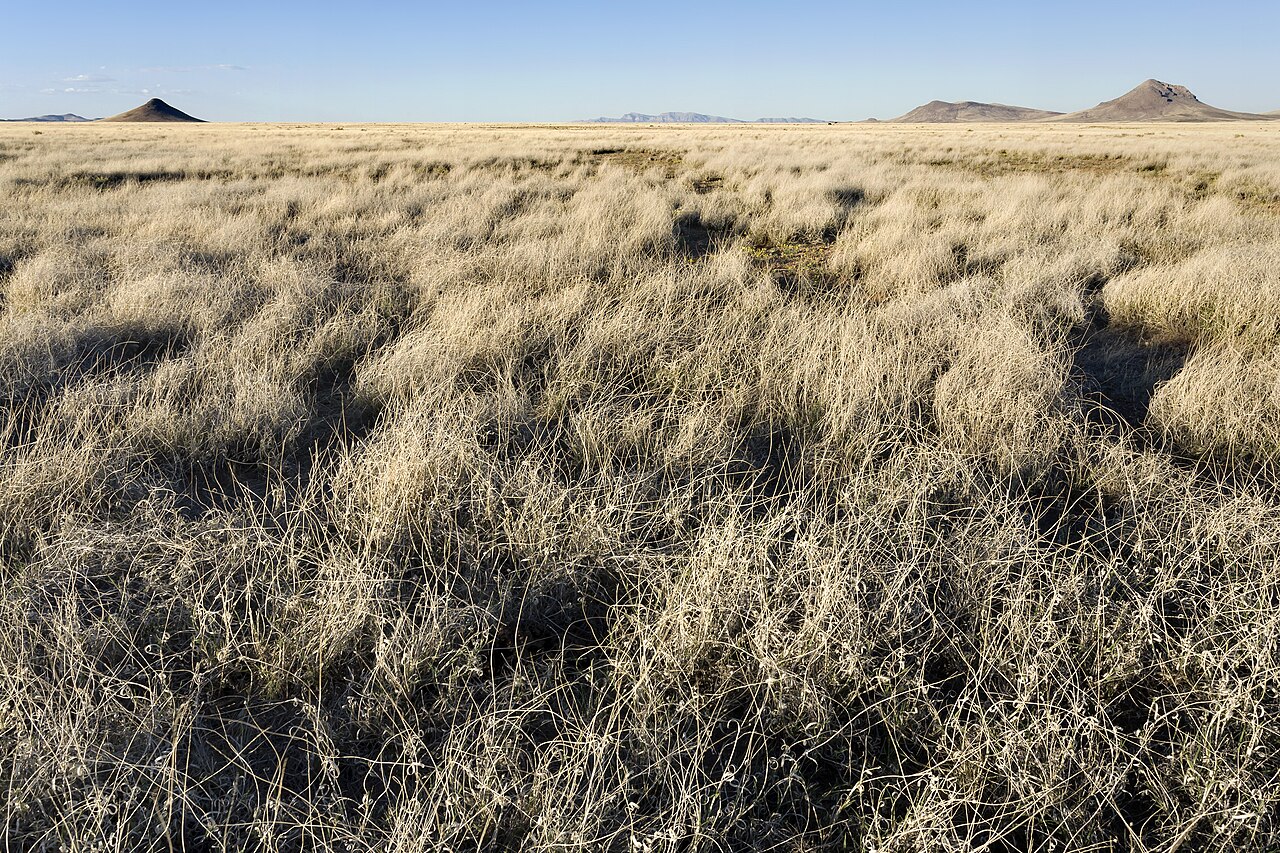
Tobosa is native to the semidesert grasslands of the southwestern United States and northern Mexico. In the United States it occurs across southern and central Arizona, most of New Mexico, the Oklahoma Panhandle, and central and western Texas, typically between about 2,500 and 6,000 feet (760–1,800 m) in elevation. It is one of the dominant grasses of the Chihuahuan and southern Sonoran desert grasslands, where it often forms nearly pure stands on flats that collect runoff.
Across this range, Tobosa is closely tied to heavy-textured bottomland and swale soils rather than rocky slopes or sandy uplands. It is a climax species on frequently flooded lowlands that pond briefly after storms and then dry out, but it also persists on drier upland clay sites, in habitats ranging from pinyon-juniper woodland margins to mesquite, creosote, and grassy shrub-steppe. It is notably absent from the eastern, more humid portions of Texas and Oklahoma, where heavier rainfall and different soils favor other grasses.
Tobosa is not cultivated or sold as an ornamental to any significant degree; where it is planted at all, it is for rangeland restoration, erosion control on clay drainages, and native-grass pasture improvement within its own native region. Gardeners outside the Southwest should not expect to find it in general nursery trade, and it is not suited to regions with regular summer humidity or acidic, well-drained soils.
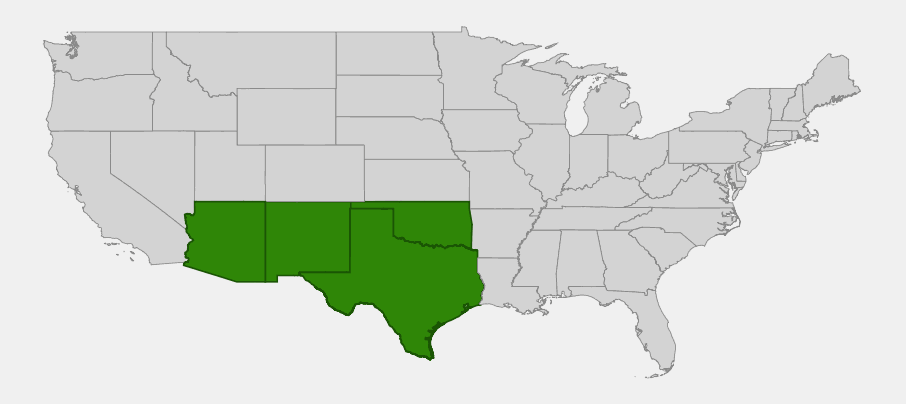
📋 Regional plant lists featuring Tobosa: Arizona & New Mexico
Growing & Care Guide
Tobosa is not a plant for ordinary garden beds; it is a rangeland and restoration grass suited to large, sunny, clay-soil sites within its native Southwest. Where the conditions fit, it needs almost no attention once established — the challenge is usually getting it established in the first place.
Light
Tobosa needs full sun. It is a plant of open grassland and does not tolerate shade from trees, shrubs, or taller competing grasses.
Soil & Water
This grass is built for heavy clay and clay-loam soils that are neutral to alkaline, including sites that pond water for a day or two after a storm before drying out completely. It does not need supplemental irrigation once established and is one of the most drought-persistent grasses in its range, but it also does not perform well on light, sandy, or acidic soils, where other native grasses are a better fit. Avoid sites with constant moisture or poor drainage over the long term; Tobosa wants wet-then-dry cycles, not permanently soggy ground.
Planting Tips
Because Tobosa rarely produces viable seed, most restoration and revegetation work uses transplanted sod plugs or rhizome divisions rather than seeding. If sowing seed is unavoidable, expect low and slow germination. Plant in spring after the threat of hard frost has passed, so new plants have a full growing season to root before winter. Space plugs or divisions 12 to 18 inches apart if the goal is a closed sod within a few years; wider spacing will fill in more slowly.
Pruning & Maintenance
Established Tobosa needs little maintenance. Periodic prescribed burning or mowing to remove old, dead thatch can stimulate fresh growth, a technique long used on Tobosa rangeland in Texas to keep stands productive. Avoid heavy grazing or mowing during active summer growth, since this reduces the plant’s ability to recover before the next dry spell.
Propagation
Propagate by dividing rhizome sections from an established stand and transplanting them into prepared clay soil, watering them in well for the first season until roots are established. Seed propagation is possible but unreliable given the species’ low seed viability.
Landscape Uses
- Erosion control on clay swales, drainage bottoms, and disturbed rangeland
- Native pasture and forage restoration in the Southwest
- Naturalistic xeric landscaping on heavy clay sites within its native range
- Wildlife habitat in large-scale grassland restoration projects
Wildlife & Ecological Value
Tobosa’s greatest ecological value lies in rangeland forage and soil stabilization rather than ornamental wildlife gardening appeal.
For Livestock & Large Herbivores
Tobosa is one of the most important native forage grasses for cattle and horses across its range. It is especially valuable during drought, since it stays productive and holds its nutritional value after many other grasses have died back or gone fully dormant. Fresh, actively growing Tobosa is palatable and nutritious; it becomes rougher and less palatable as it matures and cures.
For Birds & Small Wildlife
Dense Tobosa sod provides ground-level cover for small mammals and ground-nesting birds in otherwise open desert grassland, and its seed, though not abundant, supplements the diet of seed-eating birds and rodents in the surrounding grassland community.
Ecosystem Role
As a climax dominant on clay-flat grasslands, Tobosa plays an outsized role in stabilizing soil that would otherwise be prone to erosion and crusting under the region’s intense, infrequent rainstorms. Its deep root system and rhizome network bind heavy clay soils, slow runoff, and help the grassland recover after fire or drought. Periodic fire historically maintained open Tobosa grassland by checking the encroachment of mesquite and other woody shrubs.
Cultural & Historical Uses
Tobosa has long been valued in the ranching communities of the Southwest primarily as a working forage grass rather than as a plant of ceremonial or culinary use. Ranchers in Texas and New Mexico have relied on Tobosa flats for generations as a dependable, if rough, source of grazing and hay during drought years when other forage failed.
Historically, Tobosa could be cut for hay while still green, yielding roughly 1,000 pounds per acre in parts of Texas under careful management. In areas with adequate rainfall, ranchers used controlled burning to remove accumulated dead litter, which stimulated the grass to put out fresh green growth more palatable to livestock — a practice still used in rangeland management today.
One caution tied to its use as forage: Tobosa, like many grasses, is susceptible to ergot, a fungal infection of the seedhead that can cause ergot poisoning in livestock that graze heavily infested stands. Ranchers managing Tobosa pastures have long watched for this risk, particularly after wet, humid periods favorable to the fungus.
Frequently Asked Questions
Is Tobosa the same plant as Hilaria mutica?
Yes. Pleuraphis mutica and Hilaria mutica refer to the same species; older references, nursery lists, and rangeland literature often use the Hilaria name, while current taxonomic treatments place it in Pleuraphis.
Can I grow Tobosa in a typical home garden?
Only if you have full sun and heavy clay soil similar to its native Southwest rangeland. It is not suited to sandy, acidic, or consistently moist soils, and it is rarely sold through general garden nurseries — it is mainly used in rangeland and restoration contexts.
Why doesn’t Tobosa make much seed?
Tobosa reproduces mainly through spreading rhizomes rather than seed, and viable seed production is naturally low in this species. This is why most establishment projects use transplanted sod or rhizome divisions instead of seeding.
Is Tobosa good for erosion control?
Yes. Its dense rhizome network and deep roots make it one of the best native grasses for stabilizing heavy clay soils on swales and drainage flats in the Southwest, where it is widely used in restoration work.
Is Tobosa safe for livestock to graze?
Generally yes, and it is valued as drought forage, but stands infected with ergot fungus can cause ergot poisoning in grazing animals. Ranchers watch for infected seedheads, especially after wet weather.

Looking for a nursery that carries Tobosa?
Browse our native plant nursery directory: Arizona · New Mexico & Oklahoma · Texas