
Goodding’s Willow (Salix gooddingii)
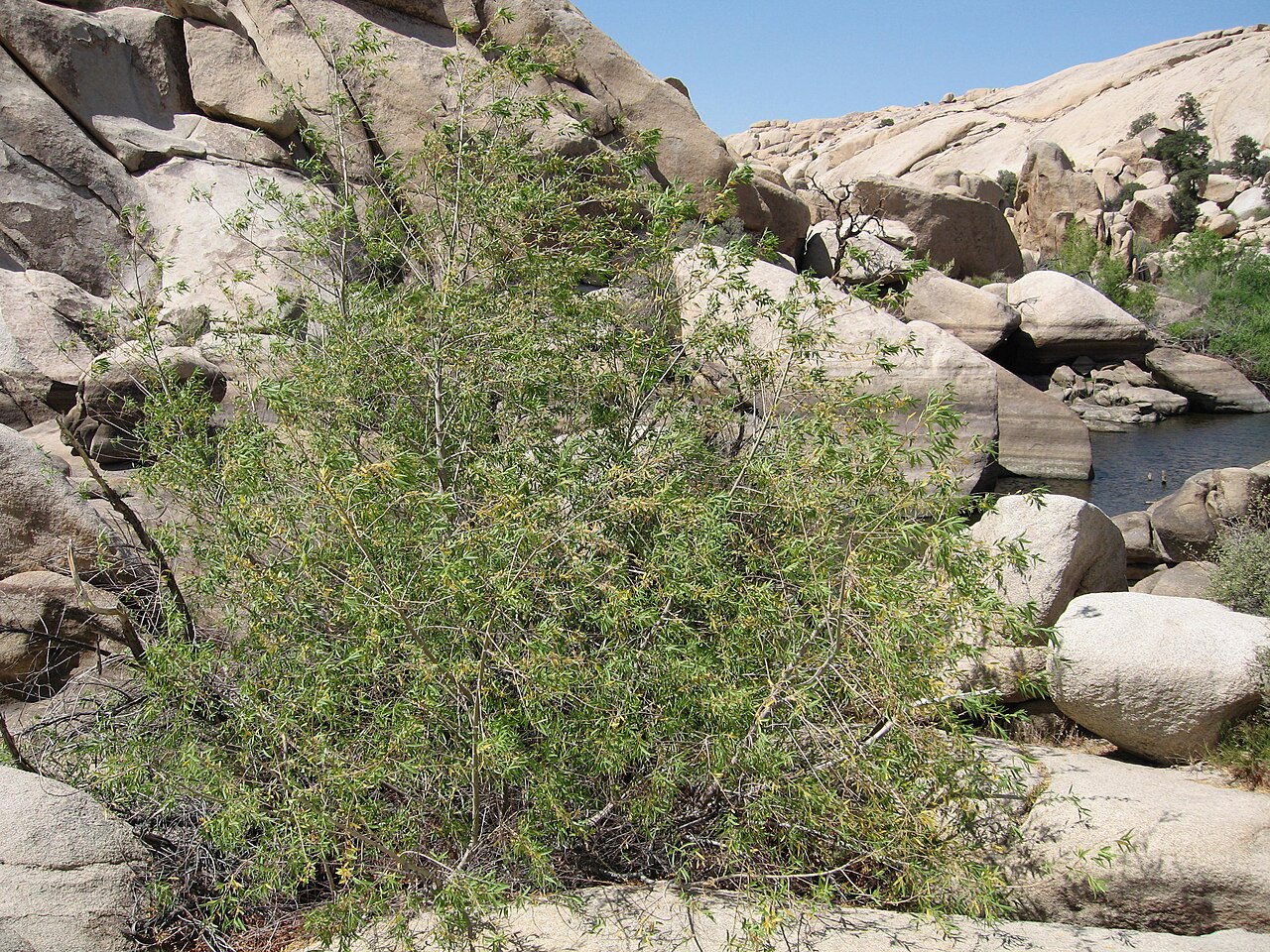
Salix gooddingii, known as Goodding’s Willow, is the signature streamside tree of the desert Southwest — the willow found wherever surface water or a shallow water table persists in Arizona, New Mexico, and the Mojave and Sonoran desert washes of California and Nevada. Where cottonwoods and willows meet along a desert stream, Goodding’s Willow is usually the fine-leaved, multi-trunked partner standing next to Fremont Cottonwood, together forming the backbone of the Southwest’s increasingly rare riparian forests.
A member of the Salicaceae (willow family), Goodding’s Willow is the largest native willow of the Southwest, capable of reaching 30 to 50 feet with a broad, rounded crown on a short, often leaning or multi-trunked base. Its narrow, finely toothed leaves flutter in the desert wind much like cottonwood leaves, and in spring its catkins offer an early pulse of pollen and nectar in landscapes where blooming plants are otherwise scarce.
Because it depends on reliable groundwater or surface flow, Goodding’s Willow is both an indicator of healthy desert riparian habitat and one of its most threatened components — the gallery forests it forms along the Rio Grande, Gila, Colorado, and Virgin Rivers have been reduced for a century by dams, groundwater pumping, and competition from invasive tamarisk. Restoring it is now a priority for river conservation across the Southwest.
Identification
Goodding’s Willow is the tallest of the southwestern willows, usually 30 to 50 feet tall, occasionally more, with a trunk diameter up to 2 feet. It typically grows with one or several leaning or crooked trunks and a rounded, somewhat open canopy, distinguishing it in silhouette from the straighter-trunked cottonwoods it often grows beside.
Bark & Stems
Young twigs are yellow-brown to reddish and slightly hairy at first, aging to smooth gray-brown. Mature bark is dark gray to blackish-brown and becomes deeply furrowed into thick, irregular ridges — notably darker and rougher than the pale, smoother bark of Fremont Cottonwood growing alongside it.
Leaves
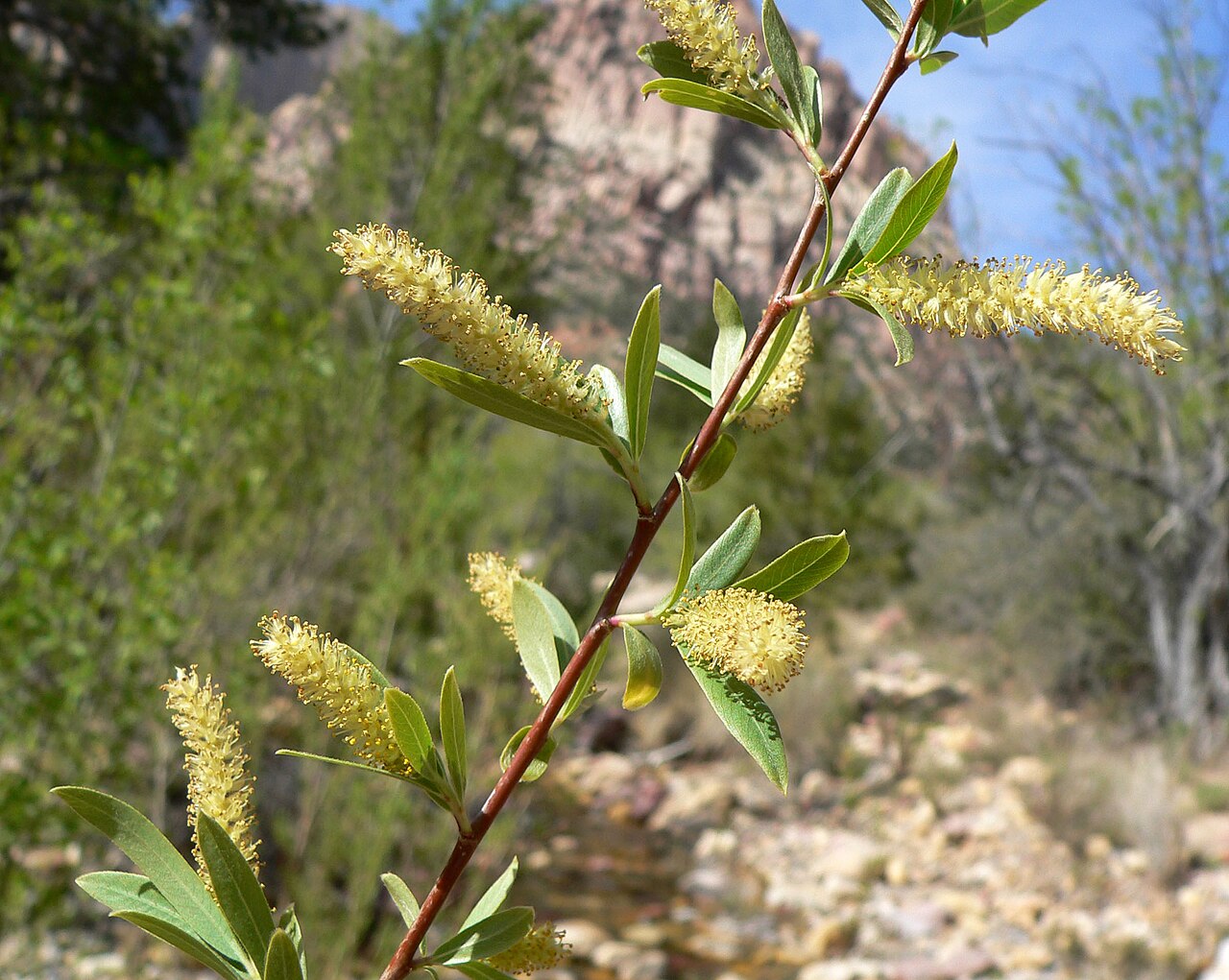
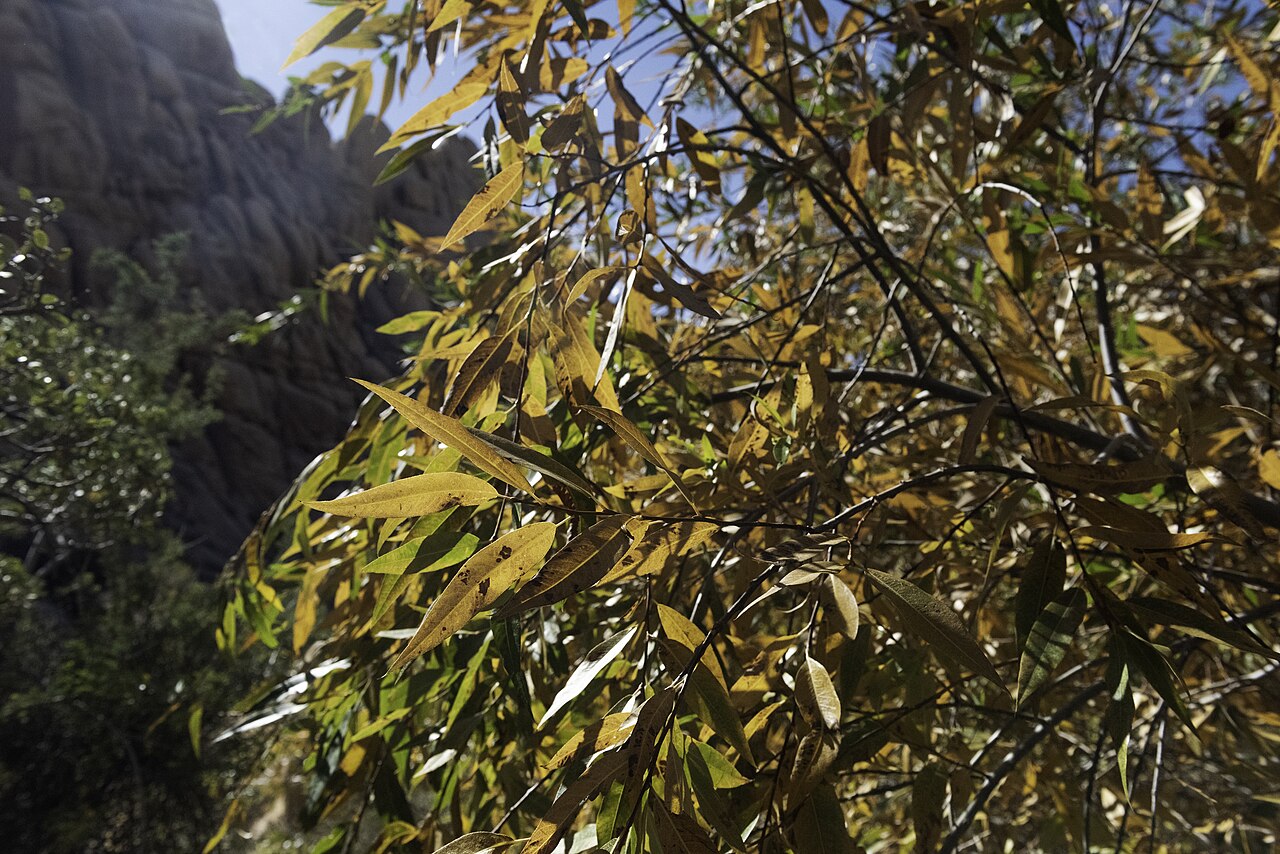
Leaves are narrow and lance-shaped, 2 to 5 inches long and less than an inch wide, tapering to a long slender tip. Both leaf surfaces are green (unlike the whitish-backed leaves of Coastal Plain Willow), with fine, even teeth along the margins and a pair of small, often persistent stipules at the leaf base. New growth and leaf undersides can show fine silky hairs that are lost with age.
Flowers & Fruit
Catkins appear in early to mid-spring as the new leaves emerge, cylindrical and 1 to 3 inches long, on separate male and female trees. Male catkins carry abundant yellow pollen and are heavily visited by bees; female catkins mature into clusters of small capsules that split to release tiny seeds on cottony tufts, dispersing on the wind to colonize fresh, bare, wet sediment left by receding floodwaters.
Quick Facts
| Scientific Name | Salix gooddingii |
| Family | Salicaceae (Willow) |
| Plant Type | Deciduous Tree |
| Mature Height | 30–50 ft |
| Trunk Diameter | Up to 2 ft |
| Growth Rate | Fast |
| Sun Exposure | Full Sun |
| Water Needs | Wet; needs perennial water or a shallow water table |
| Soil Type | Wet sand, gravel, or silt along streams |
| Soil pH | 6.0–8.0 |
| Bloom Time | Early to mid-spring |
| Flower Color | Yellow (male) / green (female) catkins |
| Fall Color | Yellow |
| Fruit | Small capsules with cottony-tufted seeds |
| Deer Resistant | No (browsed by deer and livestock) |
| USDA Hardiness Zones | 6–10 |
Native Range
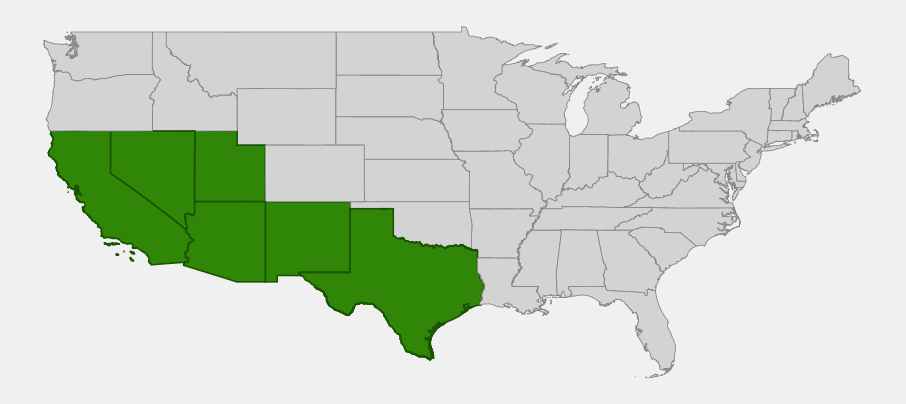
Goodding’s Willow is native to the desert Southwest, centered on Arizona and New Mexico, and extending into southern Nevada, Utah, California, and Texas, with its range continuing south into Mexico. It follows permanent and seasonal watercourses through the Sonoran, Mojave, and Chihuahuan desert regions, from low desert washes up into mid-elevation canyons.
Within this range, it is a defining species of the cottonwood-willow gallery forest, historically one of the richest wildlife habitats in the Southwest and now one of the most reduced, having lost an estimated 90 percent or more of its historic extent along major rivers such as the Rio Grande, Gila, Salt, and Colorado due to damming, diversion, groundwater depletion, and invasion by non-native tamarisk (saltcedar) and Russian olive.
Because it is a true riparian obligate, Goodding’s Willow only establishes where water is dependably available — it is not found away from streams, springs, or shallow water tables, and gardeners outside its native desert range should look to regionally appropriate willows instead.
📋 Regional plant lists featuring Goodding’s Willow: Arizona & New Mexico · Utah & Western Colorado
Growing & Care Guide
Goodding’s Willow rewards the gardener or restoration planner who has a reliable water source — it grows fast and provides shade and wildlife value quickly, but it is not a drought-tolerant desert plant and will decline without consistent moisture.
Light
Full sun produces the healthiest, fullest canopy, matching the open desert-wash conditions where it grows naturally.
Soil & Water
This willow needs a perennial or near-perennial water source — a stream, irrigation, or a shallow water table within reach of its roots. It adapts to sand, gravel, or silty soils as long as moisture is dependable, but it is not suited to upland or dry-garden plantings, where it will decline within a few seasons once roots can no longer reach water.
Planting Tips
Like other willows, Goodding’s Willow roots readily from live stakes or pole cuttings pushed into moist soil near the water table, a technique widely used in Southwest riparian restoration to quickly reestablish streamside cover. Container stock should be planted in fall or late winter to allow roots to establish before summer heat.
Pruning & Maintenance
Remove dead, storm-damaged, or crossing branches in the dormant season. Because the wood is brittle at the joints, avoid planting directly over structures, trails, or parking areas where falling limbs could be a hazard.
Propagation
Dormant-season pole cuttings or live stakes, set directly into moist streambank soil, root easily and are the standard propagation method for restoration plantings along desert rivers.
Landscape Uses
Goodding’s Willow fills several important roles in water-adjacent Southwest landscapes:
- Riparian and gallery-forest restoration alongside Fremont Cottonwood
- Streambank stabilization using pole cuttings or live stakes
- Shade tree for irrigated desert landscapes near reliable water
- Wildlife habitat plantings targeting riparian bird species
- Erosion control on desert wash and arroyo banks
Wildlife & Ecological Value
Goodding’s Willow anchors one of the Southwest’s most biologically important and most threatened habitat types: the cottonwood-willow riparian gallery forest.
For Birds
Riparian willow-cottonwood stands support some of the highest breeding bird densities in North America, including the endangered Southwestern Willow Flycatcher, which nests specifically in dense willow thickets along desert streams. Yellow-billed Cuckoos, warblers, and vireos also depend heavily on these corridors during breeding and migration.
For Pollinators
Early spring catkins are an important nectar and pollen source for native bees and honeybees at a time when few other desert plants are in bloom, helping sustain pollinator populations through the lean early-season period.
For Mammals
Beavers use willow stems for food and dam-building where they occur, and deer and livestock browse young shoots; the dense cover and shade also create microhabitat for many smaller desert mammals that rarely venture far from water.
Ecosystem Role
Goodding’s Willow stabilizes streambanks, shades and cools desert waterways (benefiting native fish), and traps sediment that helps rebuild eroded channels. Because so much of its historic habitat has been lost, restoring Goodding’s Willow stands is a named priority in recovery plans for several endangered riparian species across Arizona, New Mexico, and California.
Cultural & Historical Uses
Indigenous peoples throughout the desert Southwest, including the Pima, Tohono O’odham, and Navajo, used willow branches for basketry, cordage, and construction, taking advantage of the long, flexible young stems. Willow bark, like that of other Salix species, was also historically chewed or brewed for its pain-relieving properties — a traditional use, not a modern medical recommendation.
The species carries the name of Leslie Newton Goodding, a 20th-century botanist who collected extensively across the Southwest; it was long treated as a variety of Black Willow before being recognized as a distinct species.
Today, Goodding’s Willow is valued above all for its ecological role rather than any economic product — its soft, light wood has little commercial use, but its presence is considered a strong positive indicator for river health across the arid Southwest, and its restoration is central to many river conservation programs.
Frequently Asked Questions
How can I tell Goodding’s Willow from Coastal Plain Willow or Black Willow?
Goodding’s Willow leaves are green on both surfaces (not silvery beneath, as in Coastal Plain Willow), and it grows notably taller and more tree-like than most other native willows, often reaching 30 to 50 feet. Range also helps: Goodding’s Willow belongs to the Southwest desert region, while Coastal Plain Willow is a Southeastern species and Black Willow is more widespread across the eastern half of the country.
Can Goodding’s Willow survive in a typical xeriscape?
No. Despite growing in the desert, it is strictly tied to permanent or near-permanent water and will not thrive in a dry, low-water landscape. It belongs near streams, ponds, or irrigated riparian plantings, not in general desert xeriscaping.
Why is Goodding’s Willow important for endangered species?
Dense willow thickets along desert rivers are essential nesting habitat for the endangered Southwestern Willow Flycatcher and several other riparian bird species, making willow restoration a conservation priority across its range.
Is Goodding’s Willow the same as Black Willow?
No, though they are closely related and Goodding’s Willow was once classified as a variety of Black Willow (Salix nigra). They are now recognized as separate species with largely non-overlapping ranges — Goodding’s Willow in the desert Southwest, Black Willow across the central and eastern United States.
Does Goodding’s Willow have any toxic parts?
No parts are known to be toxic to humans or livestock, though like all willows it is not a food plant; its documented traditional uses are limited to bark preparations and woodworking material, not food.

Looking for a nursery that carries Goodding’s Willow?
Browse our native plant nursery directory: Arizona · California · Nevada & New Mexico · Texas & Utah