Blue Palo Verde (Parkinsonia florida)
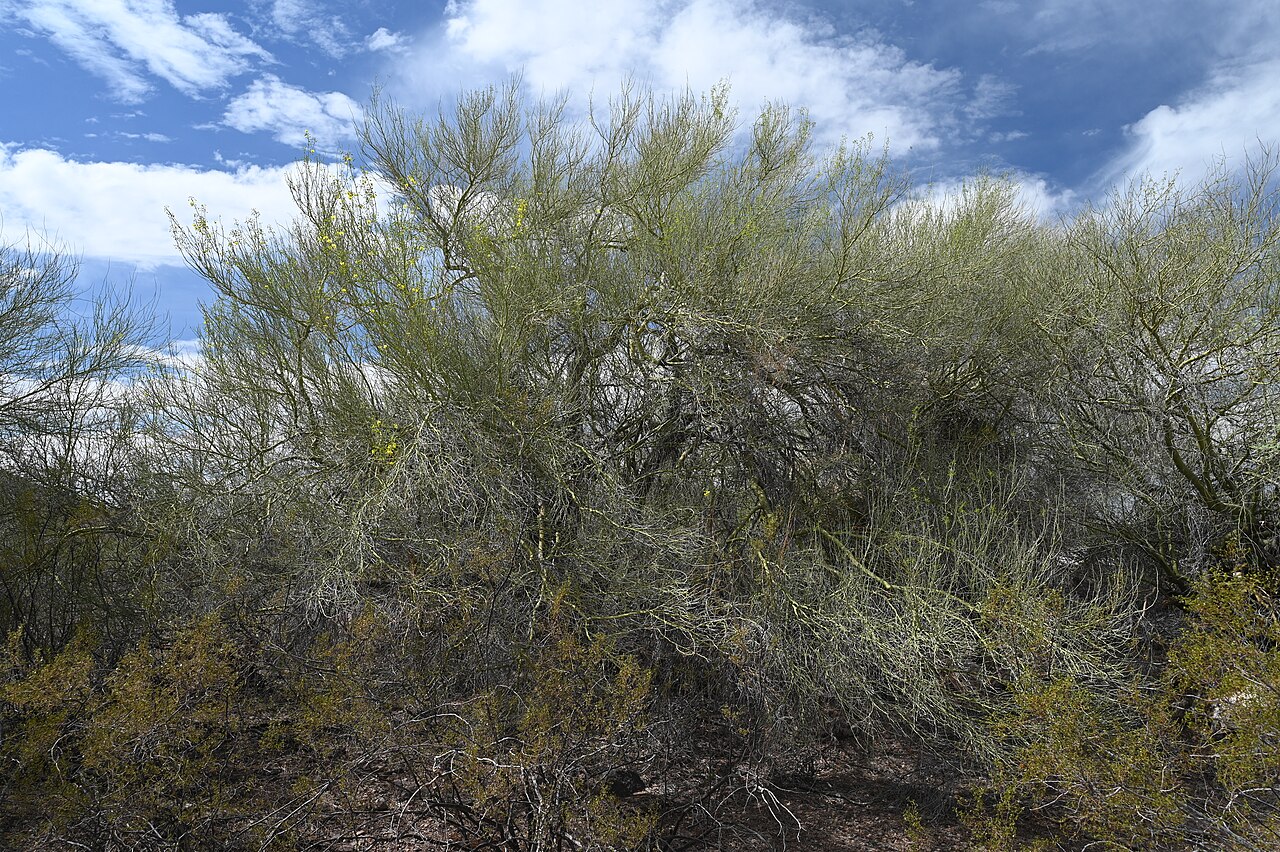
Parkinsonia florida (syn. Cercidium floridum), commonly called blue palo verde, is the signature tree of the Sonoran Desert washes — the one that turns entire valleys a sheet of gold for a few weeks each spring. “Palo verde” is Spanish for “green stick,” and the name describes the tree’s most distinctive trait: smooth, blue-green bark that carries out photosynthesis year-round, even when the tree has dropped every leaf to survive drought. Alongside the closely related foothill palo verde (Parkinsonia microphylla), it shares the honor of Arizona’s state tree.
Blue palo verde grows as a broad, spreading, often multi-trunked tree, usually 15 to 30 feet tall, with a loose, airy canopy of tiny, twice-compound leaves that appear only briefly after rain and drop again as the ground dries. For most of the year the tree photosynthesizes through its bark and bare green twigs, an adaptation that lets it keep growing through the long dry stretches typical of the low desert. In late March through May it erupts into a two-to-three-week bloom of bright yellow, five-petaled flowers that cover the canopy so completely the leaves nearly disappear beneath them.
Found along desert washes, bajadas and floodplains below about 3,600 feet in Arizona, southeastern California and southern Nevada, blue palo verde is both an ecological keystone and a genuinely beautiful landscape tree. It is one of the Sonoran Desert’s most important “nurse plants,” sheltering young saguaro cacti beneath its canopy, and in the home garden it offers fast shade, striking form and almost no water use once established — provided it has the room a 20-to-30-foot tree eventually needs.
Identification
Blue palo verde typically develops as a wide-spreading, multi-trunked small tree 15 to 30 feet tall and equally wide, though old trees in reliable washes can reach 40 feet. The overall silhouette is loose and irregular, with long, arching, nearly thornless branches (the related foothill palo verde is noticeably more thorny and gray-green rather than blue-green).
Bark & Stems
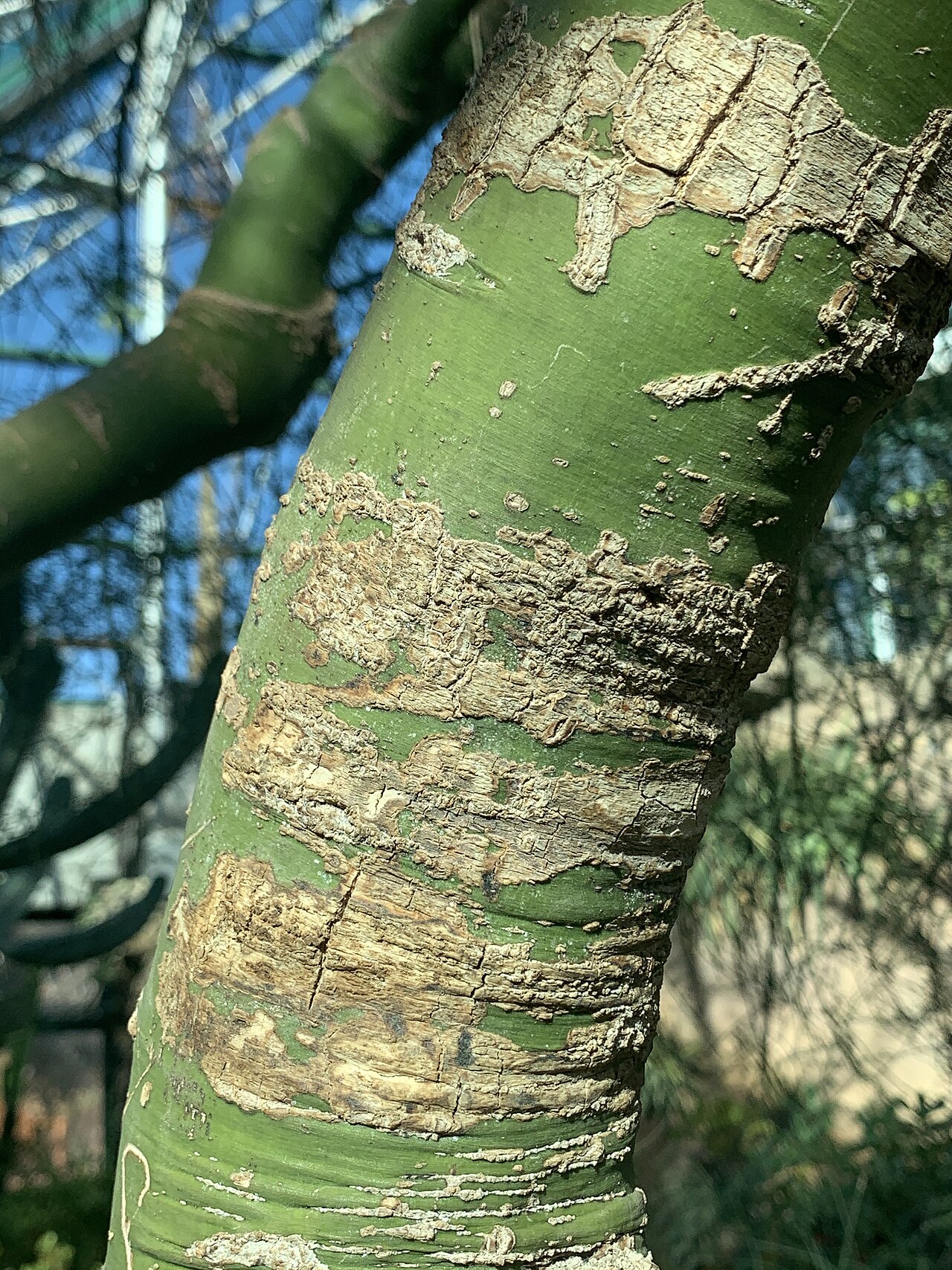
The bark is smooth and distinctly blue-green to turquoise on young trunks and branches, a color produced by chlorophyll in the outer bark tissue. This photosynthetic bark allows the tree to keep producing energy through long leafless periods, an adaptation shared by few North American trees. Older trunk bark near the base can roughen and turn grayish-brown, but the upper branches and twigs retain the blue-green color throughout the tree’s life. Branches are nearly spineless to sparsely spine-tipped, in contrast to the sharply spiny foothill palo verde.
Leaves
Leaves are small, twice-compound (bipinnate), with just one or two pairs of pinnae, each bearing 2 to 5 pairs of tiny, elliptical blue-green leaflets about ¼ inch long. The leaves emerge quickly after rain and are shed within weeks as soil moisture declines, a drought-deciduous strategy that minimizes water loss. During extended drought the tree may carry no leaves at all for months, relying entirely on its bark for photosynthesis.
Flowers
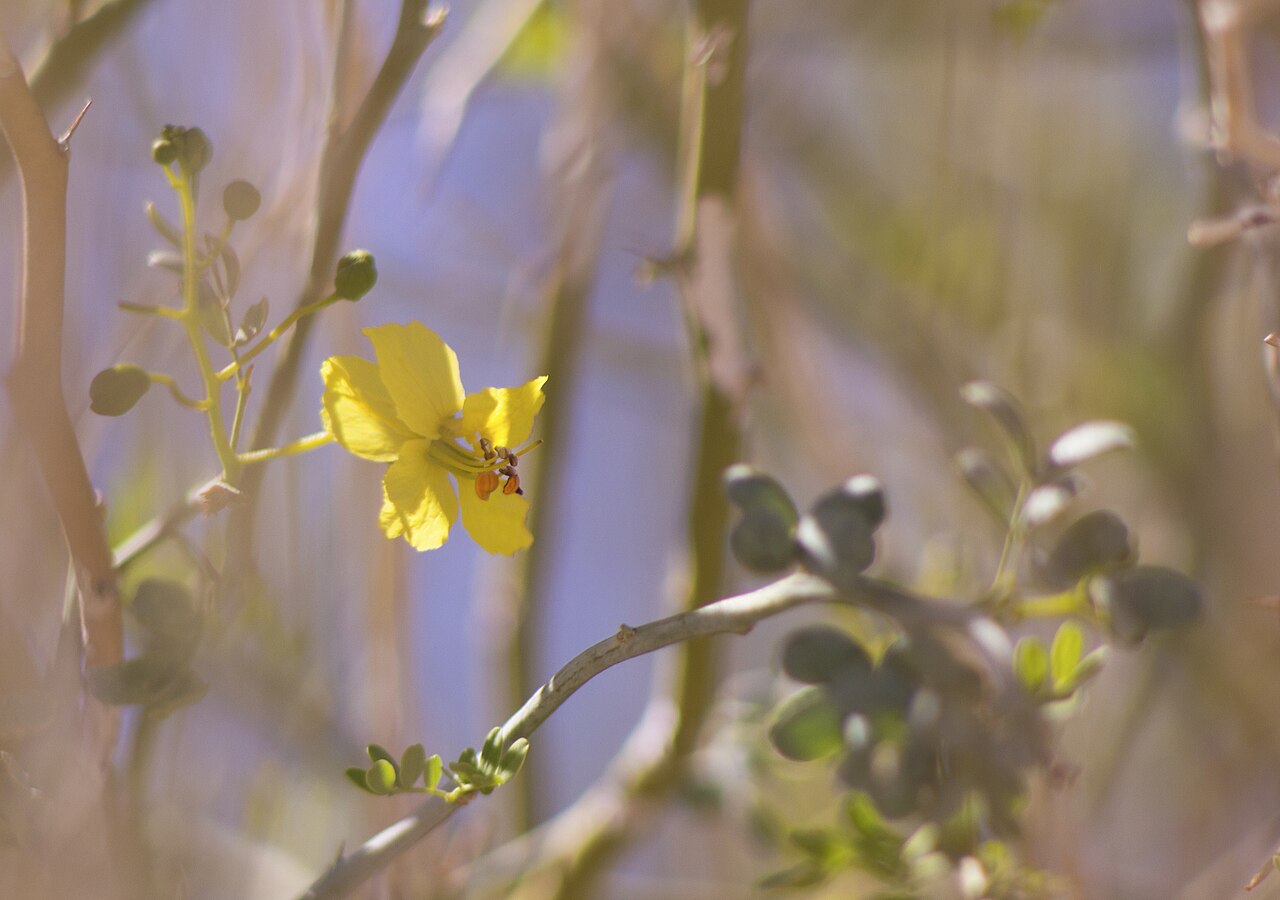
Flowers are bright yellow, about ½ to ¾ inch across, with five rounded petals — one petal (the banner) often shows faint reddish-orange flecks that fade as the flower ages, helping pollinators distinguish newly opened flowers from older ones. Flowers cluster in short racemes along the branches and open in a dense, synchronized bloom from late March into May, often triggered by late-winter rains. A light rebloom can follow summer monsoon storms.
Fruit & Seeds
The fruit is a flattened, straw-colored seed pod 2 to 4 inches long, constricted between the seeds so it looks faintly like a string of beads. Pods mature in early summer and split open to release 1 to 8 hard, oval seeds that remain viable in desert soil for years, germinating en masse after substantial rain.
Quick Facts
| Scientific Name | Parkinsonia florida (syn. Cercidium floridum) |
| Family | Fabaceae (Legume) |
| Plant Type | Deciduous small tree / large shrub |
| Mature Height | 15–30 ft (occasionally to 40 ft) |
| Mature Spread | 15–30 ft |
| Growth Rate | Fast (for a desert tree) |
| Sun Exposure | Full Sun |
| Water Needs | Low; thrives on natural rainfall once established |
| Soil Type | Well-drained sandy, gravelly or rocky soil |
| Soil pH | 7.0–8.5 (tolerates alkaline soil) |
| Bloom Time | Late March – May, light rebloom after summer rain |
| Flower Color | Bright yellow |
| Fall Color | None; bark stays green year-round |
| Fruit | Flat, beaded, straw-colored seed pods, 2–4 in |
| Deer Resistant | Yes (though javelina and bighorn browse pods) |
| USDA Hardiness Zones | 9–11 |
Native Range
Blue palo verde is native to the Sonoran Desert of the southwestern United States and northwestern Mexico. In the United States it occurs across central, southern and western Arizona, through the Colorado and Sonoran Desert portions of southeastern California, and in extreme southern Nevada. South of the border it continues through Sonora and much of the Baja California peninsula. It is absent from the cooler, higher-elevation deserts such as the Mojave’s interior basins and the Great Basin, staying instead within the frost-light, low-elevation Sonoran Desert.
Within that range the tree is tied closely to desert washes, bajadas and floodplains — the places where runoff concentrates after storms — from near sea level up to roughly 3,600 feet. It is rarely found on dry upland slopes far from a wash, since even this drought-adapted tree depends on the extra, periodic water that desert drainages provide. Mature trees are long-lived, often reaching well over a century where washes remain undisturbed.
Blue palo verde is one of the Sonoran Desert’s classic “nurse plants.” Its canopy moderates summer soil temperatures and shelters the seedlings of saguaro cactus, giving them the shade and frost protection they need to survive their vulnerable first years. Because of this role, intact stands of blue palo verde along desert washes are disproportionately important to the regeneration of the broader saguaro-palo verde desert community.
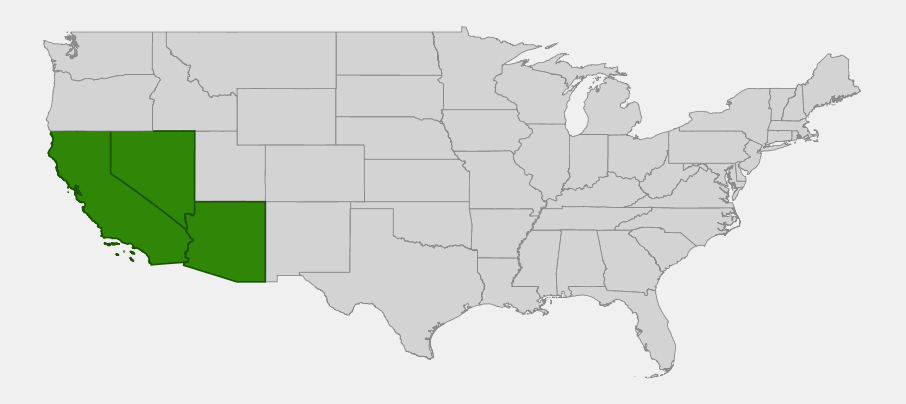
📋 Regional plant lists featuring blue palo verde: California & Nevada · Arizona & New Mexico
Note: blue palo verde is native in California only within the Colorado Desert region of the southeast — it is not native to coastal, central or northern California, and it is not native to New Mexico, where it is sometimes planted as a landscape tree outside its natural range.
Growing & Care Guide
Blue palo verde is one of the easiest, most forgiving trees for low-desert gardens, as long as it is given full sun, excellent drainage and enough room to spread. It is not a good fit for cold winters, heavy clay or regular summer irrigation on the scale a lawn-adjacent tree would need.
Light
Give blue palo verde full, all-day sun. It is adapted to the most intense desert light and does not perform well in shade, where it grows leggy and blooms poorly.
Soil & Water
This tree wants fast-draining sandy, gravelly or decomposed-granite soil and tolerates the alkaline pH typical of desert ground. It is extremely drought tolerant once established, and in low-desert landscapes often needs no supplemental irrigation beyond natural rainfall after its first two or three years. Overwatering, especially with shallow, frequent irrigation, encourages weak, over-extended branches that are prone to breaking in wind — deep, infrequent watering (or none at all once roots are established) produces a sturdier tree.
Planting Tips
Plant young, nursery-grown trees in fall or early spring so roots can establish before the first summer heat. Stake loosely for the first year only if needed, and remove stakes promptly — palo verdes develop stronger trunks when allowed to flex in the wind. Allow 20 to 30 feet of mature width; the tree’s wide, low canopy makes it a poor choice close to structures, walkways or parking areas where falling pods and litter will be a nuisance.
Pruning & Maintenance
Prune while the tree is young to establish a strong branch structure with wide crotch angles, since blue palo verde branches can be weak-wooded and are prone to splitting if left to grow long and heavy. Avoid heavy “lion-tailing” or topping, which stresses the tree and promotes exactly the kind of weak regrowth that breaks in storms. Remove dead or crossing wood in winter while the tree is leafless and its structure is easy to see.
Propagation
Blue palo verde is propagated from seed. Hard seed coats need scarification — nicking the seed coat or soaking in hot water — to break dormancy and allow water uptake, mimicking the scouring action of a flash flood in a desert wash. Seedlings grow quickly in their first few years under good conditions.
Landscape Uses
- Shade tree for desert patios and courtyards, given its wide canopy and fast early growth
- Wildlife garden centerpiece — flowers draw native bees, foliage and pods feed desert wildlife
- Xeriscaping for low-water landscapes once the tree is established
- Desert wash restoration and erosion control along natural or constructed drainages
- Specimen tree prized for its striking blue-green bark and spring flower display
Wildlife & Ecological Value
Blue palo verde is a foundation species of the Sonoran Desert, supporting wildlife through its flowers, foliage, pods and the shade and structure of its canopy.
For Pollinators
The dense spring bloom is a major nectar and pollen event for desert bees, including many native solitary bee species that time their emergence to the palo verde bloom. Honeybees also work the flowers heavily, and the synchronized, short bloom window concentrates huge numbers of pollinators into a brief but intense feeding event each spring.
For Birds
Verdins, cactus wrens, and other desert birds nest in the dense, thorny-twigged canopy, while the branches provide shaded perches during the hottest hours. Quail and doves feed on fallen seeds beneath the canopy, and the tree’s shade creates a cooler microhabitat that many birds rely on during summer heat.
For Mammals
Seed pods are an important food source for desert bighorn sheep, javelina, ground squirrels, and other rodents, which help disperse seeds away from the parent tree. Jackrabbits and other herbivores browse young foliage and seedlings, which is one reason blue palo verde seedlings often establish most successfully as “nurse-plant babies” tucked beneath the protective, often spiny canopy of another shrub.
Ecosystem Role
As one of the Sonoran Desert’s principal nurse plants, blue palo verde shelters young saguaro cacti and other slow-growing desert perennials beneath its canopy, buffering them from extreme heat, frost and herbivory during their vulnerable early years. Its root system stabilizes wash banks, and its leaf litter and nitrogen-fixing root nodules (typical of the legume family) enrich the thin desert soil around it, supporting a denser understory than open desert can sustain.
Cultural & Historical Uses
Indigenous peoples of the Sonoran Desert, including the Tohono O’odham and other desert communities, historically gathered blue palo verde seeds as a food source. Green, immature seeds were eaten fresh or cooked, while mature dried seeds were parched and ground into flour for use in gruel or flatbread, one of many desert legumes that formed part of a varied traditional diet alongside mesquite pods and cactus fruit.
The wood, though not large in dimension, was used locally for tool handles and firewood, and the tree’s deep, efficient root system and tolerance of disturbed ground made it a natural component of traditional desert agriculture, where it was sometimes left standing in cleared fields to provide shade and windbreak.
In the twentieth century blue palo verde became closely tied to Arizona’s civic identity. The Arizona Legislature designated “palo verde” the state tree in 1954, a designation generally understood to include both blue palo verde and the related, more common foothill palo verde, cementing the tree’s place as a symbol of the Sonoran Desert landscape in art, place names and regional branding across the Southwest.
Frequently Asked Questions
Why is the bark of blue palo verde green?
The outer bark contains chlorophyll, letting the tree photosynthesize through its trunk and branches even when it has no leaves. This is a drought adaptation that lets blue palo verde keep producing energy through long dry periods when most trees would be dormant.
Is blue palo verde the same as Arizona’s state tree?
Arizona’s 1954 state tree designation, “palo verde,” is generally understood to cover both blue palo verde (Parkinsonia florida) and the more widespread, thornier foothill palo verde (Parkinsonia microphylla), which are easy to confuse but have different bark color and thorniness.
How fast does blue palo verde grow?
It is fast for a desert tree, often adding 2 feet or more per year while young and well-watered, though growth slows once the tree matures and relies mainly on natural rainfall.
Do blue palo verde seed pods need any special preparation to eat?
Historically, seeds were parched and ground rather than eaten raw in quantity. This is a description of historical and ethnobotanical use, not a recommendation — do not treat garden or wild-collected pods as a food source without proper identification and preparation knowledge.
Can I grow blue palo verde outside the low desert?
It needs mild winters and struggles below about 15–20°F, so it is best suited to USDA zones 9–11 and the warm low-desert valleys of Arizona, southeastern California and southern Nevada. Gardeners in cooler, higher-elevation or coastal climates should choose a different native tree.

Looking for a nursery that carries Blue Palo Verde?
Browse our native plant nursery directory: Arizona · California · Nevada