California Fescue (Festuca californica)
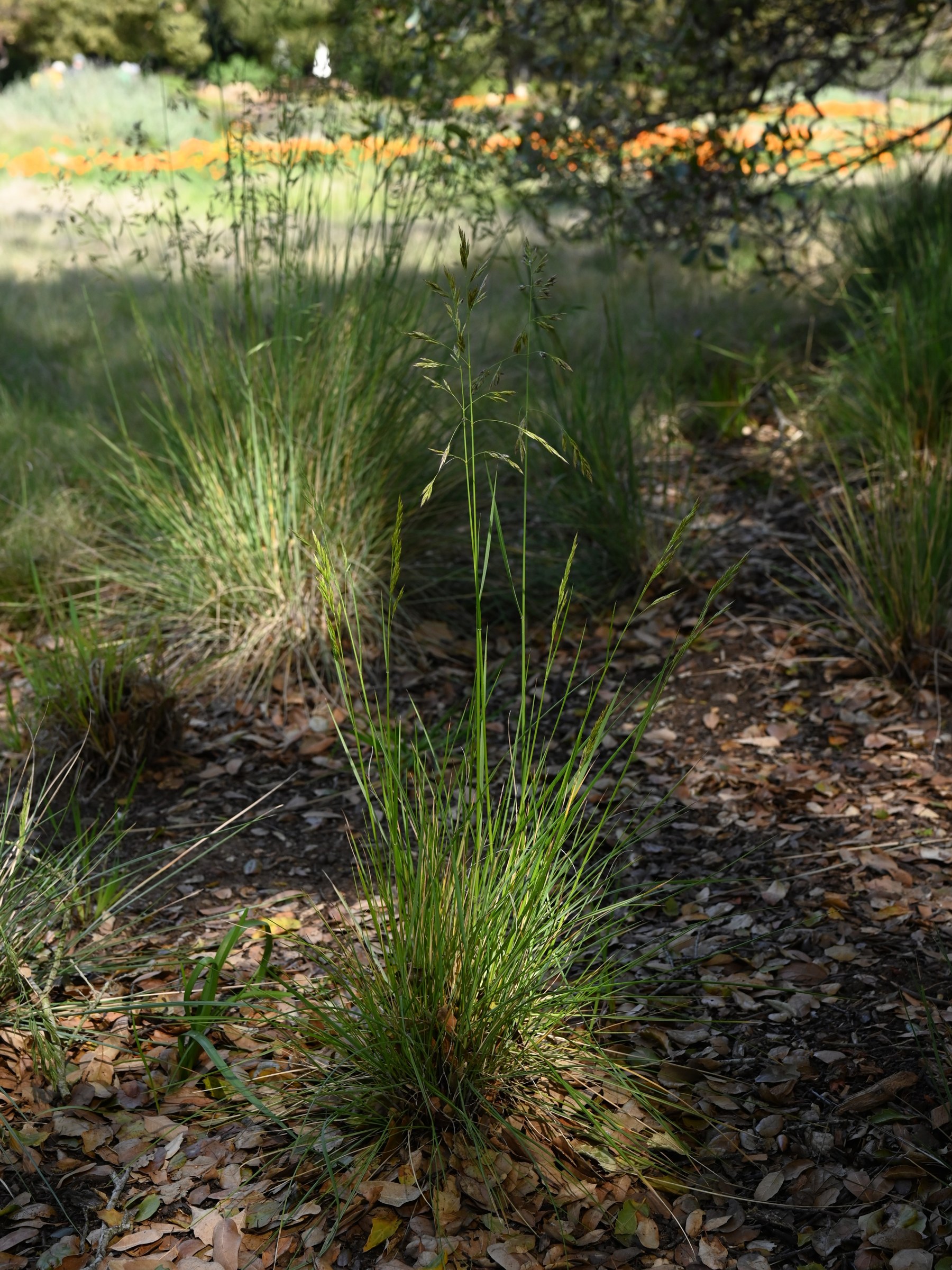
Festuca californica, commonly called California fescue, is a graceful cool-season bunchgrass found in the woodlands, chaparral margins, and shaded slopes of California and southwestern Oregon. Unlike many California native grasses that bleach to straw color and go dormant in summer, California fescue holds a fountain of blue-green to gray-green foliage through the dry months, making it one of the most reliable evergreen grasses for a dry-shade garden. It forms dense, arching clumps 2 to 3 feet tall and wide, with wiry flower stalks that rise another foot or two above the foliage in late spring.
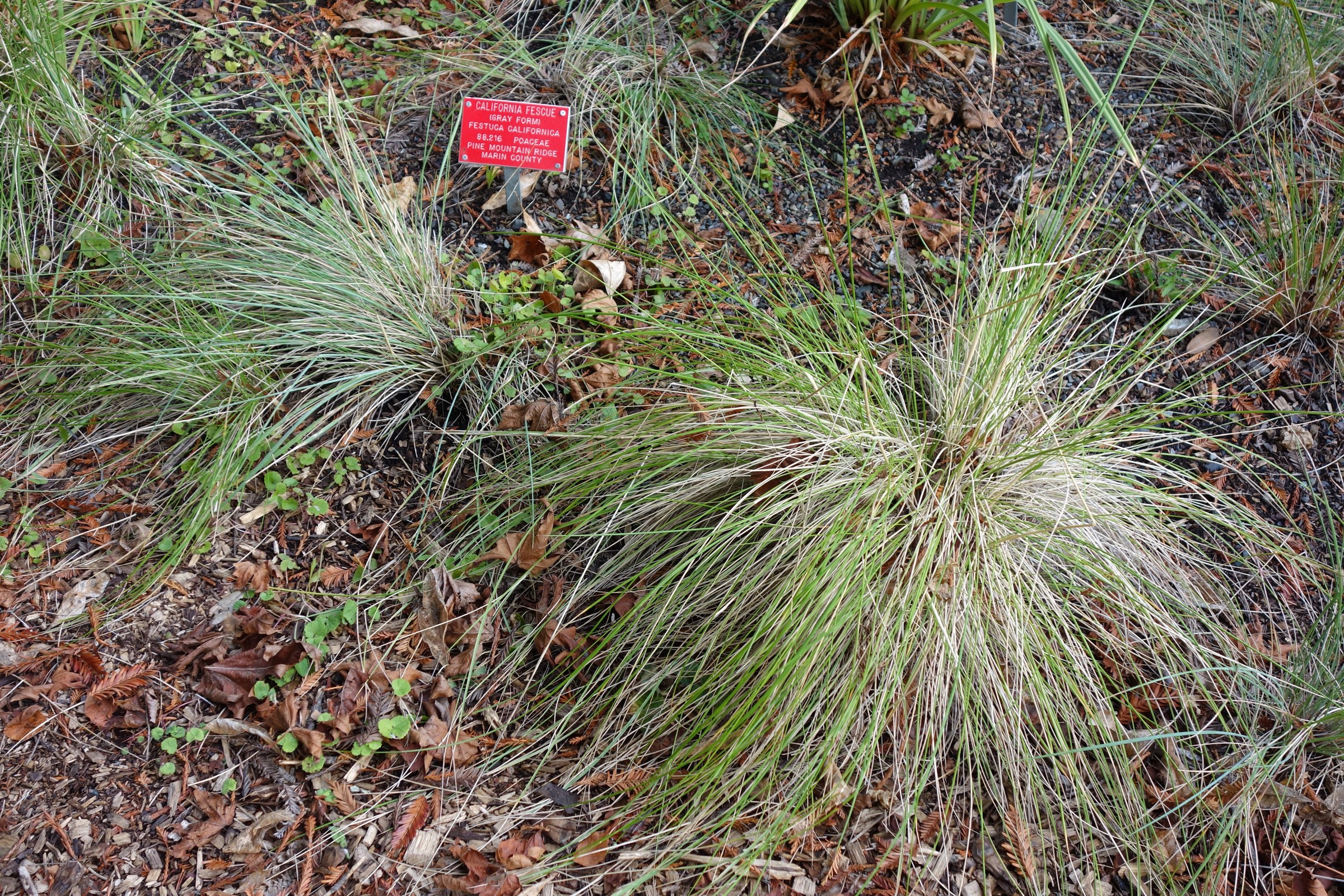
This fescue is a foundation species of the understory in oak woodlands and mixed-evergreen forests, where it tolerates the dry shade cast by Coast Live Oak, California Bay, and Douglas-fir without irrigation once established. Its fine-textured, slightly rough leaves curve outward from the base in a loose, fountain-like clump, giving it a softer look than the stiffer bunchgrasses of open grassland. Several selections with silvery-blue foliage, including the cultivar sold as ‘Phil’s Silver’, have been introduced to the nursery trade from wild populations.
California fescue is prized by native-plant gardeners for exactly the qualities that make it useful in the wild: deep roots that stabilize slopes, tolerance of summer drought and shade together — a combination few grasses offer — and a clumping habit that never turns invasive. It supports native skipper butterflies as a larval host and provides cover and seed for small birds, making it both a practical and ecologically valuable choice for woodland gardens throughout its range.
Identification
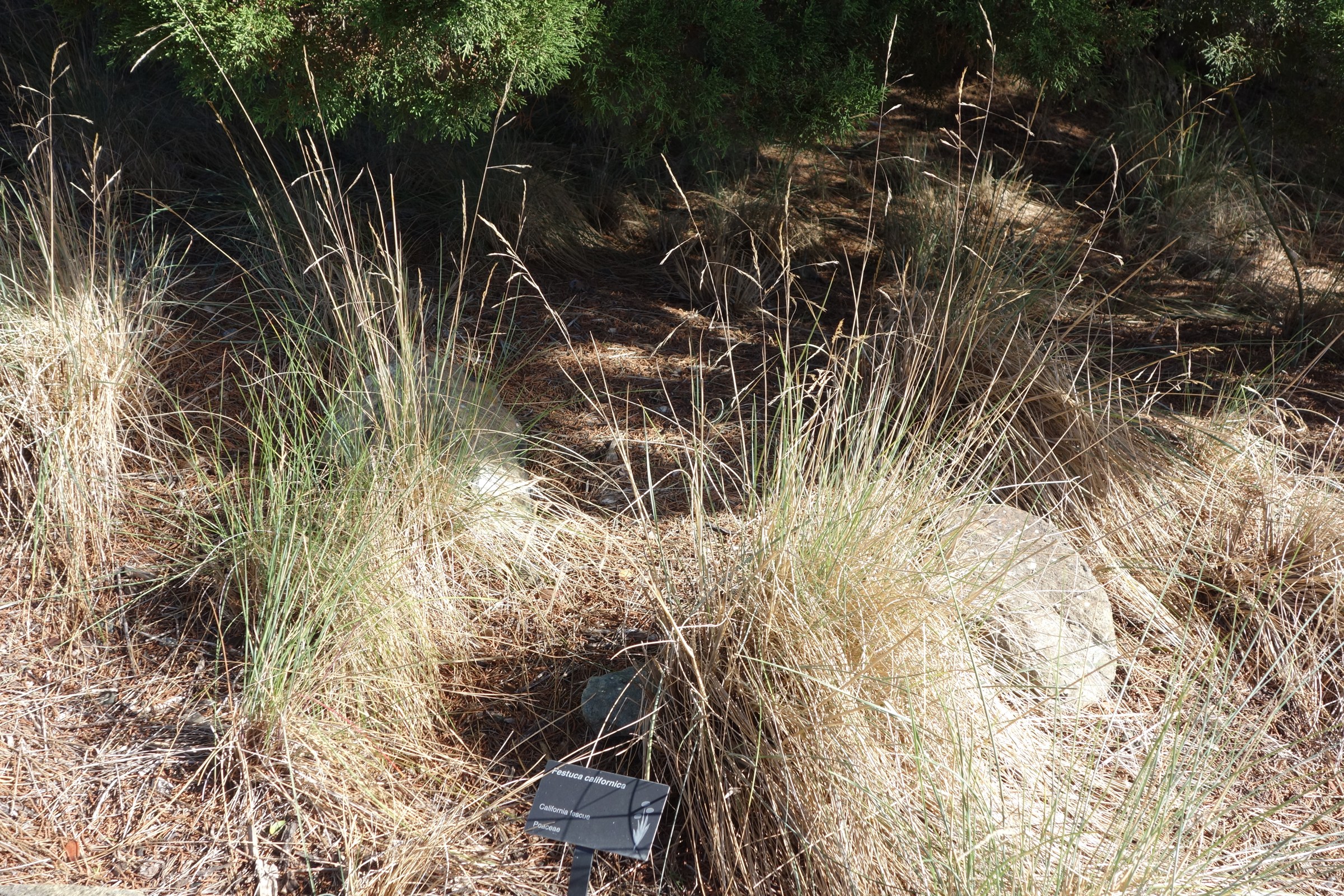
California fescue is a long-lived, densely tufted perennial bunchgrass that does not spread by rhizomes or stolons — it stays in a discrete clump that slowly widens at the base over many years. Mature clumps typically reach 2 to 3 feet tall and 2 to 4 feet wide in the vegetative foliage alone, with flowering stalks extending the overall height to 3 to 4 feet when in bloom.
Leaves
The leaf blades are flat to slightly in-rolled, 8 to 20 inches long and about ⅛ to ¼ inch wide, with a rough (scabrous) texture that can be felt by running a finger along the blade. Color ranges from blue-green to gray-green, sometimes with a noticeable silvery cast, and the foliage remains attractive and largely evergreen through the dry season, unlike many of the state’s deciduous native bunchgrasses. The leaves arch outward and downward from the base, giving mature clumps a loose, fountain-like silhouette.
Flowers & Seedheads
Flowering stems rise well above the foliage from April through June, bearing open, nodding panicles 6 to 12 inches long with slender, spreading branches. Each spikelet holds several small florets; the overall effect is airy and see-through rather than dense or showy. As the seed matures through early summer, the panicles take on a tan to straw-gold color that persists as an attractive textural element into fall.
Roots & Growth Habit
Like most native bunchgrasses, California fescue invests heavily in a deep, fibrous root system that can reach several feet into the soil profile, which is the basis of both its drought tolerance and its value for erosion control on slopes. New growth emerges from the base of the clump each year; old flowering stems and dead leaf tips should be groomed out periodically to keep the clump looking fresh.
Quick Facts
| Scientific Name | Festuca californica |
| Family | Poaceae (Grass) |
| Plant Type | Perennial Bunchgrass |
| Mature Height | 2–3 ft foliage, 3–4 ft in bloom |
| Mature Spread | 2–4 ft |
| Growth Rate | Slow to moderate |
| Sun Exposure | Part Shade to Full Shade (tolerates more sun on the coast) |
| Water Needs | Low once established |
| Soil Type | Well-drained; clay, loam or rocky soils |
| Soil pH | 6.0–7.5 |
| Bloom Time | April – June |
| Flower Color | Greenish, ripening tan/straw |
| Fall Color | Evergreen blue-green; straw-gold seed stalks |
| Fruit | Dry grass seed (caryopsis) |
| Deer Resistant | Yes |
| USDA Hardiness Zones | 7–10 |
Native Range
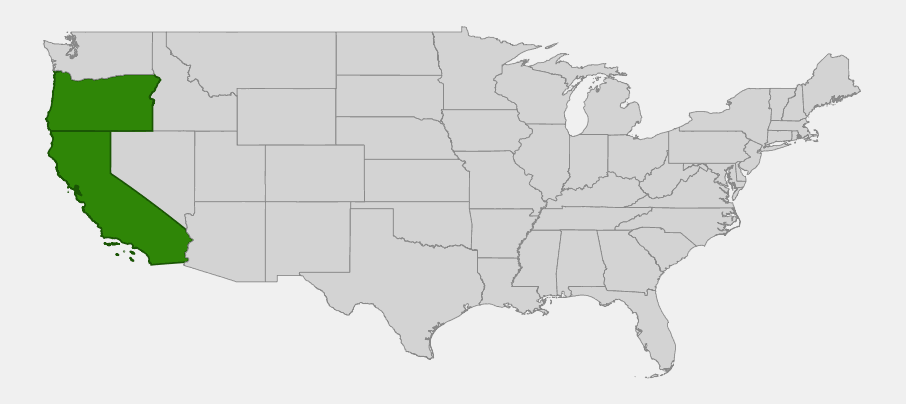
California fescue is native to the Coast Ranges from southwestern Oregon south to San Luis Obispo County, California, and to the Sierra Nevada and Cascade foothills from the Klamath region south through the northern and central Sierra. It is absent from the hot interior deserts and from the immediate coastal dunes, favoring the oak woodlands, mixed-evergreen forests, and north-facing slopes found in the state’s foothill and mid-elevation belts.
Across this range, California fescue grows as a characteristic understory grass beneath Coast Live Oak (Quercus agrifolia), Blue Oak (Quercus douglasii), California Bay (Umbellularia californica), and Douglas-fir (Pseudotsuga menziesii), as well as in canyon bottoms and on shaded road cuts. It is one of relatively few California grasses equally at home in full shade and in the dappled light at a woodland’s edge.
Although California fescue is sometimes planted outside its native range as an ornamental drought-tolerant grass, it has not naturalized or become native in Nevada or elsewhere; gardeners east of the Sierra crest should treat it as an introduced ornamental rather than a native planting.
📋 Regional plant lists featuring California fescue: California & Nevada · Western Oregon & Western Washington
Growing & Care Guide
California fescue is one of the easiest native grasses to grow in a shaded or part-shade garden, and it rewards patience: clumps take a couple of seasons to fill out but then persist for many years with little attention.
Light
Part shade to full shade is ideal, especially inland where afternoon sun can scorch the foliage. Near the coast, California fescue tolerates considerably more sun, including nearly full sun in cool, foggy gardens. In hot interior valleys, reserve it for the shadier side of a building, under oaks, or beneath taller shrubs.
Soil & Water
This fescue is adaptable to clay, loam, or rocky soils as long as drainage is reasonable, and it does not require amended or fertile soil — in fact, overly rich soil can produce floppy, less attractive growth. Water regularly the first one to two summers to establish a deep root system; after that, established clumps need little to no supplemental water in most gardens, though an occasional deep soak during extended summer heat keeps the foliage looking its best.
Planting Tips
Set out container plants in fall or early spring so roots can establish before summer heat arrives. Space clumps 2 to 3 feet apart for a continuous understory planting, or use single specimens as accents among shrubs and perennials. California fescue combines well with other dry-shade natives such as western sword fern, California polypody, and Pacific waterleaf.
Pruning & Maintenance
Comb or cut out old, dead leaf blades by hand or with gloved fingers in late winter to freshen the clump before new growth emerges; avoid shearing, which can damage the growing points. Spent flower stalks can be cut back after seed drops if a tidier look is wanted, though leaving them provides winter seed for birds.
Landscape Uses
- Dry-shade understory beneath oaks and other native trees
- Erosion control on shaded slopes and banks
- Woodland garden accent or mass planting
- Low-water lawn substitute in shaded areas
- Container specimen for its fountain-like form
- Habitat garden for native butterflies and seed-eating birds
Wildlife & Ecological Value
California fescue plays a quiet but important supporting role in the understory communities where it grows, offering food and shelter that are easy to overlook in an unassuming bunchgrass.
For Pollinators & Butterflies
California fescue serves as a larval host plant for several native skipper butterflies, whose caterpillars feed on the grass blades. Wind-pollinated flowers do not attract bees or other pollinators directly, but the structural cover the grass provides benefits a wide range of insects.
For Birds
Small seed-eating birds such as native sparrows forage through fescue clumps for grass seed, especially through summer and fall after the seedheads ripen. The dense base of the clump also offers nesting and sheltering cover for ground-feeding birds.
For Mammals
Small mammals use the cover of mature clumps for concealment from predators, and the deep root systems of California fescue and its grassland neighbors help maintain soil structure that benefits burrowing species.
Ecosystem Role
As an understory grass, California fescue helps stabilize soil on slopes and in canyons, reducing erosion beneath the open canopy of oak woodlands. Its deep, fibrous roots improve water infiltration and soil structure, and because it persists as a long-lived perennial bunchgrass rather than an annual, it provides season-to-season continuity in habitats increasingly dominated by non-native annual grasses.
Cultural & Historical Uses
California fescue does not carry the extensive documented record of food or medicinal use associated with many California native plants; as a grass rather than a plant producing edible seed crops comparable to Indian ricegrass or other staple grasses, it played a more limited direct role in Indigenous diet. Its long, fibrous leaves and stems, however, were among the many wild grasses available to California tribes for incidental use in basketry foundation material and thatching, following broader regional practices of using local grasses for construction and craft.
In the twentieth century, California fescue drew the attention of restoration ecologists and native-plant horticulturists as interest grew in using locally adapted bunchgrasses for erosion control and habitat restoration in oak woodlands. Breeding and selection work at California botanic gardens produced ornamental selections, most notably the silver-blue-leaved cultivar ‘Phil’s Silver’, which brought the species into wider use in home landscaping.
Today California fescue is a staple of California native-plant nurseries and is specified by landscape architects and restoration practitioners for its combination of shade tolerance, drought tolerance, and non-invasive clumping habit — qualities that are increasingly valued as water-wise, habitat-friendly gardening gains popularity across the state.
Frequently Asked Questions
Does California fescue stay green all year?
Yes, in most gardens it remains evergreen or nearly so, holding its blue-green foliage through summer dormancy rather than browning completely the way many native bunchgrasses do.
How much sun does California fescue need?
It prefers part to full shade, especially inland, though coastal gardens with cool summers can grow it in considerably more sun. Hot afternoon sun inland tends to scorch the foliage.
Is California fescue native to Nevada?
No. Its native range is limited to California and southwestern Oregon; populations growing in Nevada gardens are planted, not naturally occurring.
How do I keep a California fescue clump looking tidy?
Comb out dead leaf blades by hand in late winter and cut back old flower stalks after seed drop. Avoid shearing the clump, which can damage its growing points.
Can California fescue handle clay soil?
Yes, it tolerates clay as long as drainage is adequate; it is not suited to soils that stay waterlogged for extended periods.

Looking for a nursery that carries California Fescue?
Browse our native plant nursery directory: California · Oregon