Bigelow Oak (Quercus sinuata var. breviloba)
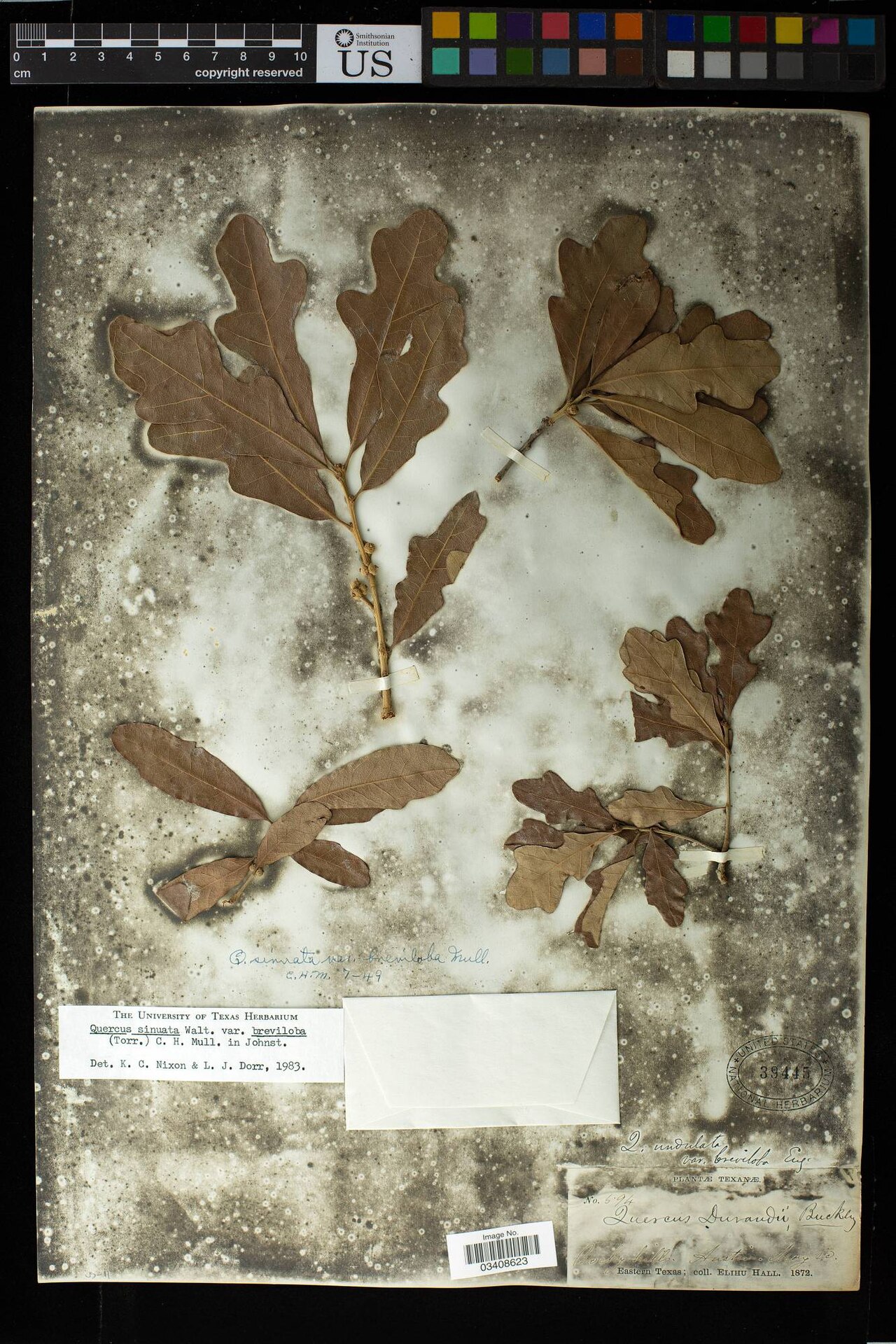
Quercus sinuata var. breviloba, commonly called Bigelow Oak (also known as Bigelow’s oak, white shin oak, scaly-bark oak, or bastard oak), is a small, shrubby evergreen-to-semi-evergreen oak of the limestone hill country of central Texas. It is a variety of Durand oak (Quercus sinuata), distinguished from the larger, more tree-like typical variety by its shorter leaf lobes and its characteristic low, thicket-forming habit on thin, rocky soils.
Where the straight species Quercus sinuata var. sinuata grows as a substantial tree on richer bottomland soils farther east, Bigelow oak is built for a harder life: it colonizes shallow caliche and limestone outcrops across the Edwards Plateau and Texas Hill Country, where it often forms dense, low thickets rather than single trunks, holding tenaciously onto sites too thin and rocky for most other oaks.
For gardeners and land managers in central Texas, Bigelow oak is valued as a tough, drought-adapted native oak for exactly the kind of poor, rocky, alkaline soil that frustrates many other trees. It is slow-growing and rarely available at mainstream nurseries, but where it is used, it offers a uniquely tough, regionally authentic small oak for xeriscapes, wildlife plantings, and limestone-soil restoration.
Identification
Bigelow oak typically grows as a large, many-stemmed shrub or small, often multi-trunked tree, usually 10 to 20 feet tall, though it can occasionally reach larger tree size on deeper soils. On shallow, rocky ground it frequently spreads by root sprouts to form dense thickets rather than a single clear trunk.
Bark
The bark is light gray and distinctly scaly or flaky, breaking into small, thin plates — a feature reflected in the common name “scaly-bark oak.” This flaky, pale bark is a useful field mark distinguishing it from smoother-barked oaks of the region.
Leaves
Leaves are thick and somewhat leathery, oval to obovate, 1.5 to 4 inches long, with shallow, rounded lobes along the margin — notably shorter and less deeply cut than the lobes of typical Durand oak. The upper surface is dark green and glossy, the underside paler and finely hairy. In much of its range the foliage is semi-evergreen to evergreen, persisting through a mild winter and dropping as new growth emerges in spring.
Flowers & Fruit
Like other oaks, Bigelow oak is wind-pollinated, with inconspicuous male catkins appearing in spring alongside new leaves. Acorns are small, about 1/2 to 3/4 inch long, maturing in a single season (as typical of white oaks) and held in a shallow, scaly cup. Acorn production can be heavy in good years, providing an important late-summer and fall food source.
Quick Facts
| Scientific Name | Quercus sinuata var. breviloba |
| Family | Fagaceae (Beech/Oak) |
| Plant Type | Semi-Evergreen Shrub / Small Tree |
| Mature Height | 10–20 ft (occasionally larger on deep soil) |
| Mature Spread | 10–20 ft; often thicket-forming |
| Growth Rate | Slow |
| Sun Exposure | Full Sun to Part Shade |
| Water Needs | Low; very drought tolerant once established |
| Soil Type | Shallow, rocky limestone or caliche |
| Soil pH | Neutral to alkaline |
| Bloom Time | Spring (with new leaves) |
| Flower Color | Inconspicuous green-yellow catkins |
| Fall Color | Minimal; semi-evergreen to evergreen foliage |
| Fruit | Small acorns, 1/2–3/4 in, maturing in one season |
| Deer Resistant | No (foliage and acorns browsed by deer) |
| USDA Hardiness Zones | 7–9 |
Native Range
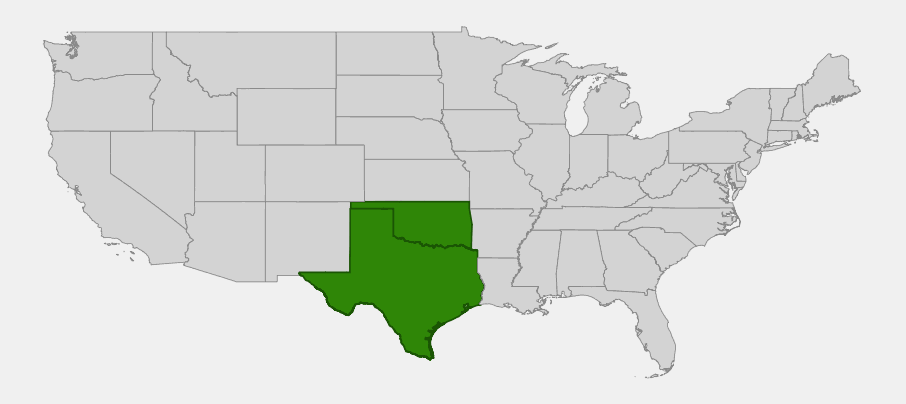
Bigelow oak’s principal range is central and north-central Texas, where it is a characteristic small oak of the Edwards Plateau, Texas Hill Country, and adjacent limestone country. A separate, disjunct population occurs roughly 150 miles to the north in south-central Oklahoma, in the Arbuckle Mountains and parts of Custer County, isolated from the main Texas range.
Typical habitat is shallow, rocky limestone soil on hillsides, bluffs, and flat-topped limestone outcrops, often in open oak-juniper woodland or savanna alongside Ashe juniper and other limestone-adapted species. It is rarely found as a single tree; more often it forms dense, low thickets where root-sprouting lets it persist and spread slowly across thin, difficult soils that exclude many other woody plants.
Its range continues south into adjoining areas of northern Mexico. Within Texas, Bigelow oak is common and not considered at risk, though the disjunct Oklahoma populations, being small and isolated from the main range, are of particular interest to botanists studying the species’ distribution.
📋 Regional plant lists featuring Bigelow Oak: South and West Texas
Growing & Care Guide
Bigelow oak is built for the toughest, rockiest sites in central Texas and is not a plant for rich, regularly irrigated garden beds — it performs best where many other trees fail.
Light
This oak grows well in full sun and tolerates part shade, particularly as a young plant establishing beneath an existing woodland canopy, but it flowers and fruits best with good sun exposure.
Soil & Water
Bigelow oak is specifically adapted to shallow, rocky, alkaline limestone soils and caliche, conditions that would stunt or kill many other trees. It is highly drought tolerant once established and generally needs no supplemental irrigation in its native range after the first few years. Deep, rich, or consistently moist soil is not necessary and may even encourage weaker, less characteristic growth than the compact form it takes on thin limestone ground.
Planting Tips
Plant small container stock in fall or winter to allow root establishment before summer heat. Because Bigelow oak grows slowly and often develops a thicket-forming habit, allow it generous room if a naturalistic grove effect is wanted, or be prepared to selectively remove root sprouts if a single-trunk tree form is preferred. It transplants best when young, as oaks in general resent having mature taproots disturbed.
Pruning & Maintenance
Minimal pruning is needed. Remove dead wood and, if a tree form rather than a thicket is desired, selectively thin root sprouts and lower branches over several years rather than all at once. Bigelow oak has no significant pest or disease problems beyond the general oak wilt risk shared by many Texas oaks, so avoid pruning during the warm months when oak wilt transmission risk is highest, and avoid unnecessary wounding of the bark.
Landscape Uses
- Xeriscapes and rock gardens on shallow, alkaline soils
- Limestone-soil restoration plantings in the Texas Hill Country
- Wildlife thickets, using its natural root-sprouting habit for cover
- Difficult-site plantings where other trees fail on thin, rocky ground
- Naturalistic oak-juniper woodland restoration
- Erosion control on rocky slopes and limestone outcrops
Wildlife & Ecological Value
As a true oak, Bigelow oak carries outsized ecological value relative to its modest stature, supporting wildlife typical of central Texas limestone woodlands.
For Pollinators
Though wind-pollinated and not a nectar source, the spring catkins provide pollen that some native bees collect opportunistically, and the structural habitat the thickets provide supports a wider insect community that in turn feeds pollinators and their predators.
For Birds
The dense, low thickets Bigelow oak forms provide excellent nesting and escape cover for small woodland birds, including wrens, towhees, and sparrows, while acorns feed jays, woodpeckers, and other acorn-eating species in fall.
For Mammals
Acorns are an important fall and winter food source for white-tailed deer, squirrels, and other mammals; deer also browse the foliage, which is part of why the species is not considered deer resistant. The dense thicket growth form offers valuable cover for small mammals on otherwise open, rocky terrain.
Ecosystem Role
Oaks are considered keystone species in North American ecosystems, supporting far more insect and wildlife diversity than most other plant genera, and Bigelow oak fills this role specifically on the shallow limestone soils of central Texas, where few other trees can establish at all. Its root-sprouting habit also helps stabilize thin, erosion-prone soils on limestone hillsides.
Cultural & Historical Uses
Like other scrub oaks of the Edwards Plateau, Bigelow oak has no major documented commercial timber use, as its small size, thicket-forming habit, and typically crooked growth make it unsuitable for lumber. Historically, Texas settlers and ranchers in the Hill Country would have encountered it simply as part of the native oak-juniper brush covering the region’s limestone hills, sometimes cleared for rangeland but also valued as a source of shade, browse, and firewood on rural land.
Acorns of white oaks, including this variety, have historically been used by Indigenous peoples across North America as a food source after leaching to remove bitter tannins, though specific historical accounts for this particular variety are limited; this is a documented historical practice for white oaks generally, not a current food recommendation.
Today Bigelow oak’s main significance is ecological and horticultural: Texas native plant advocates and restoration practitioners recognize it as an authentic, climate-adapted component of Hill Country limestone woodland, valuable for its ability to establish where more commonly planted oaks cannot.
Frequently Asked Questions
What is the difference between Bigelow oak and Durand oak?
Bigelow oak (Quercus sinuata var. breviloba) is a variety of Durand oak (Quercus sinuata). The typical variety, sometimes just called Durand oak, grows as a larger tree on richer soils farther east, while Bigelow oak is a smaller, shrubbier, thicket-forming plant adapted to shallow limestone soils in central Texas, with shorter leaf lobes than the typical variety.
Why is it sometimes called “bastard oak”?
“Bastard oak” is an older common name applied to both varieties of Quercus sinuata, reflecting old-time foresters’ and botanists’ habit of giving that name to oaks whose characteristics fell between other recognized species. It is simply a traditional regional name rather than a description of the plant’s quality.
Does Bigelow oak stay evergreen?
It is semi-evergreen to evergreen across much of its range, especially in milder winters, often holding leaves through winter and dropping them as new growth emerges in spring, though colder winters or drought stress can cause more complete leaf drop.
How fast does Bigelow oak grow?
Slowly. Like many oaks adapted to poor, rocky soils, it typically adds only a few inches of growth per year, trading speed for long-term toughness and longevity on sites unsuitable for faster-growing trees.
Can Bigelow oak get oak wilt?
Yes, like most Texas oaks in the white oak group, it can be affected by oak wilt, though white oaks are generally less susceptible than red oaks. Avoid pruning or wounding the tree during the warm-season months when the disease’s insect vectors are most active, and always use sanitized tools.

Looking for a nursery that carries Bigelow Oak?
Browse our native plant nursery directory: Texas