Parry’s Nolina (Nolina parryi)
Nolina parryi, commonly known as Parry’s Nolina (also Giant Nolina or Parry’s Beargrass), is a bold, long-lived evergreen rosette shrub of the California and Arizona deserts, closely related to yuccas and agaves though usually placed in its own genus within the Asparagaceae. Unlike the stiff, often needle-tipped leaves of many desert agavoids, Parry’s nolina leaves are flexible, grass-like and unarmed at the tip, forming a dense fountain of narrow, arching blue-green foliage that can reach 3 to 5 feet across.
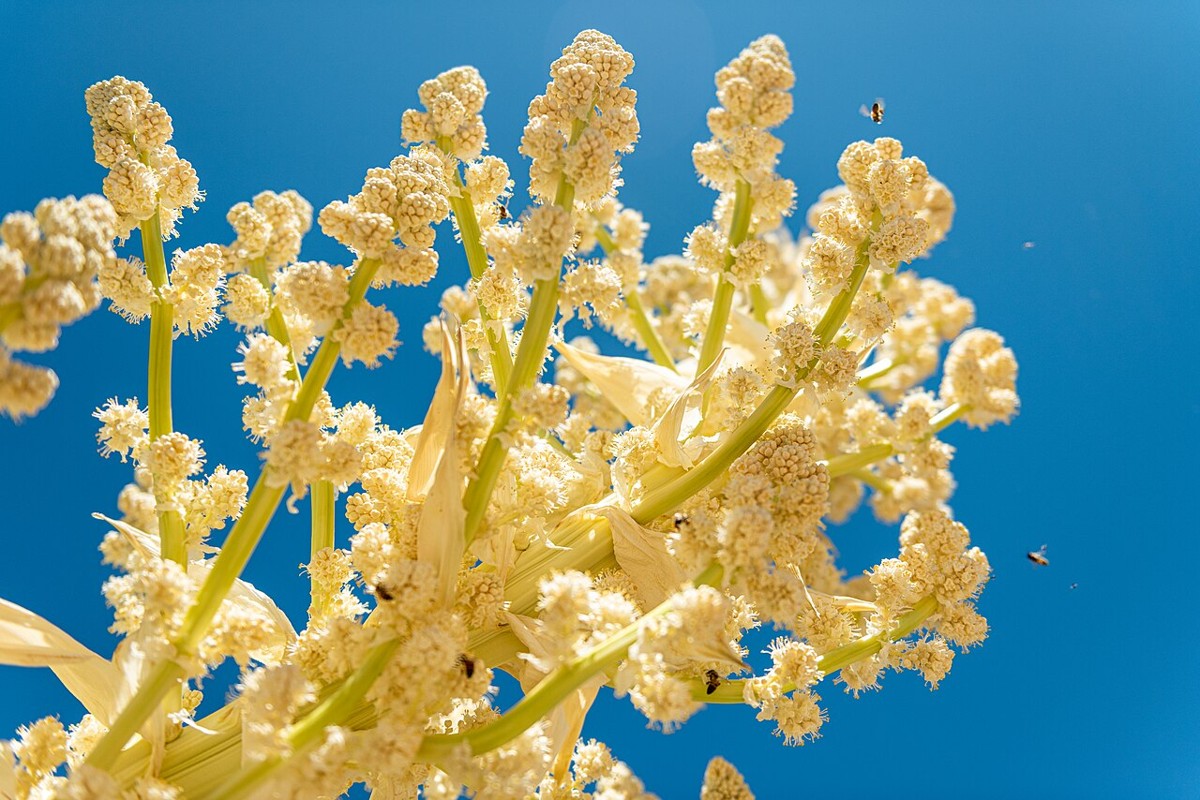
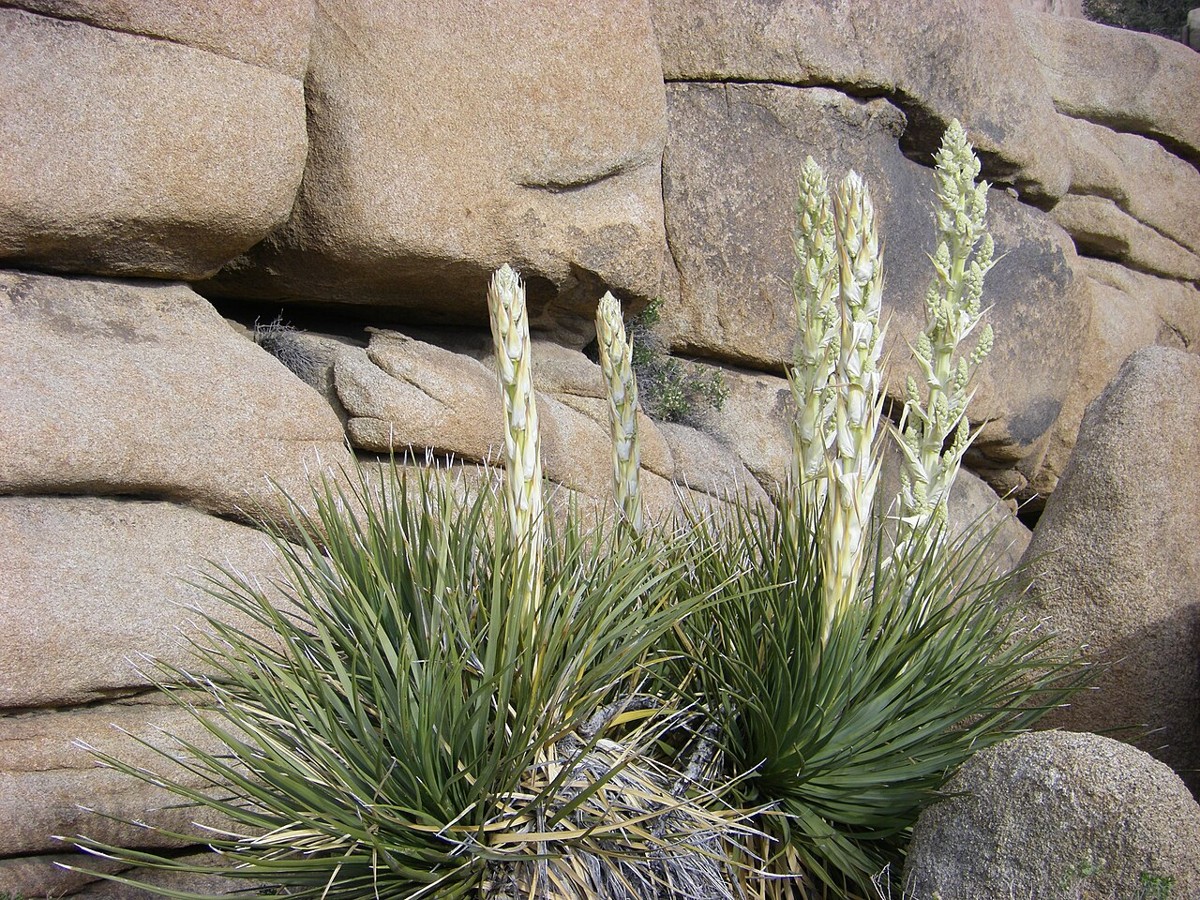
Parry’s nolina is slow-growing but ultimately one of the larger rosette plants of its desert habitat, eventually developing a thick, woody trunk-like base a few feet tall topped by one or several rosettes. In late spring, mature plants send up dramatic flower spikes, sometimes reaching 6 to 10 feet tall, densely packed with thousands of tiny cream-white flowers that hum with bee activity on a sunny day — one of the more striking flowering events in the Mojave and Colorado Desert landscape.
For desert gardeners, Parry’s nolina is an excellent large architectural accent: tough, drought tolerant, unarmed and safe near paths (unlike spine-tipped yuccas and agaves), and eventually rewarding patient growers with one of the desert’s most impressive bloom spikes. It is equally at home in a native plant garden, a xeriscape bed, or a large rock garden where its fountain-like form can be appreciated from multiple angles.
Identification
Parry’s nolina forms a dense rosette of long, narrow, grass-like leaves 2 to 4 feet long and under an inch wide, blue-green to gray-green in color, with finely toothed margins but no sharp terminal spine — a key feature distinguishing it from desert yuccas and agaves at a glance. Older plants develop a stout, woody caudex (trunk base) a few feet tall, sometimes branching to carry more than one rosette.
Flower Spikes
The flowering stalk is the plant’s most dramatic feature: a massive, densely branched panicle 6 to 10 feet tall (occasionally more), rising well above the leaf rosette and packed along its length with small, cream to white, star-shaped flowers. Individual flowers are tiny — under a quarter inch — but their sheer number turns the whole spike into a conspicuous, pale beacon visible from a distance across the desert.
Fruit & Seeds
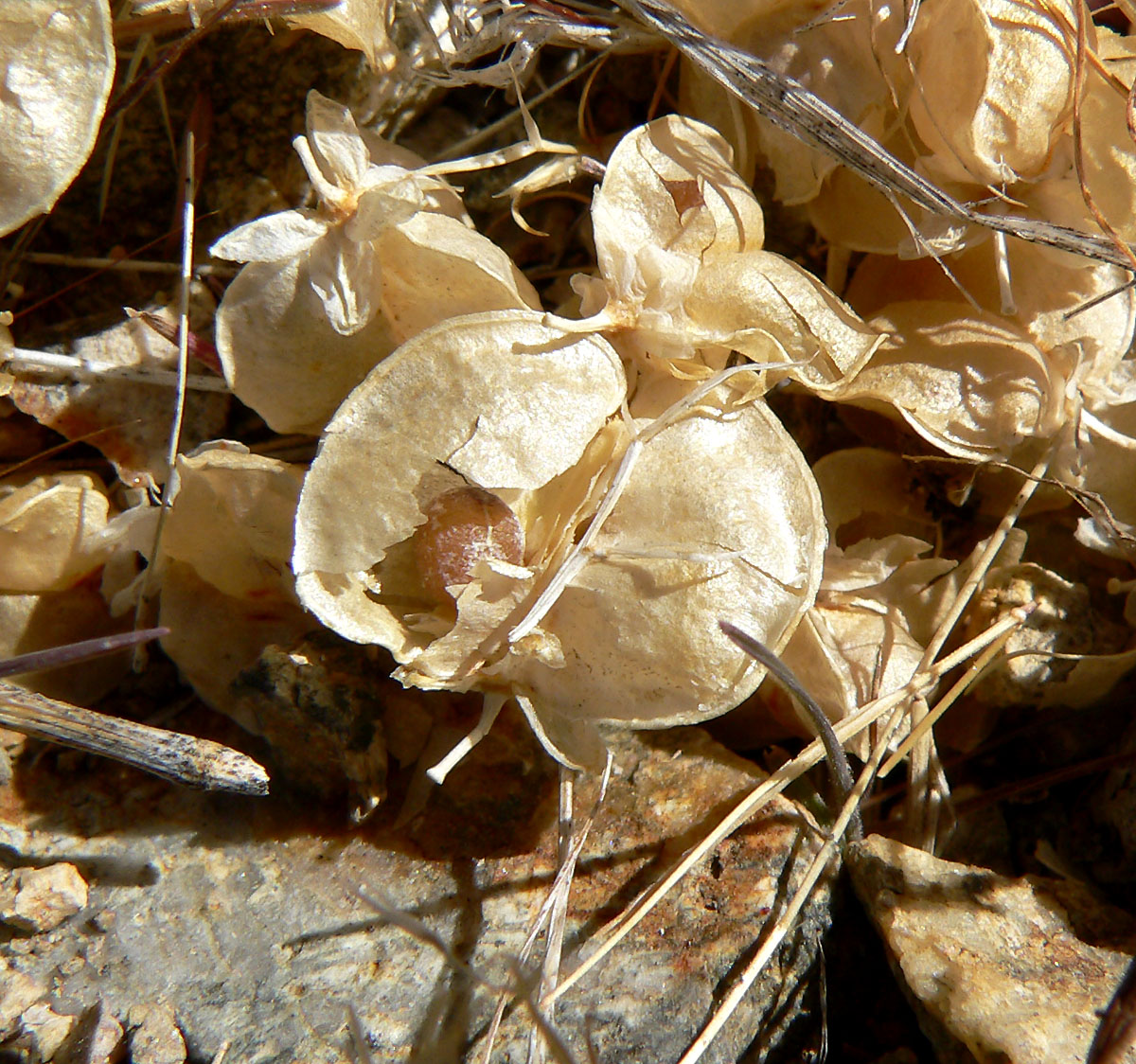
Parry’s nolina is dioecious, meaning individual plants are either male or female. Female plants produce a papery, three-chambered seed capsule about a third of an inch across that dries to a tan, parchment-like husk, each chamber holding one or two small, hard seeds. The dry capsules persist on the spent flower stalk for months, rattling in the wind long after the flowers have faded.
Quick Facts
| Scientific Name | Nolina parryi |
| Family | Asparagaceae (subfamily Nolinoideae) |
| Plant Type | Evergreen rosette shrub (succulent-leaved) |
| Mature Height | 3–6 ft (foliage); flower spikes to 6–10 ft |
| Mature Spread | 3–5 ft |
| Growth Rate | Slow |
| Sun Exposure | Full Sun |
| Water Needs | Very Low; drought tolerant once established |
| Soil Type | Rocky or gravelly, well-drained; granitic slopes |
| Soil pH | Neutral to slightly alkaline (6.5–8.0) |
| Bloom Time | April – June |
| Flower Color | Cream to white |
| Fall Color | None (evergreen) |
| Fruit | Dry, papery three-chambered capsule |
| Deer Resistant | Yes |
| USDA Hardiness Zones | 8a–10b |
Native Range
Parry’s nolina is native to the desert mountains and upper bajadas of southeastern California and southwestern Arizona, where it is a conspicuous feature of rocky slopes in the Mojave and Colorado Desert transition zone, including the mountains in and around Joshua Tree National Park, the Little San Bernardino Mountains, and ranges extending east into the Sonoran Desert fringe of western Arizona.
It typically grows on steep, rocky or boulder-strewn slopes and canyon walls, generally between 2,000 and 5,000 feet elevation, often rooted directly in crevices among granite boulders where little soil has accumulated. This rocky, well-drained setting reflects the plant’s intolerance of standing water and its preference for excellent drainage over rich soil.
Parry’s nolina is locally common within its range and not considered at risk, though its slow growth and dependence on undisturbed rocky slopes mean that populations near trails and developed areas can be slow to recover from disturbance or collection.
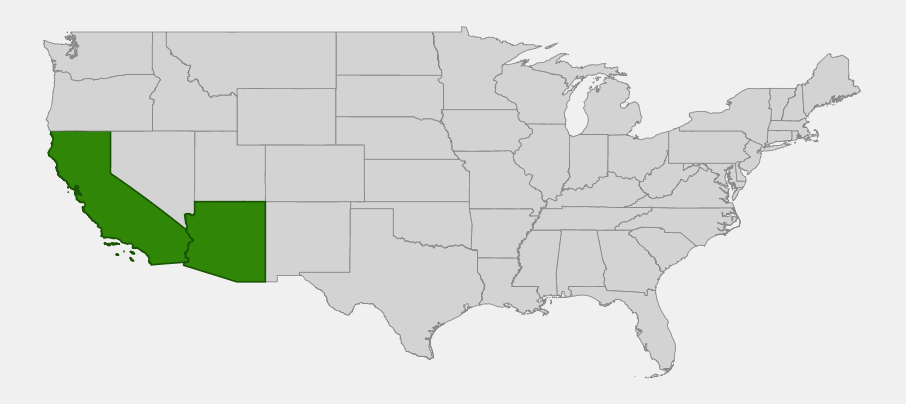
📋 Regional plant lists featuring Parry’s Nolina: California & Nevada · Arizona & New Mexico
Growing & Care Guide
Parry’s nolina is a patient gardener’s plant, slow to reach its full architectural presence but exceptionally tough and low-maintenance once it does. It is one of the safer large accent plants for gardens with foot traffic nearby, since its leaves lack the sharp terminal spines of many desert agavoids.
Light
Plant in full sun. Parry’s nolina grows naturally on open, exposed rocky slopes and develops its best form and most reliable flowering with as much direct sun as a garden can offer.
Soil & Water
Excellent drainage is critical. Plant on a slope, in a raised bed, or in soil heavily amended with coarse gravel or decomposed granite to mimic its native rocky hillside habitat. Water occasionally during the first year or two to help establish the root system, then taper off; mature plants need little to no supplemental water beyond natural desert rainfall and can suffer crown rot if kept consistently moist.
Planting Tips
Choose a permanent site with excellent drainage, since Parry’s nolina resents being moved once established and grows too slowly to recover quickly from transplant shock. Give it plenty of room — at least 4 to 5 feet of clearance in all directions — to accommodate its eventual mature spread and the base of a future flower spike. It pairs naturally with boulders and rock outcrops in the garden.
Pruning & Maintenance
Remove dead or browned lower leaves occasionally to keep the rosette tidy, cutting close to the base with care. After flowering, the spent flower stalk can be left in place for months as an architectural element and seed source for wildlife, or cut back once it has dried and turned brown. The plant needs no fertilizer in typical desert soils and has very few pest or disease problems.
Landscape Uses
- Architectural focal point in xeriscape and rock gardens
- Desert habitat plantings paired with Joshua tree, juniper and desert agave
- Safe accent near paths and seating areas, since the leaves are unarmed at the tip
- Slope and boulder plantings that echo its native rocky habitat
- Large container specimen for patios, given a sufficiently wide, deep pot
Wildlife & Ecological Value
Parry’s nolina plays an outsized ecological role for a desert plant of its kind, thanks largely to its massive, nectar-rich flower spikes.
For Pollinators
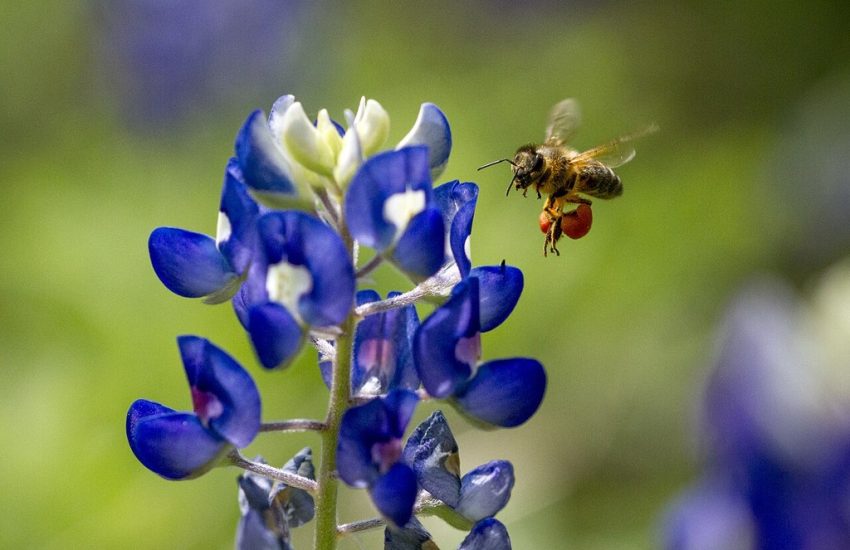
The thousands of small cream flowers produced on each spike draw heavy activity from native bees and other insects during the spring bloom, making a single flowering plant a significant, concentrated nectar resource in an otherwise sparse desert landscape. The sheer flower density means even modest populations of Parry’s nolina can support substantial pollinator traffic for several weeks each year.
For Birds
Hummingbirds and other nectar-feeding birds occasionally visit the flower spikes, and small desert birds use the dense leaf rosettes for cover and perching sites, particularly where plants form larger colonies on rocky slopes.
For Mammals
Woodrats and other small rodents shelter among the dense, fibrous leaf bases, and various desert mammals browse the leaves occasionally, though the plant is not a primary food source for any one species. Historic accounts note that desert bighorn sheep and other large herbivores would browse young flower stalks in some areas.
Ecosystem Role
As a long-lived, slow-growing rosette plant on rocky desert slopes, Parry’s nolina adds structural diversity to its plant community and, through its dramatic flowering events, functions as an important seasonal pollinator resource that helps sustain bee populations supporting the broader desert plant community.
Cultural & Historical Uses
Nolina species, including Parry’s nolina, were used by Indigenous peoples of the Southwest in ways broadly similar to related beargrass and yucca species — the tough, fibrous leaves could be processed for cordage, basketry material, and thatching, though Parry’s nolina’s more limited, rugged mountain habitat likely made it a less frequently harvested resource than more accessible lowland species.
The species honors Dr. Charles Christopher Parry, a nineteenth-century botanist and physician who conducted extensive botanical surveys of the American Southwest and Mexico, and for whom numerous Southwestern plants are named. His collecting expeditions through California and the border region in the mid-1800s documented many species new to Western science, including this one.
Today Parry’s nolina is primarily valued by native-plant gardeners and desert landscape designers for its sculptural form and spectacular flower spikes, and it is an increasingly popular specimen plant in water-wise gardens throughout its native range and beyond.
Frequently Asked Questions
Is Parry’s nolina the same as a yucca?
No, though they are related and often confused. Parry’s nolina has flexible, grass-like leaves without a sharp terminal spine, while most desert yuccas have stiffer, often needle-tipped leaves. Both belong to the broader agave family group, but Nolina is its own genus.
How long does it take Parry’s nolina to flower?
It can take many years — often a decade or more — for a plant grown from seed to reach flowering size and produce its first large flower spike. Once mature, established plants typically flower in most years given adequate sun and age.
Is Parry’s nolina safe to plant near a walkway?
Yes, more so than many desert agavoids. Its leaves are flexible and lack a sharp terminal spine, though the leaf margins do have fine, slightly rough teeth, so it is still worth giving it a little clearance from high-traffic areas.
Do male and female Parry’s nolina plants look different?
The flower spikes look broadly similar at a glance, but only female plants go on to produce the dry, papery seed capsules after flowering. Male flowers simply shed pollen and fade without forming fruit.
How much water does Parry’s nolina need?
Very little once established. In its native rocky mountain habitat it survives largely on natural rainfall; in cultivation, occasional deep watering during the first year or two helps it establish, after which it needs minimal supplemental irrigation.

Looking for a nursery that carries Parry’s Nolina?
Browse our native plant nursery directory: California · Arizona