Lime Pricklyash (Zanthoxylum fagara)
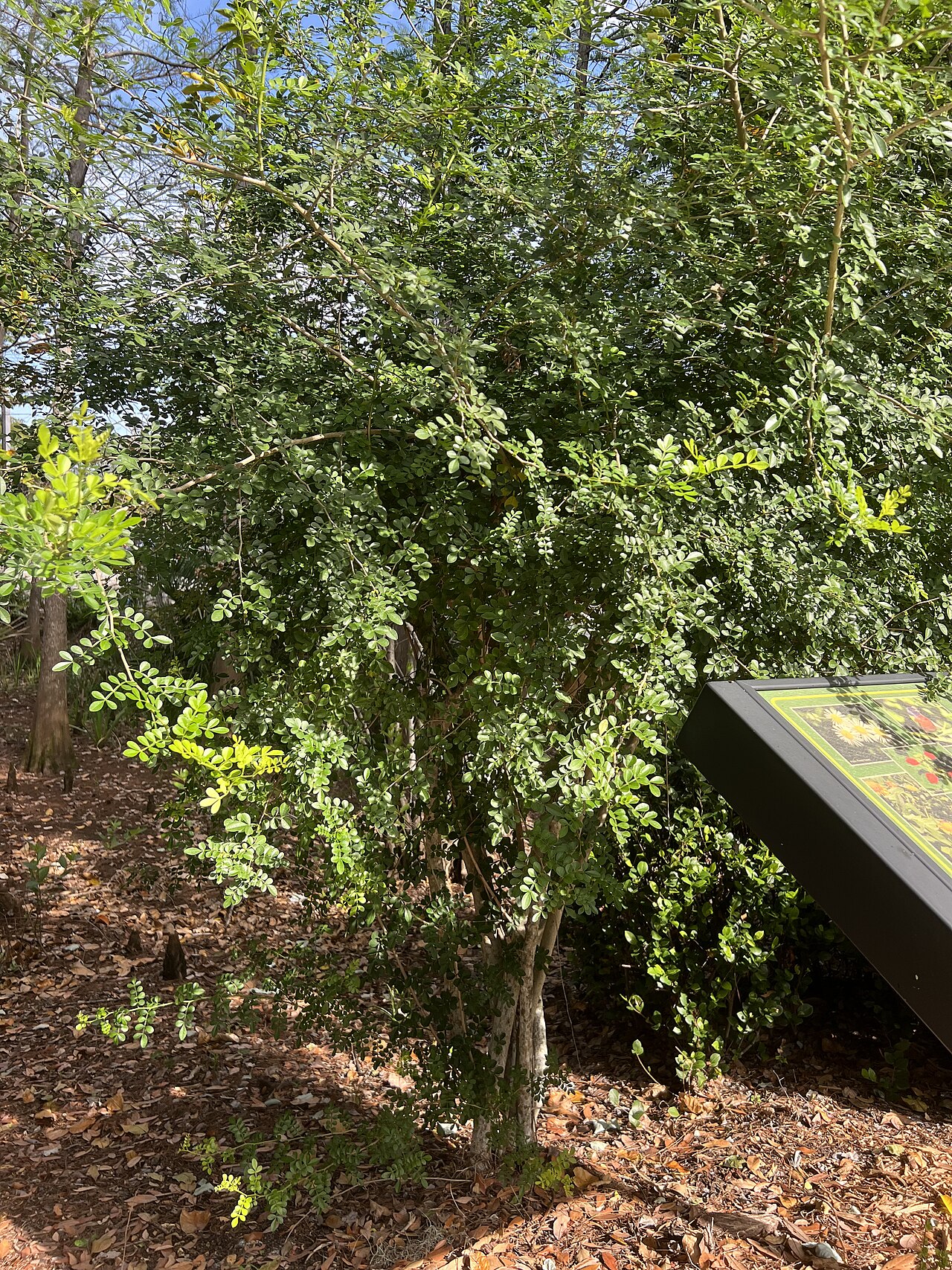
Zanthoxylum fagara, commonly called Lime Pricklyash or Wild Lime (and colima in South Texas Spanish), is a thorny, aromatic evergreen shrub or small tree of the citrus family, Rutaceae. It is one of the toughest native plants of the Rio Grande Valley’s Tamaulipan thornscrub and the Florida peninsula’s coastal hammocks, surviving salt spray, caliche soil, and long droughts that would kill less rugged species. Crush a leaflet and you get an unmistakable citrusy, resinous scent — a quick way to confirm the identification in the field.
Despite the “lime” in its name, Lime Pricklyash does not produce edible citrus fruit; the name refers to the leaf fragrance and the lime-green color of young growth, not to anything you can eat. What it does produce is an outsized ecological payoff for a modest-sized plant: it is a larval host plant for giant swallowtail butterflies, its tiny flowers feed small native bees in the lean months of late winter, and its dense, thorny tangle of branches gives songbirds secure nesting cover that few ornamentals can match.
In the landscape, Lime Pricklyash works best as an informal hedge, a wildlife thicket, or a background shrub along a property line in South Texas or peninsular Florida — anywhere it will not be brushed against often, since the paired, hooked prickles along the stems are sharp. Give it full sun to light shade, skip the irrigation once it is established, and it will reward you with years of low-maintenance structure and butterfly activity.
Identification
Lime Pricklyash typically grows as a many-branched, arching shrub 10 to 25 feet tall, occasionally developing into a small single-trunked tree under favorable conditions. The overall form is loose and thicket-like, with slender branches that often zigzag slightly between leaf nodes.
Bark & Stems
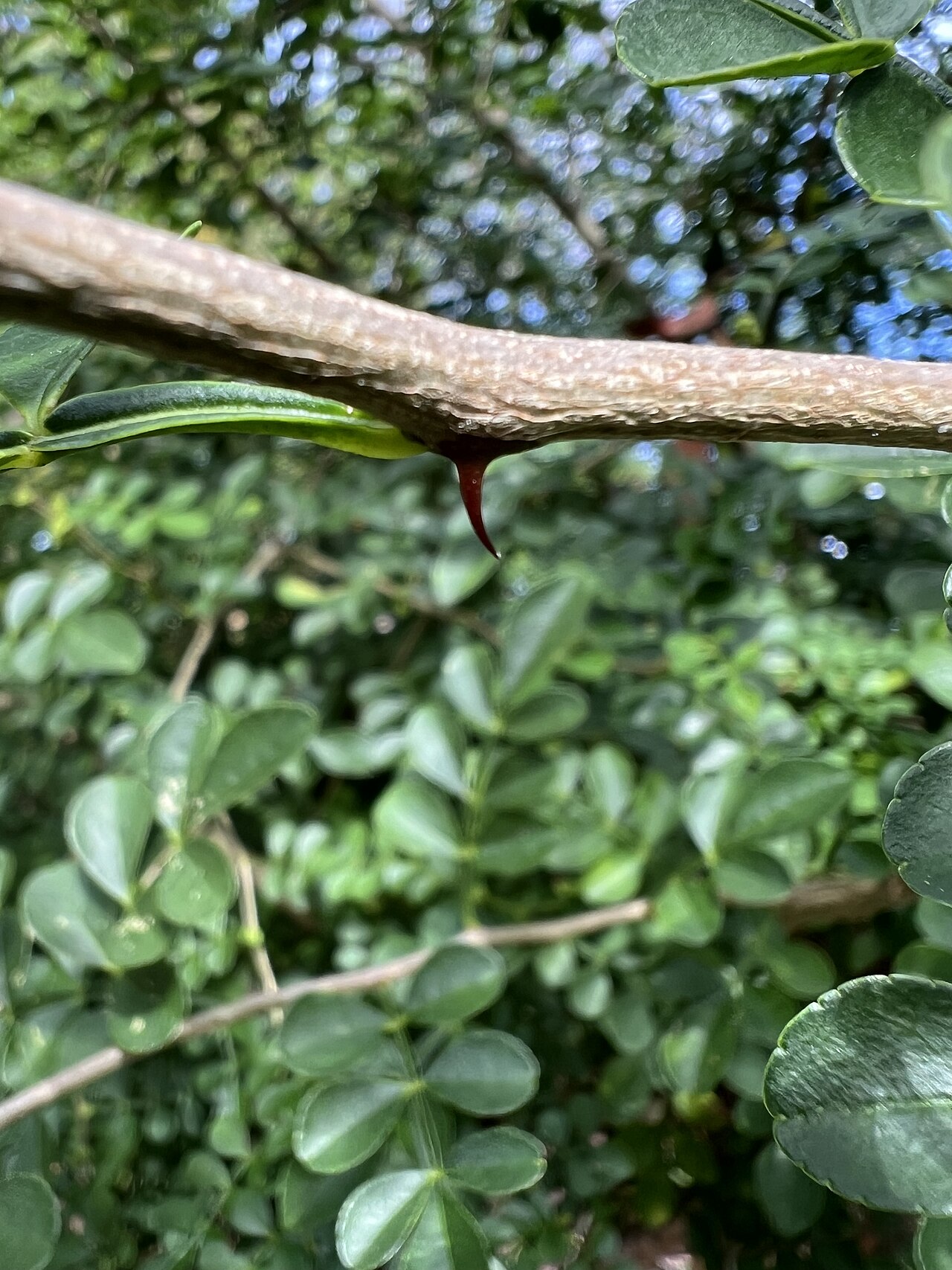
Young stems are smooth, grayish-tan, and dotted with small corky bumps (lenticels). The most distinctive feature of the plant is found here: paired, stout, curved prickles that sit just below each leaf node, pointing downward like small reddish-brown hooks. These prickles readily snag clothing and skin, which is why the species also goes by “wait-a-minute bush” in some parts of its range. Older trunks develop light gray, slightly fissured bark.
Leaves
Leaves are alternate and pinnately compound, 2 to 4 inches long, with 3 to 9 (usually 5 to 7) rounded to elliptical leaflets that have a winged, jointed rachis (leaf stalk) typical of citrus-family plants. The leaflets are glossy dark green above, paler beneath, with scalloped or finely toothed margins and translucent oil dots visible when held up to light. The foliage is evergreen to semi-evergreen, persisting through all but the hardest freezes, and releases a strong citrus-turpentine smell when crushed.
Flowers
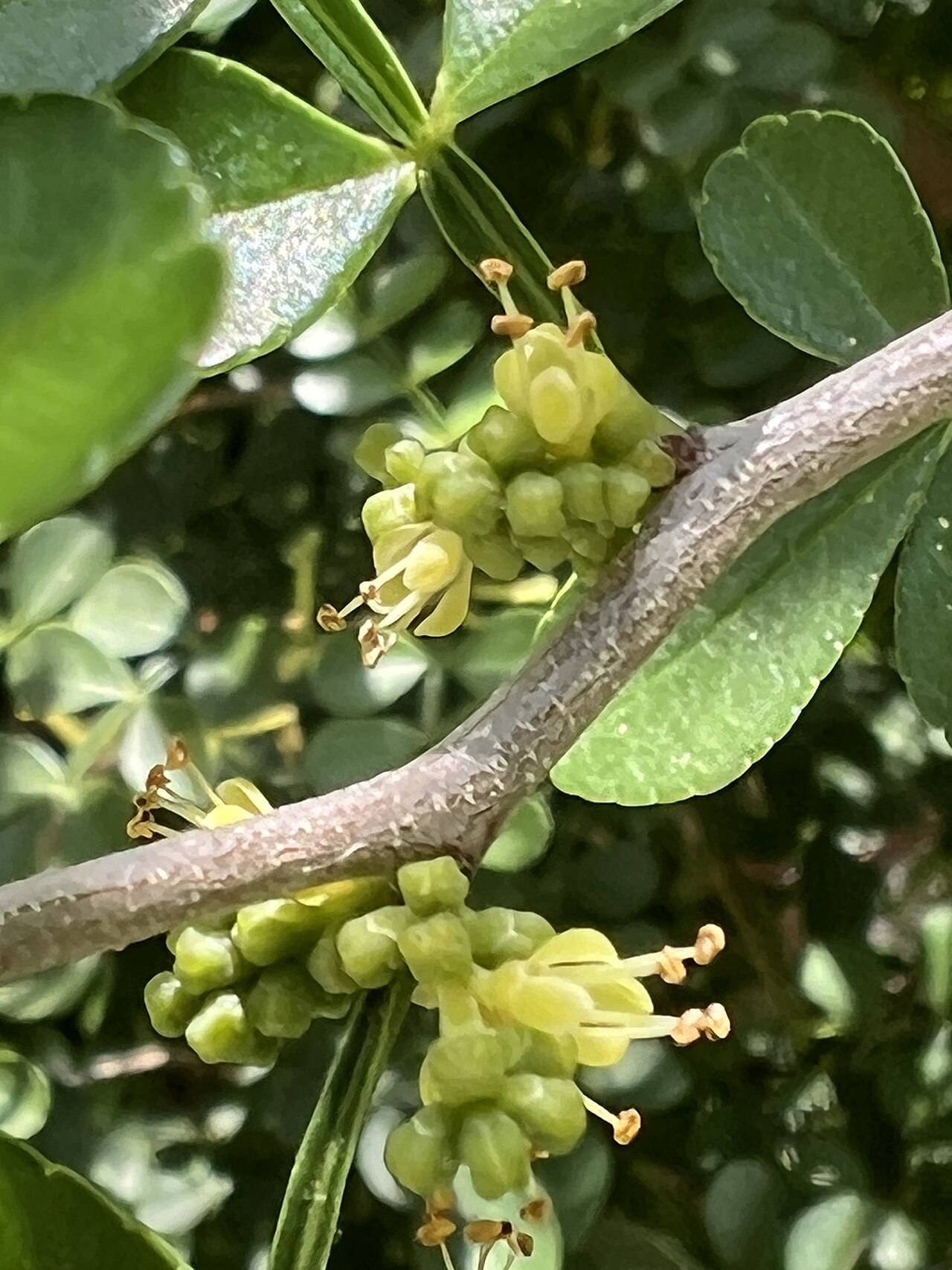
Lime Pricklyash is dioecious — male and female flowers occur on separate plants. Flowers are tiny, greenish-yellow, and borne in dense clusters (cymes) in the leaf axils. Individual flowers lack showy petals of any size and are easy to overlook, but the plant can flower on and off through much of the year in frost-free locations, with a strong peak in late winter and spring. The bloom is a magnet for small native bees and other short-tongued pollinators at a time when few other nectar sources are active.
Fruit & Seeds
Only female plants produce fruit: small, wrinkled, reddish-brown to purplish follicles about 1/4 inch across, borne in loose clusters. Each follicle splits open at maturity to reveal a single glossy black seed that hangs briefly from a slender thread before dropping or being taken by a bird. The seeds and the oily follicle husks carry the same citrus-pepper aroma as the leaves.
Quick Facts
| Scientific Name | Zanthoxylum fagara |
| Family | Rutaceae (Citrus) |
| Plant Type | Evergreen to Semi-Evergreen Shrub / Small Tree |
| Mature Height | 10–25 ft (3–8 m) |
| Mature Spread | 8–15 ft |
| Growth Rate | Slow to moderate |
| Sun Exposure | Full Sun to Part Shade |
| Water Needs | Low once established |
| Soil Type | Sandy, caliche, or limestone; well-drained |
| Soil pH | Neutral to alkaline |
| Bloom Time | Nearly year-round in frost-free areas; peak late winter–spring |
| Flower Color | Greenish-yellow |
| Fall Color | None (evergreen) |
| Fruit | Small reddish-brown follicles with glossy black seeds (female plants only) |
| Deer Resistant | Yes (thorny, aromatic foliage) |
| USDA Hardiness Zones | 9b–11 |
Native Range
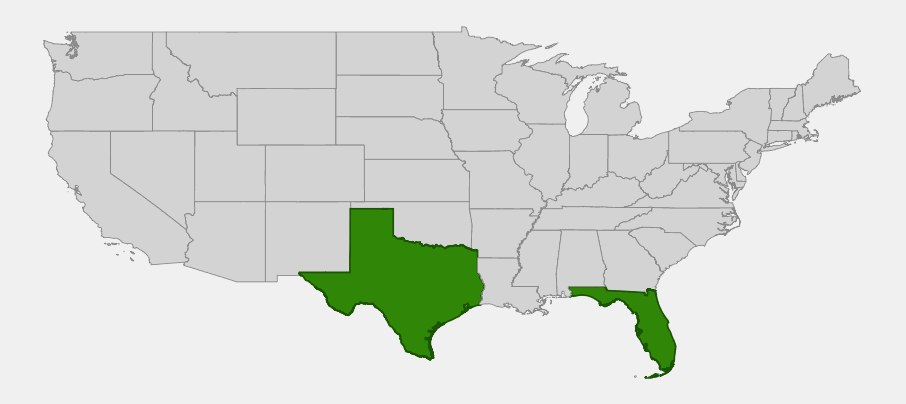
Lime Pricklyash is native to the southern tip of Texas — chiefly the Rio Grande Valley and the coastal counties running up toward Corpus Christi — and to the Florida peninsula, including the Keys. From there its range continues south through the Caribbean, eastern and southern Mexico, and into Central America and northern South America, making the U.S. populations the northernmost edge of a much larger tropical and subtropical distribution.
Within South Texas it is a signature member of Tamaulipan thornscrub, growing alongside other spiny, drought-adapted shrubs on clay and caliche soils of the Rio Grande Plain. In Florida it occupies a different but equally demanding niche: coastal hammocks, pine rockland edges, and shell middens where salt tolerance and drought tolerance matter more than cold hardiness. In both regions it tends to show up on the better-drained, slightly elevated ground within otherwise flat terrain.
Lime Pricklyash is not cold-hardy; a hard freeze will kill it back or outright kill young plants, which is why its U.S. range stops abruptly at the subtropical/temperate boundary in both Texas and Florida. Gardeners outside its native counties sometimes grow it as a container plant or in warm microclimates, but it should not be planted where it can escape into native plant communities outside this range.
📋 Regional plant lists featuring Lime Pricklyash: South and West Texas
Growing & Care Guide
Lime Pricklyash is close to maintenance-free once it is through its first year or two, which makes it a good choice for tough, exposed sites where more delicate shrubs struggle.
Light
Full sun produces the densest, most compact growth and the heaviest flowering. The plant also tolerates light to moderate shade under taller trees, where it grows looser and more open while reaching for light.
Soil & Water
This species is built for lean, well-drained ground — sandy loam, caliche, or shell-based soils are all fine, and it has no patience for soggy or heavy clay sites with poor drainage. Water regularly for the first growing season to establish roots; after that, Lime Pricklyash needs supplemental water only during extended drought. It tolerates salt spray and brief salt-water flooding well, which is part of why it thrives on the Gulf Coast and in the Keys.
Planting Tips
Plant from containers in spring once the danger of hard frost has passed, giving plants 6 to 10 feet of spacing if growing a hedge or thicket, more if you want an isolated specimen to show its arching form. Because the prickles are sharp, keep it away from walkways, patios, and play areas; a property-line planting or a back-of-border wildlife hedge is a better fit than a foundation planting.
Pruning & Maintenance
Little pruning is needed beyond removing dead wood and shaping young plants to the desired form; wear heavy gloves and long sleeves, since both old and new growth carry prickles. Established plants tolerate hard pruning and resprout readily if cut back after a rare hard freeze.
Propagation
Lime Pricklyash is most often propagated from seed collected from ripe, splitting follicles in fall; germination improves after a period of cold-moist stratification or simply sowing fresh seed outdoors. Semi-hardwood cuttings taken in summer will also root under mist, though less reliably than seed.
Landscape Uses
- Wildlife hedgerow along property lines in South Texas or Florida
- Butterfly garden host plant for giant swallowtail caterpillars
- Coastal and salt-tolerant plantings near the Gulf or barrier islands
- Thornscrub and brushland restoration projects
- Living security barrier where its prickles deter foot traffic
- Xeriscaping for low-water South Texas and Florida gardens
Wildlife & Ecological Value
For a plant most people walk past without a second glance, Lime Pricklyash punches well above its weight in supporting local food webs.
For Pollinators
The small, nectar-rich flowers bloom heavily in late winter and early spring, a lean period for South Texas and Florida pollinators, and are visited by a range of small native bees, wasps, and flies. Because male and female flowers occur on separate plants, a mixed stand of both sexes supports better pollination and fruit set.
For Butterflies
Lime Pricklyash is one of the key larval host plants for the giant swallowtail, North America’s largest butterfly, whose mottled brown-and-white caterpillars (sometimes called “orange dogs” for their resemblance to bird droppings) feed exclusively on citrus-family foliage. Other Zanthoxylum-feeding swallowtails use it as well.
For Birds
The dense, thorny branching gives small songbirds — including mockingbirds, cardinals, and various sparrows — secure nesting sites that are difficult for predators to reach. The small black seeds are eaten by a variety of resident and migratory birds once the follicles split open in fall.
Ecosystem Role
As a common thornscrub and hammock understory shrub, Lime Pricklyash helps bind sandy and caliche soils, provides year-round cover in habitats where winter deciduousness would leave gaps, and forms part of the thorny shrub layer that many South Texas and Florida wildlife species depend on for both food and shelter.
Cultural & Historical Uses
Lime Pricklyash belongs to the same genus as the “toothache trees” of the eastern and southern United States, and like its relatives, its bark and leaves contain pungent alkaloid compounds that produce a tingling, numbing sensation on the tongue. Historically, people in South Texas and Mexico chewed the bark or leaves for temporary relief from toothache pain, a folk remedy shared across several Zanthoxylum species long before modern dentistry was available locally.
The wood itself is pale, hard, and close-grained, but the plant’s small size and thorny habit have generally kept it out of lumber use; it has instead been valued more as a living fence or boundary hedge, since a dense row of Lime Pricklyash is genuinely difficult for livestock or people to push through.
In home landscapes today, Lime Pricklyash is grown almost entirely for its wildlife and butterfly-garden value rather than any practical product. The historical toothache remedy is worth knowing as folklore and plant history — it is not a recommended substitute for modern dental care, and the plant’s fruit and foliage should not be treated as food.
Frequently Asked Questions
Is Lime Pricklyash the same as a lime tree?
No. Despite being in the citrus family and having a citrusy smell, Lime Pricklyash does not produce edible lime fruit. Its small, hard follicles are a seed capsule, not a citrus fruit, and are not eaten by people.
Are the thorns on Lime Pricklyash dangerous?
They are sharp, hooked prickles that can scratch skin and snag clothing, which is why the plant earned the nickname “wait-a-minute bush,” but they are not toxic or otherwise medically dangerous — just uncomfortable. Plant it away from walkways and play areas.
Does Lime Pricklyash need a lot of water?
No. Once established, usually after its first full growing season, it is quite drought tolerant and needs supplemental water only during extended dry spells. Overwatering in heavy soil is more likely to cause problems than underwatering.
Will Lime Pricklyash survive a freeze?
Established plants can take a light frost and resprout from the base after a hard freeze, but the species is not reliably cold-hardy outside USDA zones 9b–11, which is why its native range stops at the Texas and Florida subtropics.
Why would I plant Lime Pricklyash instead of a more common hedge shrub?
If you garden in South Texas or Florida and want a true native that feeds giant swallowtail caterpillars, blooms when few other plants are active, and tolerates drought, salt, and poor soil without complaint, Lime Pricklyash offers wildlife value that most exotic hedge shrubs cannot match.