Rio Grande Cottonwood (Populus deltoides subsp. wislizeni)
Populus deltoides subsp. wislizeni, commonly known as the Rio Grande Cottonwood, is a massive, fast-growing riparian tree and the signature native species of the Rio Grande bosque, the band of floodplain forest that runs through New Mexico and far west Texas. This southwestern subspecies of eastern cottonwood is distinguished from its eastern relative by smaller, more rounded, finely toothed leaves and a greater tolerance for the hot, dry, alkaline conditions of the arid Southwest, where it still depends on reliable access to shallow groundwater or river moisture.
Rio Grande Cottonwood grows rapidly into an enormous shade tree, commonly reaching 50 to 90 feet tall with a broad, spreading crown and a massive trunk clothed in thick, deeply furrowed gray bark. Its waxy, triangular to heart-shaped leaves flutter in even light wind on flattened leaf stalks, turning a brilliant gold in autumn and giving the bosque its famous fall color. Few native Southwestern trees provide as much shade, wildlife habitat, or sheer visual presence along a riverbank.
For large properties with reliable moisture — riverside land, irrigated landscapes, or low spots that collect water — Rio Grande Cottonwood is an unmatched shade tree for the arid Southwest. It is not a fit for small yards or upland sites without supplemental water, but where conditions suit it, it is the backbone of riparian restoration and shade plantings from the Rio Grande Valley to the Pecos.
Identification
Rio Grande Cottonwood is a large, fast-growing deciduous tree with a broad, rounded to irregular crown and a thick trunk that can exceed 4 to 6 feet in diameter on old, undisturbed floodplain trees.
Bark & Stems
Young bark is smooth and pale greenish-gray; mature bark becomes thick, deeply furrowed, and ashy gray, with broad rounded ridges that give old trunks a rugged, corky appearance. Twigs are stout and yellowish-brown, with large, resinous, pointed buds that have a distinctive sweet, balsamic fragrance when the leaves first emerge in spring.
Leaves
Leaves are simple, alternate, broadly triangular to heart-shaped, 2 to 4 inches long, with finely rounded to serrate teeth along the margin — smaller and more rounded than those of eastern cottonwood. The flattened petiole allows the leaves to flutter and shimmer in even a light breeze, a trait shared by all cottonwoods and aspens. Foliage is a glossy medium green through summer, turning bright golden yellow in fall.
Flowers
Rio Grande Cottonwood is dioecious, with separate male and female trees. Flowers appear in drooping catkins in early spring before the leaves emerge, male catkins reddish and female catkins greenish, both wind-pollinated.
Fruit & Seeds
Female trees produce capsules that split open in late spring to early summer, releasing large quantities of tiny seeds embedded in cottony white fluff — the “cotton” that gives the tree its name and that can blanket the ground and drift through the air near mature female trees in late spring.
Quick Facts
| Scientific Name | Populus deltoides subsp. wislizeni |
| Family | Salicaceae (Willow) |
| Plant Type | Deciduous Tree |
| Mature Height | 50–90 ft |
| Mature Spread | 40–70 ft |
| Growth Rate | Fast |
| Sun Exposure | Full Sun |
| Water Needs | High (requires reliable groundwater or periodic flooding) |
| Soil Type | Deep, sandy to loamy river-bottom soils |
| Soil pH | Neutral to alkaline (6.5–8.5) |
| Bloom Time | February – April |
| Flower Color | Reddish (male) / greenish (female) catkins |
| Fall Color | Bright golden yellow |
| Fruit | Capsules releasing cottony-tufted seeds (female trees) |
| Deer Resistant | No (seedlings and young growth browsed) |
| USDA Hardiness Zones | 6–9 |
Native Range
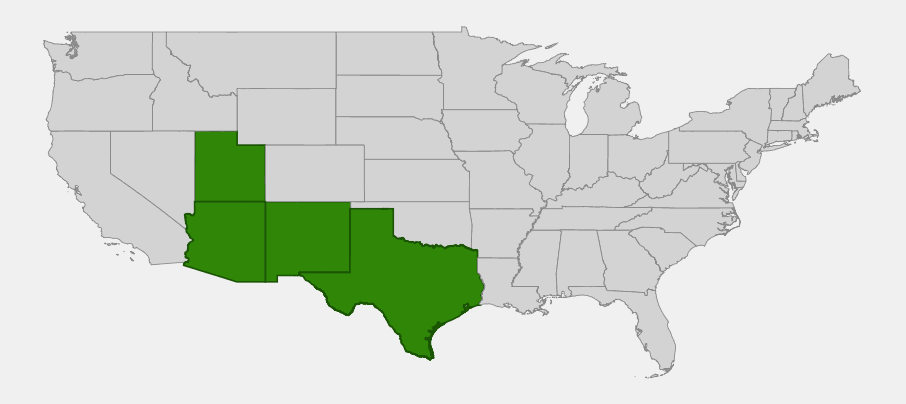
Rio Grande Cottonwood is native to the river valleys and floodplains of the arid Southwest, centered on the Rio Grande drainage of New Mexico and far west Texas, and extending west through the Gila and other river systems of Arizona and north into the Colorado River drainage of Utah, with its broader range reaching south into northeastern Mexico. It is the dominant native tree of the Rio Grande bosque, the riparian forest corridor that runs the length of the river through central New Mexico.
Throughout its range, this subspecies is confined almost entirely to riparian corridors — floodplains, riverbanks, and areas with shallow accessible groundwater — since its enormous water demand cannot be met by rainfall alone in the desert and semi-desert country it inhabits. It is rarely found far from a river, irrigation ditch, or similarly reliable water source.
Because Rio Grande Cottonwood is tied so closely to perennial or near-perennial water, it should not be expected to thrive as a dryland or upland planting anywhere in its native region; outside of riparian zones or irrigated sites, the related and more upland-tolerant native oaks, mesquites, and junipers of the Southwest are better choices.
📋 Regional plant lists featuring Rio Grande Cottonwood: South and West Texas · Arizona & New Mexico · Utah & Western Colorado
Growing & Care Guide
Rio Grande Cottonwood is a tree for sites with abundant water and plenty of room to grow — give it both and it becomes one of the fastest, largest shade trees available for Southwestern landscapes.
Light
Plant in full sun. Young trees establish and grow fastest with unobstructed overhead light, and mature specimens form their broad, spreading crown best in the open.
Soil & Water
This subspecies needs deep, consistently moist soil and performs best along riverbanks, in low areas that collect runoff, or on irrigated sites. It tolerates alkaline soils well but cannot survive extended drought without supplemental water, especially as a young tree. Mature trees with established root systems reaching groundwater are more drought-tolerant than young plantings.
Planting Tips
Plant in fall or late winter, choosing low-lying or riverside sites, or committing to regular irrigation on upland sites. Allow generous space — at least 40 to 50 feet from structures and 25 to 30 feet from other large trees — given its eventual size and vigorous, moisture-seeking root system, which can affect nearby foundations, pipes, or septic systems if planted too close.
Pruning & Maintenance
Prune to remove dead, crossing, or weakly attached limbs while the tree is young, since cottonwoods are prone to limb breakage as they age and grow heavy, brittle wood. Avoid planting female trees (which produce cottony seed fluff) near patios, pools, or gutters if the seasonal litter is a concern; male cultivars avoid this issue where available.
Propagation
Propagate easily from hardwood cuttings taken in the dormant season and inserted directly into moist soil, a traditional method used throughout the Rio Grande bosque for restoration plantings. Seed propagation is also possible but requires fresh seed sown immediately on consistently moist, bare soil.
Landscape Uses
- Riparian restoration along rivers, ditches, and floodplain corridors
- Large-property shade tree where ample water and space are available
- Windbreaks on irrigated agricultural land
- Erosion control on streambanks and floodplain edges
- Wildlife habitat plantings in riparian restoration projects
Wildlife & Ecological Value
For Birds
The Rio Grande bosque supports one of the richest concentrations of breeding and migratory birds in the arid Southwest, and Rio Grande Cottonwood is its foundation. Large cottonwoods provide nesting cavities for woodpeckers and secondary cavity-nesters, canopy nest sites for raptors including Great Horned Owls and Cooper’s Hawks, and critical stopover habitat for migrating songbirds and waterfowl.
For Mammals
Beavers rely heavily on cottonwood bark, twigs, and branches for food and dam-building material, and cottonwood bosques are classic beaver habitat throughout the Southwest. Deer and other browsers feed on young shoots and seedlings, which can limit natural regeneration in heavily browsed areas.
For Pollinators
As a wind-pollinated species, Rio Grande Cottonwood does not depend on insect pollinators, but its foliage supports numerous native moth and butterfly larvae, and the bosque understory it shades and shelters provides habitat for a wide range of pollinator-supporting native plants.
Ecosystem Role
Rio Grande Cottonwood is the structural backbone of the bosque ecosystem, creating a shaded, humid microclimate along desert rivers that supports an entire community of understory plants and wildlife otherwise absent from the surrounding arid landscape. Its roots stabilize riverbanks, its canopy moderates water temperature for aquatic life, and its decline due to reduced flooding, groundwater pumping, and competition from invasive saltcedar is a major conservation concern throughout the Rio Grande watershed.
Cultural & Historical Uses
Rio Grande Cottonwood has long held deep cultural significance for Indigenous peoples of the Rio Grande Valley, including Pueblo communities, for whom the tree provided shade, shelter, and material for traditional uses, and whose presence shaped settlement patterns along the river for centuries. The cottonwood remains an important cultural and ceremonial tree in many Pueblo communities today.
Historically, the wood was used for minor construction and fuel where larger timber was scarce in the desert Southwest, though cottonwood wood is soft and not highly prized compared to harder native woods. In New Mexico, mature Rio Grande Cottonwoods, some estimated at well over a century old, are valued landmarks of the bosque and are actively protected and replanted as part of ongoing riparian restoration efforts along the Middle Rio Grande.
Today the tree is celebrated each fall for the brilliant gold color it brings to the bosque, drawing visitors to the river corridors of Albuquerque, Santa Fe, and other New Mexico communities during peak autumn color.
Frequently Asked Questions
How is Rio Grande Cottonwood different from Eastern Cottonwood?
Rio Grande Cottonwood is a Southwestern subspecies of eastern cottonwood with smaller, more rounded, finely toothed leaves and greater tolerance of heat, aridity, and alkaline soils, provided its water needs are met. See our Eastern Cottonwood page for the more widespread species.
Does Rio Grande Cottonwood need a lot of water?
Yes. It is a riparian species that depends on reliable access to shallow groundwater, river moisture, or irrigation. It is not drought tolerant and is not suited to dry upland sites without supplemental water.
Will Rio Grande Cottonwood make a mess with cotton fluff?
Female trees release large amounts of cottony seed fluff in late spring, which can be messy near patios, pools, or gutters. Male trees produce no fluff, so choosing a male specimen avoids this issue where known male stock is available.
How big of a yard do I need for Rio Grande Cottonwood?
A large one. Mature trees commonly reach 50 to 90 feet tall with an equally wide canopy and an aggressive, moisture-seeking root system, so it is best suited to large properties, riversides, or parks rather than small residential lots.
Is Rio Grande Cottonwood native to Colorado?
County-level native records for this subspecies are concentrated in Texas, New Mexico, Arizona, and Utah. Colorado shows only general state-level presence without confirmed native county records for this subspecies, so it is not claimed as native here; the related Plains Cottonwood is the native cottonwood of Colorado’s plains rivers.

Looking for a nursery that carries Rio Grande Cottonwood?
Browse our native plant nursery directory: Texas & Utah · New Mexico · Arizona