Common Fishhook Cactus (Mammillaria tetrancistra)
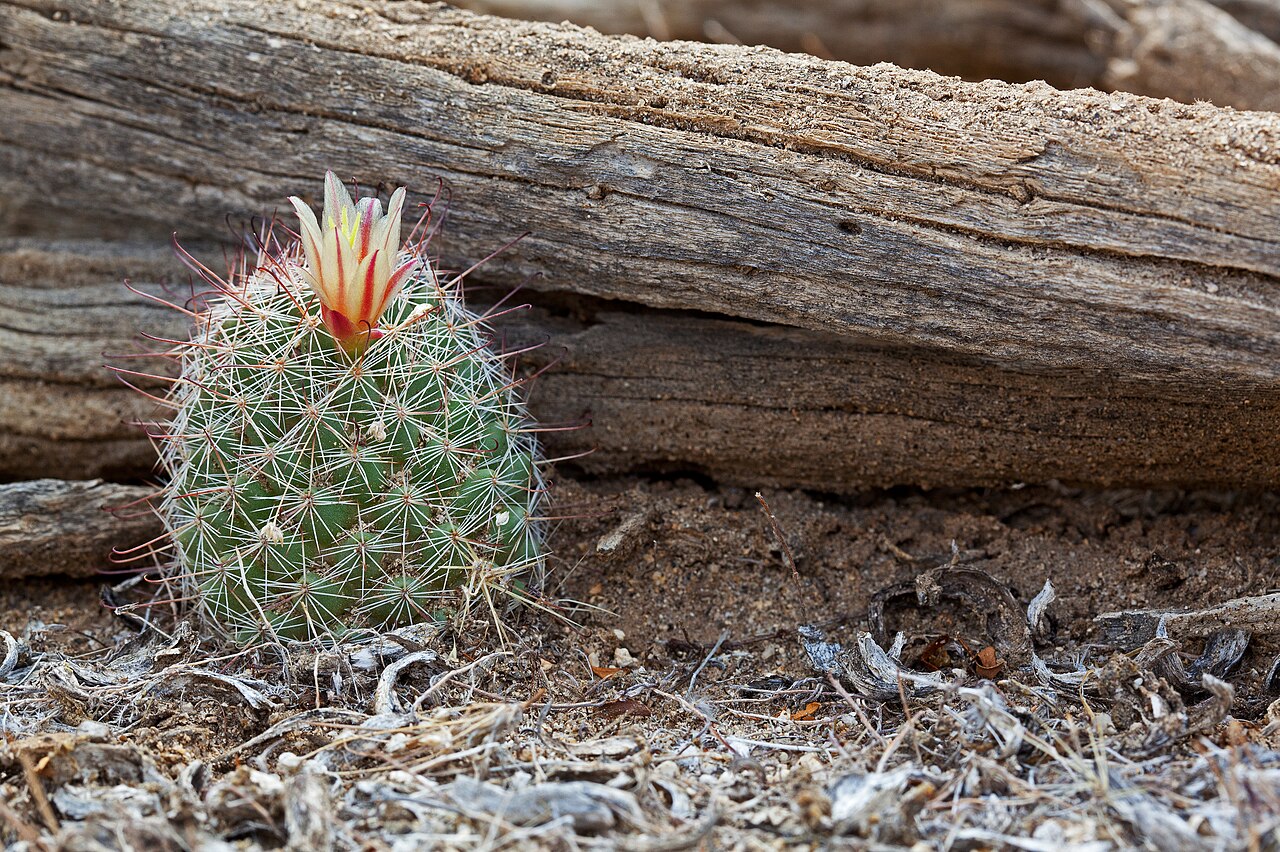
Mammillaria tetrancistra (recently reclassified by some botanists as Cochemiea tetrancistra), commonly known as common fishhook cactus, is a small, low-growing cactus scattered across the Mojave and Sonoran Deserts of California, Nevada, Arizona, and southwestern Utah. A member of the cactus family (Cactaceae), it is one of the more widespread and easily overlooked small cacti of the American desert Southwest, often tucked beneath shrubs or nestled against rocks where it is easy to miss until its pale pink flowers or bright red fruit catch the eye.
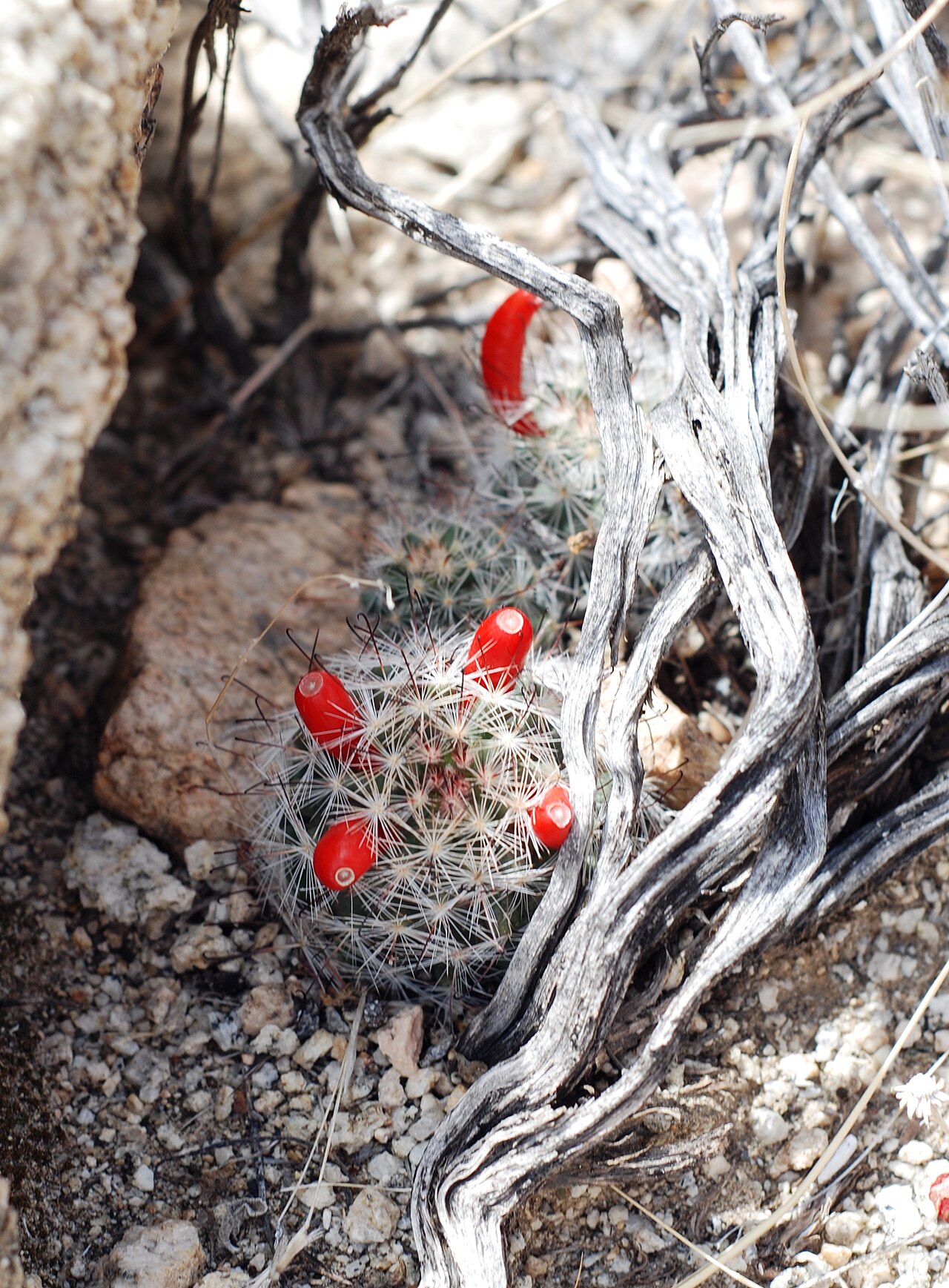
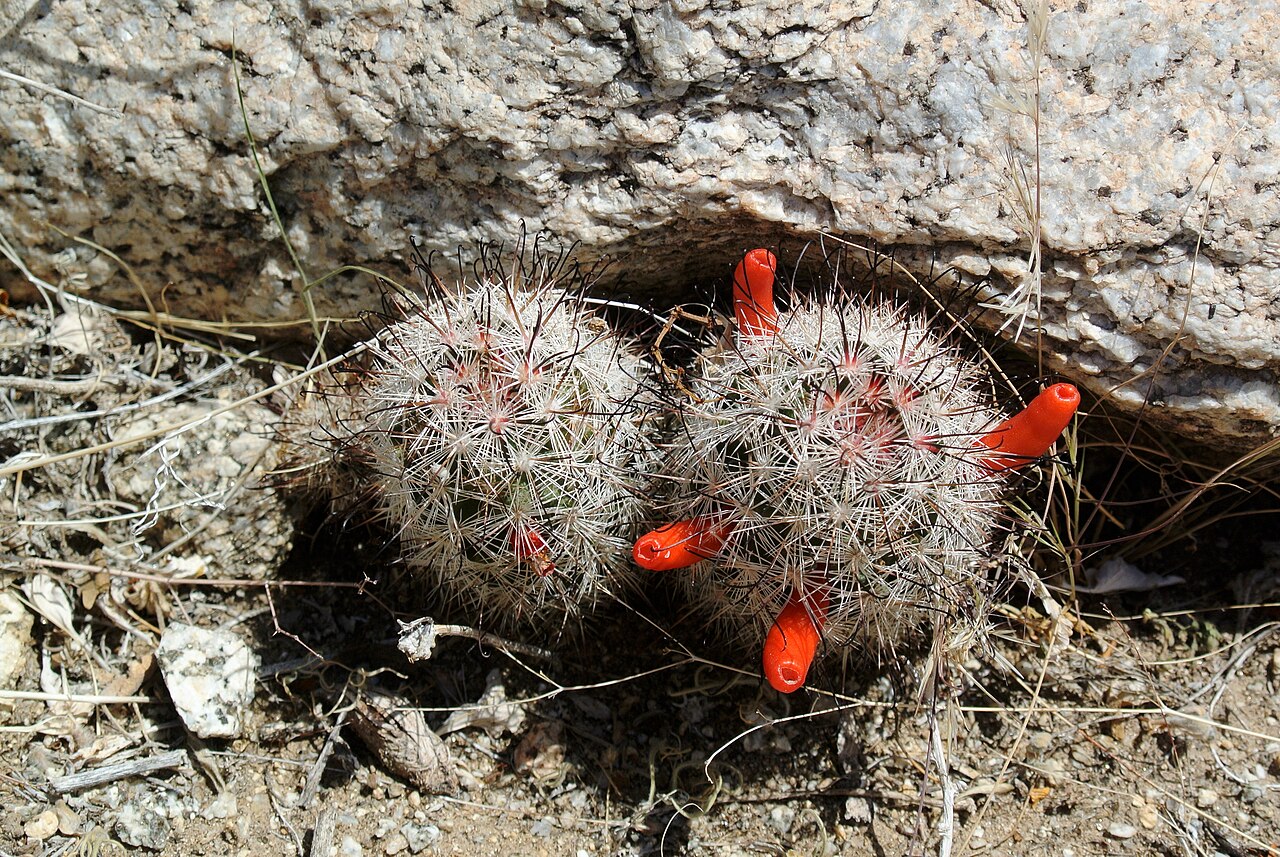
The plant forms a solitary, egg- to barrel-shaped stem covered in small conical tubercles, each tipped with a cluster of slender white radial spines and one or more strongly hooked central spines — the “fishhook” of its common name. In spring, funnel-shaped pale pink to lavender flowers ring the upper stem, followed by slender, bright scarlet-red fruits that are among the most conspicuous features of the plant and persist showily against the pale spines for weeks.
Common fishhook cactus thrives in open desert scrub, often growing partly hidden beneath the branches of larger shrubs that offer it some shade and protection. It is a modest but rewarding choice for desert gardens within its native range, valued more for its curious form and bright fruit display than for showy flowers, and well suited to rock gardens and desert habitat plantings that mimic its natural nurse-shrub associations.
Identification
Common fishhook cactus is a small, usually solitary, egg-shaped to short-cylindrical cactus typically 2 to 6 inches tall and 1½ to 3 inches in diameter, occasionally forming small clusters of a few stems with age.
Stem & Tubercles
The stem is pale to dull green, densely covered in small, conical tubercles (rather than ribs) arranged in spiraling rows, giving the plant a bumpy, knobby texture typical of the genus Mammillaria. The tubercles lack the milky sap found in some related species.
Spines
Each tubercle bears an areole with 20 to 40 slender, white to grayish radial spines and typically 1 to 4 (occasionally up to 4, hence “tetrancistra,” Greek for “four hooks”) longer central spines, at least one of which is sharply hooked at the tip. Central spines are reddish-brown to blackish, standing out against the pale radial spines.
Flowers
Flowers are funnel-shaped, 1 to 1½ inches across, with numerous narrow petals in pale pink to lavender-pink, sometimes nearly white, with darker pink midveins. They open in a ring near the stem’s crown from April through June, often appearing singly or a few at a time rather than in a dense flush.
Fruit & Seeds
The fruit is a distinctive feature: a slender, club-shaped berry up to 1 inch long that ripens to a vivid scarlet red, standing out sharply against the cactus’s pale spines. Fruits mature through summer and persist on the plant for weeks, eventually splitting to release small black seeds.
Quick Facts
| Scientific Name | Mammillaria tetrancistra (syn. Cochemiea tetrancistra) |
| Family | Cactaceae (Cactus) |
| Plant Type | Small Solitary Cactus |
| Mature Height | 2–6 in |
| Mature Spread | 1.5–3 in diameter |
| Growth Rate | Slow |
| Sun Exposure | Full Sun to Light Shade |
| Water Needs | Very Low |
| Soil Type | Gravelly, sandy, fast-draining |
| Soil pH | 7.0–8.5 (neutral to alkaline) |
| Bloom Time | April – June |
| Flower Color | Pale pink to lavender |
| Fall Color | None |
| Fruit | Slender scarlet-red berry |
| Deer Resistant | Yes |
| USDA Hardiness Zones | 7–10 |
Native Range
Common fishhook cactus is native to the Mojave and Sonoran Deserts of the American Southwest, with county-level records documenting bright-green native populations across southern Nevada and central and southern Arizona, and confirmed occurrences in the California desert (Jepson eFlora, Calflora) and in southwestern Utah’s Washington County, near the Mojave Desert transition around St. George. Its range continues south into Baja California and Sonora, Mexico.
Across this range it grows scattered through creosote bush scrub, desert pavement, and rocky or sandy flats, typically from 300 to roughly 5,000 feet elevation. It is frequently found growing partly hidden beneath the canopy of nurse shrubs such as creosote bush or bursage, which shelter it from the most extreme sun and temperature swings.
The species is not federally listed but, like most small desert cacti, benefits from being left undisturbed in the wild; its understated size and tendency to grow in the shelter of other plants make it easy to accidentally damage during off-road travel or ground disturbance.
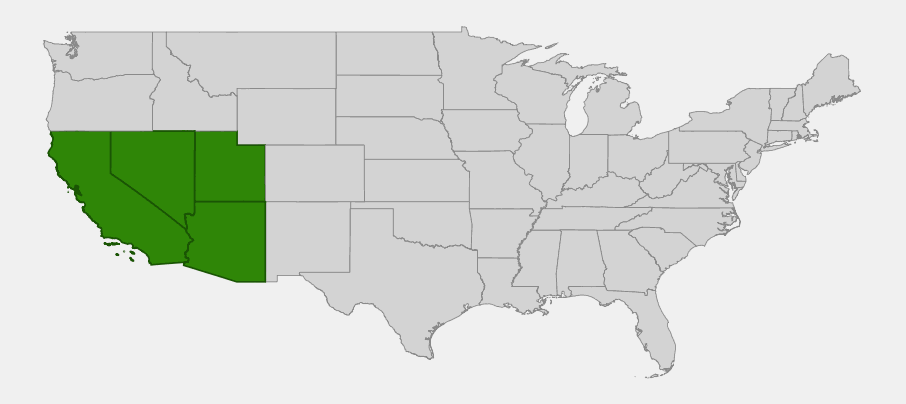
📋 Regional plant lists featuring Common Fishhook Cactus: California & Nevada, Arizona & New Mexico, Utah & Western Colorado
Growing & Care Guide
Common fishhook cactus is an easy-care miniature for desert gardens, asking mainly for sharp drainage, sun, and patience — this is a slow-growing species best enjoyed as a long-term, low-fuss addition rather than an instant garden feature.
Light
Full sun suits this species best in most garden settings, though in its wild habitat it often grows in the partial shade of nurse shrubs; light afternoon shade in the hottest low-desert gardens can mimic this and reduce stress.
Soil & Water
Fast-draining, gravelly or sandy soil is essential; this cactus does not tolerate wet feet. Water sparingly and only when soil is fully dry, reducing watering further in winter dormancy. Established plants in the ground need little to no supplemental water beyond natural desert rainfall.
Planting Tips
Plant in spring in a mineral cactus mix in a rock garden, raised bed, or container. Tucking it near the base of a small native shrub, as it grows naturally, can improve establishment by providing light shade and some frost buffering. Always use nursery-propagated plants rather than wild-collected specimens.
Pruning & Maintenance
No pruning is needed. Keep the area free of overhanging irrigation spray and competing vegetation that could shade it out or hold excess moisture against the stem. The plant is largely pest-free when grown in appropriately dry, sunny conditions.
Propagation
Propagate from seed sown in a gritty mix in spring; germination and growth are slow, and plants may take several years to reach flowering size. Division is not an option for this typically solitary species.
Landscape Uses
Common fishhook cactus fits a few specific but rewarding garden roles:
- Desert rock gardens tucked among stones or gravel mulch
- Container specimens for patios in frost-protected desert climates
- Native cactus collections showcasing Mojave and Sonoran Desert flora
- Underplanting beneath desert shrubs, echoing its natural nurse-plant habit
Wildlife & Ecological Value
Despite its small size, common fishhook cactus contributes meaningfully to desert food webs, particularly through its conspicuous, long-lasting fruit.
For Pollinators
The pale pink flowers attract native bees, which are the primary pollinators, along with occasional other desert insects drawn to the spring bloom during a season when floral resources in open desert can be limited.
For Birds
Small desert birds, including thrashers and sparrows, feed on the bright red fruits, which are easy to spot against the pale spines and remain available on the plant for an extended period.
For Mammals
Desert rodents and other small mammals eat the fruit and help disperse seeds, while the dense spine coat deters larger herbivores from browsing the stem itself. Some desert tortoises are also known to feed opportunistically on cactus fruit and pads where available.
Ecosystem Role
As a small, shrub-associated cactus, common fishhook cactus adds to the structural and species diversity of desert scrub communities, and its reliance on nurse-shrub shelter highlights the interconnected, facilitative relationships that allow many desert plants to establish and survive in harsh, open terrain.
Cultural & Historical Uses
Indigenous peoples of the Mojave and Sonoran Desert regions, including the Mojave, Chemehuevi, Southern Paiute, and Tohono O’odham, lived among a great diversity of cacti and were broadly familiar with small fishhook cacti like this species as part of the desert landscape, though it is not documented as a significant food or material source compared with larger, more productive cacti such as prickly pear or saguaro.
The species was first described by the German-American botanist George Engelmann in 1852. Its species name, “tetrancistra,” comes from Greek roots meaning “four hooks,” referencing the typical number of hooked central spines found on each areole, a key identifying trait that distinguishes it from related fishhook cacti with only a single hooked spine.
Today the plant is primarily of interest to desert botanists, native-plant gardeners, and cactus enthusiasts, prized more for its curious form, hooked spines, and brilliant fruit display than for any practical use.
Frequently Asked Questions
Why are there four hooks mentioned in the name?
The species name “tetrancistra” means “four hooks” in Greek, referring to the typical number of hooked central spines on each areole, which distinguishes it from related fishhook cacti that usually have just one hooked spine.
Are the red fruits edible?
This page does not recommend eating any part of common fishhook cactus; while some desert Mammillaria fruits have been used incidentally as food by wildlife and historically by some desert peoples, the fruit of this species is small and primarily of value to birds and small mammals rather than as a human food source.
Can I grow this cactus outside the desert Southwest?
It is difficult in humid or wet-winter climates. Common fishhook cactus needs intense sun, very fast-draining gravelly soil, and dry winter dormancy, so it is best grown in true desert gardens or containers where soil moisture can be tightly controlled.
Why does my plant grow next to a shrub instead of in the open?
In the wild, this species often grows sheltered beneath nurse shrubs like creosote bush, which moderate temperature extremes and provide some shade. Mimicking that placement in a garden, with light afternoon shade from a small shrub, can improve establishment.
How can I tell it apart from other small desert cacti?
Look for the combination of conical (not ribbed) tubercles, dense white radial spines with reddish-brown hooked central spines, pale pink flowers, and especially the slender, bright scarlet-red club-shaped fruit, which is one of its most distinctive and easily recognized features.

Looking for a nursery that carries Common Fishhook Cactus?
Browse our native plant nursery directory: California · Nevada · Arizona · Utah