Big Squirreltail (Elymus multisetus)
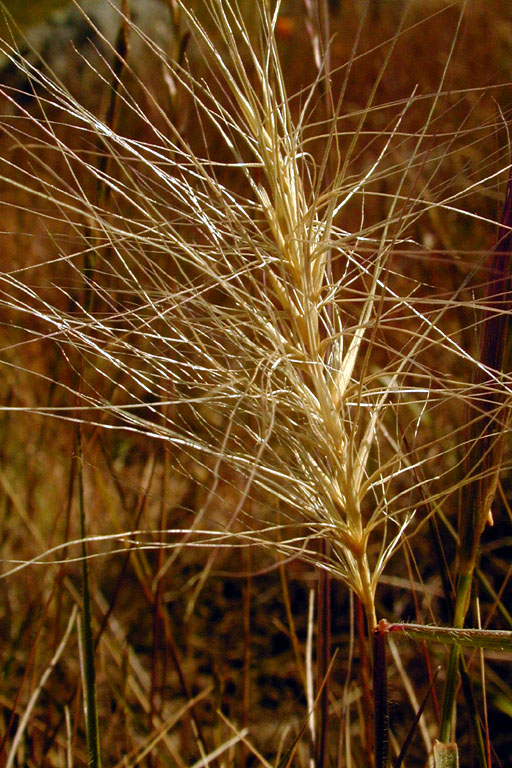
Elymus multisetus, commonly known as big squirreltail, is a short-lived, densely tufted perennial bunchgrass native to the dry mountains, foothills, and high deserts of the western United States. A member of the grass family (Poaceae), it belongs to the same genus as bottlebrush squirreltail (Elymus elymoides), a close relative it is frequently confused with and often grows alongside. Big squirreltail is easy to tell apart once its seedhead ripens: the awns are noticeably longer, softer, and more loosely spreading than those of its stiffer-bristled cousin, giving mature clumps a shaggy, windblown look that explains the “squirreltail” name.
This is a plant of harsh, open country — rocky slopes, sagebrush flats, pinyon-juniper woodlands, and disturbed ground from the Mojave Desert up into subalpine meadows. Big squirreltail germinates readily after fall and winter moisture, grows quickly in spring while the soil is still cool and moist, and then cures to a soft tan color as summer drought sets in. Individual plants are often short-lived, but established stands persist for years by reseeding themselves into bare, open microsites that other grasses cannot colonize.
Because it establishes fast, tolerates poor and disturbed soils, and produces deep, fibrous roots that stabilize soil, big squirreltail is widely used in rangeland restoration and post-fire rehabilitation seeding across the Great Basin and Intermountain West. In a home garden or naturalistic planting, it works well as a low-water accent grass for rock gardens, slopes, and dry meadow plantings where its early-season green growth and later straw-gold seedheads add texture through much of the year.
Identification
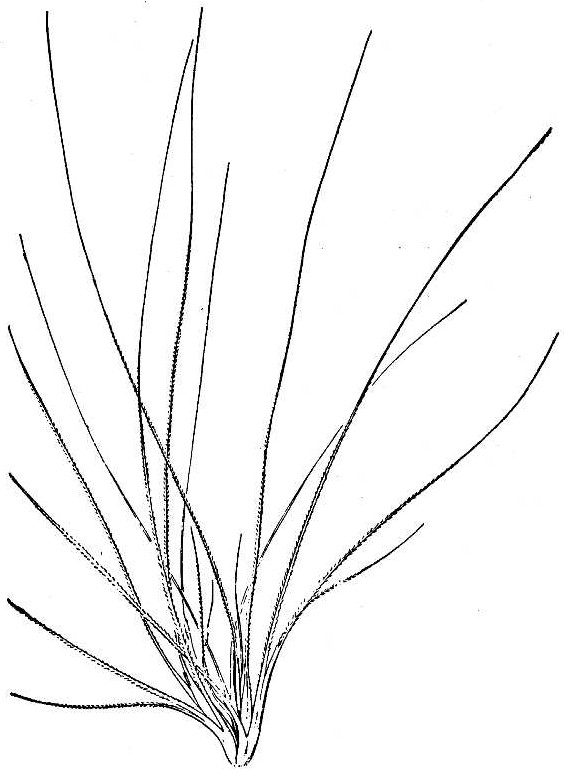
Big squirreltail is a small, densely clumped bunchgrass, usually 6 to 20 inches (15–50 cm) tall, with narrow basal leaves and slender, upright-to-arching flowering stems (culms). The whole plant has a fine, wiry texture until the seedhead matures, at which point the long awns take over the plant’s appearance.
Stems & Leaves
Culms grow in dense tufts from a fibrous root crown, usually 4 to 10 inches (10–25 cm) tall excluding the seedhead, sometimes taller on favorable sites. Leaf blades are narrow, flat or inrolled, 1 to 6 inches (2.5–15 cm) long and under ⅛ inch (3 mm) wide, often finely hairy and gray-green to blue-green in color. Leaf sheaths are typically hairy, a useful field mark that separates big squirreltail from the generally hairless-sheathed bottlebrush squirreltail.
Flowers & Seedhead
The flowering head is a dense, bristly spike 1 to 4 inches (2.5–10 cm) long, excluding awns. Spikelets occur in pairs at each node, each bearing two to several florets. The defining feature is the awns: in big squirreltail they are long — commonly 1.5 to 3 inches (4–8 cm) — thin, flexuous, and widely spreading to divergent at maturity, giving the ripe head a soft, shaggy, almost tumbleweed-like look. This contrasts with bottlebrush squirreltail, whose awns are shorter, stiffer, and more erect. Flowering occurs from late spring into early summer, with timing shifting earlier at lower, hotter elevations.
Fruit & Seeds
The grain is a small caryopsis enclosed in the floret, equipped with those characteristic long awns that aid wind dispersal and that also work the seed into soil cracks and animal fur — an effective, if occasionally irritating, seed-dispersal strategy. At maturity, the whole seedhead becomes brittle and breaks apart easily, scattering seed through late summer and fall.
Quick Facts
| Scientific Name | Elymus multisetus |
| Family | Poaceae (Grass) |
| Plant Type | Perennial Bunchgrass |
| Mature Height | 6–20 in (15–50 cm), taller in seed |
| Mature Spread | 8–14 in (20–35 cm) clump |
| Growth Rate | Fast (cool-season) |
| Sun Exposure | Full Sun |
| Water Needs | Low |
| Soil Type | Rocky, sandy, or gravelly; well-drained |
| Soil pH | 6.0–8.5 (tolerates alkaline soils) |
| Bloom Time | May – July |
| Flower Color | Pale green, curing to straw-tan |
| Fall Color | Tan/straw (dormant by midsummer) |
| Fruit | Long-awned caryopsis (grass seed) |
| Deer Resistant | Yes (grazed mainly while green) |
| USDA Hardiness Zones | 4–9 |
Native Range
Big squirreltail is native to the mountains, foothills, and high deserts of the western United States, from the eastern slope of the Cascades and Sierra Nevada across the Great Basin to the Rocky Mountain front. Its range runs from Washington and Oregon south through California and Nevada to Arizona and New Mexico, and east through Idaho, Utah, Colorado, and Wyoming. It is absent from the wetter, low-elevation valleys west of the Cascades and Sierra crest, where the climate is too moist for this drought-adapted bunchgrass.
Across this range, big squirreltail grows from low desert scrub up through sagebrush steppe, pinyon-juniper woodland, and open pine forest, into subalpine meadows at higher elevations — generally between 2,000 and 10,000 feet (600–3,000 m). It is especially characteristic of shallow, rocky, or disturbed soils: talus slopes, road cuts, burned areas, and the gravelly margins of sagebrush flats where competition from taller perennial grasses is reduced.
Big squirreltail is an important early colonizer after wildfire and other ground disturbance. Its fast germination and quick root development let it establish ahead of many competing species, and it is a standard component of post-fire and rangeland restoration seed mixes throughout the Great Basin and Intermountain West, where it helps stabilize soil and resist invasion by cheatgrass (Bromus tectorum) on recently disturbed ground.
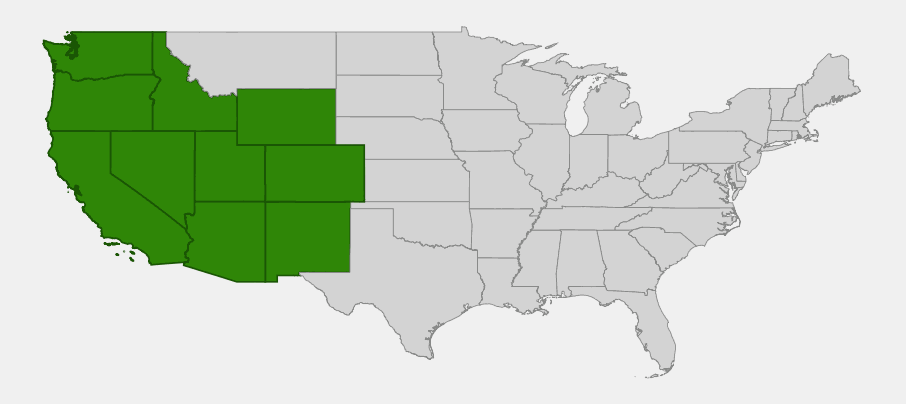
📋 Regional plant lists featuring Big Squirreltail: California & Nevada · Arizona & New Mexico · Utah & Western Colorado · Idaho, Eastern Oregon & Eastern Washington · Montana & Wyoming
Growing & Care Guide
Big squirreltail is about as low-maintenance as native grasses get, provided it has the sharp drainage and full sun it needs. It is not a plant for rich, irrigated garden beds — it performs best where conditions mimic its native rocky, open habitat.
Light
Give big squirreltail full sun. It is adapted to open, unshaded ground and will become sparse, floppy, and short-lived in shaded or densely vegetated sites where it has to compete for light.
Soil & Water
This grass needs sharply drained, rocky, sandy, or gravelly soil; it struggles and often rots in heavy clay or soils that stay wet. It is strongly drought-tolerant once established and should not be irrigated on a regular summer watering schedule — occasional deep watering during an unusually dry spring is more appropriate than routine summer irrigation. It tolerates alkaline and saline soils better than many garden grasses, reflecting its high-desert origins.
Planting Tips
Establish big squirreltail from seed sown in fall, so it can take advantage of winter moisture and cold stratification, or from container plants set out in fall or early spring. Space plants 8 to 12 inches apart for a naturalistic, textured ground cover, or scatter seed over disturbed or burned ground for erosion control. Avoid amending planting holes with rich organic matter, which can encourage rot and discourage the plant’s natural drought tolerance.
Pruning & Maintenance
Little maintenance is needed. Cut or rake out dead foliage in late summer once the plant has gone dormant and shed its seed, if a tidier look is wanted; otherwise the dried clumps can simply be left standing through winter for texture and wildlife value. Big squirreltail is a relatively short-lived bunchgrass, and stands are typically maintained over time by allowing some self-seeding into open soil rather than by dividing or replanting.
Propagation
Propagate from seed. Fresh seed benefits from a period of cold, moist stratification (naturally provided by fall sowing outdoors) to break dormancy and improve germination the following spring. Seed is commercially available from western native-seed suppliers for restoration and rangeland seeding use.
Landscape Uses
- Rock gardens and gravel gardens, where its fine, wiry texture complements stone
- Dry slopes and road cuts for erosion control and quick soil stabilization
- Post-fire and disturbed-ground restoration plantings
- Xeriscape and water-wise gardens in the Intermountain West
- Naturalistic meadow plantings mixed with other low-water native grasses and wildflowers
Wildlife & Ecological Value
Big squirreltail plays an outsized ecological role for a small, short-lived grass, largely through its ability to stabilize and recolonize disturbed ground ahead of slower-establishing perennials.
For Pollinators
As a wind-pollinated grass, big squirreltail does not offer nectar or showy flowers, but its fine foliage and loose clump structure provide shelter at ground level for native bees and other beneficial insects moving between nearby flowering plants.
For Birds
The small grains are eaten by sparrows and other seed-eating songbirds, and the dense basal tufts provide low cover and nesting material in open shrub-steppe habitat where taller vegetation is scarce.
For Mammals
Mule deer, pronghorn, and other grazers browse big squirreltail while it is green in spring, and small mammals such as ground squirrels and kangaroo rats use the grain as a food source and the clumps as cover. Once the awns mature and dry, however, the sharp, barbed seedheads can become a hazard, working into the eyes, mouths, and fur of grazing animals and pets — a trait common to many native squirreltail grasses.
Ecosystem Role
Big squirreltail’s deep, fibrous root system and rapid germination make it one of the most important native pioneer species on disturbed sagebrush-steppe and high-desert ground. By quickly occupying bare soil after fire, grazing disturbance, or erosion, it helps prevent invasion by cheatgrass and other weedy annuals, stabilizes slopes, and creates microsites where longer-lived perennial bunchgrasses can later establish.
Cultural & Historical Uses
Big squirreltail and its close relatives have long been part of the plant communities that Indigenous peoples of the Great Basin and Intermountain West managed and harvested for forage and seed. Wild rye grasses in this genus were among the native grains gathered by Great Basin tribes, including the Paiute and Shoshone, who incorporated small-seeded wild grasses into their diet alongside other native seed plants when more productive food sources were unavailable.
In the era of western range expansion, botanists and range scientists studying the Great Basin’s native grasslands recognized squirreltail species as resilient, drought-tolerant components of the native plant community capable of persisting under grazing pressure that eliminated less hardy grasses. This resilience is precisely what has made big squirreltail valuable in the modern era for a very different purpose: large-scale rangeland and post-fire restoration seeding.
Today, big squirreltail’s cultural significance is primarily as a workhorse restoration species. Land management agencies across the Great Basin rely on it, often in seed mixes with other native bunchgrasses, to stabilize soil and resist weed invasion after the increasingly frequent and severe wildfires that have reshaped sagebrush-steppe ecosystems in recent decades.
Frequently Asked Questions
What is the difference between big squirreltail and bottlebrush squirreltail?
Big squirreltail (Elymus multisetus) has longer, softer, more loosely spreading awns and hairy leaf sheaths, giving ripe seedheads a shaggy look. Bottlebrush squirreltail (Elymus elymoides) has shorter, stiffer, more upright awns and generally hairless sheaths. The two species overlap broadly in range and habitat and can grow side by side.
Is big squirreltail a good lawn substitute?
No. It is a clumping bunchgrass, not a spreading turf grass, and it goes dormant and turns tan by early-to-mid summer. It is better suited to rock gardens, slopes, and naturalistic dry plantings than to a mown lawn area.
Do the seedheads hurt pets or livestock?
The mature, dried awns are sharp and barbed and can work into fur, skin, eyes, and mouths, similar to foxtail grass seedheads. Keep an eye on pets after they walk through dry stands of mature squirreltail in late summer.
Does big squirreltail need irrigation once established?
No. Established plants are drought-tolerant and adapted to the dry summers of their native range. Regular summer irrigation can shorten the plant’s life and encourage root rot in its preferred rocky, fast-draining soils.
Why is big squirreltail used in restoration seeding?
It germinates and roots quickly after fall and winter moisture, tolerates poor and disturbed soils, and helps stabilize bare ground before slower-growing perennial grasses establish — making it valuable for post-fire rehabilitation and erosion control across the Great Basin and Intermountain West.

Looking for a nursery that carries Big Squirreltail?
Browse our native plant nursery directory: California · Nevada & New Mexico · Arizona · Idaho · Oregon · Washington · Utah · Colorado · Wyoming