Red Fescue (Festuca rubra)
Festuca rubra, commonly known as Red Fescue or creeping red fescue, is a fine-leaved, cool-season bunchgrass native to much of western and northern North America, including large stretches of the Pacific Coast and interior mountain West. It is one of the most useful and least demanding native grasses available to West Coast gardeners — forming soft, blue-green to dark green tufts of needle-thin leaves that stay attractive through conditions, shaded or sunny, moist or dry, where many other grasses struggle.
Red fescue is a variable species, with some populations forming tight bunches and others spreading steadily by underground rhizomes to knit together a loose, informal turf. This flexibility has made it one of the most widely used grasses in both native plant restoration and conventional horticulture: the same species that carpets coastal bluffs and mountain meadows in its wild form has also been bred into countless lawn and erosion-control cultivars sold worldwide. For native plant gardeners, though, straight species red fescue sourced from local or regional seed remains the better choice — delivering the fine texture and shade tolerance of the cultivated forms while supporting local ecology in a way that non-native turf blends cannot.
In the garden, red fescue earns its keep as a low-maintenance, low-water groundcover and lawn alternative, particularly in the partial shade where traditional turf grasses thin out. Left unmowed, it develops a loose, meadow-like texture and soft seed heads that catch the light; mowed occasionally, it can function as a walkable, drought-tolerant native lawn.
Identification
Red fescue is a slender, fine-textured perennial grass, typically reaching 1 to 2 feet tall in flower, though its vegetative foliage often stays considerably shorter and more mounded.
Leaves
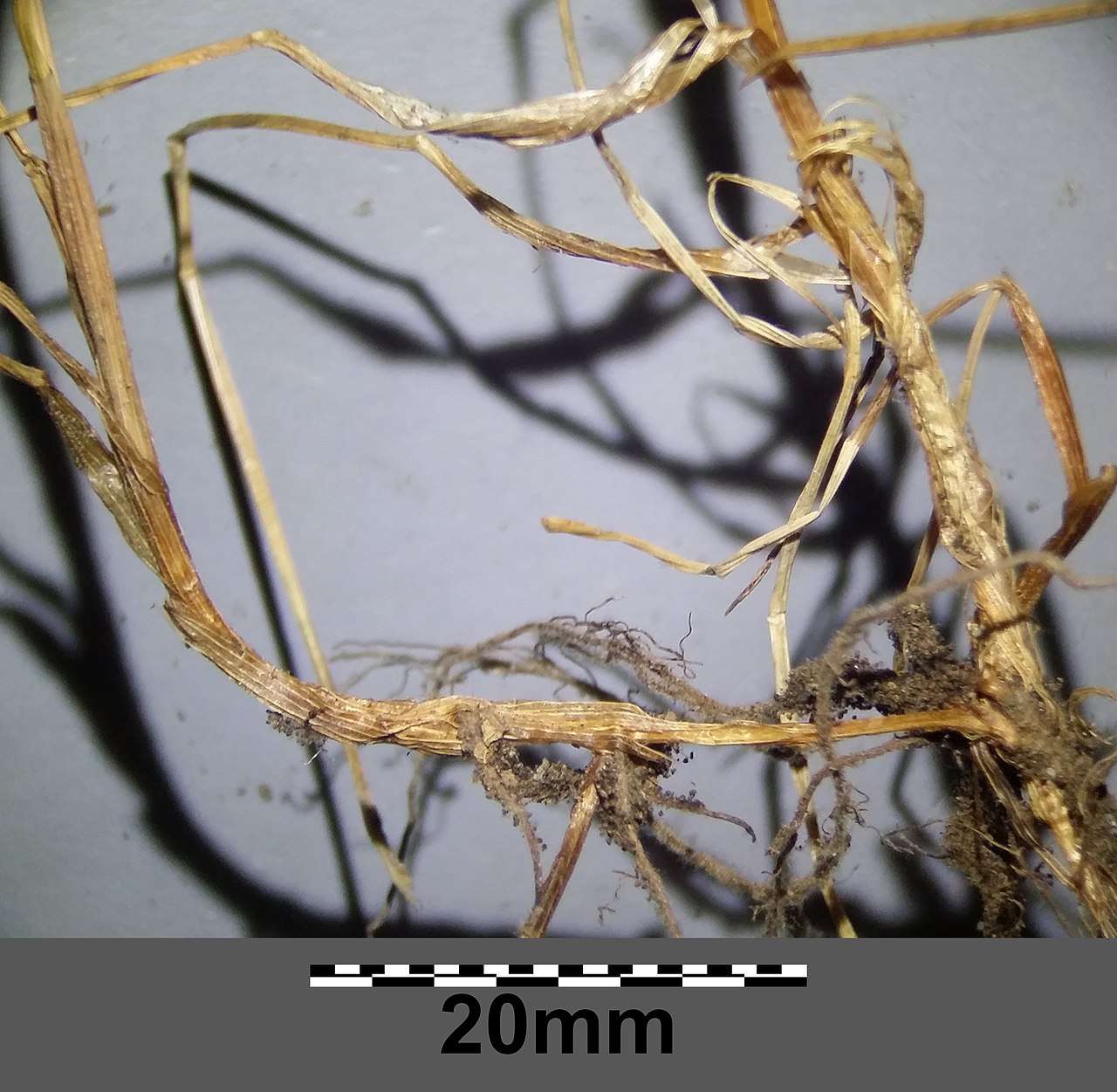
The leaves are narrow and needle-like — so fine they are sometimes described as bristle- or thread-like — giving the plant’s foliage a soft, almost hair-fine texture quite unlike coarser pasture or turf grasses. Leaf color ranges from bright to dark green, occasionally with a bluish cast, and the fine blades form dense, springy tufts. Some subspecies spread by short rhizomes to form a loose sod, while others remain strictly clump-forming; both growth forms occur within the species’ native range.
Flowers & Seed Heads
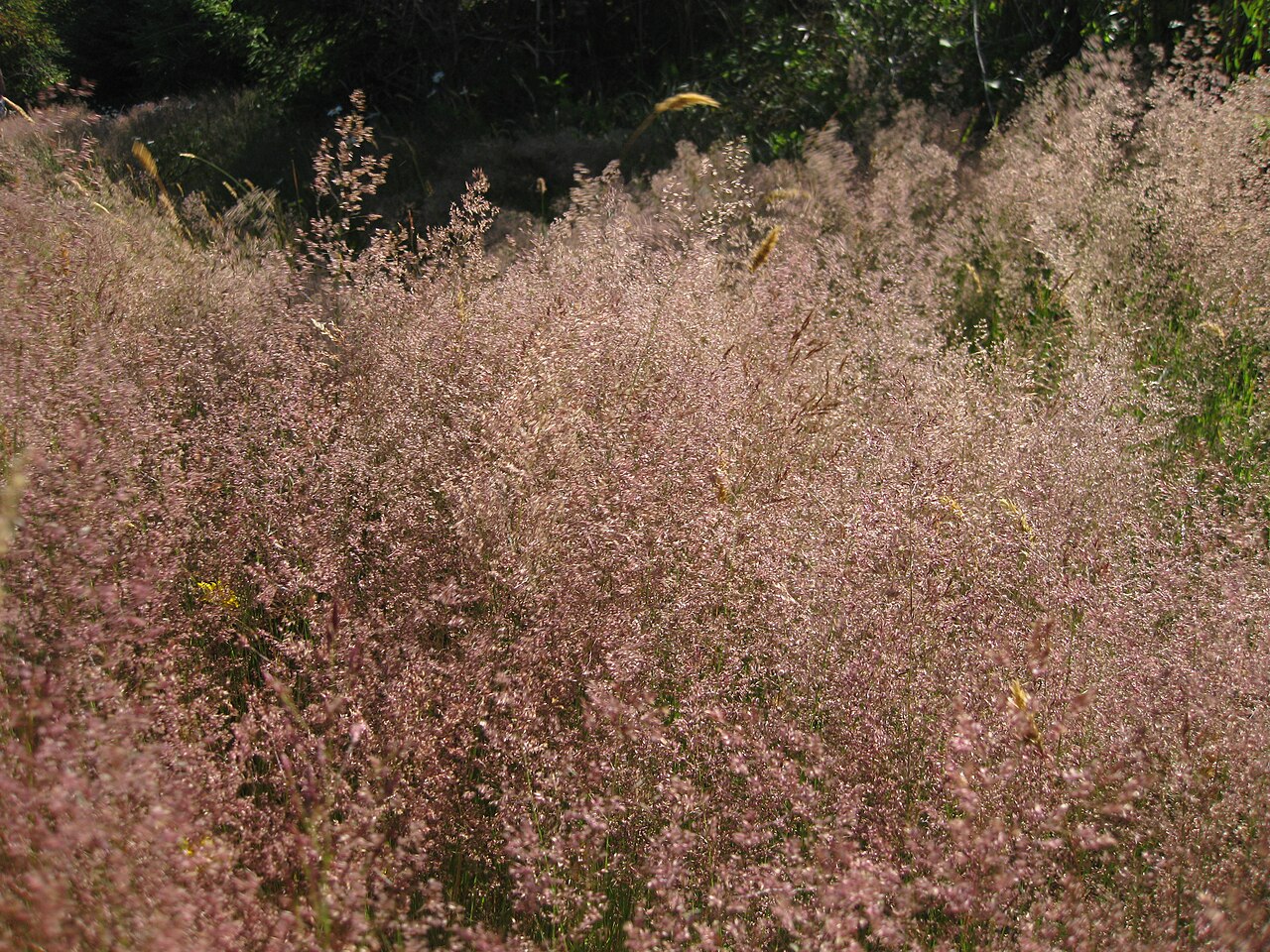
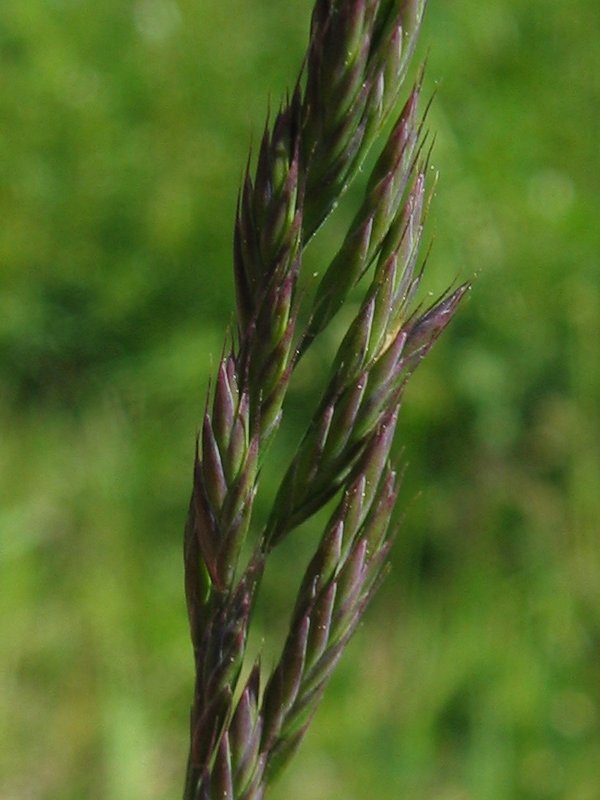
The flowering stems rise well above the foliage, carrying narrow, somewhat one-sided flower clusters (panicles) made up of slender spikelets, each holding four to ten small florets up to about half an inch long. In bloom, especially en masse, the flowering heads often take on a distinctive reddish, purplish, or bronze cast — the source of the plant’s common name — before fading to tan and buff as seed matures through summer.
Ligule & Stem Base
At the point where the leaf blade meets the sheath, red fescue has a very short, blunt ligule, a useful if subtle feature for distinguishing it from similar fine-leaved fescues in the field. The base of the plant is often tinged reddish-brown, especially on older growth, another small but consistent clue to its identity.
Quick Facts
| Scientific Name | Festuca rubra |
| Family | Poaceae (Grass) |
| Plant Type | Cool-Season Perennial Grass |
| Mature Height | 1–2 ft (30–60 cm) in flower |
| Mature Spread | Spreading by rhizomes or tight clumps, by subspecies |
| Growth Rate | Moderate |
| Sun Exposure | Full Sun to Part Shade; notably shade-tolerant |
| Water Needs | Low to Moderate once established |
| Soil Type | Well-drained; tolerates sandy, loamy, or rocky soils |
| Soil pH | 5.0–7.0 (neutral to acidic) |
| Bloom Time | Late spring to early summer |
| Flower Color | Green, often flushed reddish-purple |
| Fall Color | Remains green; tan where summer-dormant |
| Fruit | Small grain within the spikelet |
| Deer Resistant | Fairly resistant; low palatability to deer |
| USDA Hardiness Zones | 3–8 |
Native Range
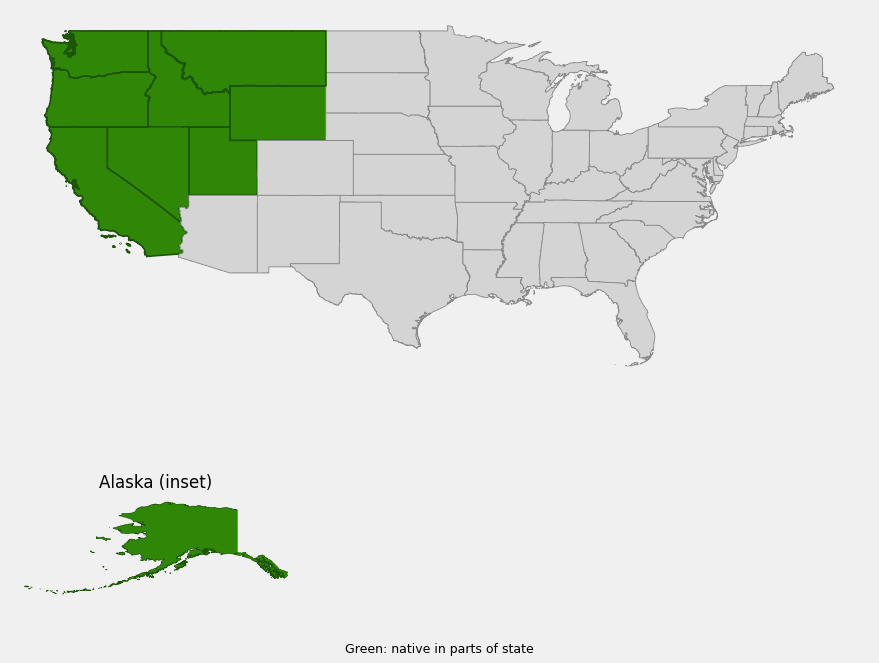
Red fescue has one of the broadest native distributions of any grass covered on this site, occurring across much of the cooler, wetter portions of western North America from Alaska south through the Pacific states and into the interior mountain West, as well as scattered populations further east and in eastern Canada. Within the western states featured here, it is confirmed native across California, Nevada, Oregon, Washington, Idaho, Montana, Wyoming, Utah, and much of Alaska, typically in cooler, moister microclimates within those states rather than the hottest, driest lowlands.
Red fescue’s natural habitats are correspondingly broad: coastal bluffs and dune swales along the Pacific Coast, subalpine and montane meadows through the Rocky Mountain states, moist forest openings and streambanks, and open grasslands at mid to high elevation. It is notably more tolerant of shade than most grasses, which allows it to persist in understory and woodland-edge settings where full-sun prairie and desert grasses cannot compete.
Because red fescue has also been extensively bred and planted as turfgrass and erosion-control seed worldwide, care is needed to distinguish naturally occurring native populations from widely sown agricultural and horticultural strains; the species carries both “native” and “introduced” status across parts of its range depending on whether a given population descends from wild stock or cultivated seed. Gardeners aiming for ecological value should seek regionally sourced, native-provenance seed rather than generic commercial turf blends.
📋 Regional plant lists featuring Red Fescue: California & Nevada · Idaho & Eastern Oregon/Washington · Montana & Wyoming · Utah & Western Colorado · Alaska · Western Oregon & Washington
Growing & Care Guide
Red fescue is forgiving and adaptable, which is precisely why it has become both a prized native groundcover and a global turfgrass staple. The straightforward care described here applies equally whether you are growing it as an informal meadow grass or a mowed native lawn alternative.
Light
Red fescue performs well across a wide range of light conditions but is particularly valued for its shade tolerance — one of relatively few grasses that stays dense and green under the partial shade of trees or north-facing slopes where conventional turf grasses struggle. It also grows well in full sun along the coast, especially where summer fog moderates heat.
Soil & Water
This species prefers well-drained soils and adapts to sandy, loamy, or even fairly rocky ground, tolerating neutral to acidic pH. Once established, red fescue is reasonably drought tolerant, going semi-dormant in the driest part of summer in warmer areas, then greening back up with fall rains. Regular but moderate watering during establishment helps develop a deep, resilient root system; established plantings in cooler coastal and mountain climates often need little to no supplemental irrigation.
Planting Tips
Sow seed or install plugs in fall or early spring, when cool, moist conditions favor germination and root establishment. For a meadow or groundcover planting, broadcast seed at a light to moderate rate and lightly rake it into prepared soil; for a native lawn substitute, denser seeding rates will produce a fuller sward more quickly. Choose seed sourced from populations native to your region rather than generic commercial turf cultivars for the best ecological fit.
Pruning & Maintenance
Red fescue can be left completely unmowed for a soft, meadow-like look with seed heads swaying through summer, or mowed occasionally — two to four times a year is usually plenty — to keep a tidier, lawn-like appearance. It tolerates light foot traffic reasonably well once established. Little to no fertilizer is needed in most native plantings; over-fertilizing tends to favor weedy competitors over the fescue itself.
Propagation
Red fescue is easily propagated from seed, and rhizomatous forms can also be divided and transplanted. Self-sown seedlings often appear naturally around established plantings, gradually filling in bare patches.
Landscape Uses
Red fescue’s fine texture and adaptability suit a wide range of garden roles:
- Native lawn alternative — mowed occasionally for a walkable, low-water groundcover
- Unmowed meadow plantings with a soft, informal texture
- Shade gardens beneath trees where turf grasses typically fail
- Erosion control on coastal bluffs, slopes, and streambanks
- Pollinator and bird habitat gardens as a structural grass component
- Mixed native grass plantings alongside California oatgrass and blue wildrye
Wildlife & Ecological Value
As a widespread, structurally important grass across coastal and montane plant communities, red fescue supports wildlife in ways that are easy to overlook but ecologically significant.
For Birds
The seed heads provide food for a variety of seed-eating songbirds, and the dense, fine-textured tufts offer good nesting cover and foraging habitat for ground-nesting birds in coastal and meadow habitats.
For Mammals
While red fescue has not historically been important livestock forage, owing to low productivity and only moderate palatability, wild grazers including deer and small mammals browse it to some degree, and the dense cover it forms is used as shelter by voles, rabbits, and other small mammals.
For Pollinators & Insects
As a wind-pollinated grass, red fescue does not offer nectar resources directly, but its foliage serves as a larval host plant for several native skipper and satyr butterfly species, and the structural cover it provides supports a range of grassland invertebrates that in turn feed insectivorous birds.
Ecosystem Role
Red fescue’s fibrous, sometimes rhizomatous root system helps bind soil on coastal bluffs, streambanks, and slopes, reducing erosion in habitats regularly exposed to wind, wave action, or runoff. Interestingly, the species has also been studied as a hyperaccumulator in arsenic-contaminated mine soils, concentrating the metal in its tissues — a reminder of how resilient and chemically tolerant this unassuming grass can be.
Cultural & Historical Uses
Red fescue’s modern fame rests almost entirely on its horticultural and agricultural use rather than any deep Indigenous ethnobotanical tradition specific to this species; it has not historically been documented as a significant food, fiber, or medicinal plant. Instead, its story is one of twentieth-century lawn and turf science: breeders selected and refined red fescue, particularly its rhizomatous “creeping red fescue” forms, into one of the most widely planted cool-season turfgrasses in the world, valued for exactly the shade tolerance and fine texture that make the wild species useful in native gardens today.
That commercial success has a double edge for native plant gardeners: the ubiquity of generic agricultural red fescue seed means that straight, regionally native-provenance stock can be harder to source than one might expect for such a common species. Seeking out seed collected from, or certified as sourced from, wild populations in your own region — rather than a big-box turf blend labeled simply “red fescue” — is the best way to get the genuine ecological benefits described on this page.
Beyond turf, red fescue continues to be used in erosion-control seed mixes for roadside and construction-site revegetation across much of its native range, a modern echo of the soil-stabilizing role it has always played naturally on coastal bluffs and mountain slopes.
Frequently Asked Questions
Is the red fescue sold at garden centers the same as native red fescue?
Often not exactly. Most commercial “red fescue” or “creeping red fescue” seed sold for lawns is a cultivated selection bred for turf performance rather than regionally native, wild-collected seed. For ecological plantings, look specifically for seed labeled as native or regionally sourced.
Can red fescue handle foot traffic like a regular lawn?
It tolerates light to moderate foot traffic reasonably well once established, though it is generally less traffic-tolerant than specialized turf cultivars bred for sports fields. For a casual, low-traffic native lawn it performs well.
Does red fescue need mowing?
No — it can be left unmowed for a soft, meadow-like look, or mowed a few times a year if a tidier, lawn-like appearance is preferred. Unlike conventional turf, it doesn’t require weekly mowing to look good.
Why do red fescue meadows sometimes look pink or red?
The flowering stems and spikelets often take on a reddish or purplish cast during bloom, which, seen in mass across a meadow, can give the whole planting a rosy haze — the source of the plant’s common name.
Is red fescue drought tolerant?
Once established, it handles moderate drought reasonably well, often going semi-dormant in the driest part of summer in warmer climates and recovering with fall rains, though it is not as extreme a drought survivor as true desert grasses.

Looking for a nursery that carries Red Fescue?
Browse our native plant nursery directory: California · Nevada · Idaho · Montana · Utah · Oregon · Washington · Alaska · Wyoming