Hall’s Panicgrass (Panicum hallii)
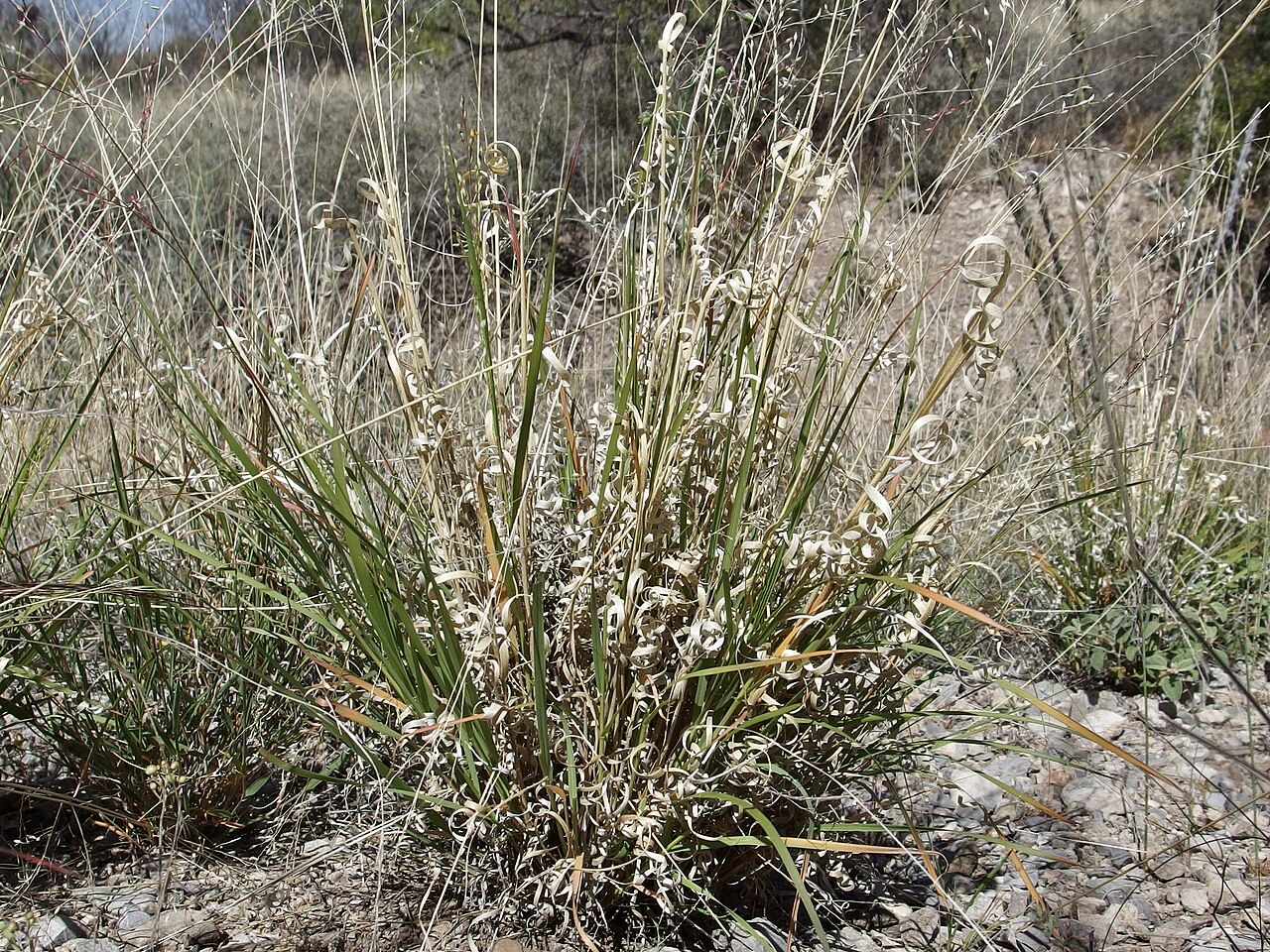
Panicum hallii, commonly known as Hall’s Panicgrass, is a small, tough perennial bunchgrass of the arid and semi-arid Southwest. It belongs to the large panic-grass genus (Poaceae), and while it rarely grows tall enough to catch the eye from a distance, it has one of the most distinctive and endearing field marks of any Southwestern native grass: as its flat leaf blades mature and dry, they curl and coil tightly like ribbons or wood shavings, giving dormant clumps a wild, tousled look that is almost unmistakable once you know to look for it.
Hall’s panicgrass forms neat, low tufts 1 to 2 feet tall, with no spreading rhizomes or stolons, so it stays exactly where it is planted. It is extremely drought tolerant and thrives on the same rocky, sun-baked slopes, arroyos, and desert grasslands where little else grows densely, making it a reliable, low-water choice for xeriscapes and native grass plantings across its range.
Because it is widespread, undemanding, and visually interesting through much of the year — green and upright in the growing season, curled and straw-colored in dormancy — Hall’s panicgrass has become a popular textural grass in Southwestern native gardens, valued as much for its curious winter form as for its contribution to habitat and erosion control.
Identification
Hall’s panicgrass is a small, warm-season perennial bunchgrass, typically 12 to 24 inches (30–60 cm) tall, growing in discrete, non-spreading clumps without rhizomes or stolons.
Growth Habit
Plants form a dense, low tuft of narrow leaves with slender flowering culms rising above. There is no underground spread — each clump stays put and slowly expands in diameter from the crown over the years, making it easy to use in defined plantings without fear of it running.
Leaves
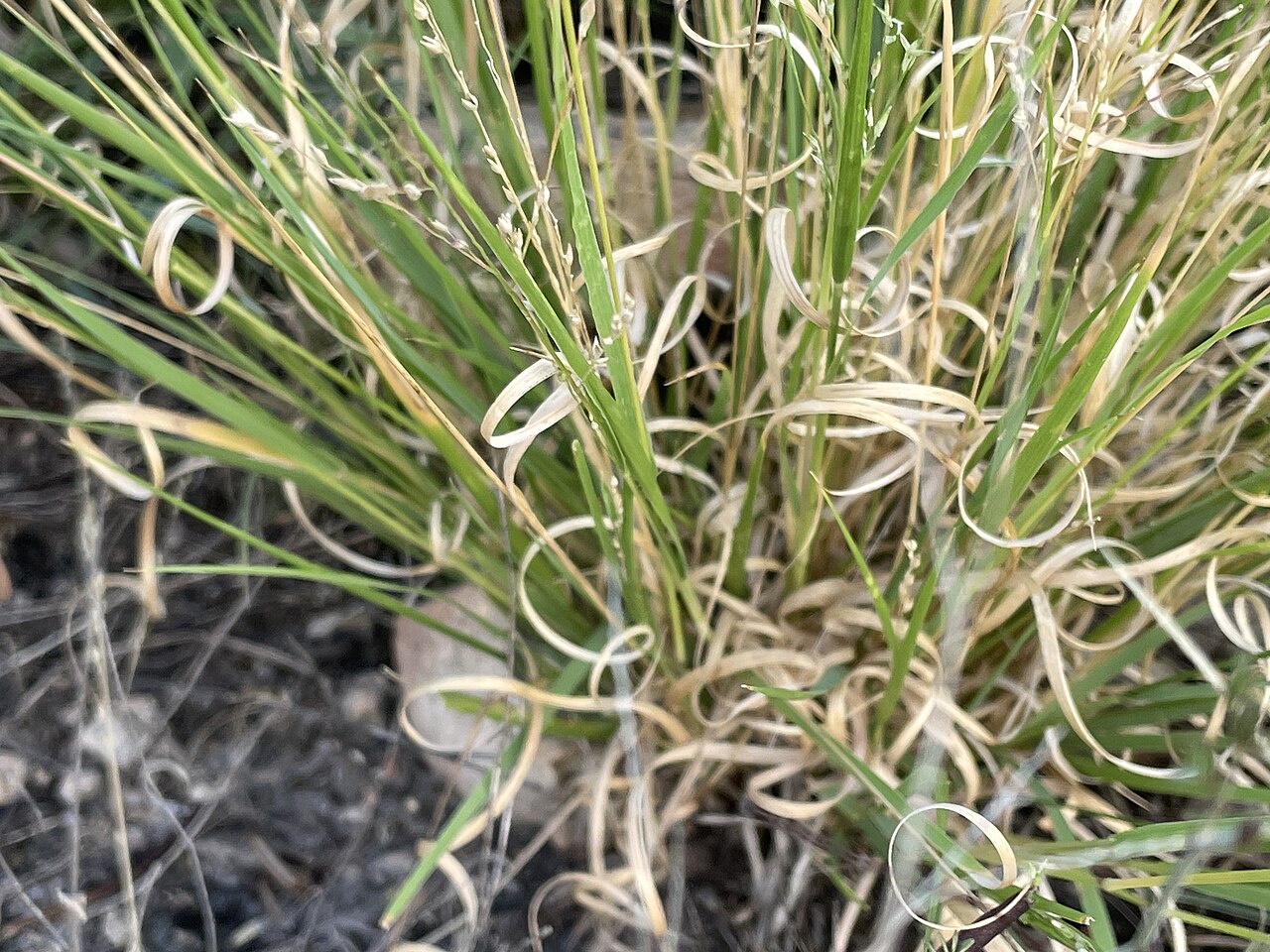
Leaf blades are flat and narrow when green and actively growing, but as they mature and dry — especially after frost or during drought dormancy — they curl and coil tightly, resembling thin ribbons or wood shavings. This curling habit is one of the most reliable field marks for identifying Hall’s panicgrass in winter or during dry periods, when many other grasses look similar.
Flowers & Seeds
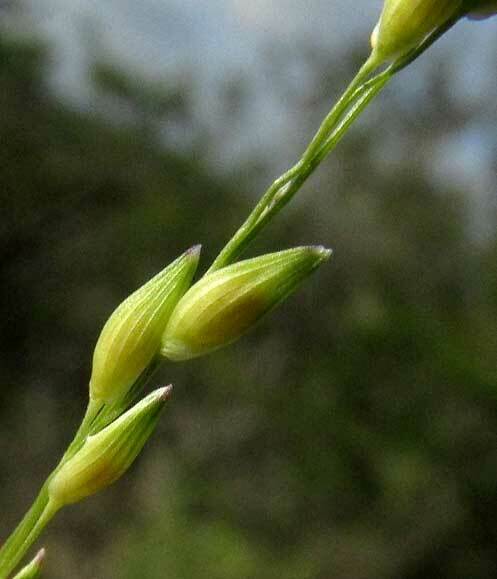
The inflorescence is an open, airy panicle bearing small spikelets, with the first glume notably shorter than the second. Flowering occurs over an unusually long season, from spring through fall (roughly April to November, peaking June through October), with green-and-brown florets that are inconspicuous individually but give a light, textured haze to the clump in bloom. As seeds ripen, the mature lemma becomes shiny, and the small grain turns a glossy dark brown.
Quick Facts
| Scientific Name | Panicum hallii |
| Family | Poaceae (Grass) |
| Plant Type | Perennial Bunchgrass |
| Mature Height | 1–2 ft (30–60 cm) |
| Mature Spread | 10–15 in clumps |
| Growth Rate | Moderate |
| Sun Exposure | Full Sun |
| Water Needs | Low once established |
| Soil Type | Rocky, sandy or caliche; well-drained |
| Soil pH | 6.5–8.0 (neutral to alkaline) |
| Bloom Time | April – November (peak June–October) |
| Flower Color | Green and brown |
| Fall Color | Straw-tan; blades curl when dormant |
| Fruit | Small, shiny dark brown grain (caryopsis) |
| Deer Resistant | Yes |
| USDA Hardiness Zones | 6–10 |
Native Range
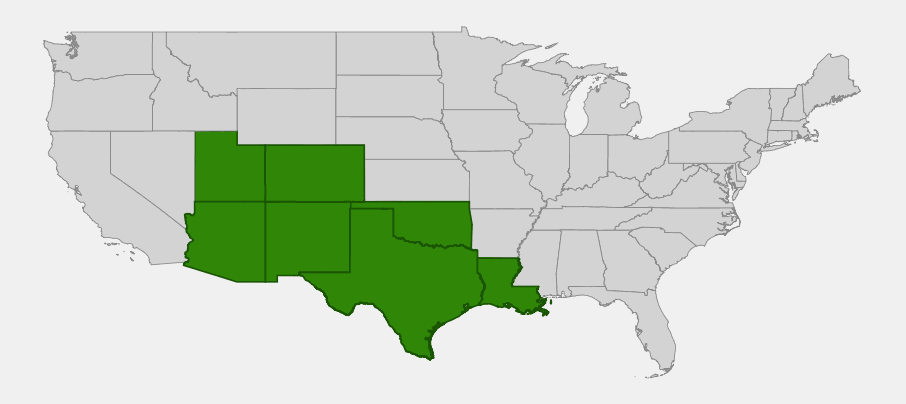
Hall’s panicgrass is native to the southwestern United States, ranging across Arizona, New Mexico, Utah, western Colorado, Texas, western and central Oklahoma, and Louisiana, extending south into northern and central Mexico. It is most abundant in Texas, New Mexico, and Arizona, where it is a common component of desert grasslands and rocky foothill vegetation.
Within this range, Hall’s panicgrass favors open, sunny ground on rocky slopes, arroyos, desert grasslands, caliche outcrops, and disturbed roadsides, generally at low to moderate elevations. It tolerates poor, thin soils and extended drought better than most grasses, which allows it to persist on sites too harsh for many other native grasses.
The species’ presence is well documented from the Trans-Pecos and Edwards Plateau of Texas, through southern New Mexico and Arizona’s desert grasslands, into the Colorado Plateau country of Utah and western Colorado, and east to isolated prairie and grassland sites in Oklahoma and Louisiana.
📋 Regional plant lists featuring Hall’s Panicgrass: South & West Texas · Arizona & New Mexico · Utah & Western Colorado · Arkansas, Louisiana, Eastern Oklahoma & Eastern Texas
Growing & Care Guide
Hall’s panicgrass is a low-water, low-maintenance bunchgrass well suited to Southwestern gardens that favor xeric plantings over thirsty lawns.
Light
Plant in full sun. Hall’s panicgrass is adapted to open, exposed, sun-baked sites and performs best with at least six hours of direct sun; in shade it grows sparse and floppy.
Soil & Water
This species is highly adaptable to lean, rocky, sandy, or caliche soils and needs excellent drainage. It is very drought tolerant once established, requiring little to no supplemental irrigation after the first growing season in most of its native range. Avoid heavy clay or consistently wet soil, which can lead to crown rot.
Planting Tips
Plant from container stock or direct-seed in spring after the danger of hard frost has passed, so seedlings can establish during the warm growing season. Space plants 12 to 15 inches apart for a naturalistic grassland look. Hall’s panicgrass transplants easily and establishes quickly compared to many native bunchgrasses, making it a good starter grass for native plantings.
Pruning & Maintenance
Cut back old growth in late winter before new spring growth emerges, which keeps clumps tidy and encourages fresh foliage; alternatively, leave the curling dry blades through winter for their ornamental, sculptural texture and cut back only every year or two. No fertilizer is necessary. Established clumps are long-lived and rarely need division.
Landscape Uses
Hall’s panicgrass fits a range of dry-climate garden styles:
- Xeriscapes and rock gardens as a low-water textural accent
- Desert grassland and prairie restorations in its native range
- Erosion control on rocky slopes and disturbed roadside cuts
- Winter-interest plantings, prized for its curling dormant leaf blades
- Mixed native grass borders alongside taller bunchgrasses for textural contrast
Wildlife & Ecological Value
As a widespread bunchgrass of arid grasslands, Hall’s panicgrass contributes modestly but reliably to Southwestern wildlife habitat.
For Birds
Seed-eating birds, including native sparrows, forage on the small ripe grains, and the dense basal tuft offers ground-level cover for quail and other ground-foraging birds in open desert grassland.
For Mammals
The foliage provides low-value but accessible forage for small mammals and, in rangeland settings, some grazing value for livestock and wildlife, particularly while green in the growing season; deer generally bypass it in favor of more palatable forage.
For Pollinators
Like other grasses, Hall’s panicgrass is wind-pollinated and offers no floral nectar, but its basal clumps provide shelter and overwintering habitat for ground-dwelling beneficial insects in otherwise sparse desert grassland.
Ecosystem Role
Hall’s panicgrass helps stabilize thin, rocky, and disturbed soils across the arid Southwest, its fibrous bunchgrass roots reducing erosion on slopes and arroyo banks. As a long-blooming, widely distributed native grass, it is a structural component of desert grassland communities that support a broader community of grassland-dependent wildlife.
Cultural & Historical Uses
Hall’s panicgrass does not carry a prominent documented history of food, fiber, or medicinal use by Indigenous peoples or early settlers, unlike larger-seeded grasses of the region. As one of many native bunchgrasses of the Southwestern desert grasslands, it was nonetheless part of the vegetation historically grazed by livestock on arid rangeland, and it continues to be recognized by range scientists as a useful, if minor, forage component on native Texas and Southwestern rangelands.
In more recent decades, Hall’s panicgrass has gained attention in horticulture and ecological restoration for its drought tolerance and distinctive curling foliage, and it has also been studied by plant scientists as a model species for genetic research into drought adaptation in C4 grasses, given its wide native range across varying rainfall and elevation gradients.
Today, the species is valued primarily for xeriscaping, native grassland restoration, and erosion control rather than any direct human use, offering gardeners in the arid Southwest a tough, low-water grass with genuine year-round visual interest.
Frequently Asked Questions
Why do the leaves of Hall’s panicgrass curl up?
As the flat leaf blades mature and dry out — especially after frost or during drought dormancy — they coil tightly into ribbon- or shaving-like curls. This is a normal, species-typical response to drying, not a sign of disease, and it is one of the most reliable ways to identify the plant when it is not in active growth.
Is Hall’s panicgrass the same as switchgrass?
No. Both belong to the genus Panicum, but switchgrass (Panicum virgatum) is a much larger prairie grass that can exceed 5 feet tall, while Hall’s panicgrass is a small, compact bunchgrass rarely topping 2 feet, suited to drier, rockier sites than switchgrass typically tolerates.
How much water does Hall’s panicgrass need?
Very little once established. In its native range it relies on seasonal rainfall alone and tolerates extended drought, making it one of the lowest-water native grasses available for Southwestern gardens.
Will Hall’s panicgrass spread and take over my garden bed?
No. It is a true bunchgrass with no rhizomes or stolons, so it stays in a discrete clump and spreads only slowly by seed, never running underground the way some ornamental grasses do.
Is Hall’s panicgrass good for erosion control?
Yes. Its dense fibrous root system and tolerance of poor, rocky soils make it a useful choice for stabilizing slopes, arroyo banks, and disturbed roadside cuts throughout its native Southwestern range.

Looking for a nursery that carries Hall’s Panicgrass?
Browse our native plant nursery directory: Arizona · New Mexico & Oklahoma · Utah & Texas · Colorado · Louisiana