Spearleaf Stonecrop (Sedum lanceolatum)
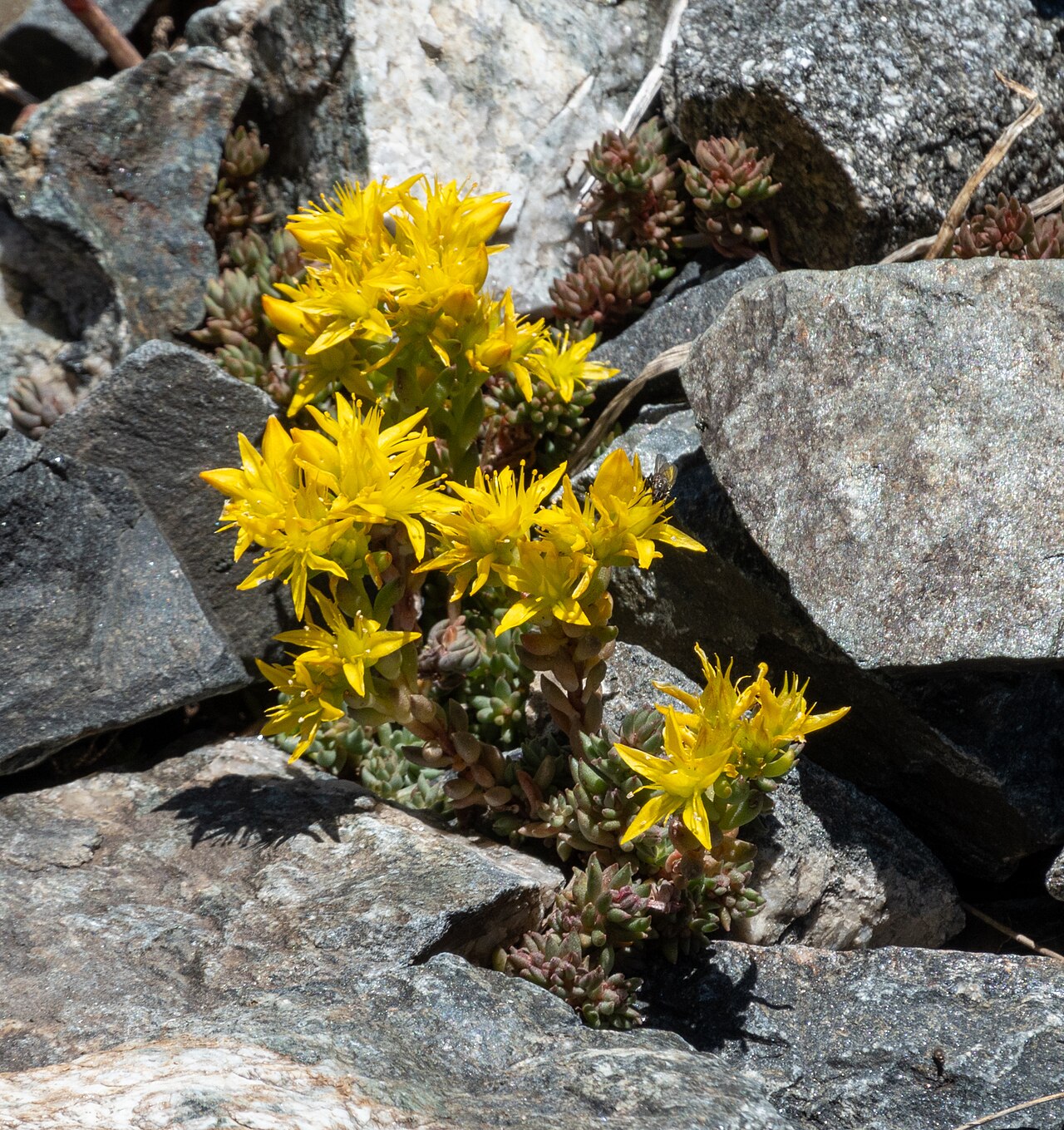
Sedum lanceolatum, commonly called Spearleaf Stonecrop or lanceleaf stonecrop, is a tough little succulent perennial that makes a living wherever most other plants cannot: bare rock ledges, gravel ridgetops, and thin alpine soils across the mountains of western North America. It belongs to the stonecrop family (Crassulaceae), the same group that gives gardeners hens-and-chicks and the many cultivated Sedum species sold at nurseries — except this one has never left the wild and is native to the very mountains it grows on.
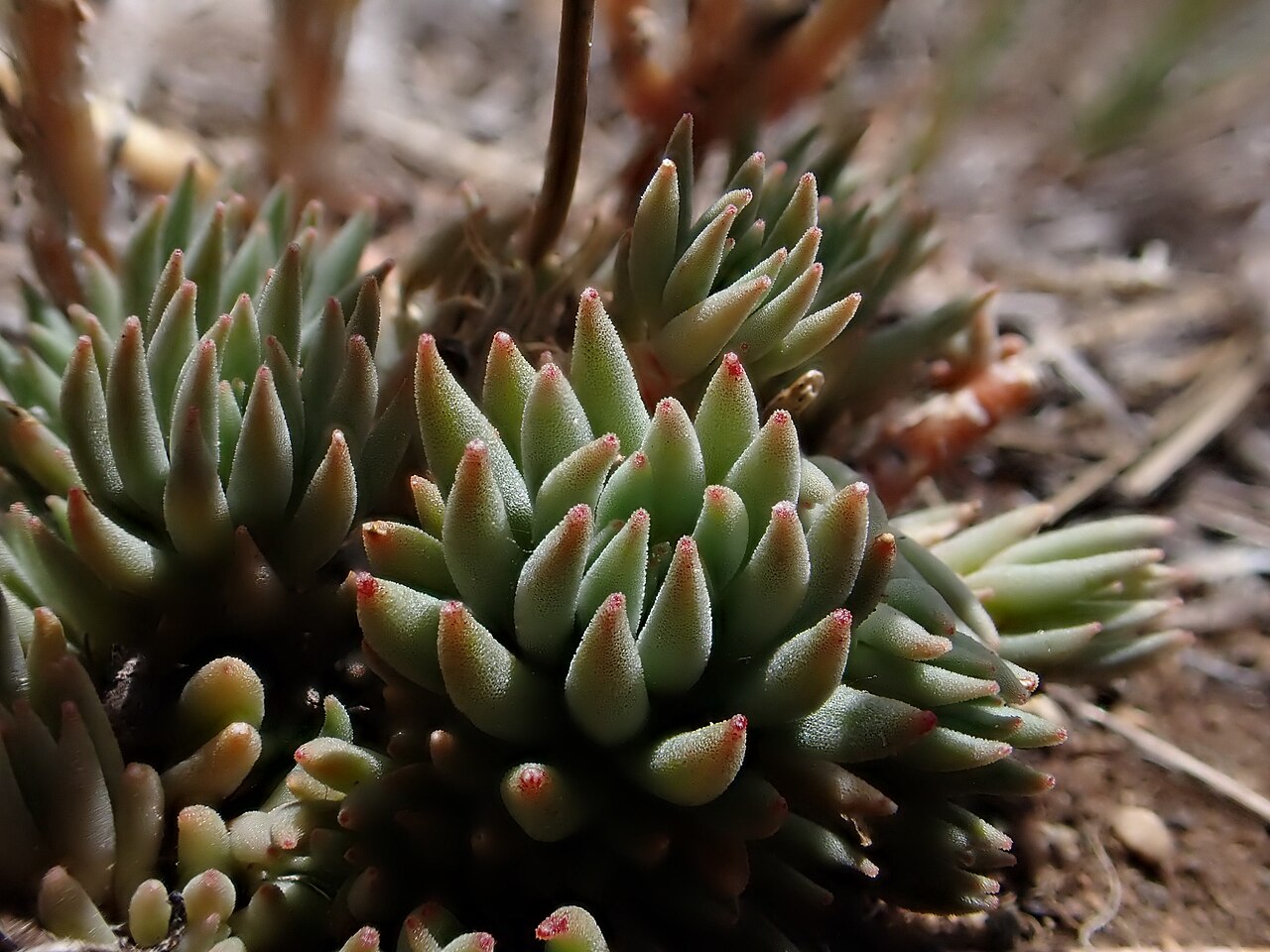
The plant forms low mats and clumps of fleshy, spear-shaped (lance-shaped) leaves that are blue-green through summer and often flush deep red or bronze under stress from cold, drought, or intense sun. In early to midsummer, clusters of bright yellow, star-shaped flowers rise just a few inches above the foliage on short stalks, drawing in native bees and other small pollinators that work the thin air of high elevations. Spearleaf stonecrop is unfussy about soil fertility but absolutely insists on sharp drainage, which is exactly why it thrives where it does: cracks in granite, volcanic scree, and gravelly ridgelines from the Black Hills of South Dakota to the high peaks of the Sierra Nevada and north into Alaska.
For a rock garden, green roof, or any spot in a western garden that bakes in sun and drains fast, spearleaf stonecrop is about as low-maintenance as native plants get. It needs almost no supplemental water once established, tolerates genuinely poor soil, and asks nothing more than good drainage and full sun. It is not a plant for a typical lawn-adjacent flower bed — it is a specialist for the driest, rockiest corner of the yard where other perennials struggle.
Identification
Spearleaf stonecrop is a low-growing, mat-forming to loosely clumping succulent perennial, typically reaching only 2 to 6 inches tall, occasionally stretching to 8 inches where soil is a bit deeper. Non-flowering shoots form tight rosettes of leaves pressed close to the ground, while flowering stems stand more upright, carrying leaves along their length up to the flower cluster.
Growth Habit
The plant spreads slowly from a woody, branching base, forming loose clumps or small mats rather than aggressively running groundcover. Each rosette persists for a year or more before sending up a flowering stalk, after which that particular rosette often dies back, with offsets continuing the clump. This gradual, well-behaved spread is part of why it never becomes a garden thug — unlike some weedier sedums, it stays where you put it.
Leaves
Leaves are thick, fleshy, and alternately arranged, narrowly egg-shaped to lance-shaped (the source of the species name lanceolatum), usually 4 to 10 mm long. They are blue-green to gray-green through the growing season and frequently take on reddish or purplish tones in response to cold nights, drought stress, or exposure to intense alpine sunlight — a trait many visitors mistake for the plant dying, when it is simply doing what stonecrops do.
Flowers
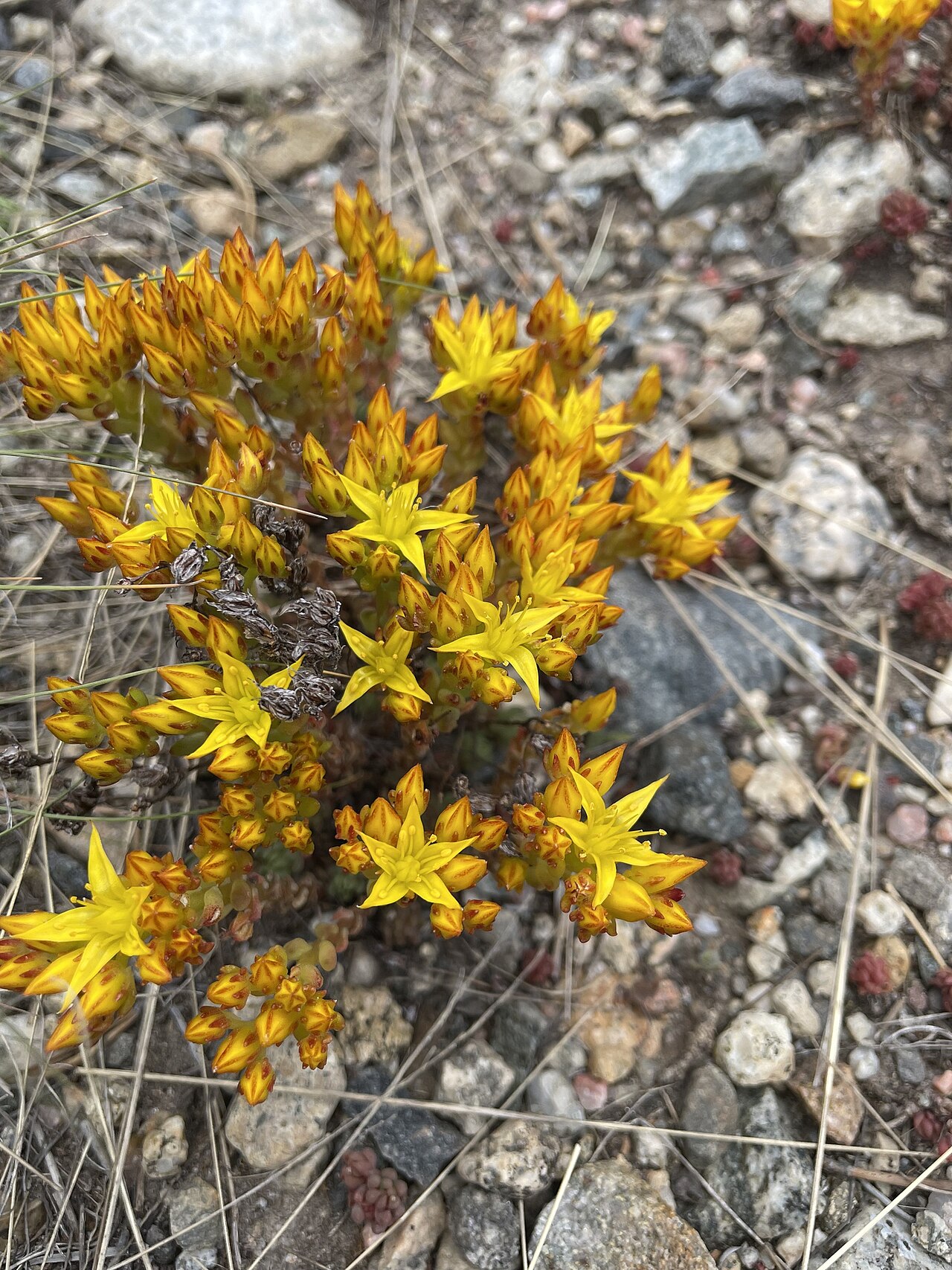
Flowers appear in flattened to slightly rounded clusters (cymes) atop short stalks from late June into August, timing that shifts later at higher elevations and further north. Each flower has five bright yellow, pointed petals forming a star shape around a center of contrasting stamens, giving blooming patches a cheerful, starry glow against gray rock. The display is modest in scale but vivid in color, and a well-established clump can be studded with dozens of small blooms at once.
Fruit & Seeds
After flowering, each bloom matures into a cluster of small, dry, pod-like follicles that split open to release fine dust-like seed. The seed pods are not ornamentally significant and are easy to miss against the foliage, but they are the plant’s primary means of colonizing new cracks and ledges nearby.
Quick Facts
| Scientific Name | Sedum lanceolatum |
| Family | Crassulaceae (Stonecrop) |
| Plant Type | Succulent Perennial |
| Mature Height | 2–6 in (occasionally to 8 in) |
| Mature Spread | 4–10 in, slowly clumping |
| Growth Rate | Slow |
| Sun Exposure | Full Sun to Light Part Sun |
| Water Needs | Low once established |
| Soil Type | Gravelly, rocky, lean; sharp drainage essential |
| Soil pH | 5.5–7.5 (adaptable) |
| Bloom Time | Late June – August |
| Flower Color | Bright yellow |
| Fall Color | Foliage often reddens/bronzes under stress |
| Fruit | Small dry follicles; not ornamental |
| Deer Resistant | Yes |
| USDA Hardiness Zones | 3–8 |
Native Range
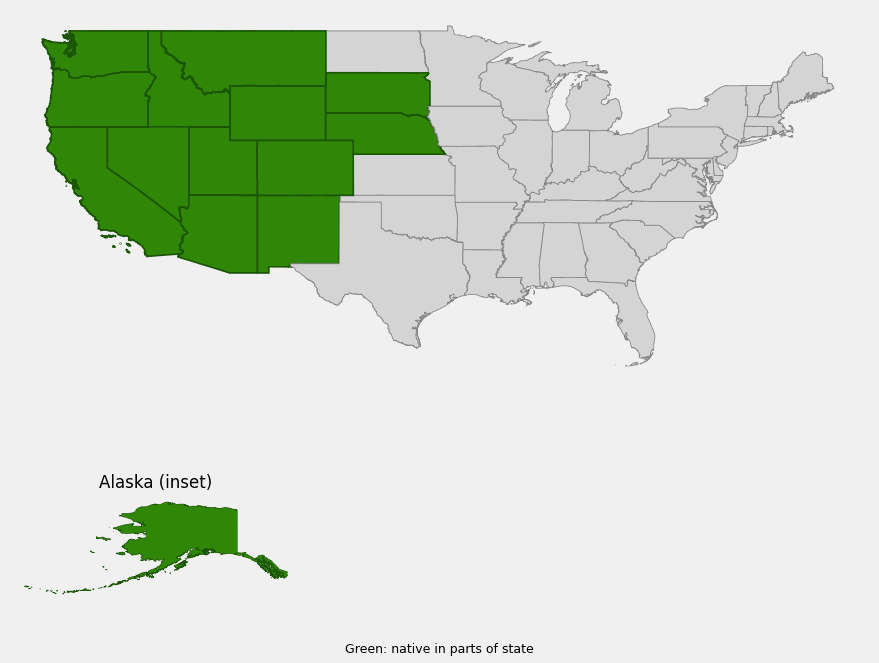
Spearleaf stonecrop is one of the most widely distributed rock-dwelling succulents in the American West, ranging from the coastal mountains of Alaska south through the Cascades, Sierra Nevada, and Rocky Mountains to Arizona and New Mexico, and east onto the high plains edges of Nebraska, the Black Hills of South Dakota, and the foothills of eastern Colorado. It is genuinely a mountain plant through most of its range, typically found from around 5,000 feet up to exposed alpine ridges above 12,000 feet, though it also occurs much closer to sea level in parts of Alaska and coastal British Columbia.
Across this huge range it is consistently a plant of thin, rocky, well-drained sites: granite and volcanic talus, rock outcrops, gravelly ridgetops, and the open, sun-baked margins of sagebrush steppe and subalpine forest. It is common in big sagebrush (Artemisia tridentata) steppe in Montana and Idaho, on exposed scree above treeline in Colorado, and tucked into basalt cracks in the Columbia Plateau — habitats that share almost nothing except excellent drainage and intense sun.
Because it tolerates such a wide range of elevation and latitude, local populations vary somewhat in bloom timing and leaf color, and botanists recognize more than one variety across its range. For garden purposes the differences are minor: wherever you are in its native mountain West, a locally sourced plant will be adapted to your conditions far better than a nursery cultivar bred for lowland gardens.
📋 Regional plant lists featuring Spearleaf Stonecrop: Alaska · California & Nevada · Utah & Western Colorado · Idaho, Eastern Oregon & Eastern Washington · Montana & Wyoming · Arizona & New Mexico · Nebraska, Kansas & Eastern Colorado · North Dakota, South Dakota & Western Minnesota
Growing & Care Guide
Spearleaf stonecrop rewards gardeners who give it exactly what it has in the wild: sun, sharp drainage, and benign neglect. It is an excellent choice for the driest, least hospitable corner of a xeriscape or rock garden planted for dry sites, where richer soil and regular watering would actually work against it.
Light
Give it full sun for the tightest growth and best flowering. In the hottest, lowest-elevation gardens within its range, light afternoon shade is tolerated and can reduce summer stress, but in general more sun means a more compact, floriferous plant.
Soil & Water
Drainage is non-negotiable. In the wild this plant lives in rock cracks and gravel, and in cultivation it needs the same: a lean, mineral soil mix, ideally amended generously with coarse sand, decomposed granite, or crushed rock. Heavy clay or any soil that holds water will rot the roots quickly. Once established, it needs very little supplemental irrigation — occasional deep watering during the driest stretches of summer is plenty, and in climates that mirror its native rainfall pattern, it may need none at all.
Planting Tips
Plant in spring or fall, tucking small divisions or nursery starts into pockets of gritty soil between rocks or along a dry slope. Raised beds, scree gardens, rock walls, and container plantings of gritty cactus-and-succulent mix all suit it well. Space plants 6 to 10 inches apart to allow clumps to fill in without crowding. Gardeners building out a broader low-water planting plan may also find useful companion ideas in our guides to drought-tolerant native plants for Colorado and drought-tolerant native plants for Nevada, both regions where spearleaf stonecrop grows wild.
Pruning & Maintenance
Essentially none is required. Spent flower stalks can be trimmed back after bloom for tidiness, but the plant is equally attractive left alone to self-seed modestly into nearby cracks. Avoid fertilizing — rich soil produces leggy, weak growth in a plant evolved for scarcity.
Propagation
Spearleaf stonecrop propagates readily from stem cuttings or by dividing established clumps in spring. Seed can also be collected after the follicles dry and surface-sown on gritty mix, though germination and early growth are slow.
Landscape Uses
- Rock gardens and scree beds — its natural habitat recreated at home
- Green roofs and gravel gardens where soil depth is minimal
- Dry rock walls and crevice plantings
- Xeriscaping for low-water, high-sun sites
- Container and trough gardens with gritty succulent mix
- Alpine and native plant collections
Wildlife & Ecological Value
Despite its small stature, spearleaf stonecrop pulls real ecological weight in the harsh, resource-poor habitats where it grows, offering nectar and groundcover in places where little else survives.
For Pollinators
The bright yellow flowers attract a range of native bees, small butterflies, and other short-tongued pollinators that are active at high elevation, where the foraging season is compressed into a few summer weeks. In alpine and subalpine settings, stonecrop blooms are an important mid-summer nectar source precisely because so few other flowering plants can tolerate the same thin, rocky soils.
For Birds
While not a major food source for birds, the dense low mats provide some cover for ground-foraging species in open, exposed terrain, and the seed, though minute, contributes to the diet of small songbirds and sparrows that work rocky alpine meadows.
For Mammals
Small mammals occasionally browse the succulent foliage, though its bitter compounds and tough leaf texture make it a low-preference food, which is part of why it tends to persist even in areas with heavy grazing pressure from deer or livestock.
Ecosystem Role
As one of the few vascular plants able to colonize bare rock and gravel, spearleaf stonecrop plays an early-succession role, helping stabilize loose scree and thin soils and creating microhabitat pockets where organic matter and moisture can accumulate for other plants to follow. In true alpine zones, it is part of a small guild of cushion and mat-forming plants that define the character of the tundra-like plant community above treeline.
Cultural & Historical Uses
Spearleaf stonecrop does not carry the same prominent documented history of use as some larger native plants, but like many wild Sedum species it was known to Indigenous peoples across its range as part of the broader knowledge of edible and useful alpine plants, though specific, well-documented uses of this particular species are sparse in the ethnobotanical record compared to more widely utilized relatives.
In the modern era, spearleaf stonecrop has found its primary human use in horticulture rather than history — valued by rock gardeners and native plant enthusiasts in the Mountain West precisely for the qualities that made it obscure to earlier chroniclers: its small size, modest flowers, and ability to live where almost nothing else would bother to grow.
Today it is increasingly used in alpine plant collections, botanical garden rock gardens, and xeriscape demonstration plantings throughout its native range, valued as a living example of how plants adapt to the most marginal, rocky micro-habitats the mountain West has to offer.
Frequently Asked Questions
Is spearleaf stonecrop the same as the Sedum sold at garden centers?
No. Most nursery “sedum” sold as groundcover (such as Sedum spurium or Sedum album) are Eurasian species. Spearleaf stonecrop (Sedum lanceolatum) is a true North American native, distinct from those imports, and better adapted to western mountain climates and soils.
Why did my plant turn red?
Reddish or bronze foliage is a normal stress response to cold nights, intense sun, or drought — it is not a sign of disease. The plant typically returns to blue-green once conditions moderate.
Does spearleaf stonecrop need winter protection?
No. It is adapted to harsh alpine winters across most of its range and is hardy well into USDA zone 3. The bigger risk in cultivation is wet feet in winter, not cold.
Will it spread aggressively in my garden?
No. Unlike some weedy groundcover sedums, spearleaf stonecrop spreads slowly by forming small clumps and occasional self-seeding, making it well-behaved in rock gardens and unlikely to overrun neighboring plants.
Can it be grown outside its native elevation range?
Yes, as long as drainage and sun requirements are met. Gardeners at lower elevations within its native states have successfully grown it in scree beds and gravel gardens, though it may need slightly more shade protection from intense lowland summer heat than it experiences in the mountains.

Looking for a nursery that carries Spearleaf Stonecrop?
Browse our native plant nursery directory: Alaska & Arizona · California · Idaho · Montana · Nebraska, Nevada & New Mexico · Oregon · Utah · Washington · Wyoming