Carolina Wild Petunia (Ruellia caroliniensis)
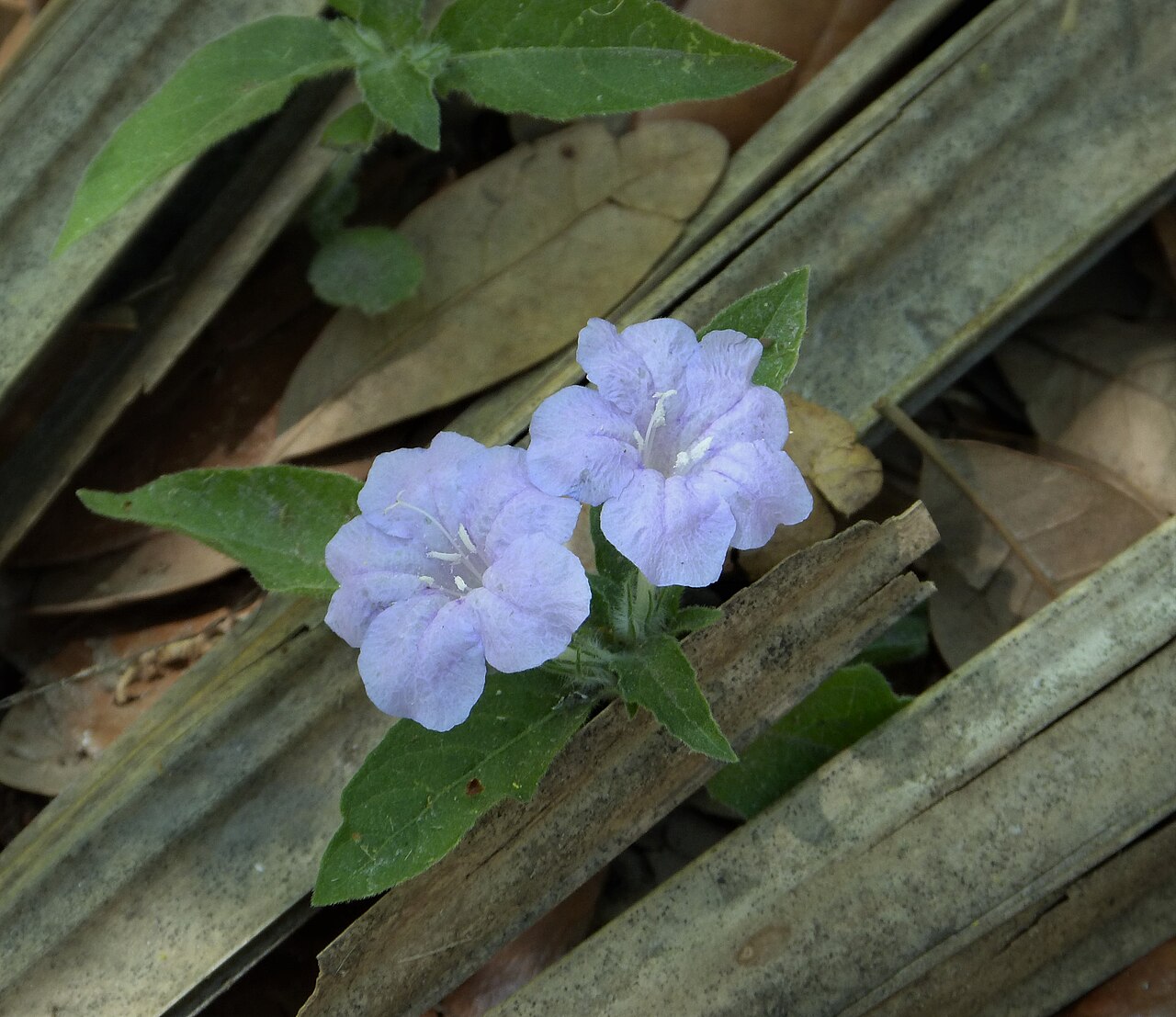
Ruellia caroliniensis, commonly called Carolina Wild Petunia or Common Wild Petunia, is a hairy, clump-forming perennial wildflower of dry open woods across the eastern and southeastern United States. Despite the common name and the superficial resemblance of its flowers, it is not related to the garden Petunia (genus Petunia, nightshade family); Carolina Wild Petunia belongs instead to the Acanthaceae, the acanthus family, and its lavender-to-purple, funnel-shaped blooms are an unrelated case of flowers converging on a similar shape.
Plants form low, slightly spreading clumps of hairy, opposite leaves, typically topped with one or two short-lived flowers at a time. Each bloom lasts only a single day, opening in the morning and wilting by afternoon, but a healthy plant produces a steady, extended succession of flowers through the heat of summer — so the display, while fleeting bloom by bloom, keeps the garden colorful for weeks on end.
Carolina Wild Petunia is an easy, reliable native for dry to average woodland-edge soil in part shade, where it tolerates the kind of dry, root-filled ground beneath established trees that frustrates many other flowering perennials. It is also an important larval host plant for several native butterflies, making it a favorite of wildlife gardeners throughout its range.
Identification
Carolina Wild Petunia is an unbranched to lightly branched perennial herb, typically 1 to 2 feet tall, with a somewhat lax, clumping habit.
Leaves
Leaves are opposite, oval to elliptic, 2 to 5 inches long, with short petioles and a soft, hairy texture on both surfaces. They are crowded along the stem, giving the plant a dense, leafy look even before flowering begins.
Flowers
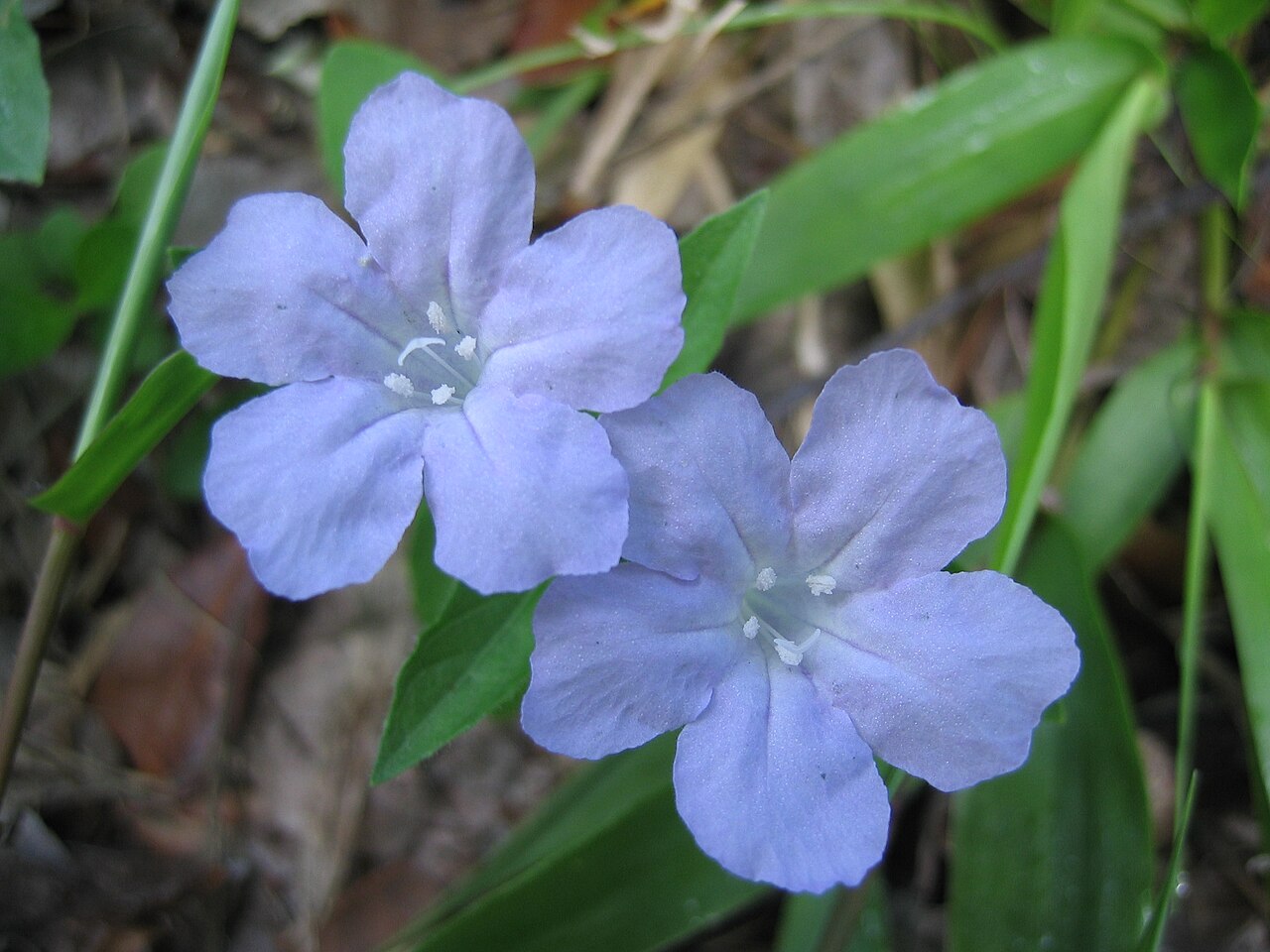
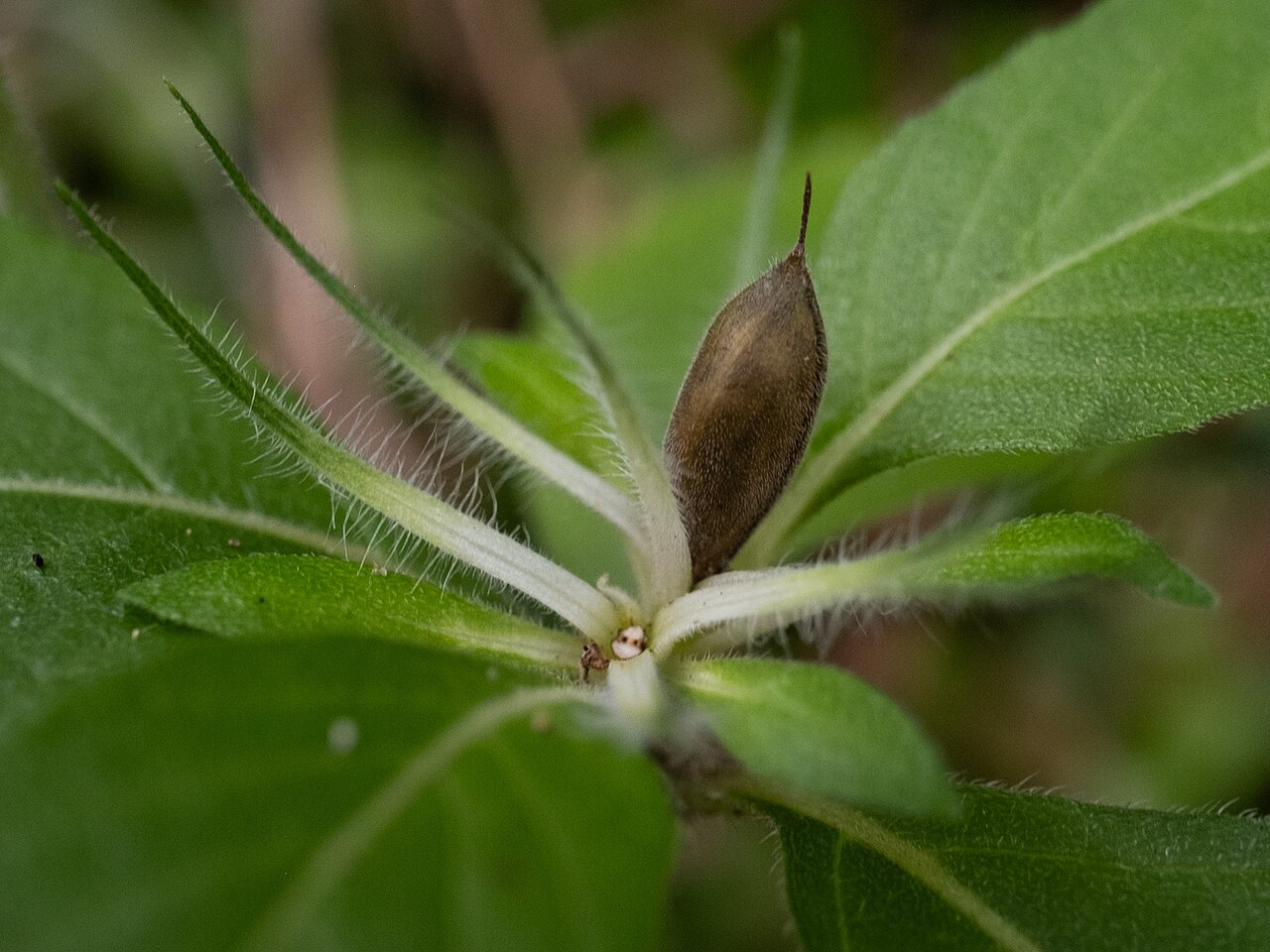
Flowers are borne in small, mostly stalkless (sessile) axillary clusters of 2 to 4, with usually only one or two open on a given plant at a time. Each flower has a slender corolla tube flaring into five broad, petal-like lobes, typically light purple to lavender-blue, occasionally pinkish, with a paler throat. The calyx lobes and the bracts beneath the flower are notably long and slender-pointed — a key feature distinguishing this species from the seven other Ruellia species found in the eastern U.S. Bloom occurs from June through August (sometimes into September farther south), with individual flowers opening for a single morning before wilting.
Fruit & Seeds
The fruit is a narrow, club-shaped capsule up to half an inch long, held upright on a long, hairy calyx. As it ripens the capsule changes from yellow to green to brown over about two months, eventually splitting open explosively to fling the small seeds away from the parent plant — a dispersal method shared across the genus.
Quick Facts
| Scientific Name | Ruellia caroliniensis |
| Family | Acanthaceae (Acanthus) |
| Plant Type | Herbaceous Perennial Wildflower |
| Mature Height | 1–2 ft |
| Mature Spread | 1–1.5 ft, slowly spreading clump |
| Growth Rate | Moderate |
| Sun Exposure | Part Shade to Full Sun |
| Water Needs | Low to Moderate |
| Soil Type | Dry to average, sandy or loamy |
| Soil pH | Slightly acidic to neutral |
| Bloom Time | June – August |
| Flower Color | Light purple to lavender-blue |
| Fall Color | Foliage browns after frost |
| Fruit | Narrow explosive seed capsule |
| Deer Resistant | Moderate |
| USDA Hardiness Zones | 6–10 |
Native Range
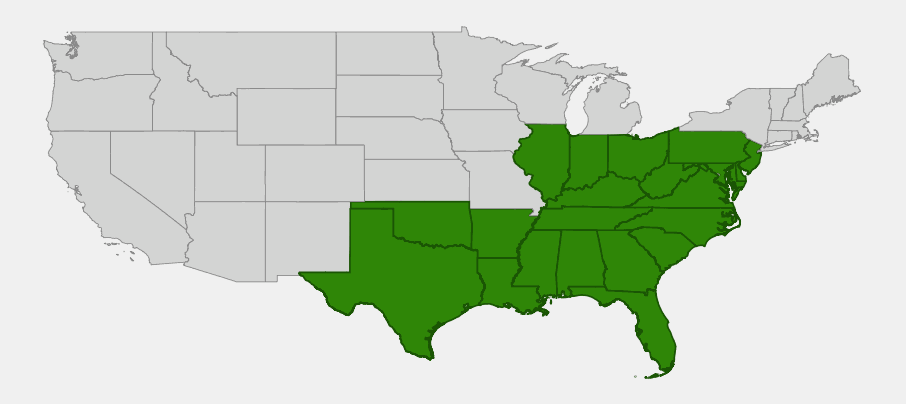
Carolina Wild Petunia is native across much of the eastern and southeastern United States, from New Jersey, southern Ohio, southern Indiana, southern Illinois, and Oklahoma south to Florida and west to eastern Texas. It is most common and continuous through the Southeast, becoming more scattered toward the northern and western edges of its range.
It typically grows in dry to average, sandy or loamy soils in open upland woods, woodland edges, and clearings — sites with part shade to filtered sun rather than deep forest shade or full open prairie. It tolerates the dry, root-competitive conditions found beneath mature oaks and pines better than most showy wildflowers, making it valuable for underplanting established trees.
Because it favors well-drained upland woods rather than wetlands, Carolina Wild Petunia has remained relatively widespread compared to many Coastal Plain wetland specialists, though local populations can still be reduced by heavy shade from closed-canopy forest succession or by conversion of open woodland to turf.
📋 Regional plant lists featuring Carolina Wild Petunia: Georgia, Alabama & Mississippi · Arkansas, Louisiana, Eastern Oklahoma & Eastern Texas · Illinois, Iowa & Missouri · Ohio & Indiana · Kentucky & Tennessee · Maryland, Virginia & West Virginia · North Carolina & South Carolina · New York, Pennsylvania & Northern New Jersey · Delaware, Southern New Jersey & Long Island, New York
Growing & Care Guide
Carolina Wild Petunia is a forgiving, low-maintenance native for the dry, partly shaded spots where many showier perennials fail — exactly the conditions found at a typical woodland edge.
Light
It grows best in part shade to filtered sun, such as the dappled light beneath high tree canopy or at a woodland margin. It also tolerates full sun, especially farther north, where it can handle more direct exposure as long as some soil moisture is available; see our woodland garden design guide for ideas on pairing it with other part-shade natives.
Soil & Water
This species is adapted to dry to average, well-drained sandy or loamy soil and handles summer drought better than many woodland perennials once established. It does not need rich soil or regular watering; in fact, soil that is too consistently wet or heavy can lead to rot. Water new transplants through their first season, then let established plants rely mostly on rainfall.
Planting Tips
Plant in spring or fall, siting it in dry to average soil under high shade or at a sunny woodland edge. Space plants 12 to 15 inches apart. It works well tucked beneath established oaks, pines, or other trees where competition for moisture limits what else will thrive.
Pruning & Maintenance
Very low maintenance: no deadheading is needed since flowers drop on their own each afternoon. Cut back dead growth in late winter. Established clumps rarely need division but can be split in spring if desired.
Propagation
Propagate from seed collected as capsules turn from green to brown (watch closely, as mature capsules dehisce explosively) or by rooting summer stem cuttings, which root readily. Seed germination can be slow and uneven; give seedlings some protection through their first year.
Landscape Uses
- Dry shade and woodland-edge plantings beneath established trees
- Butterfly gardens as a larval host plant
- Naturalized groundcover for dry, part-shaded slopes
- Low-maintenance native borders (see our low-maintenance native plants guide for Virginia)
- Pollinator gardens for long-season nectar supply
- Rock gardens on well-drained sandy soils
Wildlife & Ecological Value
Carolina Wild Petunia punches above its weight for wildlife, serving as both a nectar source and a butterfly host plant.
For Pollinators
The tubular flowers are visited by long-tongued native bees and occasionally hummingbirds, which can reach the nectar at the base of the corolla tube. Because each plant produces flowers in daily succession over many weeks, it offers a steady, if modest, nectar supply through the heart of summer — useful for a well-planned pollinator garden.
For Birds
While not a major seed source for birds, the dense low foliage provides some ground-level cover for small songbirds and insects that birds forage on.
For Mammals
The hairy foliage is not a preferred browse for deer or rabbits, giving it moderate deer resistance compared to more palatable woodland wildflowers.
Ecosystem Role
Most notably, Carolina Wild Petunia is a larval host plant for the Common Buckeye butterfly and several related species in the buckeye and checkerspot groups, which depend on Ruellia foliage to feed their caterpillars. Its presence in dry open woodland helps sustain these butterfly populations through the growing season.
Cultural & Historical Uses
Carolina Wild Petunia does not carry a widely documented history of medicinal or culinary use among Indigenous peoples of the eastern United States comparable to some other regional wildflowers; it is known primarily through botanical description of dry upland woodland flora across its range.
The genus name Ruellia honors Jean Ruel (Latinized Ruellius), a sixteenth-century French physician and botanist known for translating classical botanical texts into Latin, while the species epithet caroliniensis reflects its discovery in and strong association with the Carolinas. Its resemblance to garden Petunias, despite the unrelated lineage, has made “wild petunia” a durable and widely used common name since at least the nineteenth century.
Today the plant’s primary significance is horticultural and ecological: native plant gardeners value it as a tough, reliable groundcover for dry shade, and conservationists recognize its role as a larval host plant supporting buckeye butterfly populations.
Frequently Asked Questions
Is Carolina Wild Petunia related to garden Petunias?
No. Despite the shared common name and similar flower shape, Carolina Wild Petunia belongs to the Acanthaceae (acanthus family), while garden Petunias belong to the Solanaceae (nightshade family). The resemblance is a coincidence of flower form, not a close botanical relationship.
Why do the flowers only last one day?
Each individual Carolina Wild Petunia flower opens in the morning and wilts by afternoon, a trait shared across the genus. Healthy plants compensate by producing a continuous succession of new flowers through summer, so the overall bloom display lasts for weeks even though no single flower does.
Does Carolina Wild Petunia need shade?
It prefers part shade to filtered sun, such as beneath high tree canopy, but tolerates full sun as well, particularly in cooler climates or where some soil moisture is available.
What butterflies use Carolina Wild Petunia as a host plant?
It is a larval host for the Common Buckeye butterfly and several related species, whose caterpillars feed on the foliage.
Is Carolina Wild Petunia drought tolerant?
Yes, once established it tolerates dry, well-drained soil well, reflecting its native habitat in dry upland woods rather than moist bottomland.

Looking for a nursery that carries Carolina Wild Petunia?
Browse our native plant nursery directory: Alabama & Arkansas · Delaware, Florida & Georgia · Illinois & Indiana · Kentucky, Louisiana, Maryland & Mississippi · North Carolina, New Jersey, Ohio & Oklahoma · Pennsylvania, South Carolina, Tennessee, Texas & Virginia · West Virginia