Sea Grape (Coccoloba uvifera)
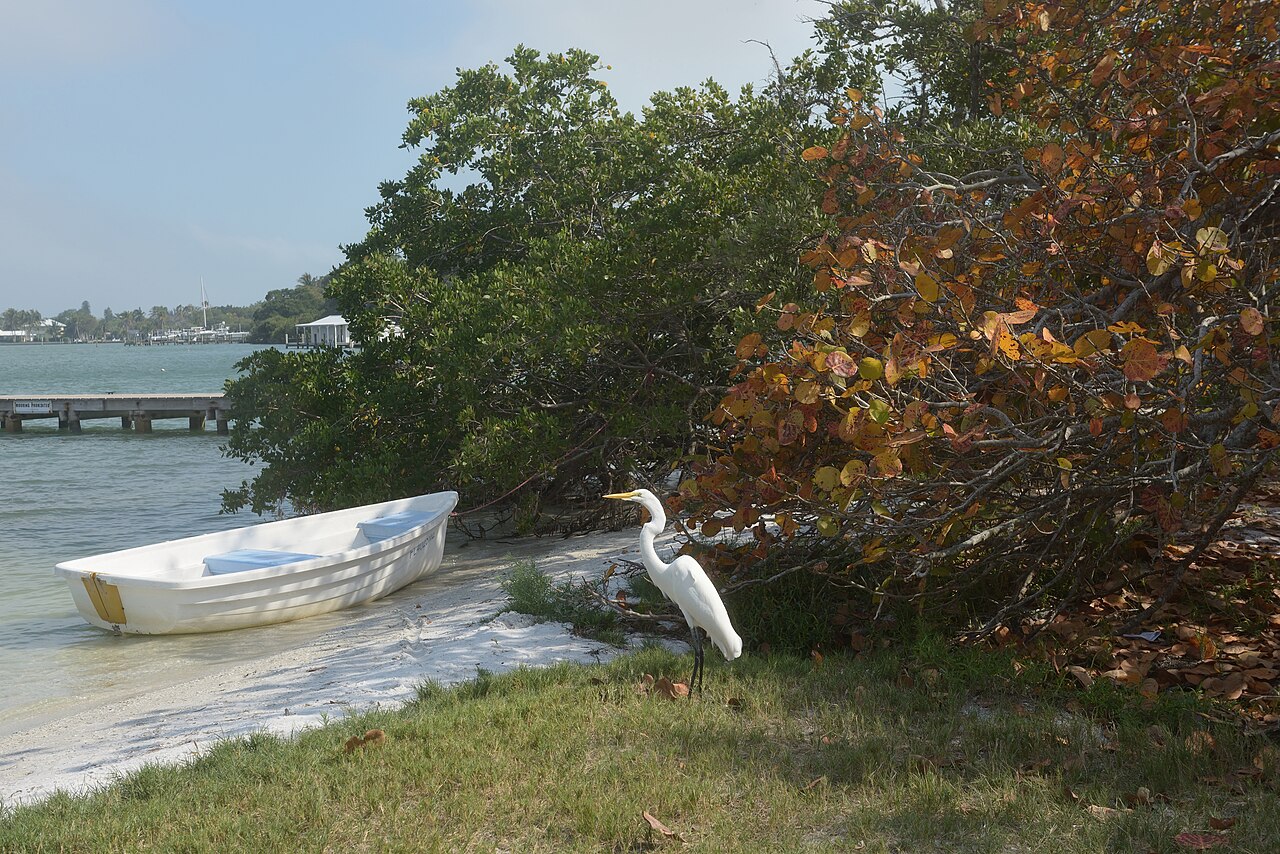
Coccoloba uvifera, commonly known as Sea Grape, is one of the most recognizable native plants of the Florida coast — a sprawling, salt-tolerant shrub or small tree with large, round, leathery leaves and grape-like clusters of edible fruit. Growing naturally in the beach dunes and coastal hammocks of peninsular and South Florida, sea grape is as much a part of the state’s shoreline identity as the sand itself, and it plays a critical, legally protected role in holding that sand in place.
In the open sun and salt spray of a beachfront dune, sea grape typically forms a low, dense, twisted shrub 3 to 10 feet tall, spreading sideways as much as it grows up. Give it more shelter and soil depth, however — in a hammock, a landscaped yard, or well back from the surf — and it readily becomes a rounded small tree 20 to 30 feet tall with a thick, often leaning or multi-trunked form. The large, nearly circular leaves, 6 to 10 inches across with prominent reddish veins, are unmistakable, and the plant is dioecious, with male and female flowers on separate plants — only female plants bear the grape-like fruit that gives the species its name.
Because sea grape is so effective at stabilizing beach dunes against erosion, Florida law directly protects it: state statute makes it illegal to harvest, cut or remove sea grapes (and sea oats) from public beaches and dune systems without authorization. For coastal Florida gardeners, it is an essential, low-maintenance native for salt-sprayed, sandy sites where few other plants thrive — just be aware that collecting cuttings, fruit-laden branches, or whole plants from beach dunes is against the law; buy nursery-grown stock instead.
Identification
Sea grape’s growth form varies enormously with its growing conditions — a wind-sheared, ground-hugging mat on an exposed dune crest, a dense rounded hedge in a sheltered yard, or a single-trunked small tree with a broad, umbrella-like canopy where it has room and protection to grow upward. Most cultivated specimens reach 15 to 25 feet tall and equally wide.
Bark & Stems
The bark is smooth and gray on young stems, becoming scaly, mottled gray-brown and attractively patterned on older trunks, not unlike a crape myrtle. Stems are often crooked or leaning, especially on wind-exposed dune plants, and they thicken noticeably with age into sculptural, gnarled trunks that are prized ornamentally.
Leaves
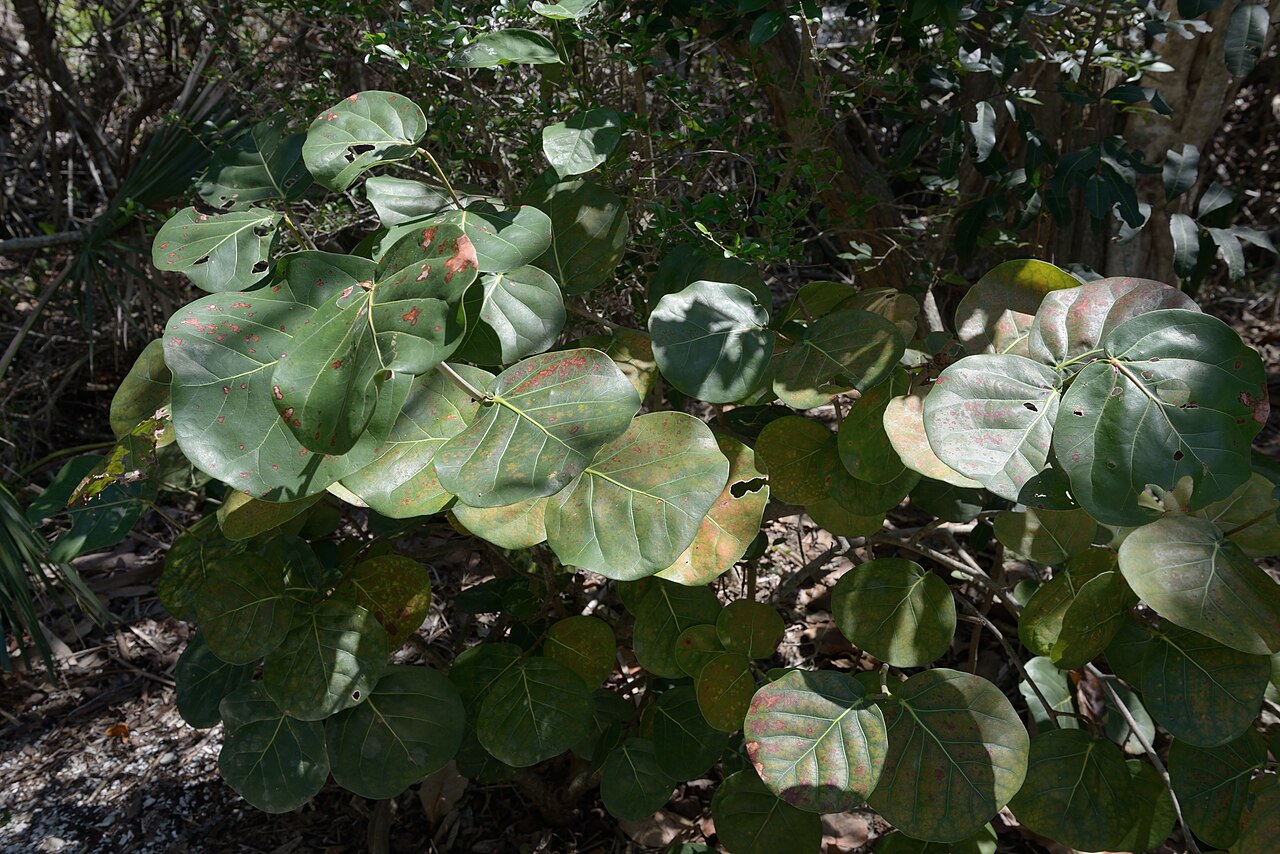
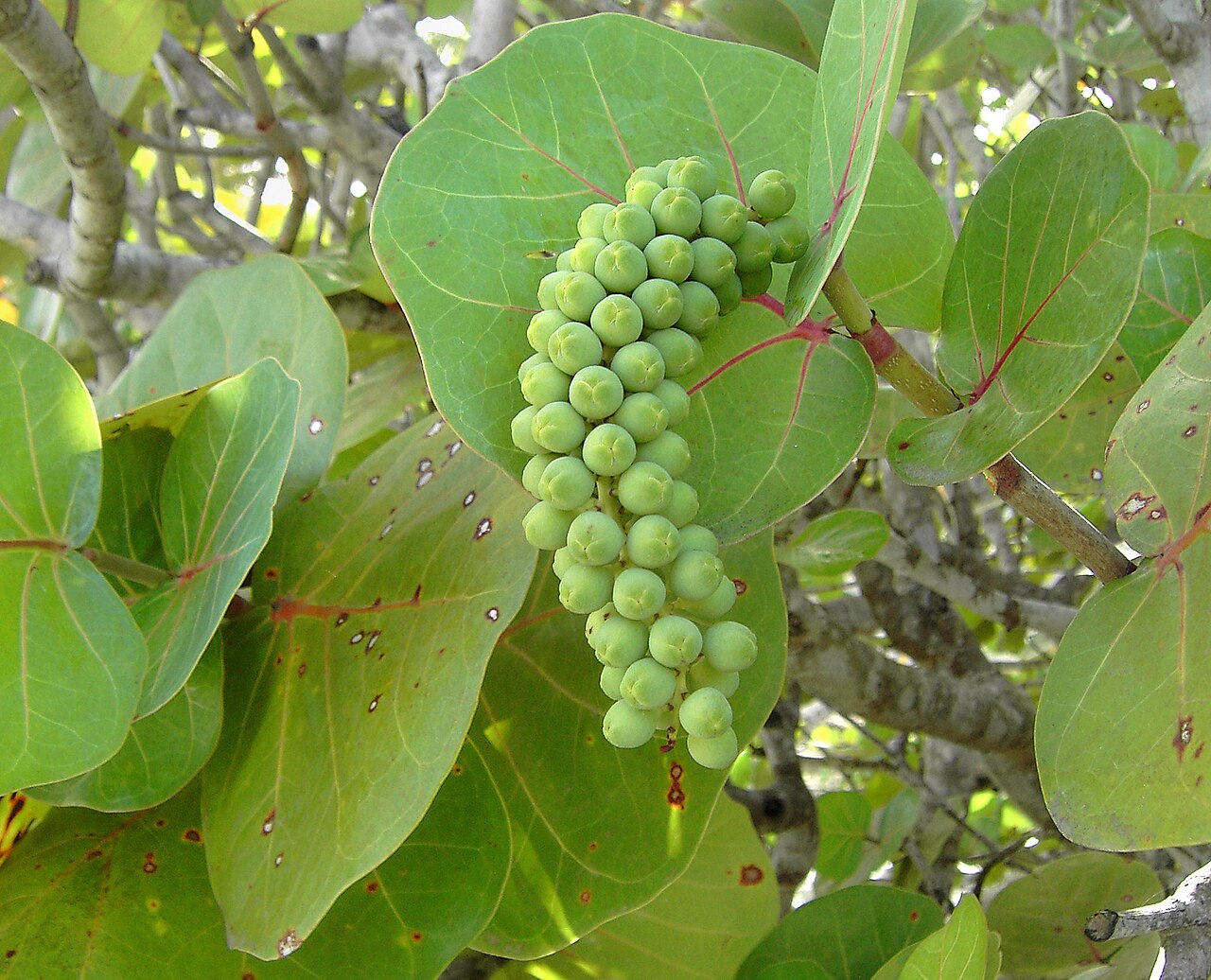
The leaves are the plant’s signature feature: broadly rounded to heart-shaped, 6 to 10 inches across, thick and leathery, with a glossy deep green upper surface marked by bold, reddish-pink veins radiating from the base. New leaves often emerge bronze-red before maturing to green, and older leaves frequently turn orange, red or copper before they drop, giving established plants a patchwork of color year-round. Leaves are arranged alternately along zigzagging stems with papery, sheathing stipules (ocreae) typical of the buckwheat family.
Flowers
Small, fragrant, greenish-white flowers are borne in long, slender spike-like racemes up to 10 inches long, held above the foliage. Sea grape is dioecious — male and female flowers occur on separate plants — so only female individuals go on to produce fruit after pollination. Flowering can occur more than once a year in South Florida’s warm climate, with peaks in spring and again after summer rains.
Fruit & Seeds
On female plants, flower spikes develop into pendant clusters of round, grape-like fruits about ¾ inch across, green at first and ripening to purplish-red or deep purple. Each fruit contains a single large seed surrounded by a thin, tart-sweet, edible pulp. Ripe fruit drops heavily in late summer and fall, and in good years a mature tree can carry a striking number of grape-like clusters among its leaves.
Quick Facts
| Scientific Name | Coccoloba uvifera |
| Family | Polygonaceae (Buckwheat/Knotweed) |
| Plant Type | Evergreen shrub or small tree |
| Mature Height | 3–30 ft (varies with exposure) |
| Mature Spread | 10–25 ft |
| Growth Rate | Moderate |
| Sun Exposure | Full Sun to Part Shade |
| Water Needs | Low once established |
| Soil Type | Sandy, well-drained; tolerates poor soil |
| Soil pH | Wide tolerance, including alkaline |
| Bloom Time | Spring and late summer (intermittent) |
| Flower Color | Greenish-white |
| Fall Color | Evergreen; older leaves turn orange-red year-round |
| Fruit | Purple-red grape-like clusters (female plants only) |
| Deer Resistant | Yes, generally |
| USDA Hardiness Zones | 10 – 11 (marginal in protected 9b sites) |
Native Range
Sea grape is native to the coastal zones of peninsular and South Florida, from roughly the central Atlantic and Gulf coasts southward through the Florida Keys, as well as throughout the Caribbean, Bermuda, and the coasts of Mexico and Central America. Within the continental U.S. it does not range beyond Florida; it is strictly a plant of frost-free, salt-influenced coastal habitats and cannot tolerate the freezes common even a short distance inland and north of its native range.
It is a defining species of Florida’s beach dune and coastal strand plant communities, typically forming the first substantial woody vegetation behind the open beach, just landward of sea oats and other dune grasses. From there it extends into coastal hammocks, maritime scrub, and the landward edges of mangrove communities, where slightly more shelter and soil allow it to grow taller and more tree-like.
Because sea grape is such an effective dune stabilizer — its extensive root system and dense growth habit bind loose sand and buffer salt spray and wind for less tolerant plants growing behind it — Florida law (chiefly F.S. 161.242 and 161.053) prohibits harvesting or damaging sea grape and the dune vegetation it grows within on public beaches. This protects both the plant and the erosion control it provides; always get fruit and cuttings from a nursery rather than a beach.
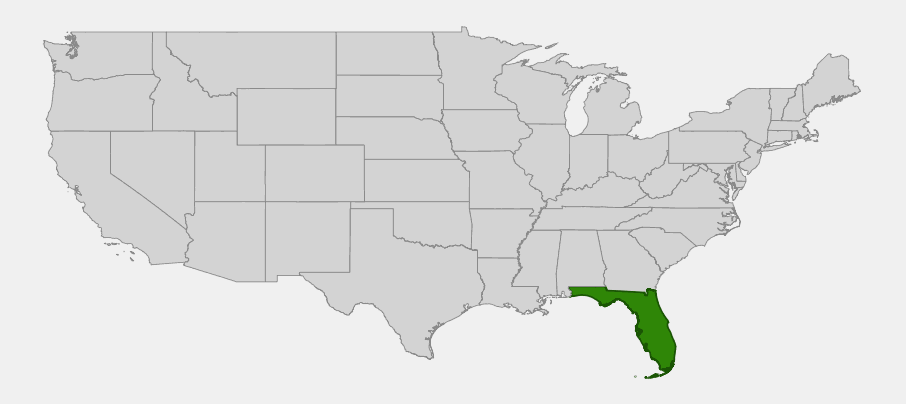
📋 Regional plant lists featuring Sea Grape: none yet — Sea Grape is native only to coastal Florida, and no plantnative.org regional list currently covers that area; see our full native plant directory for other Florida-native species.
Growing & Care Guide
Sea grape is about as forgiving as a native landscape plant gets along the Florida coast, tolerating salt spray, sandy infertile soil, drought and strong onshore wind with little complaint — but it has essentially no cold tolerance, so it is strictly a South and coastal Florida plant.
Light
Plant sea grape in full sun for the densest, most compact growth and best fruiting on female plants; it will also tolerate partial shade, especially in a hammock setting, though growth becomes more open and leggy.
Soil & Water
Sea grape thrives in sandy, well-drained soil and shrugs off the nutrient-poor conditions typical of coastal dunes. It is highly drought tolerant once established and needs supplemental water only while young or during unusually dry stretches. Good drainage is far more important than fertility — avoid heavy, poorly drained soils.
Planting Tips
Set out nursery-grown plants in spring or early summer so roots establish before any cooler weather. If fruit production matters to you, plant both male and female individuals, since sea grape is dioecious and only female plants bear fruit; nurseries sometimes sell plants as unsexed seedlings, so ask if sex is known. Give plants room to spread — 10 to 20 feet depending on whether you want a low hedge or an eventual small tree — and keep them well back from the direct wave line, since even sea grape needs some established dune behind it to root into.
Pruning & Maintenance
Sea grape tolerates heavy pruning and shearing well, which is why it is so often used as a clipped hedge or screen in South Florida landscapes; left unpruned, it develops its naturally rounded, sculptural form. Prune to remove storm-damaged or crossing branches and to shape as desired; it responds vigorously to cutting back after hurricane damage, a useful trait in its hurricane-prone native range.
Landscape Uses
Sea grape’s salt and wind tolerance make it a workhorse plant for South Florida’s toughest sites:
- Beachfront and dune stabilization plantings (where legally permitted plantings, not wild harvest, are used)
- Salt-tolerant hedges and privacy screens near the coast
- Specimen or accent tree for its sculptural trunk and colorful foliage
- Windbreaks to protect less salt-tolerant plants further inland
- Coastal restoration projects rebuilding native dune vegetation
Wildlife & Ecological Value
Sea grape is a cornerstone species of Florida’s coastal plant communities, providing food, shelter and erosion control that few other native plants can match in such harsh, salt-exposed conditions.
For Birds
Ripe fruit is eaten by a wide range of birds, including mockingbirds, catbirds and various migratory songbirds that pass through coastal Florida, while the dense branching structure offers nesting sites and shelter from coastal winds — wading birds such as herons and egrets are frequently seen resting in its shade along the shoreline.
For Mammals
Raccoons and other small mammals forage on fallen fruit, and the thick cover sea grape provides along dune edges and hammock margins offers shelter from both weather and predators in an otherwise exposed landscape.
For Pollinators
The small, fragrant flower spikes attract bees and other pollinating insects, providing a nectar source in coastal habitats where flowering plants can be scarce, especially on exposed dunes.
Ecosystem Role
Beyond feeding wildlife, sea grape’s deep, extensive root system is what makes it so important ecologically: it binds loose dune sand, reduces wind erosion, and buffers salt spray for less tolerant plants growing in its lee, helping establish the layered vegetation structure — from sea oats to sea grape to maritime hammock trees — that protects Florida’s barrier islands and coastlines from storm damage.
Cultural & Historical Uses
Sea grape has long been a familiar plant throughout the Caribbean and Florida, where its tart, grape-like fruit has traditionally been gathered to make jellies, jams and a fermented wine-like beverage once the fruit’s thin, sweet-tart pulp is separated from its large seed. These uses remain popular among Florida home gardeners and Caribbean cooks today, treated as a casual seasonal harvest rather than a commercial crop.
The wood is heavy, hard and attractively grained, and has historically been used in the Caribbean for small furniture pieces, turned items and fence posts, though its often crooked growth form limits larger lumber uses. The plant’s broad, sturdy leaves have also served informally as makeshift writing surfaces and wrapping material in Caribbean folk tradition, a detail sometimes mentioned in regional accounts of coastal life.
Today sea grape’s most significant role is ecological and regulatory rather than culinary or craft-based: its recognized value in stabilizing Florida’s eroding beaches led directly to the protective legislation that makes it illegal to harvest from public dunes, cementing its status as both a beloved garden plant and a legally safeguarded natural resource.
Frequently Asked Questions
Can you eat sea grape fruit?
Yes — the ripe purple-red fruit has a thin, tart-sweet, edible pulp traditionally used for jellies and preserves, though the large seed takes up most of the fruit. Only female plants produce fruit, and it should be harvested from cultivated or private plants, not from protected public dunes.
Is it illegal to pick sea grapes in Florida?
On public beaches and dune systems, yes. Florida law (chiefly F.S. 161.242) specifically protects sea grape and sea oats from harvesting because of their critical role stabilizing dunes against erosion. Fruit from a plant in your own yard or a nursery is fine to pick.
Why do some sea grape plants never produce fruit?
Sea grape is dioecious, meaning individual plants are either male or female, and only female plants bear fruit after pollination. A male plant, or an unpollinated female without a male nearby, will flower but never fruit.
How cold hardy is sea grape?
Not very — it is reliably hardy only in USDA zones 10–11, with some tolerance into protected zone 9b sites. Hard freezes will kill or severely damage it, which is why it is essentially restricted to South and coastal Florida.
Can sea grape grow away from the beach?
Yes, as long as the climate is warm enough — it adapts well to ordinary sandy or well-drained landscape soil away from direct salt spray, though it is especially valued for sites where salt tolerance is essential.

Looking for a nursery that carries Sea Grape?
Browse our native plant nursery directory: Florida
For another salt-tolerant Florida coastal native that pairs well with sea grape, see our page on Green Buttonwood. If you’re planning a Florida coastal landscape, check out our guides to shade trees for South Florida, privacy trees for Florida, and palm trees for Florida.