Pyramid Magnolia (Magnolia pyramidata)
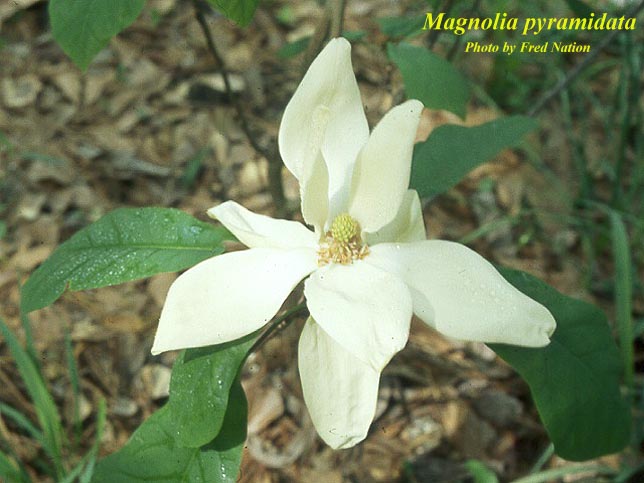
Magnolia pyramidata, the Pyramid Magnolia, is a rare small understory tree of the Deep South’s richest bottomland bluffs and ravines. It belongs to the same closely related pair as Fraser Magnolia (Magnolia fraseri) — in fact, many botanists still treat it as Magnolia fraseri var. pyramidata, the lowland Coastal Plain counterpart to the mountain-dwelling Fraser Magnolia of the Appalachians. Flora of North America and most state natural heritage programs now recognize it as the full species Magnolia pyramidata, distinguished from its mountain cousin by smaller, narrower, non-glaucous leaves and a shorter, more pyramidal crown. Whichever name you use, this is one of the least commonly seen native magnolias, found scattered through a handful of counties from South Carolina to east Texas.
Pyramid Magnolia favors shaded, moist, well-drained slopes above streams and rivers — the kind of rich, calcium-enriched “bluff forest” soil that supports an unusually diverse understory flora. Here it grows as a slender tree of 15 to 30 feet, rarely taller, with smooth gray bark and large, leathery leaves clustered toward the tips of the branches. In late spring the tree produces fragrant, creamy-white, nine-petaled flowers that open after the leaves have expanded, followed by rose-pink, cone-like fruit clusters that split open in fall to reveal bright red seeds.
Because it is restricted to a narrow set of rich-soil habitats that have been heavily logged and cleared for agriculture across its range, Pyramid Magnolia is considered rare to imperiled in most of the states where it occurs. For gardeners within its native range who have a shaded, moist site with good drainage, it is a worthwhile and distinctive addition — a chance to grow a magnolia that few nurseries carry and even fewer neighbors will recognize.
Identification
Pyramid Magnolia is usually a single- or multi-trunked small tree 15 to 30 feet tall (occasionally reported to 40 feet on the best sites), with a narrow, somewhat pyramidal crown that gives the species its common name. It is deciduous, dropping its leaves in late fall after they turn a dull yellow-brown.
Bark & Stems
The bark is thin, smooth, and light gray, becoming slightly rougher with scattered lenticels on older trunks. Young twigs are slender and greenish-brown, and like other magnolias in this group the terminal buds are covered by a single smooth, silky-hairy bud scale (a stipule) rather than overlapping scales.
Leaves
Leaves are 5 to 10 inches long, widest above the middle (obovate) and tapering to a pair of small, rounded “ear lobes” (auricles) at the base — the same distinctive auriculate base found in Fraser Magnolia. The leaves cluster near the ends of the branches in whorl-like arrangements. Pyramid Magnolia’s leaves are smaller and narrower than Fraser Magnolia’s, with green undersides rather than the pale, waxy (glaucous) undersides typical of the mountain species — the most reliable field mark separating the two where their identities are in question.
Flowers
Flowers appear in April and May, after the leaves have expanded, and are creamy white with nine thin, strap-like tepals (occasionally more), 4 to 6 inches across, with a faint, sweet fragrance. They are borne singly at the branch tips and are visited by beetles and other generalist pollinators typical of magnolias, an ancient plant lineage that evolved before bees.
Fruit & Seeds
The fruit is a cone-like aggregate of follicles, 2 to 3 inches long, maturing from green to rose-pink by late summer. In fall the follicles split open to release shiny red seeds that hang briefly on thin threads before dropping or being taken by birds.
Verified wild and cultivated photographs of this rare species are scarce online; this page uses the single confirmed, properly licensed image available.
Quick Facts
| Scientific Name | Magnolia pyramidata (also treated as Magnolia fraseri var. pyramidata) |
| Family | Magnoliaceae (Magnolia) |
| Plant Type | Deciduous Tree |
| Mature Height | 15–30 ft |
| Mature Spread | 10–15 ft |
| Growth Rate | Slow to moderate |
| Sun Exposure | Part Shade to Full Shade |
| Water Needs | Moderate; consistent moisture |
| Soil Type | Rich, moist, well-drained loam |
| Soil pH | Neutral to slightly acidic |
| Bloom Time | April – May |
| Flower Color | Creamy white |
| Fall Color | Dull yellow-brown |
| Fruit | Rose-pink cone-like aggregate with red seeds |
| Deer Resistant | Moderately (occasional browsing of young growth) |
| USDA Hardiness Zones | 7–9 |
Native Range
Pyramid Magnolia occupies a narrow, interrupted band of the Coastal Plain from central South Carolina south to the Florida Panhandle, and west through southern Georgia, Alabama, Mississippi, Louisiana, Arkansas, and into eastern Texas. Within that range it is never common — populations are scattered, small, and tied tightly to a specific habitat type, which is part of why the species is ranked critically imperiled to vulnerable in nearly every state it inhabits.
The tree’s preferred habitat is rich, mesic hardwood bluffs and ravine slopes above streams and rivers, where calcium-rich soils and reliable moisture support a diverse understory alongside beech, magnolia, and hickory. It also grows in mesic hammocks and upland hardwood forests with similar soil conditions. These sites are naturally limited and have been further reduced by clearing, logging, and development, leaving Pyramid Magnolia dependent on the protection of the remaining high-quality bluff forests across its range.
Some botanical authorities, including many state heritage programs, continue to classify this plant as Magnolia fraseri var. pyramidata rather than a full species — reflecting its very close relationship to Fraser Magnolia (Magnolia fraseri), which occupies the cooler, higher-elevation forests of the Appalachians. The two are allopatric (their ranges do not overlap) and differ consistently in leaf shape, leaf color, and overall stature, which is why most recent treatments, including Flora of North America, recognize them as separate species.
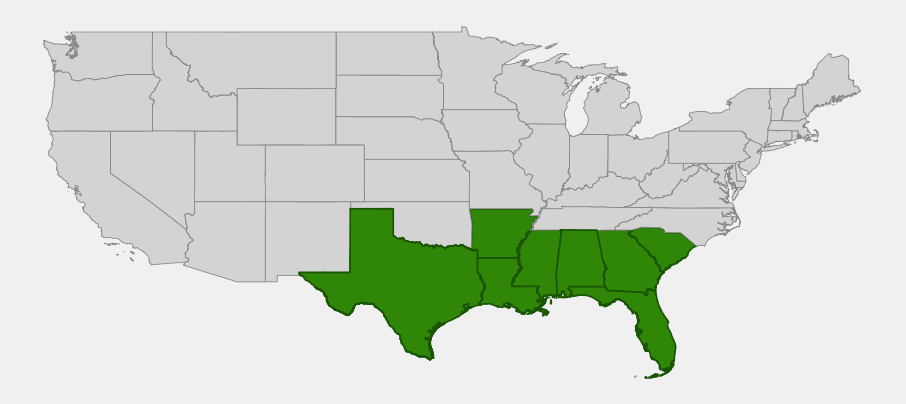
📋 Regional plant lists featuring Pyramid Magnolia: North Carolina & South Carolina · Georgia, Alabama & Mississippi · Arkansas, Louisiana, Eastern Oklahoma & Eastern Texas. No Florida regional plant list currently covers this species; browse all Native Plant Profiles.
Growing & Care Guide
Pyramid Magnolia is a specialty tree for gardeners within its native range who can offer the shaded, moist, rich-soil conditions it needs. It is not a plant for an open, sunny lawn, but it rewards a shaded ravine garden, woodland border, or north-facing slope with graceful form and fragrant late-spring flowers that few neighbors will be able to name.
Light
In the wild, Pyramid Magnolia grows almost exclusively in the dappled or deep shade of the hardwood canopy. In cultivation it tolerates partial shade best, with filtered morning sun; avoid full, all-day sun, which stresses the shallow, moisture-loving root system, especially in the hotter parts of its range.
Soil & Water
This species demands rich, well-drained, consistently moist soil — the kind found naturally on calcium-enriched bluffs above streams. Heavy clay that stays waterlogged, or thin, dry, sandy soil, are both poor matches. Mulch generously to mimic the leaf-litter-rich forest floor and to buffer soil moisture and temperature through summer heat.
Planting Tips
Choose a shaded slope or protected north- or east-facing site with good drainage, ideally near but not directly in a drainage swale. Plant container-grown stock in fall or early spring, and water deeply and regularly through the first two growing seasons while the root system establishes. Because wild populations are rare and declining, always source nursery-propagated plants rather than wild-collected material.
Pruning & Maintenance
Little pruning is needed beyond removing dead or damaged wood. The tree’s natural pyramidal form needs no shaping. Avoid disturbing the root zone, as magnolias in general are sensitive to soil compaction and grade changes around the root flare.
Propagation
Propagation is typically from fresh seed, which should be cleaned of its fleshy red coating and cold-stratified over winter before spring sowing; germination can be slow and uneven. Because the species is rare in the trade, seed-grown stock from state native-plant societies or specialty nurseries within its range is the most responsible source.
Landscape Uses
- Shaded woodland gardens and ravine or bluff-slope restoration
- Specimen tree for a protected, moist, shaded site
- Native plant collections focused on rare Southeastern flora
- Understory companion to beech-magnolia forest plantings
Wildlife & Ecological Value
For Pollinators
Like other magnolias, Pyramid Magnolia’s flowers are pollinated primarily by beetles, an ancient relationship that predates the evolution of bees. The tough, leathery petals and sturdy central cone-like receptacle can withstand the chewing feeding habits of beetle pollinators without major damage.
For Birds & Mammals
The bright red seeds that dangle from the ripened fruit in fall are attractive to songbirds, which help disperse the seeds away from the parent tree. Small mammals occasionally feed on the fallen fruit as well.
Ecosystem Role
As a component of rare bluff and ravine forest communities, Pyramid Magnolia contributes to one of the most biologically diverse habitat types in the Southeastern Coastal Plain. These calcium-rich bluff forests support many rare and specialized plants, and conserving the handful of remaining Pyramid Magnolia populations helps protect the broader ecological community that depends on the same unusual soil chemistry and moisture regime.
Cultural & Historical Uses
Pyramid Magnolia has no significant history of Indigenous or commercial use, in large part because of its naturally scarce, scattered distribution — it was never abundant enough to become an economically important timber or medicinal species the way some of its magnolia relatives did. It was first collected and described by the botanist William Bartram during his travels through the Southeast in the late 1700s, and it has remained primarily a plant of scientific and conservation interest ever since.
In recent decades, the species has drawn increasing attention from conservation horticulturists and botanical gardens working to propagate and preserve rare Southeastern magnolias ex situ, as a hedge against further habitat loss. Groups studying the conservation status of native North American magnolias have flagged Pyramid Magnolia as one of the more vulnerable species in the genus, given its narrow habitat requirements and the ongoing loss of rich bluff forest to development and agriculture.
Today, growing Pyramid Magnolia in a native plant garden is itself a small act of conservation — a way to keep a genetically diverse, nursery-propagated population of this rare tree in cultivation, reducing pressure on the wild populations that remain.
Frequently Asked Questions
Is Pyramid Magnolia the same as Fraser Magnolia?
They are extremely close relatives, and some botanists still classify Pyramid Magnolia as Magnolia fraseri var. pyramidata. Most current treatments, however, recognize it as a distinct species, Magnolia pyramidata, separated from the mountain-dwelling Fraser Magnolia by its Coastal Plain range, smaller non-glaucous leaves, and shorter stature.
Is Pyramid Magnolia rare?
Yes. It is considered critically imperiled to vulnerable across most of its range, with very small, scattered populations tied to a specific, increasingly scarce bluff-forest habitat. Always buy nursery-propagated stock rather than collecting from the wild.
Will Pyramid Magnolia grow in full sun?
Not reliably. This is a shade-adapted understory tree, and full, all-day sun — especially combined with dry soil — puts it under significant stress. Give it partial to full shade and consistent moisture instead.
How is Pyramid Magnolia different from Southern Magnolia?
Southern Magnolia (Magnolia grandiflora) is a large, broadleaf evergreen tree with huge glossy leaves and enormous white flowers, common throughout the South. Pyramid Magnolia is deciduous, much smaller, shade-loving, and far rarer — the two are not easily confused once you’ve seen both.
Can I find Pyramid Magnolia at a regular garden center?
Rarely. Because of its scarcity and specific growing requirements, it is mostly available through specialty native-plant nurseries within or near its native range, and sometimes through state native plant society plant sales.

Looking for a nursery that carries Pyramid Magnolia?
Browse our native plant nursery directory: Alabama & Arkansas · Florida & Georgia · Louisiana & Mississippi · South Carolina & Texas